Chapter 1 · CBSE Board 2027
Chemical Reactions and Equations Class 10 important questions with answers
The 10 questions to practise first, picked from every CBSE board paper 2023–2026. Each one has the official answer and how to write it for full marks. Then try the free 10-question test.
What comes in the exam
- Chemical Reactions and Equations is part of the Chemical Substances unit, which is worth 25 marks in all.
- About half the questions are 1-mark MCQs, then 3-mark and 2-mark questions, and some Assertion–Reason.
- Almost every year you get questions on balancing equations, types of reactions (combination, decomposition, displacement, double displacement), reactions that give out or take in heat, and oxidation and reduction.
- Sometimes a 5-mark question asks you to write several equations from word statements.
- Corrosion and rancidity are rare.
Top 10 Chemical Reactions and Equations questions from board papers
Real CBSE questions, printed as they appeared. Open each answer to see the marking and the steps.
- Q1 MCQ · 1 mark CBSE · 2026
Type of glucose + O₂ reaction
C6H12O6(aq) + 6O2(g) → 6CO2(g) + 6H2O(l). The above reaction is an example of -
- (A) Displacement Reaction
- (B) Endothermic Reaction
- (C) Exothermic Reaction
- (D) Neutralisation Reaction
Write your answer, send a photo, get it marked in DheeAnswer and marking
Correct option: (C) Exothermic Reaction
- Recognise the reaction: glucose oxidised in our cells is respiration. C₆H₁₂O₆ + 6O₂ → 6CO₂ + 6H₂O (respiration)
- Respiration releases energy, so the reaction is exothermic. Energy released ⇒ option (C) 1 mark
Answer: (C) Exothermic Reaction
Marks: Correct option 1
For full marks: Link respiration with release of energy — that is the reason the reaction is exothermic.
Where students lose marks: Choosing (B) endothermic: respiration gives out energy, it does not absorb it.
CBSE marking scheme
Respiration (oxidation of glucose) releases energy, so it is exothermic.
- Q2 Assertion–Reason · 1 mark CBSE · 2026
AR: quick lime, heat evolved
Assertion (A) : Reaction of quick lime with water is an exothermic reaction. Reason (R) : A large amount of heat is evolved on the reaction of quick lime and water.
- (A) Both Assertion (A) and Reason (R) are true and Reason (R) is the correct explanation of the Assertion (A).
- (B) Both Assertion (A) and Reason (R) are true, but Reason (R) is not the correct explanation of the Assertion (A).
- (C) Assertion (A) is true, but Reason (R) is false.
- (D) Assertion (A) is false, but Reason (R) is true.
Write your answer, send a photo, get it marked in DheeAnswer and marking
Correct option: (A) Both Assertion (A) and Reason (R) are true and Reason (R) is the correct explanation of the Assertion (A).
- Check A: quicklime with water is exothermic — true. CaO + H₂O → Ca(OH)₂ + heat
- Check R: a large amount of heat is given out — true. R is true
- Heat released is what makes it exothermic, so R explains A. Both true, R explains A ⇒ option (A) 1 mark
Answer: (A) Both A and R are true and R is the correct explanation of A.
Marks: Correct option 1
For full marks: Ask 'Why is A true?' — heat evolved is the reason, so R explains A.
Where students lose marks: Picking (B): R states the very reason the reaction is exothermic.
CBSE marking scheme
Both true; release of heat is what makes the reaction exothermic, so R explains A.
- Q3 MCQ · 1 mark CBSE · 2026
Pick the displacement reaction
Which of the following is an example of a displacement reaction?
- (A) The combustion of natural gas
- (B) The reaction of a reactive metal with dilute acid
- (C) The electrolysis of water
- (D) The reaction of quick lime with water
Write your answer, send a photo, get it marked in DheeAnswer and marking
Correct option: (B) The reaction of a reactive metal with dilute acid
- In displacement, a more reactive element pushes another out of its compound. Zn + H₂SO₄ → ZnSO₄ + H₂
- A reactive metal pushing hydrogen out of an acid fits this. Metal displaces hydrogen ⇒ option (B) 1 mark
Answer: (B) The reaction of a reactive metal with dilute acid
Marks: Correct option 1
For full marks: Give an example equation in your head — the metal takes the place of hydrogen.
Where students lose marks: Picking (D): quick lime with water is a combination reaction, forming one product.
CBSE marking scheme
A reactive metal displaces hydrogen from a dilute acid (e.g. Zn + H2SO4 → ZnSO4 + H2), a displacement reaction.
- Q4 Very short answer · 2 marks CBSE · 2025
Word statements to equations
Translate the following statements into balanced chemical equations: (a) Aluminium reacts with copper chloride to form aluminium chloride and copper. (b) Zinc reacts with sodium hydroxide to give sodium zincate and hydrogen gas.
Write your answer, send a photo, get it marked in DheeAnswer and marking
- Aluminium has valency 3 and copper 2; balance chlorine first. (a) 2Al(s) + 3CuCl₂(aq) → 2AlCl₃(aq) + 3Cu(s) 1 mark
- Sodium zincate is Na₂ZnO₂; two NaOH supply the two sodium atoms. (b) Zn(s) + 2NaOH(aq) → Na₂ZnO₂(aq) + H₂(g) 1 mark
Answer: (a) 2Al + 3CuCl₂ → 2AlCl₃ + 3Cu ; (b) Zn + 2NaOH → Na₂ZnO₂ + H₂
Marks: Equation (a) 1 · Equation (b) 1
For full marks: Count every atom on both sides before moving on — each mark is for a correctly balanced equation.
Where students lose marks: Writing AlCl₂ instead of AlCl₃, or forgetting the 2 before NaOH in (b).
CBSE marking scheme
(a) 2Al(s) + 3CuCl2(aq) → 2AlCl3(aq) + 3Cu(s) (1) (b) Zn(s) + 2NaOH(aq) → Na2ZnO2(aq) + H2(g) (1)
- Q5 Very short answer · 2 marks CBSE · 2025
Heat hydrated ferrous sulphate
What is observed when hydrated ferrous sulphate crystals are heated in a dry boiling tube? Give balanced chemical equation(s) of the reaction(s) that occur(s).
Write your answer, send a photo, get it marked in DheeAnswer and marking
- Crystals lose their water of crystallisation first; say what you see. Water droplets appear on the upper, cooler part of the tube 0.5 marks
- Give a second observation: the colour change on heating. Green crystals turn white, then brown on strong heating ; smell of burning sulphur 0.5 marks
- Write both steps: losing water, then decomposing. FeSO₄·7H₂O → FeSO₄ + 7H₂O ; 2FeSO₄ →(heat) Fe₂O₃ + SO₂ + SO₃ 1 mark
Answer: Water droplets form; green turns white then brown ; FeSO₄·7H₂O → FeSO₄ + 7H₂O ; 2FeSO₄ → Fe₂O₃ + SO₂ + SO₃
Marks: Two observations ½ + ½ · Equations 1
For full marks: Write two separate observations — each is paid ½.
Where students lose marks: Writing FeSO₄ → Fe₂O₃ + SO₂ + SO₃ without the 2 before FeSO₄, so it is unbalanced.
CBSE marking scheme
Observation: water droplets on upper part of tube / colour changes green to white / white to brown on strong heating / smell of burning sulphur (½+½). FeSO4·7H2O → FeSO4 + 7H2O; 2FeSO4 →(heat) Fe2O3 + SO2 + SO3 (1).
- Q6 Very short answer · 2 marks CBSE · 2023
KI + Pb(NO₃)₂: observe, type
What is observed when aqueous solutions of potassium iodide and lead nitrate are mixed together? Name the type of reaction and write the chemical equation for the reaction that occurs.
Write your answer, send a photo, get it marked in DheeAnswer and marking
- Say what you would see when the two solutions mix. A yellow precipitate of lead iodide forms 0.5 marks
- Ions are swapped and an insoluble solid forms, so name the type. Double displacement (precipitation) reaction 0.5 marks
- Write the balanced equation; lead iodide is the yellow solid. Pb(NO₃)₂ + 2KI → PbI₂ + 2KNO₃ 1 mark
Answer: Yellow precipitate of PbI₂ ; double displacement ; Pb(NO₃)₂ + 2KI → PbI₂ + 2KNO₃
Marks: Observation ½ · Type ½ · Equation 1
For full marks: Write the colour 'yellow' with the word 'precipitate' — the observation half-mark needs both.
Where students lose marks: Writing KI + Pb(NO₃)₂ → PbI₂ + KNO₃ without the 2 in front of KI and KNO₃, so it is unbalanced.
CBSE marking scheme
Yellow precipitate of lead iodide forms (½); double displacement / precipitation reaction (½); Pb(NO3)2 + 2KI → PbI2 + 2KNO3 (1).
- Q7 Short answer · 3 marks CBSE · 2026
Why the beaker becomes hot
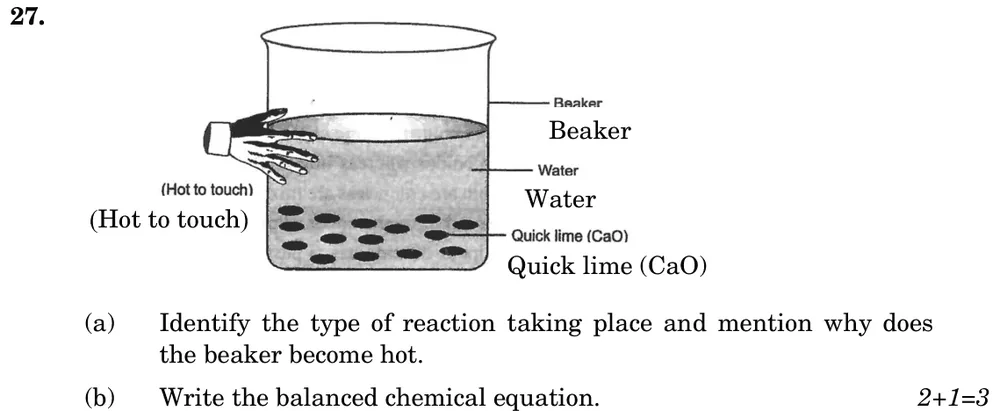
(a) Identify the type of reaction taking place and mention why does the beaker become hot. (b) Write the balanced chemical equation. Write your answer, send a photo, get it marked in DheeAnswer and marking
- (a) Two substances join to make one product; name the type. Combination reaction 1 mark
- Say why the beaker feels hot. A large amount of heat is released ; highly exothermic reaction 1 mark
- (b) Write the equation with heat on the product side. CaO(s) + H₂O(l) → Ca(OH)₂(aq) + heat 1 mark
Answer: (a) Combination, exothermic (heat released) ; (b) CaO(s) + H₂O(l) → Ca(OH)₂(aq) + heat
Marks: Type 1 · Reason 1 · Equation 1
For full marks: Use the word 'exothermic' and say heat is released — that is the reason mark.
Where students lose marks: Naming only 'exothermic' as the type and missing 'combination' for the first mark.
CBSE marking scheme
(a) Combination reaction (1); the beaker becomes hot because a large amount of heat is released - highly exothermic reaction (1). (b) CaO(s) + H2O(l) → Ca(OH)2(aq) + heat (1).
- Q8 Short answer · 3 marks CBSE · 2025
Why balance? Zn + H₃PO₄
Why do we balance a chemical equation? Name and state the law that suggests the balancing of a chemical equation. Balance the following chemical equation: Zn + H3PO4 → Zn3(PO4)2 + H2
Write your answer, send a photo, get it marked in DheeAnswer and marking
- Say what balancing makes equal on both sides. The number of atoms of each element must be the same before and after the reaction 0.5 marks
- Name the law behind it. Law of conservation of mass 0.5 marks
- State the law in full. Mass can neither be created nor destroyed in a chemical reaction 1 mark
- Balance phosphate first, then zinc, then hydrogen. 3Zn + 2H₃PO₄ → Zn₃(PO₄)₂ + 3H₂ 1 mark
Answer: Atoms of each element equal on both sides ; law of conservation of mass ; 3Zn + 2H₃PO₄ → Zn₃(PO₄)₂ + 3H₂
Marks: Reason ½ · Law named ½ · Law stated 1 · Balanced equation 1
For full marks: Both name AND state the law — 'mass can neither be created nor destroyed' earns a full mark.
Where students lose marks: Balancing zinc but leaving 2H₂ instead of 3H₂: there are 6 hydrogen atoms in 2H₃PO₄.
CBSE marking scheme
Number of atoms of each element must be the same before and after the reaction (½). Law of conservation of mass (½): mass can neither be created nor destroyed in a chemical reaction (1). 3Zn + 2H3PO4 → Zn3(PO4)2 + 3H2 (1).
- Q9 Short answer · 3 marks CBSE · 2025
Decomposition and compost
(i) Define the term decomposition reaction. Write one chemical equation each for decomposition reaction where energy is supplied in the form of heat, light or electricity. (ii) Decomposition of vegetable matter into compost is considered an exothermic reaction. Why ?
Write your answer, send a photo, get it marked in DheeAnswer and marking
- (i) Define it by what happens to the single reactant. A single reactant breaks down into two or more products 0.5 marks
- Example with heat. CaCO₃ →(heat) CaO + CO₂ 0.5 marks
- Example with light. 2AgCl →(sunlight) 2Ag + Cl₂ 0.5 marks
- Example with electricity. 2H₂O →(electric current) 2H₂ + O₂ 0.5 marks
- (ii) Say what is given out as compost forms. Because heat energy is released 1 mark
Answer: (i) One reactant → two or more products ; CaCO₃ → CaO + CO₂ ; 2AgCl → 2Ag + Cl₂ ; 2H₂O → 2H₂ + O₂ ; (ii) heat is released
Marks: Definition ½ · Three equations 1½ · Reason 1
For full marks: Write the energy (heat, sunlight, electric current) over each arrow so each example clearly fits.
Where students lose marks: Giving one equation for all three energies; each energy form needs its own equation.
CBSE marking scheme
(i) Single reactant breaks down into two or more products (½). CaCO3 → (heat) CaO + CO2 (½); 2AgCl → (sunlight) 2Ag + Cl2 (½); 2H2O → (electric current) 2H2 + O2 (½). (ii) Because heat energy is released (1).
- Q10 Short answer · 3 marks CBSE · 2023
Electrolysis of water with acid
(i) While electrolysing water before passing the current some drops of an acid are added. Why ? Name the gases liberated at cathode and anode. Write the relationship between the volume of gas collected at anode and the volume of gas collected at cathode. (ii) What is observed when silver chloride is exposed to sunlight ? Give the type of reaction involved.
Write your answer, send a photo, get it marked in DheeAnswer and marking
- (i) Pure water conducts poorly; say what the acid does. Acid increases the conductivity of water 0.5 marks
- Name the gas at the cathode. Hydrogen at the cathode 0.5 marks
- Name the gas at the anode. Oxygen at the anode 0.5 marks
- Water gives twice as much hydrogen as oxygen; write the ratio. Volume at anode : volume at cathode = 1 : 2 0.5 marks
- (ii) Say the colour change you see. White silver chloride turns grey 0.5 marks
- Light breaks it down; name the type. Photolytic decomposition reaction 0.5 marks
Answer: (i) Acid makes water conduct ; H₂ at cathode, O₂ at anode ; anode : cathode = 1 : 2 ; (ii) white → grey, photolytic decomposition
Marks: Acid ½ · Gases ½ + ½ · Ratio ½ · (ii) ½ + ½
For full marks: Write the ratio in the order asked — anode : cathode = 1 : 2.
Where students lose marks: Writing the ratio as 2 : 1 by mixing up anode and cathode; oxygen at the anode is the smaller volume.
CBSE marking scheme
(i) Acid increases the conductivity of water (1/2); hydrogen at cathode, oxygen at anode (1/2, 1/2); volume at anode : cathode = 1 : 2 (1/2). (ii) White silver chloride turns grey (1/2); photolytic decomposition reaction (1/2).
Free 10-question test: Chemical Reactions and Equations
MCQ and Assertion–Reason questions from CBSE papers. About 10 minutes. Your score shows straight away.
Common mistakes in Chemical Reactions and Equations
Mistake Leaving an equation unbalanced.
Fix Count each atom on both sides before you move on. The scheme cuts ½ mark for each equation that is not balanced.
Mistake Writing a decomposition equation with no condition on the arrow.
Fix Write heat, sunlight or electric current over the arrow. When a question asks for decomposition by heat, light and electricity, the condition shows which one each equation is. Add state symbols too; copper oxide and copper are solids: CuO(s), Cu(s).
Mistake Thinking every decomposition takes in heat, so calling composting endothermic.
Fix Most decomposition reactions need heat, light or electricity. But vegetable matter turning into compost gives out heat, so it is exothermic. Learn the two facts separately.
Mistake Mixing up the mass ratio and the volume ratio in electrolysis of water.
Fix Hydrogen and oxygen come out 2 : 1 by volume. The mass ratio is different: work it out from 2H₂O → 2H₂ + O₂ using H = 1 and O = 16.
Mistake Saying the wrong substance is oxidised.
Fix The substance that gains oxygen (or loses hydrogen) is oxidised. The one that loses oxygen is reduced. In CuO + H₂ → Cu + H₂O, check which one gains oxygen.
Mistake Calling a precipitation reaction 'displacement'.
Fix One metal pushing another out of its compound (iron in CuSO₄ solution) is displacement. Two compounds swapping ions, often giving a precipitate like BaSO₄, is double displacement.
How to write for full marks
- Answer in the order asked: name the reaction type, give the reason, then the balanced equation. Each part carries its own mark.
- Write the full balanced equation with states and the condition, like CaCO₃(s) → CaO(s) + CO₂(g) with 'heat' over the arrow.
- For 'what is observed', write what you see or smell: colour change, gas, smell, heat or a precipitate. Give two clear observations when the scheme marks them ½ each.
- When asked to 'name and state' a law, give the name and the full statement. They carry separate marks.
- For 'define and give an example', write a one-line definition, the example in words with reactant and product names, and then the balanced equation.
Not in the 2026-27 exam
Leave these out of your revision.
- Information in the NCERT boxes
Questions students ask
Which Chemical Reactions and Equations questions are most important for the Class 10 board exam 2027?
Expect MCQs on reaction types and balancing, 2- and 3-mark questions that need balanced equations, and sometimes a 5-mark set of equations. The 10 questions on this page are real CBSE board questions from 2023–2026, chosen across the chapter's topics and question types.
How many marks does Chemical Reactions and Equations carry in the Class 10 board exam?
Chemical Reactions and Equations is part of the Chemical Substances – Nature and Behaviour unit, which carries 6 of the 80 theory marks in the CBSE Class 10 Science paper.
Are these real CBSE previous year questions?
Yes. Each question is printed as it appeared in a CBSE board paper or sample paper, with its source, and the answer follows CBSE's official marking scheme.
Questions and answers: CBSE board papers, sample papers and official marking schemes, 2023–2026. Worked steps and tips: Dhee.