Chapter 7 · CBSE Board 2027
How do Organisms Reproduce? Class 10 important questions with answers
The 10 questions to practise first, picked from every CBSE board paper 2023–2026. Each one has the official answer and how to write it for full marks. Then try the free 10-question test.
What comes in the exam
- How do Organisms Reproduce?
- is in the World of Living unit, which is worth 25 marks in all.
- 1-mark MCQs and 5-mark questions come most, then 2- and 3-mark questions, some Assertion–Reason and a 4-mark case study.
- Almost every year you get the asexual methods (fission, budding, regeneration, spores, vegetative propagation), the parts of a flower and pollination, gametes and chromosome number, and the human male system.
- The female system, the placenta and what a flower becomes after fertilisation also come almost every year.
- Contraception and seed germination come often.
Top 10 How do Organisms Reproduce? questions from board papers
Real CBSE questions, printed as they appeared. Open each answer to see the marking and the steps.
- Q1 MCQ · 1 mark CBSE · 2026, 2023 Asked in 2026, 2023
Why chromosome number is steady
The number of chromosomes in parents and offspring of a particular species undergoing sexual reproduction remains constant due to:
- (A) doubling of chromosomes after zygote formation.
- (B) halving of chromosomes after zygote formation.
- (C) doubling of chromosomes before gamete formation.
- (D) halving of chromosomes at the time of gamete formation.
Write your answer, send a photo, get it marked in DheeAnswer and marking
Correct option: (D) halving of chromosomes at the time of gamete formation.
- Gametes get half the chromosomes. Halving at gamete formation
- Two gametes fuse and restore the full number. Number stays constant ⇒ option (D) 1 mark
Answer: (D) halving of chromosomes at the time of gamete formation.
Marks: Correct option 1
For full marks: Say when the halving happens: at the time of gamete formation.
Where students lose marks: Picking (A): chromosomes are not doubled after the zygote forms; fusion of two halves restores the number.
CBSE marking scheme
Gametes get half the chromosomes (meiosis); fusion of two gametes restores the original number in the zygote.
- Q2 Short answer · 3 marks CBSE · 2026
Why chromosome number stays same
"Each organism has two sets of all genes, one inherited from each parent i.e. both parents contribute equally to the DNA of the progeny during sexual reproduction". If such is the case, then how is the stability of DNA of the species ensured? Discuss.
Write your answer, send a photo, get it marked in DheeAnswer and marking
- Start with the pairs in every body cell. Each cell has two copies of each chromosome, one from each parent. 1 mark
- Say how the germ cell halves this. Each germ cell (gamete) takes only one chromosome of each pair. 1 mark
- Show what fusion does to the number. When two gametes fuse, the normal chromosome number is restored in the progeny, so the DNA of the species stays stable. 1 mark
Answer: Gametes carry one chromosome of each pair, so fusion restores the normal number and keeps the species' DNA stable
Marks: Pairs in cells 1 · Halving in gametes 1 · Restored on fusion 1
For full marks: Write 'the normal chromosome number is restored in the progeny'; that line is the last full mark.
Where students lose marks: Saying the DNA doubles each generation, or skipping that gametes carry only one of each pair, misses the middle mark.
CBSE marking scheme
Each cell has two copies of each chromosome, one from each parent (1). Each germ cell (gamete) takes only one chromosome of each pair (1). When two gametes fuse, the normal chromosome number is restored in the progeny, keeping the DNA of the species stable (1).
- Q3 Case study · 4 marks CBSE · 2025
Case: egg release in a girl
When a girl is born, the ovaries already contain thousands of immature eggs. On reaching puberty, some of these start maturing. One matured egg is released every month by one of the ovaries. The two oviducts unite into an elastic bag-like structure known as uterus. (i) Write the site of fertilization in human female. (1) (ii) How does the uterus prepare itself to receive and nurture the growing embryo ? Explain. (1) (iii) What happens when the egg is not fertilized ? (2) OR (iii) How does the developing embryo get nutrition from the mother's blood ? Explain. (2)
Write your answer, send a photo, get it marked in DheeAnswer and marking
- (i) Name the tube where egg and sperm meet. (i) Oviduct (fallopian tube) 1 mark
- (ii) Say how the lining changes and why. (ii) The uterine lining becomes thick and spongy and is richly supplied with blood to nourish the embryo. 1 mark
- (iii) Say what happens to the lining when no embryo comes. (iii) The thick lining is no longer needed, so it slowly breaks down. 1 mark
- Say how it leaves the body and give the name. It comes out through the vagina as blood and mucus with the unfertilised egg ; this is menstruation. 1 mark
- (iii) Name the special tissue and where it sits. (iii) Through the placenta, a special tissue embedded in the uterine wall. 1 mark
- Say what passes through it to the embryo. It passes oxygen and nutrients from the mother's blood to the embryo. 1 mark
Answer: (i) Oviduct ; (ii) lining thickens and gets rich blood supply ; (iii) (a) lining breaks down, menstruation / (b) through the placenta
Marks: (i) 1 · (ii) 1 · (iii) 2
For full marks: In (ii) write 'richly supplied with blood'; a thick lining alone does not show how the embryo will be nourished.
Where students lose marks: Writing 'uterus' for the site of fertilisation in (i): the egg and sperm meet in the oviduct, and the embryo only implants in the uterus.
CBSE marking scheme
(i) Oviduct/fallopian tube (1). (ii) Uterus lining thickens (becomes spongy) and is richly supplied with blood to nourish the embryo (1). (iii) The lining slowly breaks down and comes out through the vagina as blood and mucus along with the unfertilised egg — menstruation (2). OR (iii) Through the placenta, a special tissue embedded in the uterine wall, which provides oxygen and nutrients from mother's blood to the embryo (2).
- Q4 Case study · 4 marks CBSE · 2024
Case: plantation drive saplings
Plantation drives are often carried out especially during monsoon season for the protection of our environment. Such programmes need a lot of saplings for tree plantation. Plants are propagated by sexual or asexual means in fields and nurseries. Over the years horticulturists have developed asexual methods that use vegetative parts of the plants to multiply. Many plants can reproduce by this method naturally as well as by artificial means. (i) Which specific part of the plant is used for sexual and asexual means of propagation to produce a new plant? (1) (ii) Give one example of (a) a flower, and (b) a fruit grown by vegetative propagation. (1) (iii) List two advantages of growing plants by vegetative propagation. (2) OR Describe an activity to show how potatoes reproduce asexually. (2)
Write your answer, send a photo, get it marked in DheeAnswer and marking
- (i) Name the part used when plants grow from sexual reproduction. (i) Sexual: seed 0.5 marks
- Now name the parts used without seeds. Asexual: roots, stems or leaves 0.5 marks
- (ii) Give a flower grown by vegetative propagation. (ii)(a) Flower: rose (or jasmine) 0.5 marks
- Give a fruit grown the same way. (b) Fruit: grapes (or banana, orange) 0.5 marks
- (iii) Give the first advantage about the new plants. (iii) The new plants are genetically similar to the parent plant. 1 mark
- Give a second advantage about time or seedless plants. They bear flowers and fruits earlier than plants grown from seeds. 1 mark
- (iii) Describe the set-up: what you keep and where. (iii) Keep small pieces of potato, each with a notch (bud or eye), on moist cotton for a few days. 1 mark
- Say what you see and what it shows. The buds give rise to green shoots and roots, so a new plant grows from the potato without seeds. 1 mark
Answer: (i) Seed ; roots/stem/leaves ; (ii) rose ; grapes ; (iii) (a) genetically similar plants, earlier flowers and fruits / (b) potato pieces with buds on moist cotton grow shoots and roots
Marks: (i) 1 · (ii) 1 · (iii) 2
For full marks: In the activity, say each potato piece must have a notch or bud; the shoots and roots grow only from that bud.
Where students lose marks: Giving one advantage twice in new words, like 'same as parent' and 'identical plants', earns only one of the two marks.
CBSE marking scheme
(i) Sexual – seed (½); asexual – roots/stem/leaves (½). (ii) Flower: rose/jasmine (½); fruit: grapes/orange/banana (½). (iii) Any two (1, 1): genetically similar plants; bear fruits earlier than seed-grown plants; propagation of plants that have lost the capacity to produce seeds. OR Keep small potato pieces with notches/buds on moist cotton for a few days; the buds give rise to green shoots and roots (2).
- Q5 Case study · 4 marks CBSE · 2024
Case: pollination and its agents
Pollination is an important process in sexual reproduction of plants. It is an essential process that facilitates fertilisation in plants. Pollinating agents can be wind, water, insects and birds. Several changes take place in the flower after the fertilization has taken place. (i) Write the main difference between self-pollination and cross-pollination. (1) (ii) Name the part of the flower which attracts insects for pollination. What happens to this part after fertilisation? (1) (iii) Define fertilisation. What is the fate of ovules and the ovary in a flower after fertilisation? (2) OR (iii) In a germinating seed, which parts are known as future shoot and future root? Mention the function of cotyledon. (2)
Write your answer, send a photo, get it marked in DheeAnswer and marking
- (i) Compare where the pollen lands in each case. (i) Self-pollination: pollen goes from anther to the stigma of the same flower ; cross-pollination: to the stigma of another flower. 1 mark
- (ii) Name the bright part that draws insects. (ii) Petals 0.5 marks
- Say what happens to it after fertilisation. They dry and fall off. 0.5 marks
- (iii) Define fertilisation in terms of gametes. (iii) Fertilisation is the fusion of the male and female gametes to form a zygote. 1 mark
- Give the fate of the ovule. Ovule → seed 0.5 marks
- Give the fate of the ovary. Ovary → fruit 0.5 marks
- (iii) Name the future shoot. (iii) Plumule: future shoot 0.5 marks
- Name the future root. Radicle: future root 0.5 marks
- Give the cotyledon's job. Cotyledon stores food for the growing seedling. 1 mark
Answer: (i) Same flower vs another flower ; (ii) petals, dry and fall off ; (iii) (a) fusion of gametes, ovule → seed, ovary → fruit / (b) plumule, radicle, cotyledon stores food
Marks: (i) 1 · (ii) 1 · (iii) 2
For full marks: Write 'to form a zygote' in the definition; fusion of gametes is the full mark only when the zygote is named.
Where students lose marks: Swapping the fates: the ovule becomes the seed and the ovary becomes the fruit, not the other way round.
CBSE marking scheme
(i) Self: pollen from anther to stigma of the same flower; cross: to the stigma of another flower (1). (ii) Petals (½); they dry and fall off (½). (iii) Fusion of male and female gametes to form a zygote (1); ovule → seed (½), ovary → fruit (½). OR (iii) Plumule – future shoot (½), radicle – future root (½), cotyledon stores food (1).
- Q6 Case study · 4 marks CBSE · 2023
Case: asexual, sexual types
All the reproductive methods of living organisms are broadly categorized into two types: 1. Asexual reproduction, and 2. Sexual reproduction. Asexual reproduction involves the participation of a single parent without the formation of gametes, fertilisation and transfer of genetic material. This method is a common means of rapidly increasing offsprings under favourable conditions. (i) Name the type of fission that occurs in Leishmania and Plasmodium. (1) (ii) Write one advantage of sexual mode of reproduction over asexual reproduction. (1) (iii) Give reasons why: (I) Colonies of yeast fail to multiply in water but multiply in sugar solution. (II) Rhizopus individuals do not grow on a dry slice of bread. (2) OR (iii) Name the filamentous structures a student could identify when he collected water from a pond that appeared dark green. How do these organisms multiply? Explain. (2)
Write your answer, send a photo, get it marked in DheeAnswer and marking
- (i) Leishmania splits into two, so name that fission. (i) Leishmania: binary fission 0.5 marks
- Plasmodium splits into many at once, so name that one. Plasmodium: multiple fission 0.5 marks
- (ii) Say what sexual reproduction makes and why it helps. (ii) Sexual reproduction creates more variations, which are useful for the survival of the species. 1 mark
- (iii) Think about what yeast needs to grow. (iii)(I) Sugar solution provides nutrients for growth and multiplication ; plain water does not. 1 mark
- Think about what the mould needs from the bread. (II) Rhizopus needs moisture to grow, and a dry slice has none. 1 mark
- (iii) Name the green threads in pond water. (iii) Spirogyra 0.5 marks
- Name the way they multiply. Fragmentation 0.5 marks
- Explain how one filament becomes many. On maturing, the filament breaks into small pieces ; each piece grows into a new individual. 1 mark
Answer: (i) Binary ; multiple ; (ii) more variation, useful for survival ; (iii) (a) sugar gives nutrients, moisture needed / (b) Spirogyra, fragmentation
Marks: (i) 1 · (ii) 1 · (iii) 2
For full marks: In (i) pair each organism with its own fission; Leishmania binary and Plasmodium multiple are separate ½ marks.
Where students lose marks: Swapping the two: Plasmodium divides into many cells at once (multiple fission), while Leishmania splits into two.
CBSE marking scheme
(i) Leishmania - binary fission; Plasmodium - multiple fission (½, ½). (ii) Sexual reproduction creates more variations, useful for survival of the species (1). (iii)(I) Sugar solution provides nutrients for growth and multiplication; water does not (1). (II) Moisture is needed for Rhizopus to grow (1). OR (iii) Spirogyra (½); fragmentation (½) - the mature filament breaks into pieces, each growing into a new individual (1).
- Q7 Long answer · 5 marks CBSE · 2026
Analyse five situations
Given below are certain situations. Analyse each and describe its possible impact: (i) A population of bacteria living in temperate waters whose temperature increased by global warming. (ii) The sperm encounters the egg when it reaches the oviduct in human females. (iii) Self pollination does not occur in a flower that contains only pistil. (iv) Egg does not get fertilised in a human female. (v) When the seed is placed under appropriate condition of water and air in the soil?
Write your answer, send a photo, get it marked in DheeAnswer and marking
- (i) Think which bacteria can stand the heat. (i) Most bacteria die, but the few heat-resistant variants survive and grow further. 1 mark
- (ii) Say what the meeting of sperm and egg produces. (ii) Fertilisation occurs and a zygote is formed. 1 mark
- (iii) No stamens means pollen must come from another flower. (iii) Cross-pollination may occur by agents like insects or wind, leading to fertilisation and fruit formation. 1 mark
- (iv) Say what happens to the unused uterine lining. (iv) The thick, spongy uterine lining breaks down and comes out through the vagina as blood and mucus: menstruation. 1 mark
- (v) Say what water and air start in a seed. (v) The seed germinates and develops into a seedling. 1 mark
Answer: (i) Heat-resistant variants survive ; (ii) zygote forms ; (iii) cross-pollination ; (iv) menstruation ; (v) seed germinates
Marks: (i) 1 · (ii) 1 · (iii) 1 · (iv) 1 · (v) 1
For full marks: In (i) write that the heat-resistant variants survive and grow; saying only 'bacteria die' misses the point.
Where students lose marks: In (iv) writing only 'the egg dies': the change asked for is the thick uterine lining breaking down and leaving as menstruation.
CBSE marking scheme
(i) Most bacteria would die but the few heat-resistant variants survive and grow further (1). (ii) Fertilisation occurs to form a zygote (1). (iii) Cross-pollination may occur leading to fruit formation / no fertilisation / no fruit (1). (iv) Thick spongy uterine lining breaks down and comes out through the vagina as blood and mucus — menstruation (1). (v) Seed develops into a seedling / germinates (1).
- Q8 Long answer · 5 marks CBSE · 2026
Flower changes after fertilising
(i) In an angiospermic flower, fertilization is said to take place when male gametes carried in the pollen tube fuse with the female gamete, present in the embryo sac. This results in lot of changes in different parts of the flower. State the changes taking place in the following structures of flower post fertilization : (a) Zygote (b) Ovule (c) Ovary (d) Sepals (ii) Define germination.
Write your answer, send a photo, get it marked in DheeAnswer and marking
- (i)(a) Say what the zygote turns into and where. (i)(a) The zygote divides several times to form an embryo within the ovule. 1 mark
- (b) Say what the ovule grows around itself. (b) The ovule develops a tough coat and becomes a seed. 1 mark
- (c) Say what the ovary becomes. (c) The ovary grows rapidly and ripens to form a fruit. 1 mark
- (d) Say what happens to the sepals. (d) The sepals shrivel and fall off. 1 mark
- (ii) Define germination as seed to seedling. (ii) Germination: the mature seed develops into a seedling under appropriate conditions. 1 mark
Answer: Zygote → embryo ; ovule → seed ; ovary → fruit ; sepals shrivel and fall ; germination = seed to seedling
Marks: (i) Four changes 4 · (ii) Definition 1
For full marks: For the ovule write 'develops a tough coat and becomes a seed'; the coat is part of the change.
Where students lose marks: Writing 'zygote becomes the seed': the zygote becomes the embryo, and the whole ovule becomes the seed.
CBSE marking scheme
(i)(a) Zygote divides several times to form an embryo within the ovule (1). (b) Ovule develops a tough coat and becomes a seed (1). (c) Ovary grows rapidly and ripens to form a fruit (1). (d) Sepals shrivel and fall off (1). (ii) Germination: the mature seed develops into a seedling under appropriate conditions (1).
- Q9 Long answer · 5 marks CBSE · 2026
Diagram: name, type, stage P
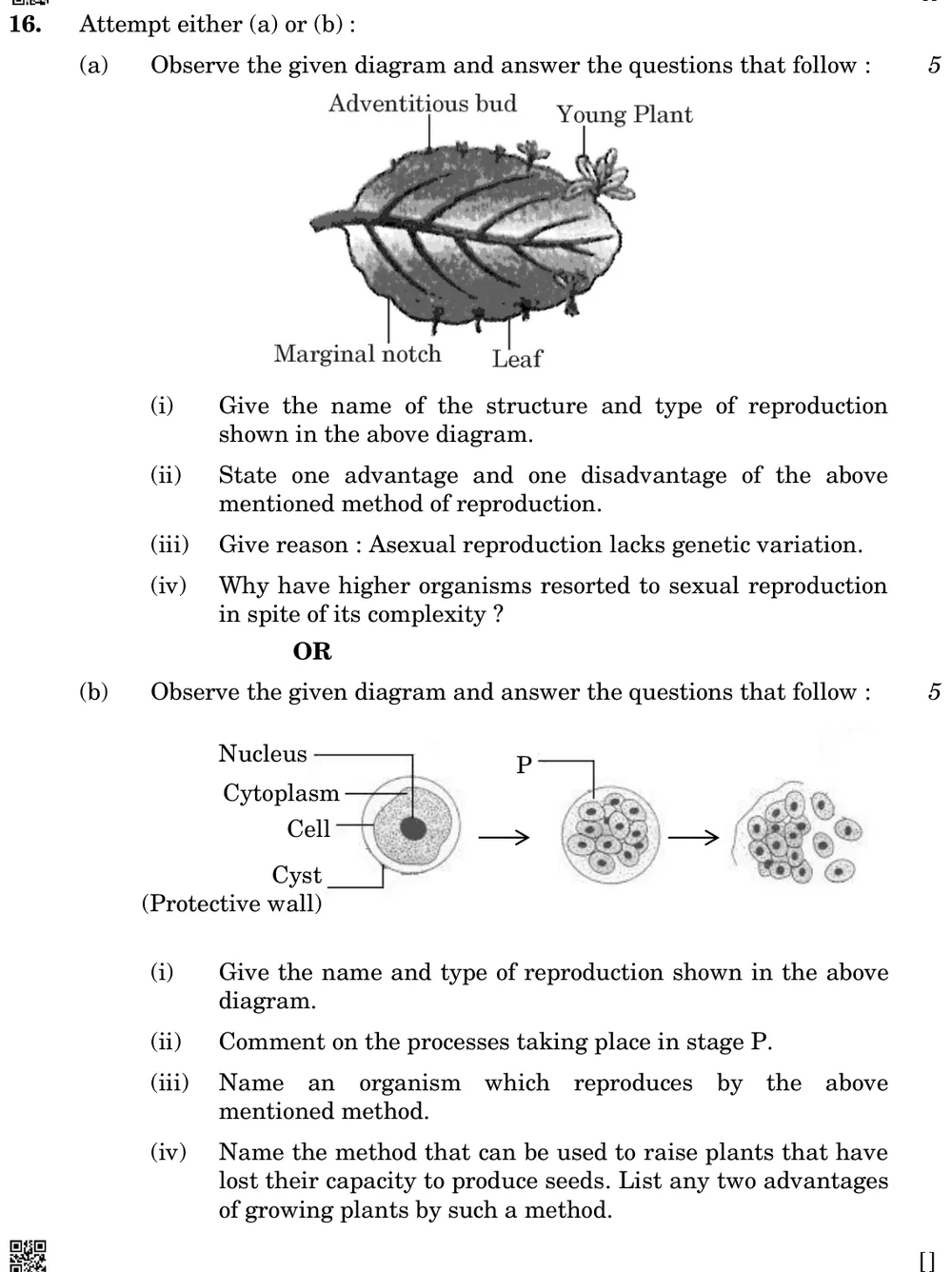
Observe the given diagram and answer the questions that follow: (i) Give the name and type of reproduction shown in the above diagram. (ii) Comment on the processes taking place in stage P. (iii) Name an organism which reproduces by the above mentioned method. (iv) Name the method that can be used to raise plants that have lost their capacity to produce seeds. List any two advantages of growing plants by such a method. Write your answer, send a photo, get it marked in DheeAnswer and marking
- (i) One cell gives many daughter cells, so name the fission. (i) Multiple fission 0.5 marks
- Say which type of reproduction it is. Asexual reproduction 0.5 marks
- (ii) Describe what divides inside the cyst. (ii) In stage P the nucleus divides repeatedly, then the cytoplasm divides, producing many daughter cells inside the cyst. 1 mark
- (iii) Name an organism that does this. (iii) Plasmodium 0.5 marks
- (iv) Name the method for seedless plants. (iv) Vegetative propagation 0.5 marks
- Give the first advantage. Plants are genetically similar to the parent plant. 1 mark
- Give the second advantage. They bear flowers and fruits earlier than plants grown from seeds. 1 mark
Answer: (i) Multiple fission, asexual ; (ii) nucleus divides repeatedly in the cyst ; (iii) Plasmodium ; (iv) vegetative propagation
Marks: (i) 1 · (ii) 1 · (iii) ½ · (iv) 2½
For full marks: In (ii) write that the nucleus divides repeatedly inside the cyst; that is what makes it multiple, not binary, fission.
Where students lose marks: Naming Leishmania or Amoeba in (iii): they show binary fission, while Plasmodium shows multiple fission.
CBSE marking scheme
(i) Multiple fission (½); asexual reproduction (½). (ii) In stage P the nucleus divides repeatedly followed by cytoplasmic division, producing many daughter cells inside the cyst (1). (iii) Plasmodium (½). (iv) Vegetative propagation (½); advantages: plants genetically similar to parent (1); bear flowers and fruits earlier than those from seeds (1).
- Q10 Long answer · 5 marks CBSE · 2026
Radha: ways to prevent pregnancy
Radha has three children. She does not want to have more children. Radha visits a nearby hospital, to know the methods to prevent pregnancy. (i) Mention the name of any two ways other than the surgical methods, following which Radha can avoid unwanted pregnancies. (2) (ii) Name the surgical methods to prevent pregnancy. (2) (iii) Give one example each of sexually transmitted diseases caused by bacteria and virus. (1)
Write your answer, send a photo, get it marked in DheeAnswer and marking
- (i) Give a barrier method. (i) Mechanical barrier: condom, or a covering like a diaphragm in the vagina 1 mark
- Give a second, non-surgical method. Oral contraceptive pills (or copper-T / loop placed in the uterus) 1 mark
- (ii) Name the surgical method for males. (ii) Vasectomy: the vas deferens of the male is blocked. 1 mark
- Name the surgical method for females. Tubectomy: the fallopian tube of the female is blocked. 1 mark
- (iii) Give a disease caused by bacteria. (iii) Bacterial: gonorrhoea (or syphilis) 0.5 marks
- Give a disease caused by a virus. Viral: warts (or HIV-AIDS) 0.5 marks
Answer: (i) Condom, oral pills ; (ii) vasectomy, tubectomy ; (iii) gonorrhoea (bacterial), warts or AIDS (viral)
Marks: (i) 2 · (ii) 2 · (iii) 1
For full marks: In (ii) write what each surgery blocks, the vas deferens or the fallopian tube, along with its name.
Where students lose marks: Putting AIDS under bacteria or syphilis under viruses: gonorrhoea and syphilis are bacterial, warts and HIV-AIDS are viral.
CBSE marking scheme
(i) Any two: mechanical barrier (condom/diaphragm or similar covering in vagina); oral contraceptive pills; copper-T/loop (1+1). (ii) Vasectomy - vas deferens of male blocked (1); tubectomy - fallopian tube of female blocked (1). (iii) Bacterial: gonorrhoea/syphilis (½); viral: warts/AIDS (½).
Free 10-question test: How do Organisms Reproduce?
MCQ and Assertion–Reason questions from CBSE papers. About 10 minutes. Your score shows straight away.
Common mistakes in How do Organisms Reproduce?
Mistake Mixing up pollination and fertilisation.
Fix Keep the two words apart: one is about moving pollen, the other is about gametes fusing. For 'two differences', compare them on the same point each time. Each pair carries 1 mark.
Mistake Writing the changes after fertilisation for only one or two parts.
Fix The question goes part by part, and each part carries 1 mark. Learn the change for the zygote, the ovule, the ovary, and the sepals and petals as one set, and write one line for each.
Mistake Getting the chromosome number of the zygote wrong.
Fix Gametes carry half the chromosomes of a body cell. When two gametes fuse, the zygote gets both sets, so add the two numbers. This is also how the number stays the same in every generation.
Mistake Naming the wrong method for an organism.
Fix Learn the book example for each method: binary fission (Amoeba, Leishmania), multiple fission (Plasmodium), budding (Hydra, yeast), fragmentation (Spirogyra), regeneration (Planaria), spores (Rhizopus), vegetative propagation (Bryophyllum). Fragmentation and regeneration are easy to confuse.
Mistake Mixing up the sites in the female system.
Fix Fertilisation happens in the oviduct (fallopian tube). The embryo is implanted in the lining of the uterus. The placenta brings food and oxygen from the mother's blood and removes the embryo's wastes.
Mistake Mixing up diseases caused by bacteria and by viruses.
Fix Gonorrhoea and syphilis are caused by bacteria. Warts and HIV-AIDS are caused by viruses. When asked for one of each, the scheme gives ½ mark for each.
How to write for full marks
- In 'analyse each situation' questions, write one clear result for each part, such as what grows or what is prevented. Each part carries 1 mark.
- When asked to 'name the type', give both: the method and that it is asexual reproduction. Each carries ½ mark.
- For advantages of vegetative propagation, give any two of these book points: plants flower and fruit earlier, they are like the parent, and plants without seeds can still be grown. Each carries 1 mark.
- For 'give reasons', write the reason, not only the fact: the testes lie outside the abdomen because sperm formation needs a lower temperature than the body.
- For a labelled diagram such as budding in Hydra, draw the stages in order and label the parent, the bud and the tentacles. The drawing and the labels carry 1 mark each.
Not in the 2026-27 exam
Leave these out of your revision.
- Information in the NCERT boxes
Questions students ask
Which How do Organisms Reproduce? questions are most important for the Class 10 board exam 2027?
Expect MCQs on modes of reproduction, 5-mark questions on flowers, human reproduction and asexual methods, and 2- or 3-mark questions on gametes and chromosomes. The 10 questions on this page are real CBSE board questions from 2023–2026, chosen across the chapter's topics and question types.
How many marks does How do Organisms Reproduce? carry in the Class 10 board exam?
How do Organisms Reproduce? is part of the World of Living unit, which carries 7 of the 80 theory marks in the CBSE Class 10 Science paper.
Are these real CBSE previous year questions?
Yes. Each question is printed as it appeared in a CBSE board paper or sample paper, with its source, and the answer follows CBSE's official marking scheme.
Questions and answers: CBSE board papers, sample papers and official marking schemes, 2023–2026. Worked steps and tips: Dhee.