Chapter 5 · CBSE Board 2027
Life Processes Class 10 important questions with answers
The 10 questions to practise first, picked from every CBSE board paper 2023–2026. Each one has the official answer and how to write it for full marks. Then try the free 10-question test.
What comes in the exam
- Life Processes is part of the World of Living unit, which is worth 25 marks in all.
- MCQs (1 mark) come most, then 3-mark and 2-mark questions, with some Assertion–Reason and a few 5-mark and 4-mark case-study questions.
- Almost every year you get photosynthesis and stomata, digestion from the mouth to the small intestine, aerobic and anaerobic respiration, the heart and double circulation, and the nephron.
- Transport in xylem and phloem, transpiration, breathing and lymph also come almost every year.
- A 5-mark question may ask you to draw stomata or a nephron.
Top 10 Life Processes questions from board papers
Real CBSE questions, printed as they appeared. Open each answer to see the marking and the steps.
- Q1 Very short answer · 2 marks CBSE · 2023
No xylem; bleeding injury
What will happen if: (a) Xylem tissue in a plant is removed? (b) We are injured and start bleeding?
Write your answer, send a photo, get it marked in DheeAnswer and marking
- (a) Xylem is the tissue that carries water and minerals up from the roots. Movement of water and minerals from the soil to other parts of the plant stops, and the plant ultimately dies. 1 mark
- (b) Think of the blood cells that seal a cut. Platelets help the blood to clot at the injury and plug the leak ; otherwise loss of blood lowers pressure and pumping efficiency. 1 mark
Answer: (a) water and minerals stop reaching the plant parts; the plant dies ; (b) platelets clot the blood and plug the leak
Marks: Xylem removed 1 · Bleeding 1
For full marks: In (b) name platelets and say they help the blood clot; just 'blood comes out' earns nothing.
Where students lose marks: In (a) saying food stops moving; food moves in phloem, while xylem carries water and minerals.
CBSE marking scheme
(a) Movement of water and minerals from the soil to other parts of the plant stops and the plant ultimately dies (1). (b) Platelets help blood clot at the injury and plug the leak / otherwise loss of blood lowers pressure and pumping efficiency (1).
- Q2 Very short answer · 2 marks CBSE · 2023
Blood mixing in birds, mammals
(a) Why is it important to prevent oxygenated and deoxygenated blood from mixing in birds and mammals? (b) Which animals can tolerate some mixing of the oxygenated and deoxygenated blood streams? On what factor does the body temperature of these animals depend?
Write your answer, send a photo, get it marked in DheeAnswer and marking
- (a) Link their need for energy to keeping the body warm. Birds and mammals need high energy to maintain their body temperature ; separation gives a highly efficient supply of oxygen. 1 mark
- (b) Name the animals with 3-chambered hearts that manage with some mixing. Amphibians / reptiles 0.5 marks
- These animals do not keep a fixed body temperature of their own. Their body temperature depends on the temperature of the environment. 0.5 marks
Answer: (a) high energy need to maintain body temperature ⇒ efficient O₂ supply ; (b) amphibians/reptiles; temperature of the environment
Marks: Reason for separation 1 · Animals ½ · Factor ½
For full marks: In (a) connect 'high energy need' with 'maintaining body temperature'; the examiner wants both ideas.
Where students lose marks: Saying fish can tolerate mixing; only deoxygenated blood enters a fish heart, so the answer is amphibians or reptiles.
CBSE marking scheme
(a) Birds and mammals have high energy needs to maintain body temperature; separation gives a highly efficient oxygen supply (1). (b) Amphibians / reptiles (½); body temperature depends on the temperature of the environment (½).
- Q3 Short answer · 3 marks CBSE · 2025
Xylem vs phloem
Differentiate between xylem and phloem on the basis of the following: (i) Direction of transport of the substances (ii) Major driving forces involved in the transport (iii) Nature of the substance(s) transported
Write your answer, send a photo, get it marked in DheeAnswer and marking
- (i) Compare the direction each tissue moves material. Xylem: one direction, upwards ; phloem: both upwards and downwards 1 mark
- (ii) Compare what drives each flow. Xylem: transpiration pull (or root pressure) ; phloem: osmotic pressure created using energy from ATP 1 mark
- (iii) Compare what each one carries. Xylem: water and dissolved minerals ; phloem: products of photosynthesis (sucrose), amino acids 1 mark
Answer: (i) Xylem up only, phloem up and down (ii) Transpiration pull vs ATP-driven osmotic pressure (iii) Water and minerals vs food
Marks: (i) Direction 1 · (ii) Driving force 1 · (iii) Substances 1
For full marks: For phloem in (ii) say 'using ATP energy'; that is the driving force the mark wants.
Where students lose marks: Writing that phloem moves only downwards; it moves food both up and down.
CBSE marking scheme
(i) Xylem: unidirectional/upwards; phloem: both up and down (1) (ii) Xylem: transpiration pull (or root pressure); phloem: osmotic pressure using ATP (1) (iii) Xylem: water and dissolved minerals; phloem: products of photosynthesis, sucrose, amino acids (1)
- Q4 Case study · 4 marks CBSE · 2026
Case: kidneys and dialysis
Kidneys help to regulate the volume of fluid and various metabolites waste products in the body. Normally, kidney filter about 180 L of fluid daily but the volume actually excreted out is only a litre or two a day. Patients with kidney failures can be saved by dialysis and kidney transplant. (i) Write the structure and function of Bowman's capsule. (1) (ii) Although kidneys filter a large amount (about 180 L daily) of fluids, still the excretion from the body is only about a litre or two. Why ? (1) (iii) What is excretion ? Why is it necessary for any living organism ? (2) OR (iii) State two similarities between lungs and kidneys. (2)
Write your answer, send a photo, get it marked in DheeAnswer and marking
- (i) Describe the shape of Bowman's capsule. Cup-shaped end of the coiled tube of the nephron 0.5 marks
- Say what it does. It collects the filtrate from the blood. 0.5 marks
- (ii) Most of the filtrate is taken back into the blood. Most of the water, salts, glucose and amino acids are selectively reabsorbed into the blood as urine flows along the tubule. 1 mark
- (iii) Define excretion. Excretion is the removal of harmful metabolic (nitrogenous) wastes such as urea and uric acid from the body. 1 mark
- Say why it is needed. It is necessary because these wastes are toxic and harm the body if they build up. 1 mark
- (iii) Both organs remove a waste made in the body. Both remove metabolic wastes: lungs remove CO₂, kidneys remove urea. 1 mark
- Both have a structure built for quick exchange with blood. Both have thin-walled blood capillaries, for gas exchange in lungs and filtration in kidneys. 1 mark
Answer: (i) Cup-shaped start of the nephron ; collects filtrate (ii) Selective reabsorption of water, glucose, salts (iii) (a) Removal of toxic metabolic wastes / (b) both remove wastes ; both have thin-walled capillaries
Marks: (i) Structure and function 1 · (ii) Reabsorption 1 · (iii) Two points 2
For full marks: In (ii) use the word 'reabsorbed' and name what is taken back: water, glucose, salts, amino acids.
Where students lose marks: In (ii) saying the kidney filters less, when the full 180 L is filtered and most is reabsorbed.
CBSE marking scheme
(i) Cup-shaped end of the coiled tube (nephron) (½); collects the filtrate from blood (½). (ii) Most of the water, salt, glucose, amino acids are selectively reabsorbed into blood as urine flows along the tubular part of the nephron (1). (iii) Excretion = removal of metabolic/nitrogenous wastes (urea, uric acid) from the body (1); necessary because these wastes are toxic/harmful (1). OR (iii) Both remove metabolic wastes - lungs CO2, kidneys urea (1); both have thin-walled blood capillaries for gas exchange/filtration (1).
- Q5 Case study · 4 marks CBSE · 2026
Case: unusual photosynthesis
Read the following passage and answer the questions that follow: Not all plants carry out photosynthesis by the same mechanism. In most plants, it depends directly on gaseous carbon dioxide that diffuses into the leaf. However, some plants can store carbon dioxide in the vacuole of the leaf cells as part of a complex carbon compound. This compound is transported to the chloroplast and releases carbon dioxide when required for photosynthesis. This special mechanism is believed to have evolved as an adaptation in such plants which do not open stomata during the daytime to conserve water for survival in dry conditions (desert conditions). Attempt either (a) or (b): (a) (i) Which process in these plants is minimised to help the plants survive in dry conditions? (ii) Which part of the leaf is responsible for exchange of gases during photosynthesis? OR (b) (i) List the events that occur during the process of photosynthesis. (ii) When are such desert plants likely to take in carbon dioxide from the environment, unlike other plants? (iii) Draw a labelled diagram of stomata with open stomatal pore.
Write your answer, send a photo, get it marked in DheeAnswer and marking
- (a)(i) These plants keep stomata shut in the day, so less water escapes. Transpiration (opening of stomata during the day) is minimised to prevent water loss. 2 marks
- (ii) Gases enter and leave the leaf through tiny pores on its surface. Stomata 2 marks
- (b)(i) Start with the light step: the green pigment traps light. Absorption of light energy by chlorophyll. 0.5 marks
- Next, the trapped energy is changed, and water is split. Conversion of light energy to chemical energy and splitting of water molecules into hydrogen and oxygen. 0.5 marks
- Last, carbon dioxide is turned into food. Reduction of carbon dioxide to carbohydrates. 0.5 marks
- (ii) Their stomata open only when it is cool, so CO₂ enters then. At night 0.5 marks
- (iii) Draw two bean-shaped guard cells with the pore open between them. Diagram: two guard cells around an open stomatal pore 1 mark
- Label the parts with neat straight lines. Labels: guard cells, stomatal pore 1 mark
Answer: (a) (i) Transpiration (ii) Stomata / (b) (i) light absorbed by chlorophyll; light → chemical energy and water split; CO₂ reduced to carbohydrate (ii) at night (iii) labelled open stoma
Marks: First half: (a)(i) or (b)(i)+(ii) 2 · Second half: (a)(ii) or (b)(iii) 2
For full marks: In (b)(i) write all three events in order; each one earns its own ½.
Where students lose marks: In (b)(ii) saying 'during the day'; these desert plants keep stomata shut by day and take in CO₂ at night.
CBSE marking scheme
(a)(i) Transpiration / opening of stomata during the day is minimised to prevent water loss (2). (ii) Stomata (2). OR (b)(i) Absorption of light by chlorophyll; conversion of light energy to chemical energy and splitting of water into hydrogen and oxygen; reduction of CO2 to carbohydrates (½ each, as split in MS). (ii) At night (½). (iii) Diagram of open stomatal pore (1) with labels such as guard cells, stomatal pore (1).
- Q6 Case study · 4 marks CBSE · 2025
Case: maintenance life processes
The maintenance functions of all living organisms must go on even when they are not doing anything particular. Even when we are just sitting in a class or even asleep, this maintenance job has to go on. These maintenance processes require energy to prevent damage and break-down of cells and tissues, which is obtained by the individual organism from the food prepared by the autotrophs, called producers. (a) Name and define the process by which green plants prepare food. (1) (b) Write the chemical equation involved in the above process. (1) (c) (i) State in proper sequence the events that occur in synthesis of food by desert plants. (2) OR (c) (ii) Explain giving reasons what happens to the rate at which the green plants will prepare food (I) during cloudy weather, and (II) when stomata get blocked due to dust. (2)
Write your answer, send a photo, get it marked in DheeAnswer and marking
- (a) Name the process green plants use to make food. Photosynthesis 0.5 marks
- Define it with the raw materials and conditions. The process by which green plants convert CO₂ and water into carbohydrates using sunlight and chlorophyll 0.5 marks
- (b) Write the balanced equation with conditions over the arrow. 6CO₂ + 12H₂O →(sunlight, chlorophyll) C₆H₁₂O₆ + 6O₂ + 6H₂O 1 mark
- (c)(i) Desert plants take in CO₂ at night, then absorb light by day. At night stomata open, CO₂ is taken up and stored as an intermediate ; by day chlorophyll absorbs light energy 1 mark
- The trapped energy then turns the stored CO₂ into food. Light energy is converted to chemical energy ; CO₂ from the intermediate is reduced to carbohydrates 1 mark
- (c)(ii)(I) Clouds cut down the light reaching the leaves. Rate decreases, because less sunlight is available. 1 mark
- (II) Blocked stomata stop air getting in. Rate decreases, because gaseous exchange (CO₂ uptake) is reduced. 1 mark
Answer: (a) Photosynthesis (b) 6CO₂ + 12H₂O → C₆H₁₂O₆ + 6O₂ + 6H₂O (c) (i) CO₂ stored at night as an intermediate, used by day / (ii) both decrease: less light, less CO₂
Marks: (a) Name and definition 1 · (b) Equation 1 · (c) Two points 2
For full marks: Write sunlight and chlorophyll over the arrow; in (c)(ii) give the reason, not just 'rate decreases'.
Where students lose marks: Writing 'rate decreases' without the reason, or saying blocked stomata stop light reaching the leaf.
CBSE marking scheme
(a) Photosynthesis (½): process by which green plants convert CO2 and water into carbohydrates using sunlight and chlorophyll (½). (b) 6CO2 + 12H2O —sunlight, chlorophyll→ C6H12O6 + 6O2 + 6H2O (1). (c)(i) Absorption of light by chlorophyll; conversion of light to chemical energy; reduction of CO2 to carbohydrates; desert plants take up CO2 at night forming an intermediate that is acted upon by energy absorbed during the day (2). OR (c)(ii) (I) Rate decreases — less sunlight (1); (II) rate decreases — reduced gaseous exchange/CO2 uptake (1).
- Q7 Case study · 4 marks CBSE · 2024
Case: kidney failure
Kidneys are vital organs for survival. Several factors like infections, injury or restricted blood flow to kidneys reduce the activity of kidneys. This leads to accumulation of poisonous wastes in the body, which can even lead to death. In case of kidney failure, an artificial kidney can be used. An artificial kidney is a device to remove waste products from the blood through dialysis. (i) (a) Name the artery that brings oxygenated blood to the kidney. (b) Name the cluster of thin-walled blood capillaries present in the Bowman's capsule. (1) (ii) In human excretory system name the organ which stores urine. Is this organ under hormonal control or nervous control? (1) (iii) List two major steps involved in the formation of urine and state in brief their functions. (2) OR (iii) In which part of the nephron does selective reabsorption take place? List the factors which the amount of water reabsorbed depends on. (2)
Write your answer, send a photo, get it marked in DheeAnswer and marking
- (i) The artery carrying blood into the kidney is named after the kidney. (a) Renal artery 0.5 marks
- Inside Bowman's capsule, the cluster of capillaries that filters blood has its own name. (b) Glomerulus 0.5 marks
- (ii) Urine collects in a muscular bag before it is passed out. Urinary bladder 0.5 marks
- We can hold urine and choose when to pass it, so think nerves, not hormones. It is under nervous control. 0.5 marks
- (iii) Name the first step and say what it removes from the blood. Filtration: nitrogenous wastes such as urea and uric acid are removed from the blood. 1 mark
- Name the second step and list what goes back into the blood. Reabsorption: glucose, amino acids, salts and a major amount of water are reabsorbed. 1 mark
- (iii) Reabsorption happens as the filtrate flows along the tube after Bowman's capsule. In the tubular part of the nephron. 1 mark
- The body keeps the water it needs and lets go of the rest. How much excess water there is in the body. 0.5 marks
- More waste to remove needs more water to carry it out. How much dissolved waste has to be excreted. 0.5 marks
Answer: (i) Renal artery; glomerulus ; (ii) Urinary bladder; nervous control ; (iii) (a) filtration removes nitrogenous wastes; reabsorption returns glucose, amino acids, salts, water / (b) tubular part; excess body water and dissolved waste
Marks: (i) 1 · (ii) 1 · (iii) 2
For full marks: In (iii) write each step's name AND its function; the name alone earns only half of each mark.
Where students lose marks: Saying the bladder is under hormonal control; its emptying is under nervous control, so that ½ is lost.
CBSE marking scheme
(i) Renal artery (½); glomerulus (½). (ii) Urinary bladder (½); nervous control (½). (iii) Filtration: nitrogenous wastes such as urea/uric acid are removed from blood (½+½); reabsorption: glucose, amino acids, salts and major amount of water are reabsorbed (½+½). OR (iii) Tubular part of nephron (1); depends on how much excess water is in the body (½) and how much dissolved waste is to be excreted (½).
- Q8 Long answer · 5 marks CBSE · 2026
Stomata diagram; photosynthesis
(a) Draw a labelled diagram showing open and closed stomatal pore. (b) List the main events that occur during the process of photosynthesis. (c) Write a balanced chemical equation showing photosynthesis in plants.
Write your answer, send a photo, get it marked in DheeAnswer and marking
- (a) Draw one stoma with the pore open and one with it closed. Diagram: open stomatal pore and closed stomatal pore 1 mark
- Label the parts on both drawings clearly. Labels: guard cells, stomatal pore, chloroplast 1 mark
- (b) List the three events in order, from trapping light to making food. Absorption of light energy by chlorophyll ; conversion of light energy to chemical energy and splitting of water into hydrogen and oxygen ; reduction of carbon dioxide to carbohydrates 2 marks
- (c) Write the equation with chlorophyll and sunlight over the arrow. 6CO₂ + 12H₂O → C₆H₁₂O₆ + 6O₂ + 6H₂O (chlorophyll, sunlight) 1 mark
Answer: (a) labelled open and closed stomata ; (b) light absorbed, light → chemical energy and water split, CO₂ reduced ; (c) 6CO₂ + 12H₂O → C₆H₁₂O₆ + 6O₂ + 6H₂O
Marks: Diagrams 1 · Labels 1 · Three events 2 · Equation 1
For full marks: Write 'chlorophyll' and 'sunlight' on the arrow; the equation is not complete without them.
Where students lose marks: Drawing only an open stoma: part (a) asks for both the open and the closed pore, each labelled.
CBSE marking scheme
(a) Diagram of open and closed stomatal pore with labels guard cells, stomatal pore, chloroplast (1+1). (b) Absorption of light energy by chlorophyll; conversion of light energy to chemical energy and splitting of water into hydrogen and oxygen; reduction of CO2 to carbohydrates (2). (c) 6CO2 + 12H2O → (chlorophyll, sunlight) C6H12O6 + 6O2 + 6H2O (1).
- Q9 Long answer · 5 marks CBSE · 2025
Cartilage, ribs, cramps
(i) State the role of rings of cartilage present in the throat. (ii) Discuss the role of the ribs and diaphragm when air is taken in during the breathing cycle. (iii) Why do we get muscle cramps during heavy exercise ? Explain.
Write your answer, send a photo, get it marked in DheeAnswer and marking
- (i) Say what the rings do for the air passage. Rings of cartilage ensure that the air passage does not collapse when there is less air 1 mark
- (ii) Start with what the ribs and diaphragm do as you breathe in. Ribs are lifted ; diaphragm flattens 1 mark
- Then say what this does to the chest and to the air. Chest cavity becomes larger ⇒ air is sucked into the lungs (alveoli) 1 mark
- (iii) Say what muscle cells are short of during heavy exercise. Heavy exercise ⇒ lack of oxygen in muscle cells ⇒ anaerobic respiration 1 mark
- Name the product and say how it causes cramps. Pyruvate → (lack of oxygen) Lactic acid + Energy ; build-up of lactic acid causes cramps 1 mark
Answer: (i) Rings keep the air passage from collapsing (ii) Ribs lift, diaphragm flattens, chest cavity enlarges, air is sucked in (iii) Lactic acid builds up when muscles lack oxygen
Marks: (i) Role of cartilage 1 · (ii) Ribs and diaphragm 2 · (iii) Cause of cramps 2
For full marks: In (ii) end with 'chest cavity becomes larger, so air is sucked into the lungs'. In (iii) name lactic acid and lack of oxygen.
Where students lose marks: Writing that the diaphragm rises during inhalation; it flattens, and the ribs are lifted.
CBSE marking scheme
(i) Rings of cartilage ensure the air passage does not collapse when there is less air. (ii) Ribs are lifted, diaphragm flattens, chest cavity becomes larger, so air is sucked into the lungs (alveoli). (iii) Lack of oxygen in muscle cells during heavy exercise → anaerobic respiration converts pyruvate to lactic acid; its build-up causes cramps.
- Q10 Long answer · 5 marks CBSE · 2024
Lime water: air vs exhaled air
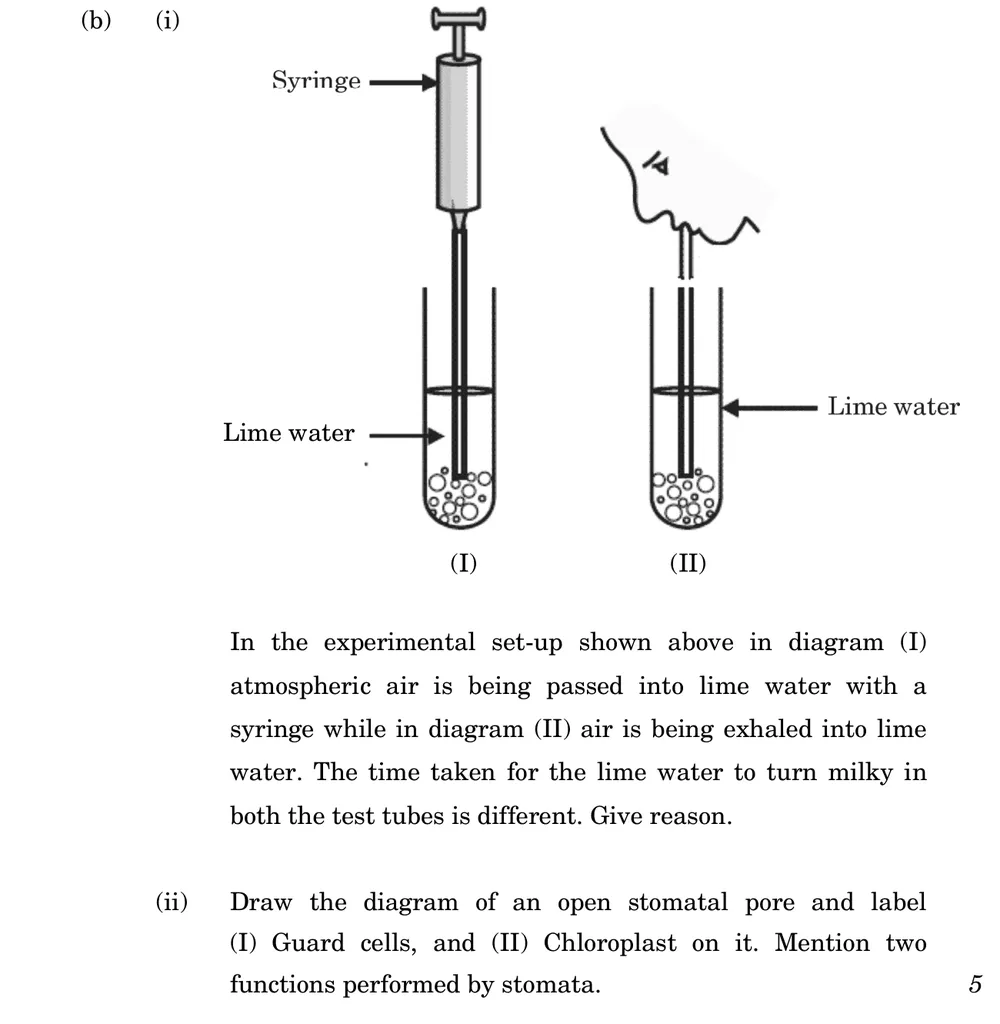
(i) In the experimental set-up shown above in diagram (I) atmospheric air is being passed into lime water with a syringe while in diagram (II) air is being exhaled into lime water. The time taken for the lime water to turn milky in both the test tubes is different. Give reason. (ii) Draw the diagram of an open stomatal pore and label (I) Guard cells, and (II) Chloroplast on it. Mention two functions performed by stomata. Write your answer, send a photo, get it marked in DheeAnswer and marking
- (i) First say which test tube turns milky later. Lime water in (I) takes more time to turn milky than in (II). 1 mark
- Then give the reason: more CO₂ turns lime water milky faster. Exhaled air contains a higher percentage of CO₂ than atmospheric air. 1 mark
- (ii) Draw two bean-shaped guard cells with the open pore between them. Diagram: open stomatal pore between two guard cells 1 mark
- Label the bean-shaped cells on both sides of the pore. Label (I): guard cells 0.5 marks
- Show and label the small green bodies inside the guard cells. Label (II): chloroplast 0.5 marks
- Stomata let gases in and out of the leaf. Function 1: gaseous exchange 0.5 marks
- Water also escapes from the leaf as vapour through stomata. Function 2: transpiration 0.5 marks
Answer: (i) (I) takes longer because exhaled air has more CO₂ ; (ii) labelled open stoma; gaseous exchange and transpiration
Marks: Observation and reason 2 · Diagram with labels 2 · Two functions 1
For full marks: In (i) compare both tubes and say exhaled air has MORE CO₂; a reason with no comparison loses a mark.
Where students lose marks: Writing that exhaled air is only CO₂; the point is a higher percentage of CO₂ than atmospheric air.
CBSE marking scheme
(i) Lime water in (I) takes more time to turn milky than in (II) because exhaled air contains a higher percentage of CO2 than atmospheric air (1, 1). (ii) Diagram of open stomatal pore (1) labelled guard cells (½) and chloroplast (½); functions: gaseous exchange (½), transpiration (½).
Free 10-question test: Life Processes
MCQ and Assertion–Reason questions from CBSE papers. About 10 minutes. Your score shows straight away.
Common mistakes in Life Processes
Mistake Writing the photosynthesis equation without conditions or with the wrong numbers.
Fix Learn the NCERT balanced form, which has water on both sides of the arrow. Write chlorophyll and sunlight over the arrow, and check that the atoms balance.
Mistake Writing 'plants make food from sunlight' when the events of photosynthesis are asked.
Fix List all three events as separate points, in the order NCERT gives them. The marks are split across the events, so a missing event loses marks.
Mistake Missing a chamber or a vessel when tracing double circulation.
Fix Write it as two loops and name every atrium, ventricle and vessel in order. Remember that the left side of the heart carries oxygen-rich blood. Each step carries ½ mark.
Mistake Mixing up anaerobic respiration in yeast and in muscles.
Fix Both start with glucose → pyruvate. In yeast, pyruvate becomes ethanol and CO₂. In muscles, when oxygen is short, it becomes lactic acid. Lactic acid building up causes muscle cramps.
Mistake Saying transpiration or xylem carries food.
Fix Xylem carries water and minerals upward, pulled mainly by transpiration. Phloem carries food (like sucrose) both up and down, using energy from ATP. This is called translocation.
Mistake Drawing the diagram but giving fewer labels than asked.
Fix Count the labels the question asks for and give at least that many. For a nephron, label parts like Bowman's capsule, glomerulus, tubular part and collecting duct. Each label carries ½ mark.
How to write for full marks
- For 'differentiate' questions, make a two-column table and compare the same point in each row. Each row carries its own mark.
- Draw diagrams neatly in pencil and label them with straight lines. The drawing and the labels carry separate marks.
- For 'which and why' questions, give both parts: name it first, then give the reason in one sentence. Each part carries 1 mark.
- Use the exact NCERT words, like villi, alveoli, guard cells, glomerulus, emulsify and translocation, and add one line on what each part does.
- In a case study, answer only the OR choice you pick. For a 2-mark part, give two clear points.
Not in the 2026-27 exam
Leave these out of your revision.
- Information in the NCERT boxes
Questions students ask
Which Life Processes questions are most important for the Class 10 board exam 2027?
Expect MCQs on nutrition, respiration, transport and excretion, 2- and 3-mark 'explain' questions, and sometimes a labelled diagram of stomata or the nephron. The 10 questions on this page are real CBSE board questions from 2023–2026, chosen across the chapter's topics and question types.
How many marks does Life Processes carry in the Class 10 board exam?
Life Processes is part of the World of Living unit, which carries 8 of the 80 theory marks in the CBSE Class 10 Science paper.
Are these real CBSE previous year questions?
Yes. Each question is printed as it appeared in a CBSE board paper or sample paper, with its source, and the answer follows CBSE's official marking scheme.
Questions and answers: CBSE board papers, sample papers and official marking schemes, 2023–2026. Worked steps and tips: Dhee.