Chapter 14 · CBSE Board 2027
Probability Class 10 important questions with answers
The 10 questions to practise first, picked from every CBSE board paper 2023–2026. Each one has the official answer and how to write it for full marks. Then try the free 10-question test.
What comes in the exam
- Probability is in the Statistics and Probability unit, worth 11 marks together with Statistics.
- MCQs (1 mark) come most, then 2- and 3-mark questions and Assertion–Reason, and often a 4-mark case study.
- Almost every year there are questions on two dice, a deck of 52 cards, two or three coins, and numbers or letters picked at random.
- P(not E) = 1 − P(E), and the rule that a probability lies from 0 to 1, come almost every year in MCQs and Assertion–Reason.
- Bag-of-balls questions also come almost every year, and some ask you to find a number of balls.
Top 10 Probability questions from board papers
Real CBSE questions, printed as they appeared. Open each answer to see the marking and the steps.
- Q1 Assertion–Reason · 1 mark CBSE · 2026, 2024 Asked in 2026, 2024
A-R: probability of 8 on a die
Assertion (A): The probability of getting number 8 on rolling a die is zero (0). Reason (R): The probability of an impossible event is zero (0).
- (A) Both Assertion (A) and Reason (R) are true and Reason (R) is the correct explanation of Assertion (A).
- (B) Both Assertion (A) and Reason (R) are true but Reason (R) is not the correct explanation of Assertion (A).
- (C) Assertion (A) is true but Reason (R) is false.
- (D) Assertion (A) is false but Reason (R) is true.
Write your answer, send a photo, get it marked in DheeAnswer and marking
Correct option: (A) Both Assertion (A) and Reason (R) are true and Reason (R) is the correct explanation of Assertion (A).
- A die shows only 1 to 6, so getting 8 cannot happen. Getting 8 is impossible ⇒ P(8) = 0 ⇒ A is true
- R is the basic fact about impossible events. P(impossible event) = 0 ⇒ R is true
- A is true exactly because of R, so R explains A. Option (A) 1 mark
Answer: (A) Both Assertion (A) and Reason (R) are true and Reason (R) is the correct explanation of Assertion (A).
Marks: Correct option 1
For full marks: Write that 8 is an impossible event; that word links A to R.
Where students lose marks: Option (B): treating R as a separate fact, though A is true only because getting 8 is impossible.
CBSE marking scheme
A die shows only 1 to 6, so getting 8 is an impossible event with probability 0; R is true and explains A.
- Q2 MCQ · 1 mark CBSE · 2023
Two coins: at least one tail
Two coins are tossed together. The probability of getting at least one tail is :
- (A) 1/4
- (B) 1/2
- (C) 3/4
- (D) 1
Write your answer, send a photo, get it marked in DheeAnswer and marking
Correct option: (C) 3/4
- List the outcomes of two coins. HH, HT, TH, TT
- 'At least one tail' means one or two tails. HT, TH, TT ⇒ 3/4 ⇒ option (C) 1 mark
Answer: (C) 3/4
Marks: Correct option 1
For full marks: 'At least one' includes TT, where both coins show tails.
Where students lose marks: Picking (B) 1/2: that counts exactly one tail (HT, TH) and leaves out TT.
CBSE marking scheme
Outcomes HH, HT, TH, TT; at least one tail in 3 ⇒ 3/4. (c) (1)
- Q3 Short answer · 3 marks CBSE · 2026
Two employees absent: same day
Offices in Delhi are open for 5 days a week Monday to Friday. Two employees of an office remain absent for one day in the same particular week. Find the probability that they remain absent on the same day. Also, find the probability that it was a Friday.
Write your answer, send a photo, get it marked in DheeAnswer and marking
- Pair the days the two employees are absent; each has 5 choices. Outcomes (1st, 2nd): (M, M), (M, T), …, (F, F) → 5 × 5 = 25 1 mark
- Same day means both are absent on Monday, Tuesday, …, or Friday together. Same day: (M, M), (T, T), (W, W), (Th, Th), (F, F) → 5 ; P(same day) = 5/25 = 1/5 1 mark
- Read 'it was a Friday' as both absent on Friday, out of all 25 outcomes. Both absent on Friday: (F, F) → 1 ; P(both absent on Friday) = 1/25 1 mark
Answer: P(same day) = 1/5 ; P(both absent on Friday) = 1/25
Marks: Outcomes 1 · Same day 1 · Friday 1
For full marks: Write the pairs like (M, T) to show all 25 outcomes — the first mark is for listing them.
Where students lose marks: Adding 5 + 5 = 10 outcomes instead of multiplying 5 × 5 = 25 gives P(same day) = 5/10 = 1/2.
CBSE marking scheme
Outcomes (day of 1st, day of 2nd): 5 × 5 = 25 listed (1); P(same day) = 5/25 = 1/5 (1); P(both absent on Friday) = 1/25 (1).
- Q4 Short answer · 3 marks CBSE · 2026
Bag of 30: find m, blue balls
A bag contains 30 balls out of which 'm' number of balls are blue in colour. (i) Find the probability that a ball drawn at random from the bag is not blue. (ii) If 6 more blue balls are added in the bag, then the probability of drawing a blue ball will be 5/4 times the probability of drawing a blue ball in the first case. Find the value of m.
Write your answer, send a photo, get it marked in DheeAnswer and marking
- (i) Balls that are not blue are the rest of the 30. P(not blue) = (30 − m)/30 1 mark
- (ii) Add 6 to the blue balls and to the total. Total = 36, blue = m + 6 ; P(blue) = (m + 6)/36 1 mark
- Set the new chance equal to 5/4 times the first chance. (m + 6)/36 = (5/4) × (m/30) 0.5 marks
- Cross-multiply and solve for m. (m + 6)/36 = m/24 ⇒ 24m + 144 = 36m ⇒ 12m = 144 ⇒ m = 12 0.5 marks
Answer: (i) (30 − m)/30 (ii) m = 12
Marks: (i) 1 · New probability 1 · Equation and m 1
For full marks: Write the equation (m + 6)/36 = (5/4) × (m/30) as a line — it carries ½ by itself.
Where students lose marks: Keeping the total at 30 after adding balls gives (m + 6)/30 = (5/4)(m/30), so m = 24 instead of 12.
CBSE marking scheme
(i) P(not blue) = (30 − m)/30 (1). (ii) Now 36 balls, m + 6 blue, P = (m + 6)/36 (1); (m + 6)/36 = (5/4)(m/30) (½) ⇒ m = 12 (½).
- Q5 Short answer · 3 marks CBSE · 2025
Defective pens: customer buys
A lot consists of 200 pens of which 180 are good and the rest are defective. A customer will buy a pen if it is not defective. The shopkeeper draws a pen at random and gives it to the customer. What is the probability that the customer will not buy it ? Another lot of 100 pens containing 80 good pens is mixed with the previous lot of 200 pens. The shopkeeper now draws one pen at random from the entire lot and gives it to the customer. What is the probability that the customer will buy the pen ?
Write your answer, send a photo, get it marked in DheeAnswer and marking
- The customer won't buy a defective pen, so count the defective ones first. Defective = 200 − 180 = 20 ; P(not buy) = 20/200 = 1/10 1 mark
- Mix the lots: add the totals and add the good pens. Total = 200 + 100 = 300 ; good = 180 + 80 = 260 1 mark
- The customer buys only a good pen, so use the good count. P(buy) = 260/300 = 13/15 1 mark
Answer: P(not buy) = 1/10 ; P(buy) = 13/15
Marks: First probability 1 · Mixed counts 1 · Second probability 1
For full marks: Write 'Total = 300 ; good = 260' as its own line — that count earns a full mark.
Where students lose marks: Using only the new lot (80/100 = 4/5) instead of all 300 mixed pens gives the wrong second answer.
CBSE marking scheme
P(not buy) = 20/200 = 1/10 (1); after mixing: total 300, good 260 (1); P(buy) = 260/300 = 13/15 (1).
- Q6 Short answer · 3 marks CBSE · 2024
Discs 1–90: three conditions
A box contains 90 discs which are numbered 1 to 90. If one disc is drawn at random from the box, find the probability that it bears a : (i) 2-digit number less than 40. (ii) number divisible by 5 and greater than 50. (iii) a perfect square number.
Write your answer, send a photo, get it marked in DheeAnswer and marking
- (i) Two-digit numbers below 40 start at 10 and stop at 39. Total = 90 ; 10 to 39 → 30 numbers ; P = 30/90 = 1/3 1 mark
- (ii) List multiples of 5 above 50; 50 itself is not greater than 50. 55, 60, 65, 70, 75, 80, 85, 90 → 8 ; P = 8/90 = 4/45 1 mark
- (iii) List the squares 1², 2², 3², … that stay within 90. 1, 4, 9, 16, 25, 36, 49, 64, 81 → 9 ; P = 9/90 = 1/10 1 mark
Answer: (i) 1/3 (ii) 4/45 (iii) 1/10
Marks: (i) 1 · (ii) 1 · (iii) 1
For full marks: In (ii) write the list 55, 60, …, 90 — it shows the examiner you left out 50.
Where students lose marks: In (i) counting 1 to 39 takes in one-digit numbers: 39/90 = 13/30 instead of 1/3.
CBSE marking scheme
Total outcomes = 90. (i) 10 to 39: 30/90 = 1/3 (1); (ii) 55, 60, …, 90: 8/90 = 4/45 (1); (iii) 1, 4, …, 81: 9/90 = 1/10 (1).
- Q7 Case study · 4 marks CBSE · 2026
Case: lucky draw chits
A school conducted a lucky draw during its annual function. The draw box contained 100 chits, each with a unique number from 1 to 100. The distribution of the chits is as follows : – 30 chits had red markings. – 20 chits were having numbers which are multiples of 5. – 15 chits had both red markings and numbers which are multiples of 5. – The rest were plain having no marking and no number. One chit is drawn at random from the box. Based on the above, answer the following questions : (i) What are the total number of outcomes ? (1) (ii) What is the probability that the chit drawn has a red marking only ? (1) (iii) (a) What is the probability that the chit has a multiple of 5 but no red marking ? (2) OR (iii) (b) What is the probability that the chit drawn is neither of red marking nor a multiple of 5 ? (2)
Write your answer, send a photo, get it marked in DheeAnswer and marking
- (i) Every one of the chits in the box is a possible outcome. Total outcomes = 100 1 mark
- (ii) Take away the red chits that are also multiples of 5. Red only = 30 − 15 = 15 0.5 marks
- Divide by 100 and simplify. P(red only) = 15/100 = 3/20 0.5 marks
- (iii) Take away the red ones from the multiples of 5. Multiple of 5 only = 20 − 15 = 5 1 mark
- Divide by 100 and simplify. P(multiple of 5, no red) = 5/100 = 1/20 1 mark
- (iii) From 100 take away red-only, both, and multiple-of-5-only chits. Neither = 100 − (15 + 15 + 5) = 65 1 mark
- Divide by 100 and simplify. P(neither) = 65/100 = 13/20 1 mark
Answer: (i) 100 · (ii) 3/20 · (iii)(a) 1/20 / (iii)(b) 13/20
Marks: (i) 1 · (ii) 1 · (iii) 2
For full marks: In (iii)(b) write 'Neither = 100 − (15 + 15 + 5) = 65' — that count earns a mark before the probability.
Where students lose marks: In (ii) using all 30 red chits gives 30/100 = 3/10; 15 of them are also multiples of 5.
CBSE marking scheme
(i) 100 (1). (ii) red only = 30 − 15 = 15 (½); P = 15/100 = 3/20 (½). (iii)(a) multiple of 5 only = 20 − 15 = 5 (1); P = 5/100 = 1/20 (1). OR (iii)(b) neither = 100 − (15 + 15 + 5) = 65 (1); P = 65/100 = 13/20 (1).
- Q8 Case study · 4 marks CBSE · 2025
Case: Rahul's lucky charm cards
Rahul is a lucky charm for his cricket team. He has a jar of cards with numbers from 10 to 74. Before each match, he draws a card from the jar. If the card bears an even number, the team wins. If the number is even and divisible by 5, they win by a big margin. If the number is an odd number less than 30, they win by a small margin. And if the number is a prime number between 50 and 74, they lose. Answer the following questions if Rahul draws a card today : (i) What is the probability that Rahul draws a card with an even number ? (1) (ii) What is the probability that Rahul draws a card with an odd number less than 30 ? (1) (iii) (a) What is the probability that Rahul draws a card with a prime number between 50 and 74 ? (2) OR (iii) (b) What is the probability that Rahul draws a card with an even number divisible by 5 ? (2)
Write your answer, send a photo, get it marked in DheeAnswer and marking
- (i) Count the cards from 10 to 74, including both ends. Total outcomes = 74 − 10 + 1 = 65 0.5 marks
- Count the even cards and divide by the total. Even: 10, 12, …, 74 → 33 ; P(even) = 33/65 0.5 marks
- (ii) List the odd numbers from 11 up to 29. 11, 13, …, 29 → 10 ; P(odd less than 30) = 10/65 = 2/13 1 mark
- (iii) List the primes between 50 and 74. Primes: 53, 59, 61, 67, 71, 73 → 6 1 mark
- Divide by the 65 cards. P(prime between 50 and 74) = 6/65 1 mark
- (iii) An even number divisible by 5 is a multiple of 10. 10, 20, 30, 40, 50, 60, 70 → 7 1 mark
- Divide by the 65 cards. P(even and divisible by 5) = 7/65 1 mark
Answer: (i) 33/65 · (ii) 2/13 · (iii)(a) 6/65 / (iii)(b) 7/65
Marks: (i) 1 · (ii) 1 · (iii) 2
For full marks: Write 'Total outcomes = 74 − 10 + 1 = 65' — that line carries ½ of part (i).
Where students lose marks: In (iii)(a) counting 51 or 57 as prime (51 = 3 × 17, 57 = 3 × 19) gives 7/65 or 8/65 instead of 6/65.
CBSE marking scheme
Total outcomes = 74 − 10 + 1 = 65 (½). (i) P(even) = 33/65 (½). (ii) P(odd < 30) = 10/65 = 2/13 (1). (iii)(a) Primes 53, 59, 61, 67, 71, 73 (1) ⇒ 6/65 (1). OR (b) 10, 20, …, 70 = 7 numbers (1) ⇒ 7/65 (1).
- Q9 Case study · 4 marks CBSE · 2025
Case: Ashima's toffee bag
Aarav and Ashima are brother and sister and on Ashima's birthday, Aarav gifts her a bag filled with 8 red toffees, 10 green toffees and 6 blue toffees. Ashima decides to randomly draw a toffee from the bag. She wants to find the chances of picking a toffee of specific colour and asks the following questions: (i) What is the probability of getting a green toffee? (1) (ii) What is the probability of getting a blue toffee? (1) (iii) (a) What is the probability of getting a non-red toffee? (2) OR (b) What is the probability of getting a red or a green toffee? (2)
Write your answer, send a photo, get it marked in DheeAnswer and marking
- (i) Add all the toffees for the total, then use the green ones. Total = 8 + 10 + 6 = 24 ; P(green) = 10/24 = 5/12 1 mark
- (ii) Divide the blue toffees by the total. P(blue) = 6/24 = 1/4 1 mark
- (iii) Non-red means green or blue, so add those. P(non-red) = (10 + 6)/24 = 16/24 = 2/3 2 marks
- (iii) Add the red and the green toffees over the total. P(red or green) = (8 + 10)/24 = 18/24 = 3/4 2 marks
Answer: (i) 5/12 · (ii) 1/4 · (iii)(a) 2/3 / (iii)(b) 3/4
Marks: (i) 1 · (ii) 1 · (iii) 2
For full marks: Write 'Total = 8 + 10 + 6 = 24' at the start — every part divides by it.
Where students lose marks: In (iii)(a) counting non-red as only green gives 10/24 = 5/12 instead of 2/3.
CBSE marking scheme
Total 24. (i) P(green) = 10/24 = 5/12 (1). (ii) P(blue) = 6/24 = 1/4 (1). (iii)(a) P(non-red) = (10 + 6)/24 = 2/3 (2). OR (b) P(red or green) = (8 + 10)/24 = 3/4 (2).
- Q10 Case study · 4 marks CBSE · 2024
Case: holiday transport chart
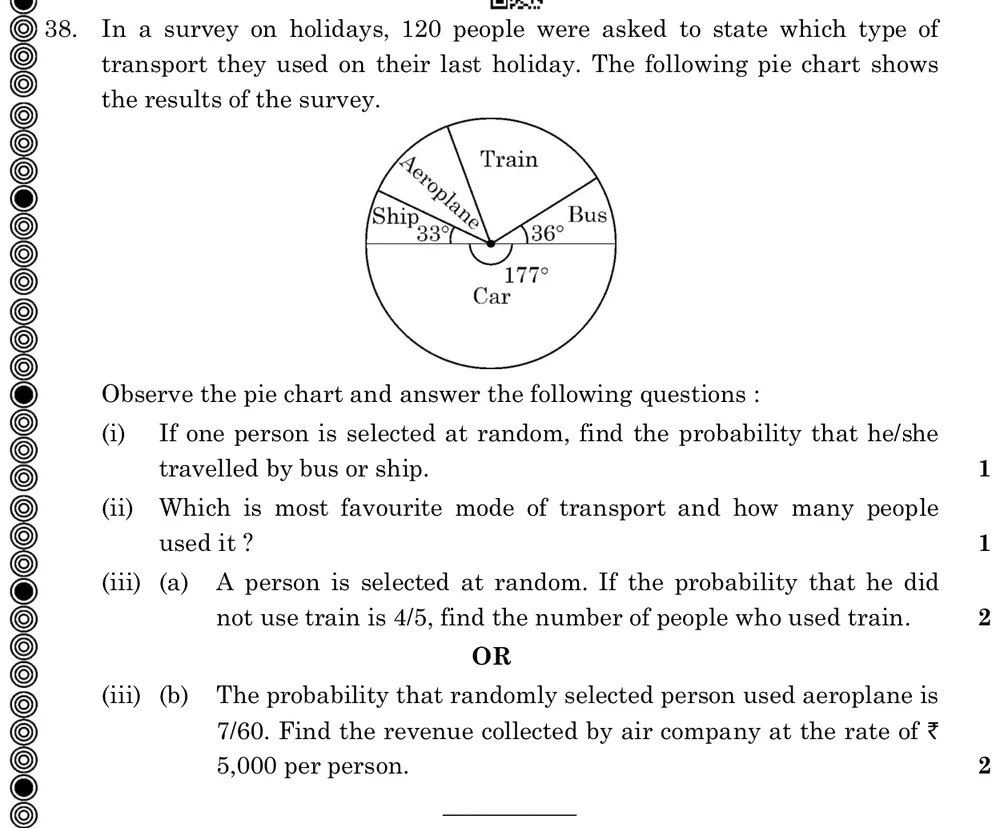
In a survey on holidays, 120 people were asked to state which type of transport they used on their last holiday. The following pie chart shows the results of the survey. Observe the pie chart and answer the following questions : (i) If one person is selected at random, find the probability that he/she travelled by bus or ship. (1) (ii) Which is most favourite mode of transport and how many people used it ? (1) (iii) (a) A person is selected at random. If the probability that he did not use train is 4/5, find the number of people who used train. (2) OR (iii) (b) The probability that randomly selected person used aeroplane is 7/60. Find the revenue collected by air company at the rate of ₹ 5,000 per person. (2) Write your answer, send a photo, get it marked in DheeAnswer and marking
- (i) Add the bus and ship angles and divide by 360°. P(bus or ship) = (36 + 33)/360 = 69/360 = 23/120 1 mark
- (ii) The biggest sector shows the favourite mode. Most favourite: Car 0.5 marks
- Turn the car's angle into people out of 120. People who used car = (177/360) × 120 = 59 0.5 marks
- (iii) Use P(not E) = 1 − P(E) for the train's chance. P(train) = 1 − 4/5 = 1/5 1 mark
- Multiply that chance by the 120 people. Train users = 120/5 = 24 1 mark
- (iii) Multiply the aeroplane chance by the 120 people. Aeroplane users = (7/60) × 120 = 14 1 mark
- Each person pays ₹5,000, so multiply by the number of people. Revenue = 14 × 5000 = ₹70,000 1 mark
Answer: (i) 23/120 · (ii) Car, 59 people · (iii)(a) 24 / (iii)(b) ₹70,000
Marks: (i) 1 · (ii) 1 · (iii) 2
For full marks: In (ii) write both 'Most favourite: Car' and the 59 people — each answer earns ½.
Where students lose marks: In (iii)(a) multiplying 4/5 by 120 gives 96 — those did not use train; the answer is 24.
CBSE marking scheme
(i) P(bus or ship) = (36 + 33)/360 = 69/360 = 23/120 (1). (ii) Car; (177/360) × 120 = 59 people (½+½). (iii)(a) P(train) = 1 – 4/5 = 1/5 (1); train users = 120/5 = 24 (1). OR (iii)(b) Aeroplane users = (7/60) × 120 = 14 (1); revenue = 14 × 5000 = ₹ 70,000 (1).
Free 10-question test: Probability
MCQ and Assertion–Reason questions from CBSE papers. About 10 minutes. Your score shows straight away.
Common mistakes in Probability
Mistake Getting the total number of outcomes wrong.
Fix Count the numbers from a to b as b − a + 1. Write 'total outcomes = …' as the first line; it can carry ½ mark. If a card is lost or balls are added, change the total too.
Mistake With two dice, missing the reversed pairs.
Fix There are 36 ordered pairs. (1, 4) and (4, 1) are different outcomes, but (4, 4) is only one. Write out the pairs you count.
Mistake With cards, counting the same card twice in an 'or' question.
Fix For 'a heart or a king', count the hearts, then add only the kings that are not hearts. Know the deck: 4 suits of 13, 26 red and 26 black, 12 face cards.
Mistake Counting 1 as a prime or a composite number.
Fix 1 is neither prime nor composite. List the primes in the range before you count them.
Mistake In a bag question, stopping at the probability when it asks for a number of balls.
Fix Write P(yellow) = number of yellow balls / total balls, put in the values, and solve for the number. If balls are added, change both the count and the total.
Mistake In Assertion–Reason, choosing 'R explains A' because both are true.
Fix Check A and R on their own first. Then ask: does R give the reason for A? A true R can still be about something else.
How to write for full marks
- Write three lines: total outcomes, favourable outcomes (with the list), and P(E) = favourable ÷ total.
- List the favourable outcomes: the primes, the dice pairs or the cards. In 2- and 3-mark answers the list earns marks.
- Give the answer as a fraction in its lowest terms, and check that it lies from 0 to 1.
- When two things overlap, like red chits and multiples of 5, find the 'only' counts first: red only = red − both.
Questions students ask
Which Probability questions are most important for the Class 10 board exam 2027?
Expect MCQs and 2- or 3-mark questions on dice, cards, coins, numbers and bags, plus P(not E) = 1 − P(E) and 0 ≤ P(E) ≤ 1. The 10 questions on this page are real CBSE board questions from 2023–2026, chosen across the chapter's topics and question types.
How many marks does Probability carry in the Class 10 board exam?
Probability is part of the Statistics and Probability unit, which carries 5 of the 80 theory marks in the CBSE Class 10 Maths paper.
Are these real CBSE previous year questions?
Yes. Each question is printed as it appeared in a CBSE board paper or sample paper, with its source, and the answer follows CBSE's official marking scheme.
Questions and answers: CBSE board papers, sample papers and official marking schemes, 2023–2026. Worked steps and tips: Dhee.