Chapter 13 · CBSE Board 2027
Statistics Class 10 important questions with answers
The 10 questions to practise first, picked from every CBSE board paper 2023–2026. Each one has the official answer and how to write it for full marks. Then try the free 10-question test.
What comes in the exam
- Statistics is in the Statistics and Probability unit, worth 11 marks together with Probability.
- MCQs (1 mark) come most, then 5-mark questions, with some 3-mark questions, case studies and Assertion–Reason.
- Almost every year there is a 5-mark question on a grouped table: find the mean by the step-deviation method, the median, or the mode, or find missing frequencies like x and y from a given mean or median.
- MCQs almost every year use the relation 3 Median = Mode + 2 Mean, or ask for the median class or the modal class.
Top 10 Statistics questions from board papers
Real CBSE questions, printed as they appeared. Open each answer to see the marking and the steps.
- Q1 Short answer · 3 marks CBSE · 2025
Find y from the mean expenditure
Weekly expenditure on Ayurvedic medicines of a few households in a locality is recorded below. Weekly expenditure (in ₹): 100–150, 150–200, 200–250, 250–300, 300–350 Number of households: 4, 5, y, 2, 2 If the mean expenditure for this is ₹211, then find the value of the missing frequency y.
Write your answer, send a photo, get it marked in DheeAnswer and marking
- Take A = 225 and h = 50, find uᵢ, then fᵢuᵢ, and add. uᵢ: −2, −1, 0, 1, 2 ; fᵢuᵢ: −8, −5, 0, 2, 4 ; Σf = 13 + y, Σfu = −7 1.5 marks
- Put these into the mean formula and set it equal to 211. 225 + (−7/(13 + y)) × 50 = 211 1 mark
- Solve for y. 350/(13 + y) = 14 ⇒ 13 + y = 25 ⇒ y = 12 0.5 marks
Answer: y = 12
Marks: Table 1½ · Mean equation 1 · Value of y ½
For full marks: Write Σf as '13 + y', not 13 — the y must stay in the total for the equation to work.
Where students lose marks: Taking Σfu = +7 instead of −7; then 225 + 350/(13 + y) = 211 has no positive y.
CBSE marking scheme
Step-deviation with A = 225, h = 50: Σf = 13 + y, Σfu = −7 (table 1½); 225 + (−7/(13 + y)) × 50 = 211 (1) ⇒ y = 12 (½).
- Q2 Short answer · 3 marks CBSE · 2024
Mean marks of 100 students
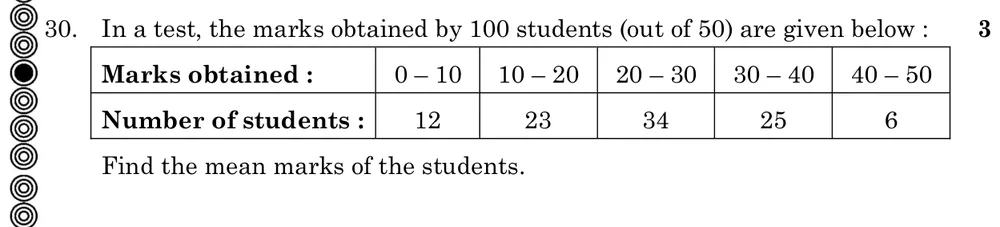
In a test, the marks obtained by 100 students (out of 50) are given below : Marks obtained : 0–10, 10–20, 20–30, 30–40, 40–50 Number of students : 12, 23, 34, 25, 6 Find the mean marks of the students. Write your answer, send a photo, get it marked in DheeAnswer and marking
- Find each class mark and multiply it by its frequency; then add both columns. xᵢ: 5, 15, 25, 35, 45 ; fᵢxᵢ: 60, 345, 850, 875, 270 ; Σfᵢ = 100, Σfᵢxᵢ = 2400 1.5 marks
- Divide Σfᵢxᵢ by Σfᵢ. Mean = Σfᵢxᵢ/Σfᵢ = 2400/100 1 mark
- Simplify. Mean = 24 marks 0.5 marks
Answer: Mean marks = 24
Marks: Table 1½ · Formula 1 · Answer ½
For full marks: Show the fᵢxᵢ column with its total 2400 — the table itself carries 1½ marks.
Where students lose marks: Multiplying by the class's lower limit (0, 10, 20…) instead of the class mark, which gives a mean of 19.
CBSE marking scheme
Class marks 5, 15, 25, 35, 45; fi·xi = 60, 345, 850, 875, 270; Σfi = 100, Σfixi = 2400 (correct table 1½); mean = 2400/100 (1) = 24 (½).
- Q3 Short answer · 3 marks CBSE · 2024
Mean age of rescued people
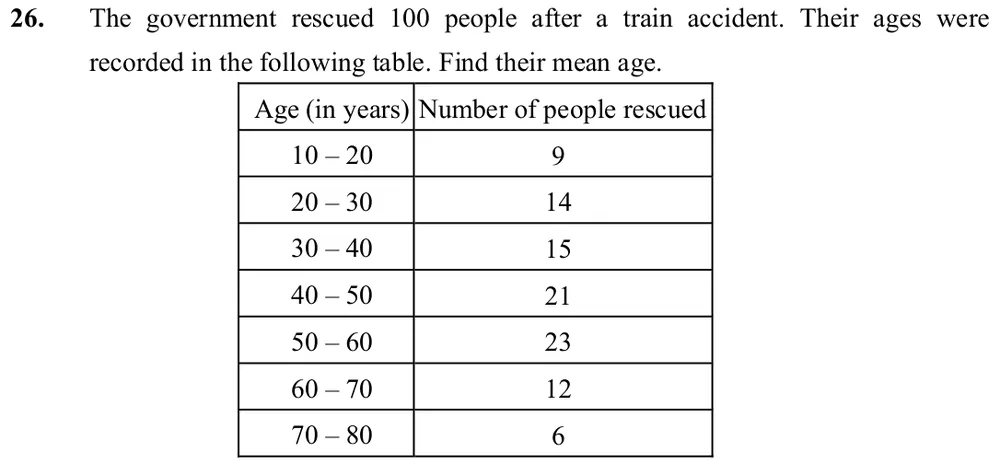
The government rescued 100 people after a train accident. Their ages were recorded in the following table. Find their mean age. Age (in years): 10–20, 20–30, 30–40, 40–50, 50–60, 60–70, 70–80 Number of people rescued: 9, 14, 15, 21, 23, 12, 6 Write your answer, send a photo, get it marked in DheeAnswer and marking
- Take a = 45 and h = 10, find uᵢ = (xᵢ − 45)/10, then fᵢuᵢ. uᵢ: −3, −2, −1, 0, 1, 2, 3 ; fᵢuᵢ: −27, −28, −15, 0, 23, 24, 18 ; Σf = 100, Σfu = −5 1.5 marks
- Use the step-deviation formula. Mean = a + (Σfu/Σf) × h = 45 + (−5/100) × 10 1 mark
- Simplify and give the unit. Mean = 45 − 0.5 = 44.5 years 0.5 marks
Answer: Mean age = 44.5 years
Marks: Table 1½ · Formula 1 · Answer ½
For full marks: Write 'Mean = a + (Σfu/Σf) × h' with the values in — the formula line carries 1 mark.
Where students lose marks: Dropping the minus in Σfu = −5 and getting 45.5 years instead of 44.5 years.
CBSE marking scheme
Step-deviation with a = 45, h = 10: Σf = 100, Σfu = −5 (1½ for table). Mean = 45 + (−5/100) × 10 (1) = 44.5 years (½).
- Q4 Case study · 4 marks CBSE · 2026
Case: SO2 air pollution data
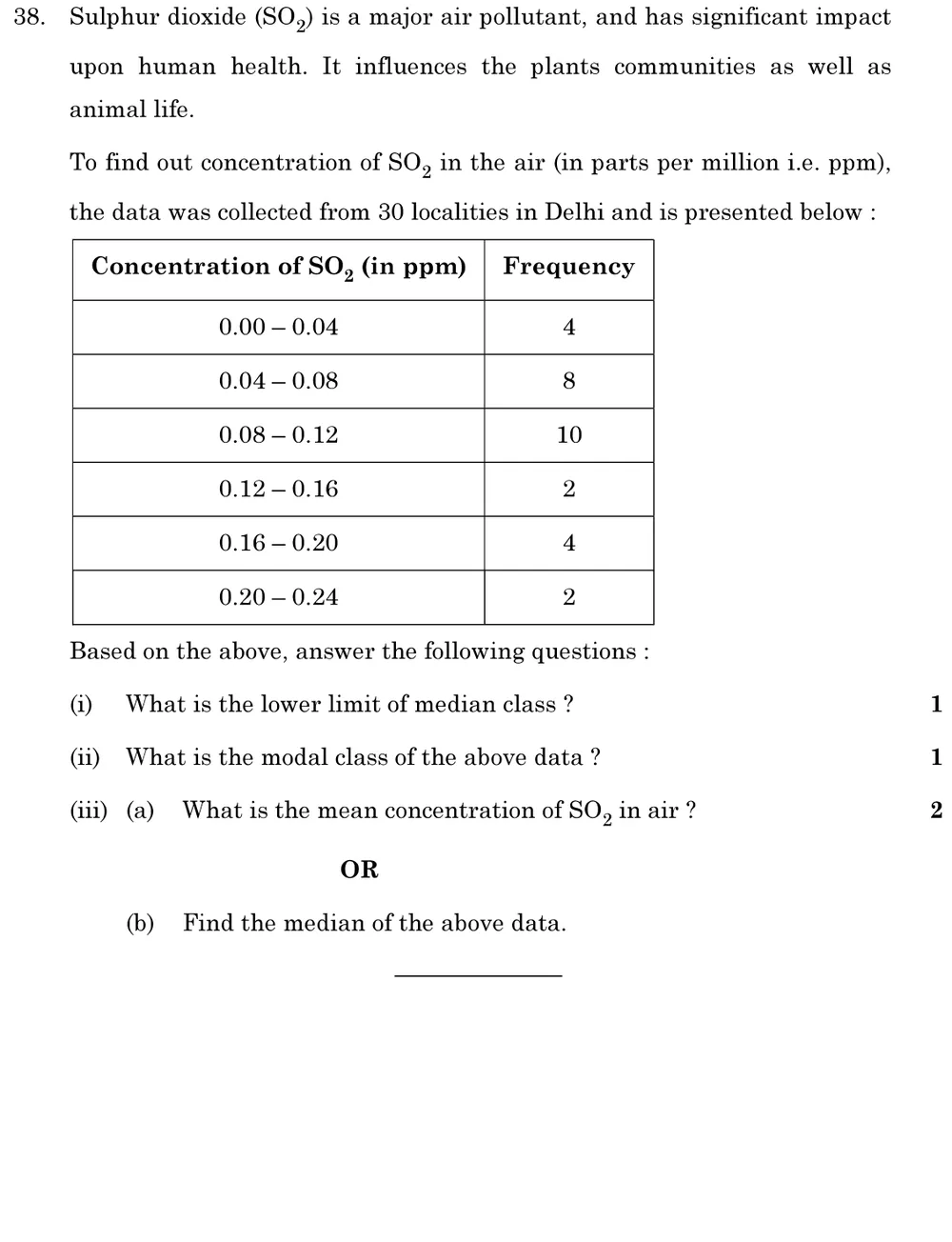
Sulphur dioxide (SO2) is a major air pollutant, and has significant impact upon human health. It influences the plants communities as well as animal life. To find out concentration of SO2 in the air (in parts per million i.e. ppm), the data was collected from 30 localities in Delhi and is presented below: Concentration of SO2 (in ppm): 0.00–0.04, 0.04–0.08, 0.08–0.12, 0.12–0.16, 0.16–0.20, 0.20–0.24 Frequency: 4, 8, 10, 2, 4, 2 (i) What is the lower limit of median class? (1) (ii) What is the modal class of the above data? (1) (iii) (a) What is the mean concentration of SO2 in air? (2) OR (iii) (b) Find the median of the above data. (2) Write your answer, send a photo, get it marked in DheeAnswer and marking
- (i) Build the cf column, halve N, and read the lower limit of the class reaching 15. cf: 4, 12, 22, 24, 28, 30 ; N/2 = 15 ⇒ median class 0.08–0.12 ; lower limit = 0.08 1 mark
- (ii) Pick the class with the highest frequency, 10. Modal class = 0.08–0.12 1 mark
- (iii)(a) Take a = 0.10, h = 0.04 and make the u and fu columns. xi: 0.02, 0.06, 0.10, 0.14, 0.18, 0.22 ; ui = (xi − 0.10)/0.04: −2, −1, 0, 1, 2, 3 ; fiui: −8, −8, 0, 2, 8, 6 ; Σfiui = 0 1 mark
- Put the sums into the step-deviation mean formula. Mean = a + (Σfiui/Σfi) × h = 0.10 + (0/30) × 0.04 = 0.10 ppm 1 mark
- (iii)(b) Write the cf table and find the median class. cf: 4, 12, 22, 24, 28, 30 ; N/2 = 15 ⇒ median class 0.08–0.12 1 mark
- Use l = 0.08, cf = 12, f = 10, h = 0.04 in the median formula. Median = 0.08 + ((15 − 12)/10) × 0.04 = 0.08 + 0.012 = 0.092 ppm 1 mark
Answer: (i) 0.08 · (ii) 0.08–0.12 · (iii) (a) Mean = 0.10 ppm / (b) Median = 0.092 ppm
Marks: Lower limit 1 · Modal class 1 · Mean or median 2
For full marks: In (iii)(a) show the fiui column adding to Σfiui = 0 — the correct table is worth a full mark.
Where students lose marks: Taking h = 0.4 instead of 0.04 in the median gives 0.08 + 0.12 = 0.20 ppm, which is not even in the median class.
CBSE marking scheme
(i) cf: 4, 12, 22, 24, 28, 30; N/2 = 15 ⇒ median class 0.08–0.12, lower limit 0.08 (1). (ii) Modal class 0.08–0.12 (1). (iii)(a) a = 0.10, h = 0.04, u_i = −2, −1, 0, 1, 2, 3; Σf_i u_i = 0 (correct table 1); mean = 0.10 + (0/30) × 0.04 = 0.10 ppm (1). OR (iii)(b) correct cf table (1); median = 0.08 + ((15 − 12)/10) × 0.04 = 0.092 ppm (1).
- Q5 Case study · 4 marks CBSE · 2025
Case: rainfall in sub-divisions
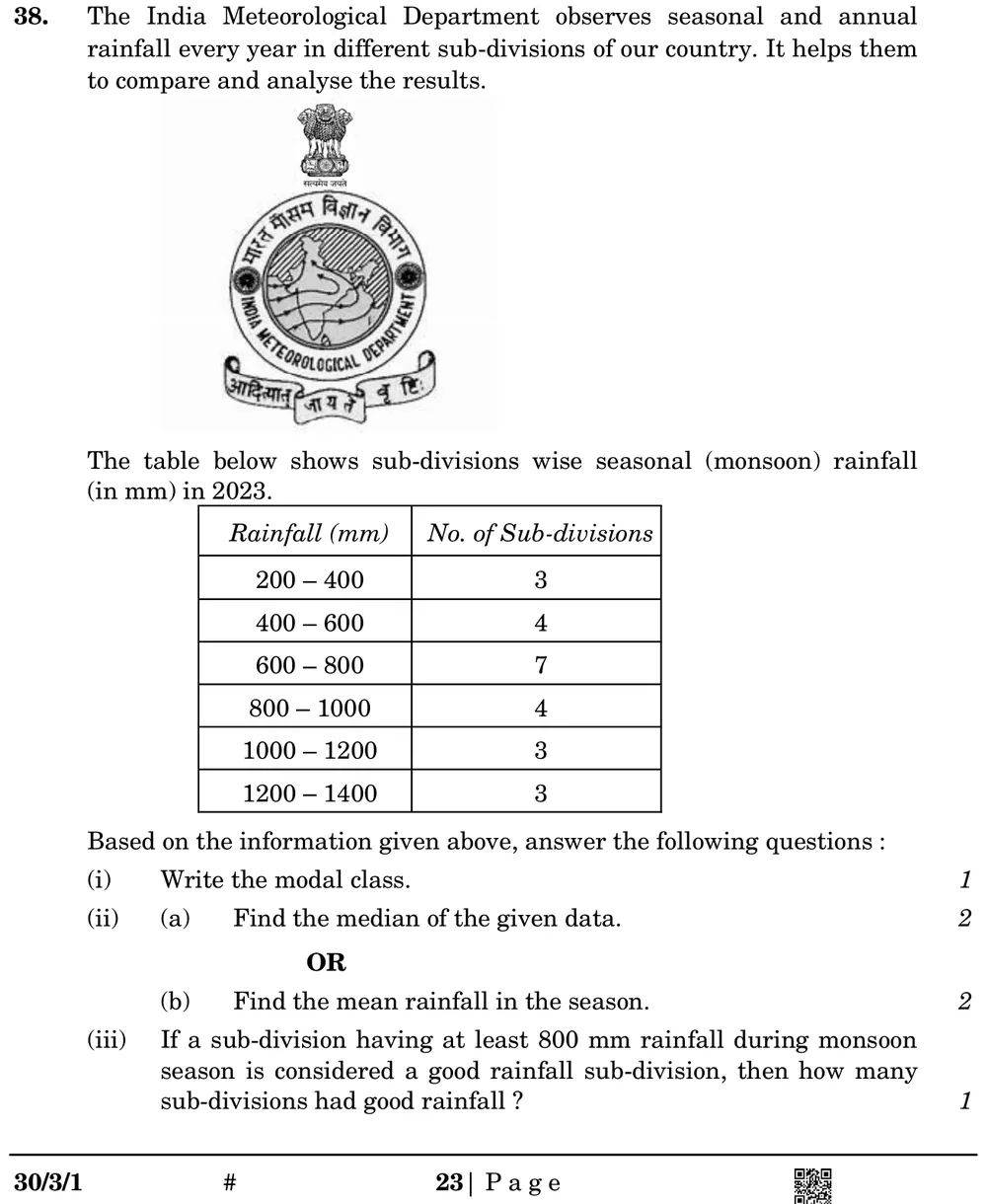
The India Meteorological Department observes seasonal and annual rainfall every year in different sub-divisions of our country. It helps them to compare and analyse the results. The table below shows sub-divisions wise seasonal (monsoon) rainfall (in mm) in 2023. Rainfall (mm): 200–400, 400–600, 600–800, 800–1000, 1000–1200, 1200–1400 No. of sub-divisions: 3, 4, 7, 4, 3, 3 (i) Write the modal class. (1) (ii) (a) Find the median of the given data. (2) OR (ii) (b) Find the mean rainfall in the season. (2) (iii) If a sub-division having at least 800 mm rainfall during monsoon season is considered a good rainfall sub-division, then how many sub-divisions had good rainfall ? (1) Write your answer, send a photo, get it marked in DheeAnswer and marking
- (i) Pick the class with the most sub-divisions. Highest frequency 7 ⇒ modal class = 600–800 1 mark
- (ii)(a) Add the frequencies one by one to make the cf column. cf: 3, 7, 14, 18, 21, 24 0.5 marks
- Halve N and find the first cf that reaches it. N = 24, N/2 = 12 ⇒ median class = 600–800 0.5 marks
- Use l = 600, cf = 7, f = 7, h = 200 in the median formula. Median = 600 + ((12 − 7)/7) × 200 0.5 marks
- Simplify, then divide to get the decimal. = 600 + 1000/7 = 5200/7 ≈ 742.86 mm 0.5 marks
- (ii)(b) Find the class marks and multiply each by its frequency. xi: 300, 500, 700, 900, 1100, 1300 ; fixi: 900, 2000, 4900, 3600, 3300, 3900 ; Σfi = 24, Σfixi = 18600 1 mark
- Divide the total of fixi by the number of sub-divisions. Mean = Σfixi/Σfi = 18600/24 = 775 mm 1 mark
- (iii) Add the sub-divisions in every class from 800 mm upward. 800–1000, 1000–1200, 1200–1400 ⇒ 4 + 3 + 3 = 10 sub-divisions 1 mark
Answer: (i) 600–800 · (ii) (a) Median ≈ 742.86 mm / (b) Mean = 775 mm · (iii) 10
Marks: Modal class 1 · Median or mean 2 · Good rainfall count 1
For full marks: In (ii)(a) write 'N/2 = 12 ⇒ median class = 600–800' before the formula — that line earns its own ½.
Where students lose marks: 'At least 800' includes the 800–1000 class; leaving it out gives 6 sub-divisions instead of 10.
CBSE marking scheme
(i) Modal class 600–800 (1). (ii)(a) cf 3, 7, 14, 18, 21, 24 (table ½); N = 24, median class 600–800 (½); median = 600 + (12 − 7)/7 × 200 (½) = 5200/7 ≈ 742.8 mm (½). OR (ii)(b) xi 300…1300, Σfi = 24, Σfixi = 18600 (table 1); mean = 18600/24 = 775 mm (1). (iii) 4 + 3 + 3 = 10 sub-divisions (1).
- Q6 Case study · 4 marks CBSE · 2024
Case: heart rate data
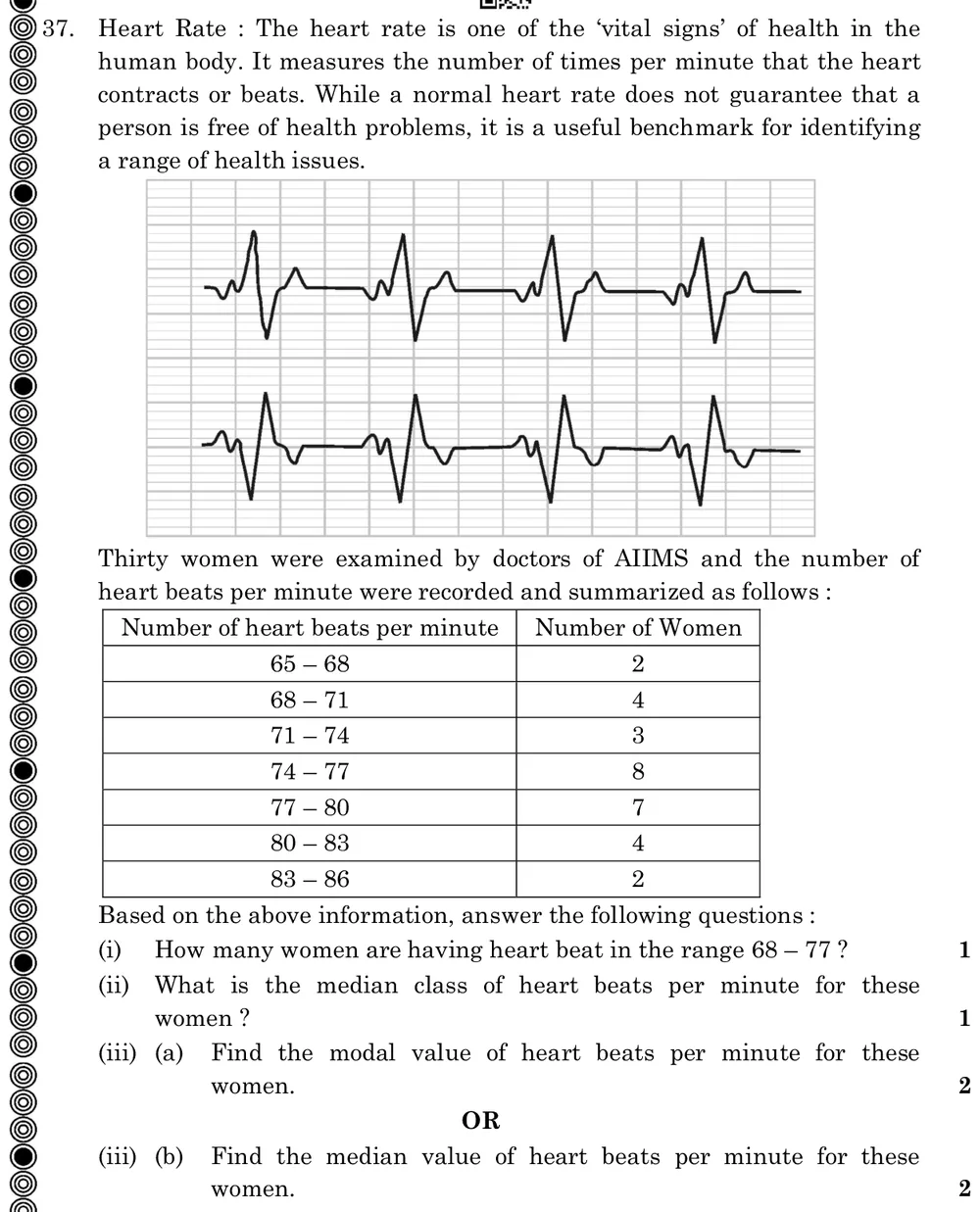
Heart Rate: The heart rate is one of the 'vital signs' of health in the human body. It measures the number of times per minute that the heart contracts or beats. While a normal heart rate does not guarantee that a person is free of health problems, it is a useful benchmark for identifying a range of health issues. Thirty women were examined by doctors of AIIMS and the number of heart beats per minute were recorded and summarized as follows: Number of heart beats per minute: 65–68, 68–71, 71–74, 74–77, 77–80, 80–83, 83–86 Number of women: 2, 4, 3, 8, 7, 4, 2 Based on the above information, answer the following questions: (i) How many women are having heart beat in the range 68–77? (1) (ii) What is the median class of heart beats per minute for these women? (1) (iii) (a) Find the modal value of heart beats per minute for these women. (2) OR (iii) (b) Find the median value of heart beats per minute for these women. (2) Write your answer, send a photo, get it marked in DheeAnswer and marking
- (i) The range 68–77 covers three classes; add their women. 4 + 3 + 8 = 15 1 mark
- (ii) N/2 = 15; find the class where cf first passes 15. Median class = 74–77 1 mark
- (iii) Pick the highest frequency class and use the mode formula. l = 74, f₁ = 8, f₀ = 3, f₂ = 7, h = 3 ; mode = 74 + (8 − 3)/(16 − 3 − 7) × 3 1.5 marks
- Simplify. Mode = 74 + 2.5 = 76.5 beats per minute 0.5 marks
- (iii) Add the frequencies one by one for the cumulative frequency. cf: 2, 6, 9, 17, 24, 28, 30 0.5 marks
- Use l = 74, cf = 9, f = 8, h = 3 in the median formula. Median = 74 + (15 − 9)/8 × 3 1 mark
- Simplify. Median = 74 + 2.25 = 76.25 beats per minute 0.5 marks
Answer: (i) 15 women ; (ii) 74–77 ; (iii) (a) mode = 76.5 / (b) median = 76.25
Marks: Count 1 · Median class 1 · Mode or median 2
For full marks: In (iii) write 'l = 74, f₁ = 8, f₀ = 3, f₂ = 7, h = 3' before substituting — it earns most of the 1½.
Where students lose marks: In (iii)(b) using cf = 17 of the median class instead of 9; the median then drops below 74, which is impossible.
CBSE marking scheme
(i) 4 + 3 + 8 = 15 (1). (ii) Median class 74–77 (1). (iii)(a) l = 74, f1 = 8, f0 = 3, f2 = 7, h = 3; mode = 74 + (8 − 3)/(16 − 3 − 7) × 3 (1½) = 76.5 (½). OR (iii)(b) cf: 2, 6, 9, 17, 24, 28, 30 (½); median = 74 + (15 − 9)/8 × 3 (1) = 76.25 (½).
- Q7 Long answer · 5 marks CBSE · 2025
Mean and mode, frequency table
Find 'mean' and 'mode' of the following data : Class: 10-25, 25-40, 40-55, 55-70, 70-85, 85-100 Number of Students: 12, 10, 15, 13, 8, 12
Write your answer, send a photo, get it marked in DheeAnswer and marking
- Take a = 47.5, h = 15 and make the class mark, u and fu columns. xi: 17.5, 32.5, 47.5, 62.5, 77.5, 92.5 ; ui = (xi − 47.5)/15: −2, −1, 0, 1, 2, 3 ; fiui: −24, −10, 0, 13, 16, 36 ; Σf = 70, Σfu = 31 1.5 marks
- Put the sums into the step-deviation mean formula. Mean = 47.5 + 15 × 31/70 = 47.5 + 465/70 ≈ 54.14 1.5 marks
- Pick the class with the highest frequency, 15. Modal class = 40-55 ; l = 40, f1 = 15, f0 = 10, f2 = 13, h = 15 0.5 marks
- Substitute in the mode formula and simplify. Mode = 40 + 15 × (15 − 10)/(30 − 10 − 13) = 40 + 75/7 ≈ 50.71 1.5 marks
Answer: Mean ≈ 54.14, Mode ≈ 50.71
Marks: Table 1½ · Mean 1½ · Modal class ½ · Mode 1½
For full marks: Write 'Modal class = 40-55' on its own line — it earns ½ even before the formula.
Where students lose marks: Swapping f0 and f2 (f0 = 13, f2 = 10) gives 40 + 15 × 2/7 ≈ 44.29 instead of 50.71.
CBSE marking scheme
Correct table (1½): xi 17.5…92.5, ui = (xi − 47.5)/15, Σf = 70, Σfu = 31. Mean = 47.5 + 15 × 31/70 = 54.14 (1½). Modal class 40-55 (½); Mode = 40 + 15 × (15 − 10)/(30 − 10 − 13) = 50.71 (1½).
- Q8 Long answer · 5 marks CBSE · 2025
Median length of 40 leaves
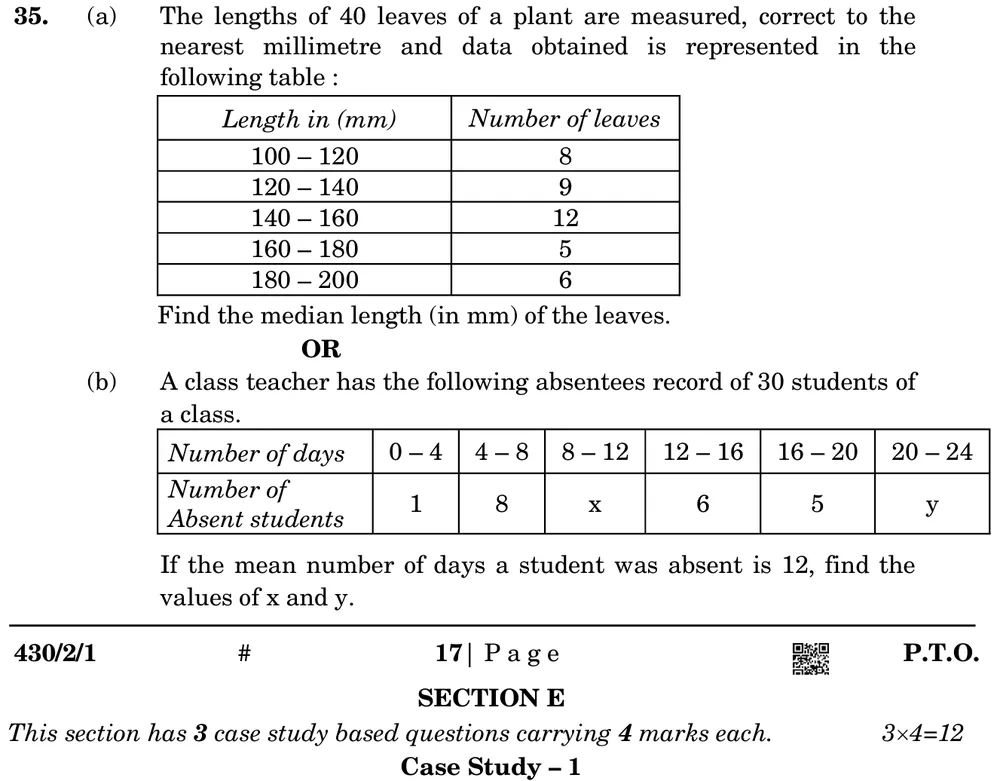
The lengths of 40 leaves of a plant are measured, correct to the nearest millimetre and data obtained is represented in the following table : Length (in mm): 100 − 120, 120 − 140, 140 − 160, 160 − 180, 180 − 200 Number of leaves: 8, 9, 12, 5, 6 Find the median length (in mm) of the leaves. Write your answer, send a photo, get it marked in DheeAnswer and marking
- Add the frequencies one by one to build the cumulative frequency column. cf: 8, 17, 29, 34, 40 2 marks
- Halve N and find the first cf that reaches it. N = 40, N/2 = 20 ⇒ median class = 140 − 160 1 mark
- Use l = 140, cf = 17, f = 12, h = 20 in the formula. Median = l + ((N/2 − cf)/f) × h = 140 + ((20 − 17)/12) × 20 1 mark
- Simplify the fraction and add to 140. = 140 + (3/12) × 20 = 140 + 5 = 145 mm 1 mark
Answer: Median length = 145 mm
Marks: Cumulative table 2 · Median class 1 · Formula 1 · Answer 1
For full marks: Write the cf column 8, 17, 29, 34, 40 in full — that table alone is worth 2 marks.
Where students lose marks: Using f = 9 (the class before) instead of 12 gives 140 + (3/9) × 20 ≈ 146.67 mm.
CBSE marking scheme
Correct cumulative frequency table: 8, 17, 29, 34, 40 (2). N/2 = 20, median class 140 − 160 (1). Median = l + [(N/2 − cf)/f] × h = 140 + [(20 − 17)/12] × 20 (1) = 145 mm (1).
- Q9 Long answer · 5 marks CBSE · 2024
Find x and y from mean allowance
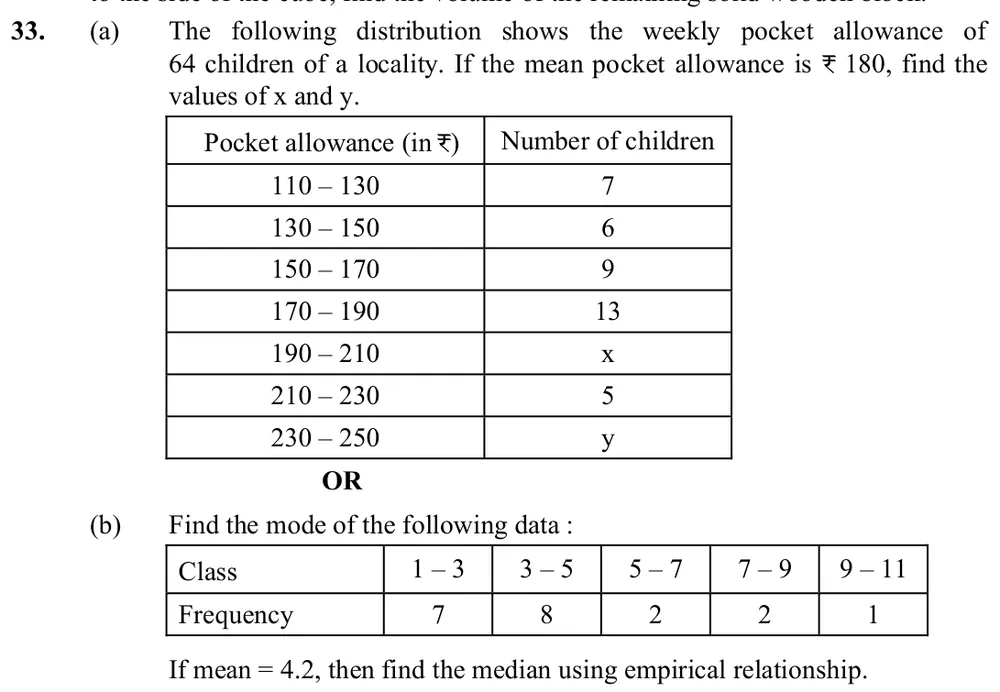
The following distribution shows the weekly pocket allowance of 64 children of a locality. If the mean pocket allowance is ₹180, find the values of x and y. Pocket allowance (in ₹): 110–130, 130–150, 150–170, 170–190, 190–210, 210–230, 230–250 Number of children: 7, 6, 9, 13, x, 5, y Write your answer, send a photo, get it marked in DheeAnswer and marking
- Find each class mark, then write Σf and Σfx with x and y in them. Class marks: 120, 140, 160, 180, 200, 220, 240 ; Σf = 40 + x + y ; Σfx = 6560 + 200x + 240y 2 marks
- There are 64 children, so set Σf equal to 64. 40 + x + y = 64 ⇒ x + y = 24 1 mark
- Set the mean formula equal to 180 and simplify. 180 = (6560 + 200x + 240y)/64 ⇒ 200x + 240y = 4960 ⇒ 5x + 6y = 124 1 mark
- Put y = 24 − x into the second equation and solve. 5x + 6(24 − x) = 124 ⇒ 144 − x = 124 ⇒ x = 20 0.5 marks
- Use x + y = 24 to find y. y = 24 − 20 = 4 0.5 marks
Answer: x = 20, y = 4
Marks: Table 2 · Two equations 2 · Values 1
For full marks: Write both equations, x + y = 24 and 5x + 6y = 124, as separate lines — each earns 1 mark.
Where students lose marks: Forgetting the 40 children already counted and writing x + y = 64 gives wrong values for both x and y.
CBSE marking scheme
Class marks 120…240; Σf = 40 + x + y, Σfx = 6560 + 200x + 240y (table 2); 40 + x + y = 64 ⇒ x + y = 24 (1); 180 = (6560 + 200x + 240y)/64 ⇒ 5x + 6y = 124 (1); x = 20, y = 4 (½+½).
- Q10 Long answer · 5 marks CBSE · 2023
Mean and mode of student weights
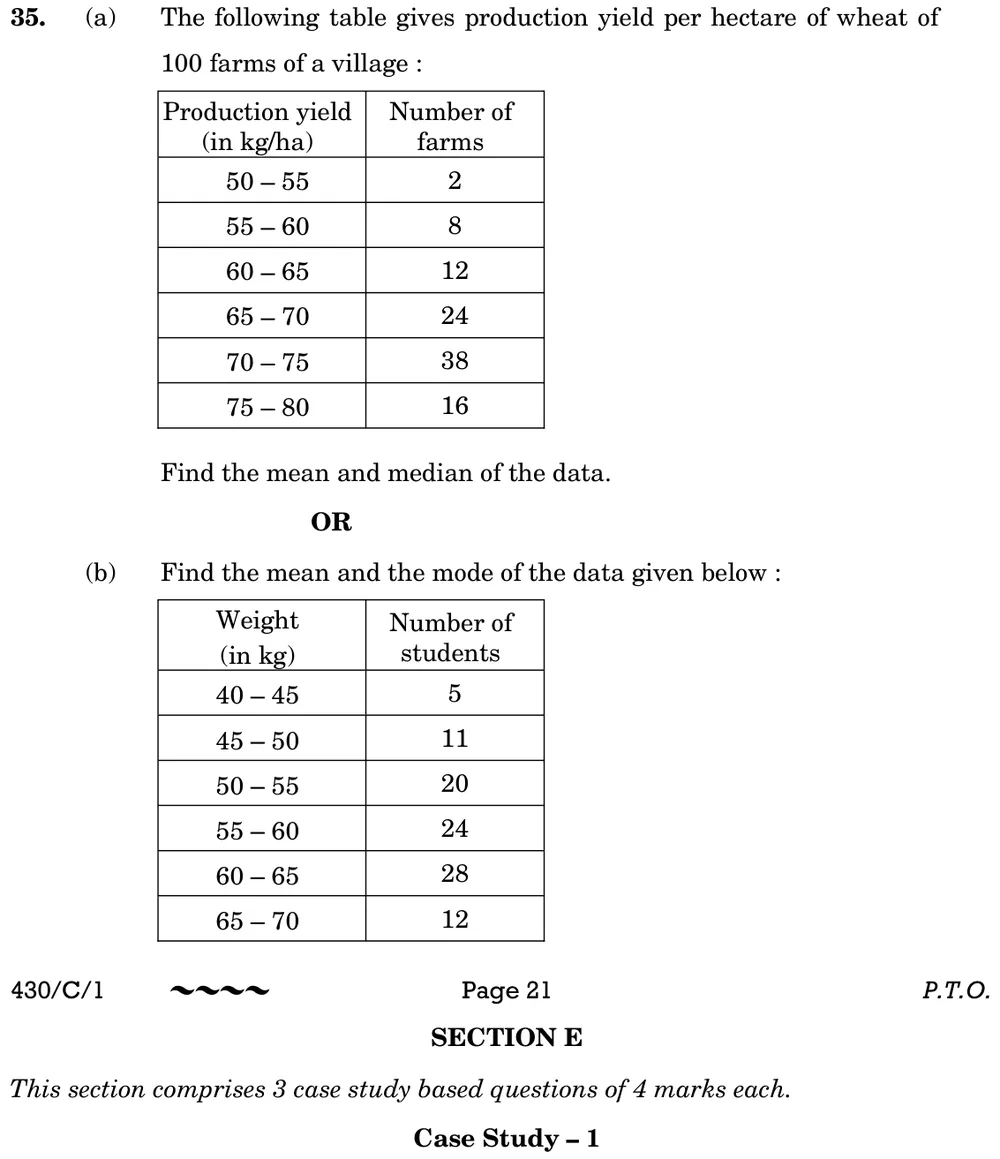
Find the mean and the mode of the data given below : Weight (in kg): 40–45, 45–50, 50–55, 55–60, 60–65, 65–70 Number of students: 5, 11, 20, 24, 28, 12 Write your answer, send a photo, get it marked in DheeAnswer and marking
- Take a = 57.5, h = 5 and make the u and fu columns. xi: 42.5, 47.5, 52.5, 57.5, 62.5, 67.5 ; ui = (xi − 57.5)/5: −3, −2, −1, 0, 1, 2 ; fiui: −15, −22, −20, 0, 28, 24 ; Σfi = 100, Σfiui = −5 1.5 marks
- Put the sums into the step-deviation mean formula. Mean = 57.5 + (−5/100) × 5 = 57.5 − 0.25 = 57.25 kg 1.5 marks
- Pick the class with the highest frequency, 28, then substitute in the mode formula. Modal class 60–65: l = 60, f1 = 28, f0 = 24, f2 = 12, h = 5 ; Mode = 60 + ((28 − 24)/(2 × 28 − 24 − 12)) × 5 1.5 marks
- Simplify the fraction and add to 60. = 60 + (4/20) × 5 = 60 + 1 = 61 kg 0.5 marks
Answer: Mean = 57.25 kg, Mode = 61 kg
Marks: Table 1½ · Mean 1½ · Mode 2
For full marks: Write 'Modal class 60–65: l = 60, f1 = 28, f0 = 24, f2 = 12' before substituting, so each value's source is clear.
Where students lose marks: Dropping the minus sign in Σfiui = −5 gives mean 57.75 kg instead of 57.25 kg.
CBSE marking scheme
Correct table with ui = (xi − 57.5)/5, Σfiui = −5 (1½); mean = 57.5 + (−5/100)×5 = 57.25 kg (1½); modal class 60–65: mode = 60 + (28 − 24)/(2×28 − 24 − 12) × 5 = 61 kg (1½ + ½).
Free 10-question test: Statistics
MCQ and Assertion–Reason questions from CBSE papers. About 10 minutes. Your score shows straight away.
Common mistakes in Statistics
Mistake Taking the wrong cf in the median formula.
Fix In Median = l + ((N/2 − cf)/f) × h, cf is the cumulative frequency of the class BEFORE the median class, and f is the frequency of the median class itself.
Mistake Calling N/2 the median.
Fix N/2 only tells you which class holds the median. Write 'N/2 = …, so the median class is …', then use the formula.
Mistake Choosing the modal class by cumulative frequency, or mixing up f₀ and f₂.
Fix The modal class has the highest frequency. f₁ is its frequency, f₀ the class before it, f₂ the class after it. Mode = l + ((f₁ − f₀)/(2f₁ − f₀ − f₂)) × h.
Mistake Writing the empirical relation the wrong way round.
Fix Learn it as 3 Median = Mode + 2 Mean. Put in the two values you know, then solve for the third.
Mistake In step deviation, forgetting to multiply by h.
Fix Use class marks for xᵢ, take a from the middle, and uᵢ = (xᵢ − a)/h. Then x̄ = a + h × (Σfᵢuᵢ/Σfᵢ). In one 5-mark question, the correct table alone carried 1½ marks.
Mistake With two missing frequencies, making only one equation.
Fix Make two equations: the frequencies add up to the given total, and the mean (or median) gives the second. Each equation carries 1 mark. Then solve both.
How to write for full marks
- Draw the full table: class, fᵢ, xᵢ, uᵢ, fᵢuᵢ for the mean, and a cf column for the median. A correct table carries 1 to 2 marks.
- Write the formula, then put in the values. The scheme does not cut marks if you put the values in correctly without writing l, cf, f, h first, but writing them helps you avoid slips.
- Name the median class or modal class in a line of its own before you use the formula.
- If classes have gaps, like 10–19, 20–29, change to true class limits (9.5–19.5, 19.5–29.5) before you take l.
- Round the final answer to two decimal places and write its unit, like kg, mm or days.
Not in the 2026-27 exam
Leave these out of your revision.
- Data with two modes (bimodal data)
- Cumulative frequency graphs, ogives (removed from the syllabus)
Questions students ask
Which Statistics questions are most important for the Class 10 board exam 2027?
Expect a 5-mark mean, median, mode or missing-frequency question, and MCQs on 3 Median = Mode + 2 Mean and on the median or modal class. The 10 questions on this page are real CBSE board questions from 2023–2026, chosen across the chapter's topics and question types.
How many marks does Statistics carry in the Class 10 board exam?
Statistics is part of the Statistics and Probability unit, which carries 6 of the 80 theory marks in the CBSE Class 10 Maths paper.
Are these real CBSE previous year questions?
Yes. Each question is printed as it appeared in a CBSE board paper or sample paper, with its source, and the answer follows CBSE's official marking scheme.
Questions and answers: CBSE board papers, sample papers and official marking schemes, 2023–2026. Worked steps and tips: Dhee.