Chapter 1 · CBSE Board 2027
Real Numbers Class 10 important questions with answers
The 10 questions to practise first, picked from every CBSE board paper 2023–2026. Each one has the official answer and how to write it for full marks. Then try the free 10-question test.
What comes in the exam
- Real Numbers is in the Number Systems unit, worth 6 marks.
- MCQs (1 mark) come most, then 3-mark and 2-mark questions, and some Assertion–Reason.
- Almost every year there is a 3-mark proof that √2, √3 or √5 is irrational, and a 2- or 3-mark proof that a number like 2 + 3√5 is irrational.
- HCF and LCM come almost every year too: MCQs from prime factors, and 2- or 3-mark word problems about squares, strips or planks.
- A 4-mark case study is rare.
Top 10 Real Numbers questions from board papers
Real CBSE questions, printed as they appeared. Open each answer to see the marking and the steps.
- Q1 MCQ · 1 mark CBSE · 2026, 2023 Asked in 2026, 2023
LCM of x³y² and xy³
If two positive integers a and b are written as a = x3 y2 and b = x y3, where x and y are prime numbers, then LCM(a, b) is :
- (A) xy
- (B) xy2
- (C) x3 y3
- (D) x2 y2
Write your answer, send a photo, get it marked in DheeAnswer and marking
Correct option: (C) x3 y3
- For the LCM, take each prime with its greatest power. x: greatest power x³ ; y: greatest power y³
- Multiply these powers and match the option. LCM(a, b) = x³y³ ⇒ option (C) 1 mark
Answer: (C) x³y³
Marks: Correct option 1
For full marks: For the LCM take the greatest power of each prime; the smallest powers give the HCF instead.
Where students lose marks: Choosing (B) xy²: that uses the smallest powers, which gives the HCF, not the LCM.
CBSE marking scheme
LCM takes the greatest power of each prime: x3 y3.
- Q2 MCQ · 1 mark CBSE · 2026, 2024 Asked in 2026, 2024
Find k: HCF, LCM of 2520, 6600
If HCF(2520, 6600) = 40 and LCM(2520, 6600) = 252 × k, then the value of k is
- (A) 165
- (B) 1600
- (C) 1625
- (D) 1650
Write your answer, send a photo, get it marked in DheeAnswer and marking
Correct option: (D) 1650
- Use the rule: HCF × LCM = product of the two numbers. 40 × 252 × k = 2520 × 6600
- Cancel 2520 ÷ 252 = 10, then divide by 40. k = 10 × 6600 / 40 = 1650 ⇒ option (D) 1 mark
Answer: (D) 1650
Marks: Correct option 1
For full marks: Write HCF × LCM = 2520 × 6600 first, then cancel before you multiply.
Where students lose marks: Picking (A) 165: a zero gets lost when 2520 ÷ 252 = 10 is cancelled.
CBSE marking scheme
HCF × LCM = product: 40 × 252 × k = 2520 × 6600 ⇒ k = 1650.
- Q3 MCQ · 1 mark CBSE · 2025, 2024 Asked in 2025, 2024
Find x from LCM of a, b, c
If a = 22 × 3x, b = 22 × 3 × 5, c = 22 × 3 × 7 and LCM(a, b, c) = 3780, then x is equal to
- (A) 1
- (B) 2
- (C) 3
- (D) 0
Write your answer, send a photo, get it marked in DheeAnswer and marking
Correct option: (C) 3
- Write the LCM using the greatest power of each prime. LCM = 2² × 3ˣ × 5 × 7 = 140 × 3ˣ
- Set it equal to 3780 and solve for x. 140 × 3ˣ = 3780 ⇒ 3ˣ = 27 = 3³ ⇒ x = 3 ⇒ option (C) 1 mark
Answer: (C) 3
Marks: Correct option 1
For full marks: Write the LCM as 140 × 3ˣ, then equate it to 3780.
Where students lose marks: Picking (A) 1: using the power of 3 in b and c, but the LCM takes the greatest power, 3ˣ.
CBSE marking scheme
LCM = 22 × 3x × 5 × 7 = 140 × 3x = 3780, so 3x = 27 = 33, x = 3.
- Q4 Very short answer · 2 marks CBSE · 2024, 2023 Asked in 2024, 2023
Prove −7 − 2√3 irrational
Prove that −7 − 2√3 is an irrational number, given that √3 is an irrational number.
Write your answer, send a photo, get it marked in DheeAnswer and marking
- Suppose the number is rational, call it x, and make √3 the subject. Let x = −7 − 2√3 be rational ⇒ 2√3 = −7 − x ⇒ √3 = (−7 − x)/2 0.5 marks
- Compare the two sides: one is rational, the other is not. (−7 − x)/2 is rational, but √3 is irrational 1 mark
- They cannot be equal, so the assumption was wrong. Contradiction ⇒ −7 − 2√3 is irrational 0.5 marks
Answer: −7 − 2√3 is irrational.
Marks: Assumption ½ · Rational vs irrational 1 · Conclusion ½
For full marks: Say clearly that (−7 − x)/2 is rational because x is rational; that line carries the 1 mark.
Where students lose marks: Sign slip while isolating √3, for example writing (7 − x)/2 instead of (−7 − x)/2.
CBSE marking scheme
Assume x = −7 − 2√3 is rational; then √3 = (−7 − x)/2 (½). RHS is rational but LHS is irrational (1), a contradiction, so −7 − 2√3 is irrational (½).
- Q5 Short answer · 3 marks CBSE · 2026, 2025, 2024, 2023 Asked in 2026, 2025, 2024, 2023
Prove √5 irrational
Prove that √5 is an irrational number.
Write your answer, send a photo, get it marked in DheeAnswer and marking
- Suppose √5 is rational, so write it as a fraction in lowest terms. Let √5 = p/q, where p, q are coprime integers and q ≠ 0 0.5 marks
- Square both sides and see what it tells you about p. 5q² = p² ⇒ 5 divides p² ⇒ 5 divides p 1 mark
- Put p = 5m back in and see what it tells you about q. p = 5m ⇒ 5q² = 25m² ⇒ q² = 5m² ⇒ 5 divides q 1 mark
- Now 5 divides both p and q, which breaks your starting assumption. This contradicts that p and q are coprime ; so √5 is irrational 0.5 marks
Answer: √5 is irrational.
Marks: Assumption ½ · Two deductions 2 · Conclusion ½
For full marks: Write 'which contradicts that p and q are coprime' — the last ½ is for saying it.
Where students lose marks: Skipping the step '5 divides p² ⇒ 5 divides p', or not saying p, q are coprime at the start, loses marks.
CBSE marking scheme
Assume √5 = p/q, p, q co-prime, q ≠ 0 (½); 5q2 = p2 ⇒ 5 | p2 ⇒ 5 | p (1); p = 5m ⇒ q2 = 5m2 ⇒ 5 | q (1); contradiction with co-prime, so √5 is irrational (½).
- Q6 Short answer · 3 marks CBSE · 2026, 2025, 2024, 2023 Asked in 2026, 2025, 2024, 2023
Prove √3 irrational
Prove that √3 is an irrational number.
Write your answer, send a photo, get it marked in DheeAnswer and marking
- Suppose √3 is rational, so write it as a fraction in lowest terms. Let √3 = p/q, where p, q are coprime integers and q ≠ 0 0.5 marks
- Square both sides and see what it tells you about p. 3q² = p² ⇒ 3 divides p² ⇒ 3 divides p 1 mark
- Put p = 3a back in and see what it tells you about q. p = 3a ⇒ 3q² = 9a² ⇒ q² = 3a² ⇒ 3 divides q 1 mark
- Now 3 divides both p and q, which breaks your starting assumption. This contradicts that p and q are coprime ; so √3 is irrational 0.5 marks
Answer: √3 is irrational.
Marks: Assumption ½ · Two deductions 2 · Conclusion ½
For full marks: Write 'which contradicts that p and q are coprime' — the last ½ is for saying it.
Where students lose marks: Skipping the step '3 divides p² ⇒ 3 divides p', or not saying p, q are coprime at the start, loses marks.
CBSE marking scheme
Assume √3 = p/q, q ≠ 0, p, q coprime (½); 3q2 = p2 ⇒ 3 | p2 ⇒ 3 | p (1); p = 3a ⇒ q2 = 3a2 ⇒ 3 | q (1); contradiction with coprime, so √3 is irrational (½).
- Q7 Short answer · 3 marks CBSE · 2026, 2025, 2023 Asked in 2026, 2025, 2023
Prove √2 irrational
Prove that √2 is an irrational number.
Write your answer, send a photo, get it marked in DheeAnswer and marking
- Suppose √2 is rational, so write it as a fraction in lowest terms. Let √2 = a/b, where a, b are coprime integers and b ≠ 0 0.5 marks
- Square both sides and see what it tells you about a. 2b² = a² ⇒ 2 divides a² ⇒ 2 divides a ; so a = 2p 1 mark
- Put a = 2p back in and see what it tells you about b. 2b² = 4p² ⇒ b² = 2p² ⇒ 2 divides b 1 mark
- Now 2 is a common factor of a and b, which breaks your assumption. This contradicts that a and b are coprime ; so √2 is irrational 0.5 marks
Answer: √2 is irrational.
Marks: Assumption ½ · Two deductions 2 · Conclusion ½
For full marks: Write '2 is a common factor of a and b, which contradicts that they are coprime' — the last ½ is for it.
Where students lose marks: Forgetting to write a = 2p before finding b² = 2p², so the second deduction has no working.
CBSE marking scheme
Assume √2 = a/b, a, b coprime, b ≠ 0 (½). 2b2 = a2 ⇒ 2 | a2 ⇒ 2 | a; a = 2p (1). Then b2 = 2p2 ⇒ 2 | b (1). 2 is a common factor of a, b — contradiction; so √2 is irrational (½).
- Q8 Short answer · 3 marks CBSE · 2024, 2023 Asked in 2024, 2023
Prove 3 − 2√5 irrational
Prove that 3 − 2√5 is an irrational number, given that √5 is an irrational number.
Write your answer, send a photo, get it marked in DheeAnswer and marking
- Assume the opposite: suppose it is rational and call it x. Let 3 − 2√5 = x, where x is rational 1 mark
- Rearrange to get √5 alone. √5 = (3 − x)/2, which is rational 1 mark
- That contradicts √5 being irrational; state the conclusion. Contradiction, as √5 is irrational ; so 3 − 2√5 is irrational 1 mark
Answer: 3 − 2√5 is irrational
Marks: Assumption 1 · √5 = … 1 · Contradiction and conclusion 1
For full marks: End with 'this contradicts that √5 is irrational', then conclude.
Where students lose marks: Sign slip: writing √5 = (x − 3)/2 instead of (3 − x)/2.
CBSE marking scheme
Assume 3 − 2√5 = x rational (1); then √5 = (3 − x)/2 is rational (1); contradicts √5 irrational, so 3 − 2√5 is irrational (1).
- Q9 Case study · 4 marks CBSE · 2025
Case: factor tree quiz
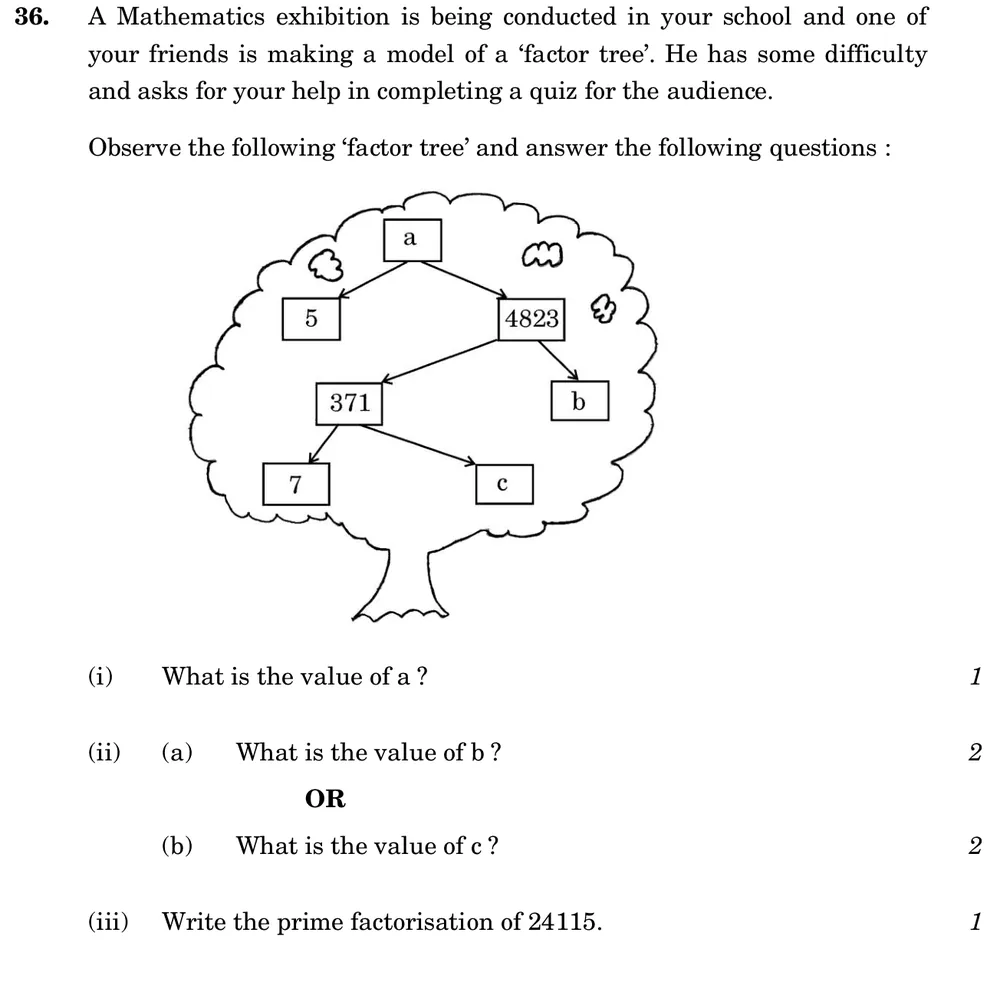
A Mathematics exhibition is being conducted in your school and one of your friends is making a model of a 'factor tree'. He has some difficulty and asks for your help in completing a quiz for the audience. Observe the following 'factor tree' and answer the following questions: (i) What is the value of a? (1) (ii) (a) What is the value of b? (2) OR (b) What is the value of c? (2) (iii) Write the prime factorisation of 24115. (1) Write your answer, send a photo, get it marked in DheeAnswer and marking
- (i) The top box is the product of the two numbers below it. a = 5 × 4823 = 24115 1 mark
- (ii)(a) 4823 splits into 371 and b, so divide. 4823 = 371 × b ⇒ b = 4823 ÷ 371 = 13 2 marks
- (ii)(b) 371 splits into 7 and c, so divide. 371 = 7 × c ⇒ c = 371 ÷ 7 = 53 2 marks
- (iii) Write 24115 as the product of all the primes at the ends. 24115 = 5 × 7 × 13 × 53 1 mark
Answer: (i) 24115 (ii) (a) b = 13 / (b) c = 53 (iii) 5 × 7 × 13 × 53
Marks: (i) 1 · (ii) 2 · (iii) 1
For full marks: In (iii) list only primes: 5 × 7 × 13 × 53, not 371 or 4823.
Where students lose marks: In (iii) writing 5 × 4823 or 5 × 371 × 13; those are not all prime factors.
CBSE marking scheme
(i) a = 5 × 4823 = 24115 (1). (ii)(a) 4823 = 371 × b ⇒ b = 13 (2). OR (b) 371 = 7 × c ⇒ c = 53 (2). (iii) 24115 = 5 × 7 × 13 × 53 (1).
- Q10 Case study · 4 marks CBSE · 2024
Case: prime number game
Teaching Mathematics through activities is a powerful approach that enhances students' understanding and engagement. Keeping this in mind, Ms. Mukta planned a prime number game for class 5 students. She announces the number 2 in her class and asked the first student to multiply it by a prime number and then pass it to second student. Second student also multiplied it by a prime number and passed it to third student. In this way by multiplying to a prime number, the last student got 173250. Now, Mukta asked some questions as given below to the students: (i) What is the least prime number used by students? (1) (ii) (a) How many students are in the class? (2) OR (ii) (b) What is the highest prime number used by students? (2) (iii) Which prime number has been used maximum times? (1)
Write your answer, send a photo, get it marked in DheeAnswer and marking
- (i) Factorise 173250; the first 2 came from the teacher. 173250 = 2 × 5³ × 3² × 7 × 11 ; least prime used by students = 3 1 mark
- (ii)(a) List the primes the students multiplied by. Students used 5, 5, 5, 3, 3, 7, 11 1 mark
- Each student used one prime, so count them. 3 + 2 + 1 + 1 = 7 students 1 mark
- (ii)(b) Pick the biggest prime in the factorisation. Highest prime = 11 2 marks
- (iii) See which prime has the highest power. 5 is used the most (5³) 1 mark
Answer: (i) 3 (ii) (a) 7 students / (b) 11 (iii) 5
Marks: (i) 1 · (ii) 2 · (iii) 1
For full marks: In (i) say the 2 was the teacher's number; that is why the answer is 3, not 2.
Where students lose marks: Answering 2 in (i), or counting 8 students by including the teacher's 2.
CBSE marking scheme
173250 = 2 × 53 × 32 × 7 × 11; the 2 was announced by the teacher. (i) 3 (1). (ii)(a) students used 5,5,5,3,3,7,11: 3 + 2 + 1 + 1 = 7 students (1+1). OR (ii)(b) 11 (1+1). (iii) 5 (1).
Free 10-question test: Real Numbers
MCQ and Assertion–Reason questions from CBSE papers. About 10 minutes. Your score shows straight away.
Common mistakes in Real Numbers
Mistake Starting the √5 (or √3, √2) proof with only '√5 = p/q'.
Fix Write the full assumption: '√5 = p/q, where p and q are co-prime integers and q ≠ 0'. This line alone carries ½ mark.
Mistake Stopping after showing that the prime divides p.
Fix Do both halves. Square both sides and show the prime divides p (1 mark). Then put p = prime × m and show it divides q too (1 mark). End with: 'p and q have a common factor, so they are not co-prime — a contradiction' (½ mark).
Mistake For a number like 2 + 3√5, starting from scratch, or slipping while moving terms.
Fix Use the given fact. Assume the number is rational, get √5 alone on one side, and write: 'the right side is rational but √5 is irrational — a contradiction.' This line carries 1 mark. Check signs and the divisor as you move terms.
Mistake Using HCF when the question needs LCM, or the other way round.
Fix Greatest, longest, maximum size, as wide as possible → HCF. Smallest number divisible by both → LCM. Then read again: words like 'increased by 17' or 'leaving remainder' change the numbers before or after you find it.
Mistake Answering only the first part of a word problem.
Fix Many also ask how many squares or pieces you get. That part carries 1 mark, so finish it and write the unit with every length.
Mistake In Assertion–Reason, picking 'R explains A' just because both are true.
Fix First check A and R on their own. A rule that says 'always' can fail — test one pair. A number ends in 0 only if its prime factors include both 2 and 5. Then ask: does R give the reason for A?
How to write for full marks
- Write each number as a product of primes, with powers, like 360 = 2³ × 3² × 5. Each factorisation earns ½ mark, and every factor must be prime.
- Say what you are finding before you work it out: 'side of the square = HCF' or 'required number = LCM'.
- Change lengths to one unit first (2 m 5 cm = 205 cm), and write the unit in the final answer.
- Set out an irrational proof in the four steps the scheme marks: assumption (½), first 'divides' step (1), second 'divides' step (1), contradiction and conclusion (½).
- For HCF × LCM questions, write the rule first: HCF × LCM = product of the two numbers. It holds for two numbers only.
Not in the 2026-27 exam
Leave these out of your revision.
- Proof of the Fundamental Theorem of Arithmetic (only the statement is asked)
- Euclid's division lemma (removed from the syllabus)
Questions students ask
Which Real Numbers questions are most important for the Class 10 board exam 2027?
Expect MCQs on HCF, LCM and primes, a 3-mark proof that √2, √3 or √5 is irrational, and 2- or 3-mark HCF/LCM word problems. The 10 questions on this page are real CBSE board questions from 2023–2026, chosen across the chapter's topics and question types.
How many marks does Real Numbers carry in the Class 10 board exam?
Real Numbers is part of the Number Systems unit, which carries 6 of the 80 theory marks in the CBSE Class 10 Maths paper.
Are these real CBSE previous year questions?
Yes. Each question is printed as it appeared in a CBSE board paper or sample paper, with its source, and the answer follows CBSE's official marking scheme.
Questions and answers: CBSE board papers, sample papers and official marking schemes, 2023–2026. Worked steps and tips: Dhee.