Chapter 2 · CBSE Board 2027
Polynomials Class 10 important questions with answers
The 10 questions to practise first, picked from every CBSE board paper 2023–2026. Each one has the official answer and how to write it for full marks. Then try the free 10-question test.
What comes in the exam
- Polynomials is in the Algebra unit, which is worth 20 marks in all.
- About half the questions are 1-mark MCQs, then 3-mark and 2-mark questions, with a few Assertion–Reason.
- Almost every year there are questions on the zeroes of a quadratic, often a 3-mark 'find the zeroes and verify the relationship with the coefficients'.
- Also almost every year: a 2- or 3-mark question to form a quadratic from given zeroes, or from zeroes like 1/α and 1/β, and MCQs that use the sum and product of zeroes to find k, or count zeroes from a graph.
- A 4-mark case study on a parabola shape comes sometimes.
Top 10 Polynomials questions from board papers
Real CBSE questions, printed as they appeared. Open each answer to see the marking and the steps.
- Q1 MCQ · 1 mark CBSE · 2025, 2024 Asked in 2025, 2024
Find k when α + β = αβ
If α and β are zeroes of the polynomial p(x) = kx2 − 30x + 45k and α + β = αβ, then the value of 'k' is :
- (A) −2/3
- (B) −3/2
- (C) 3/2
- (D) 2/3
Write your answer, send a photo, get it marked in DheeAnswer and marking
Correct option: (D) 2/3
- Write the sum and product of zeroes from the coefficients. α + β = 30/k ; αβ = 45k/k = 45
- Set them equal and solve for k. 30/k = 45 ⇒ k = 30/45 = 2/3 ⇒ option (D) 1 mark
Answer: (D) 2/3
Marks: Correct option 1
For full marks: Write α + β = −b/a and αβ = c/a with the signs before you equate.
Where students lose marks: Picking (C) 3/2 by turning 30/k = 45 upside down as k = 45/30.
CBSE marking scheme
α + β = 30/k, αβ = 45k/k = 45 ⇒ 30/k = 45 ⇒ k = 2/3.
- Q2 MCQ · 1 mark CBSE · 2024, 2023 Asked in 2024, 2023
Zeroes of 3x² + 11x − 4
The zeroes of the polynomial 3x2 + 11x − 4 are:
- (A) 1/3, 4
- (B) −1/3, −4
- (C) 1/3, −4
- (D) −1/3, 4
Write your answer, send a photo, get it marked in DheeAnswer and marking
Correct option: (C) 1/3, −4
- Split the middle term: numbers with product −12 and sum 11 are 12 and −1. 3x² + 12x − x − 4 = (3x − 1)(x + 4)
- Set each factor to zero. x = 1/3, x = −4 ⇒ option (C) 1 mark
Answer: (C) 1/3, −4
Marks: Correct option 1
For full marks: Write the factors, then solve 3x − 1 = 0 and x + 4 = 0.
Where students lose marks: Choosing (D) −1/3, 4 by copying signs from the factors.
CBSE marking scheme
3x2 + 11x − 4 = (3x − 1)(x + 4) ⇒ zeroes 1/3, −4.
- Q3 Very short answer · 2 marks CBSE · 2026
Polynomial from 1/(3α), 1/(3β)
If α and β are two zeroes of the polynomial 25p2 − 15p + 2, find a quadratic polynomial whose zeroes are 1/(3α) and 1/(3β).
Write your answer, send a photo, get it marked in DheeAnswer and marking
- Find the sum and product of α and β from the polynomial. α + β = 15/25 ; αβ = 2/25 0.5 marks
- Add the new zeroes over a common denominator. Sum = 1/(3α) + 1/(3β) = (1/3)(α + β)/αβ = 5/2 0.5 marks
- Multiply the new zeroes. Product = 1/(3α) × 1/(3β) = 1/(9αβ) = 25/18 0.5 marks
- Use x² − (sum)x + (product), then clear fractions. x² − (5/2)x + 25/18, or 18x² − 45x + 25 0.5 marks
Answer: 18x² − 45x + 25 (or x² − (5/2)x + 25/18)
Marks: Old sum, product ½ · New sum ½ · New product ½ · Polynomial ½
For full marks: Write the new sum as (α + β)/(3αβ) before substituting.
Where students lose marks: Taking the new product as 1/(3αβ) instead of 1/(9αβ).
CBSE marking scheme
α + β = 15/25, αβ = 2/25 (½); S = (1/3)(α + β)/αβ = 5/2 (½); P = 1/(9αβ) = 25/18 (½); polynomial x2 − (5/2)x + 25/18 or 18x2 − 45x + 25 (½).
- Q4 Short answer · 3 marks CBSE · 2025
Zeroes of 6x² − 7x − 3; verify
Find zeroes of the polynomial 6x2 − 7x − 3 and verify the relationship between zeroes and its coefficients.
Write your answer, send a photo, get it marked in DheeAnswer and marking
- Split −7x as −9x + 2x (product −18), factorise, then set each factor to 0. 6x² − 7x − 3 = (2x − 3)(3x + 1) ; zeroes 3/2 and −1/3 1 mark
- Add the zeroes and compare with −(coefficient of x) ÷ (coefficient of x²). 3/2 + (−1/3) = 7/6 = −(−7)/6 = −(coefficient of x)/(coefficient of x²) 1 mark
- Multiply the zeroes and compare with constant ÷ coefficient of x². 3/2 × (−1/3) = −1/2 = −3/6 = constant/(coefficient of x²) 1 mark
Answer: Zeroes 3/2 and −1/3; sum 7/6 and product −1/2 verified.
Marks: Factorisation and zeroes 1 · Sum check 1 · Product check 1
For full marks: In each check write the formula side too, like −(−7)/6 — the mark is for matching it with the coefficients.
Where students lose marks: Getting the signs of the zeroes wrong, such as −3/2 and 1/3, which spoils both checks.
CBSE marking scheme
6x2 − 7x − 3 = (2x − 3)(3x + 1); zeroes 3/2, −1/3 (1). Sum = 7/6 = −(coeff of x)/(coeff of x2 (1). Product = −3/6 = constant/(coeff of x2 (1).
- Q5 Short answer · 3 marks CBSE · 2024
Zeroes of x² − 15, verify
Find the zeroes of the quadratic polynomial x2 − 15 and verify the relationship between the zeroes and the coefficients of the polynomial.
Write your answer, send a photo, get it marked in DheeAnswer and marking
- x² − 15 is a difference of squares, since 15 = (√15)². x² − 15 = (x − √15)(x + √15) 1 mark
- Put each factor equal to 0. Zeroes are √15 and −√15 1 mark
- Check the sum: there is no x term, so its coefficient is 0. Sum = √15 + (−√15) = 0 = −(coefficient of x)/(coefficient of x²) = −0/1 0.5 marks
- Check the product against constant ÷ coefficient of x². Product = √15 × (−√15) = −15 = constant/(coefficient of x²) = −15/1 0.5 marks
Answer: Zeroes √15 and −√15; sum 0 = −b/a, product −15 = c/a verified.
Marks: Factorisation 1 · Zeroes 1 · Sum ½ · Product ½
For full marks: Write both sides of each check: '0 = −0/1' and '−15 = −15/1' — the ½ is for matching with the coefficients.
Where students lose marks: Writing only x = √15 and missing the negative zero −√15.
CBSE marking scheme
x2 − 15 = (x − √15)(x + √15) (1); zeroes √15, −√15 (1); sum = 0 = −(coeff of x)/(coeff of x2 (½); product = −15 = constant/(coeff of x2 (½).
- Q6 Short answer · 3 marks CBSE · 2024
Find α/β + β/α for x² + x − 2
If α and β are the zeroes of the polynomial x2 + x − 2, then find the value of α/β + β/α.
Write your answer, send a photo, get it marked in DheeAnswer and marking
- Read the sum and product of the zeroes from the coefficients. α + β = −1 ; αβ = −2 1 mark
- Take a common denominator, then write α² + β² using (α + β)². α/β + β/α = (α² + β²)/αβ = [(α + β)² − 2αβ]/αβ 1 mark
- Substitute the values and simplify. = [(−1)² − 2(−2)]/(−2) = (1 + 4)/(−2) = −5/2 1 mark
Answer: α/β + β/α = −5/2
Marks: Sum and product 1 · Identity 1 · Value 1
For full marks: Show (α² + β²) = (α + β)² − 2αβ in the working — the middle mark is for this identity.
Where students lose marks: Writing −2αβ as −4 instead of +4, because αβ = −2 makes −2αβ = +4.
CBSE marking scheme
α + β = −1, αβ = −2 (1); α/β + β/α = (α2 + β2/αβ = [(α + β)2 − 2αβ]/αβ (1) = (1 + 4)/(−2) = −5/2 (1).
- Q7 Short answer · 3 marks CBSE · 2023
Polynomial with zeroes α+1, β+1
If α, β are zeroes of the quadratic polynomial x2 + 3x + 2, find a quadratic polynomial whose zeroes are α + 1, β + 1.
Write your answer, send a photo, get it marked in DheeAnswer and marking
- Read the sum and product of α, β from the coefficients. α + β = −3/1 = −3 ; αβ = 2/1 = 2 1 mark
- Add the new zeroes and use α + β. (α + 1) + (β + 1) = α + β + 2 = −3 + 2 = −1 0.5 marks
- Multiply the new zeroes out, then substitute. (α + 1)(β + 1) = αβ + (α + β) + 1 = 2 − 3 + 1 = 0 1 mark
- Use x² − (sum)x + product to build the polynomial. x² − (−1)x + 0 = x² + x ; or k(x² + x), k ≠ 0 0.5 marks
Answer: x² + x (or k(x² + x), k ≠ 0)
Marks: Sum and product 1 · New sum ½ · New product 1 · Polynomial ½
For full marks: Show the expansion αβ + (α + β) + 1 for the new product — that line carries a full mark.
Where students lose marks: Writing the polynomial as x² − x by forgetting that the new sum is −1.
CBSE marking scheme
α + β = –3, αβ = 2 (½ + ½); new sum = α + β + 2 = –1 (½); new product = αβ + (α + β) + 1 = 0 (1); polynomial k(x2 + x), e.g. x2 + x (½).
- Q8 Case study · 4 marks CBSE · 2026
Case: parabolic railway arch
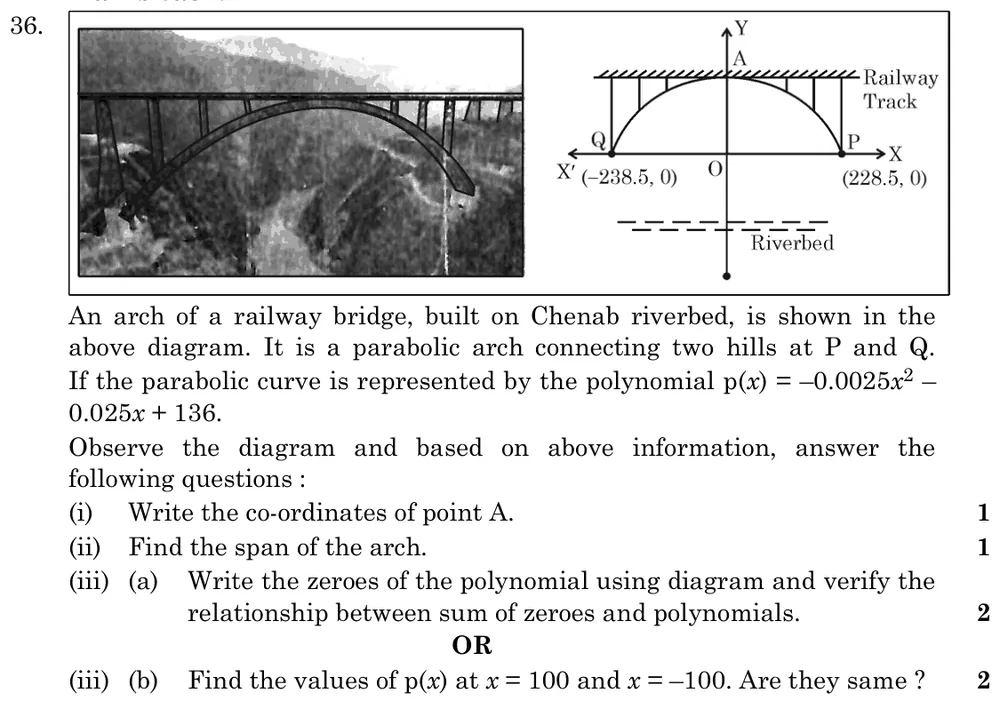
An arch of a railway bridge, built on Chenab riverbed, is shown in the diagram. It is a parabolic arch connecting two hills at P and Q. The parabolic curve is represented by the polynomial p(x) = −0.0025x^2 − 0.025x + 136. (i) Write the co-ordinates of point A. [1] (ii) Find the span of the arch. [1] (iii) (a) Write the zeroes of the polynomial using diagram and verify the relationship between sum of zeroes and coefficients of the polynomial. [2] OR (iii) (b) Find the values of p(x) at x = 100 and x = −100. Are they same? [2] Write your answer, send a photo, get it marked in DheeAnswer and marking
- (i) A lies on the y-axis, so put x = 0 in p(x). p(0) = 136 ⇒ A(0, 136) 1 mark
- (ii) The span is the distance between Q and P on the x-axis. Span = 238.5 + 228.5 = 467 units 1 mark
- (iii)(a) The zeroes are where the arch meets the x-axis, at P and Q. Zeroes are 228.5 and −238.5 1 mark
- Add them and compare with −(coefficient of x) ÷ (coefficient of x²). Sum = 228.5 + (−238.5) = −10 = −(−0.025)/(−0.0025) = −(coefficient of x)/(coefficient of x²) 1 mark
- (iii)(b) Put x = 100 in p(x). p(100) = −0.0025(100)² − 0.025(100) + 136 = −25 − 2.5 + 136 = 108.5 1 mark
- Now put x = −100; watch the sign of the x term. p(−100) = −25 + 2.5 + 136 = 113.5 0.5 marks
- Compare the two values. 108.5 ≠ 113.5, so they are not the same 0.5 marks
Answer: (i) A(0, 136) (ii) 467 units (iii) (a) zeroes 228.5, −238.5; sum −10 = −b/a / (b) 108.5 and 113.5; not the same
Marks: (i) 1 · (ii) 1 · (iii) 2
For full marks: In (iii)(b) end with 'not the same' — answering the question asked carries the last ½.
Where students lose marks: In (ii), subtracting 238.5 − 228.5 = 10 instead of adding the two distances from O.
CBSE marking scheme
(i) At x = 0, p = 136: A(0, 136) (1). (ii) Span = 238.5 + 228.5 = 467 units (1). (iii)(a) Zeroes 228.5 and −238.5 (1); sum = −10 = −(−0.025)/(−0.0025) = −(coeff of x)/(coeff of x2 (1). OR (iii)(b) p(100) = 108.5 (1), p(−100) = 113.5 (½); not the same (½).
- Q9 Case study · 4 marks CBSE · 2024
Case: ball thrown in the air
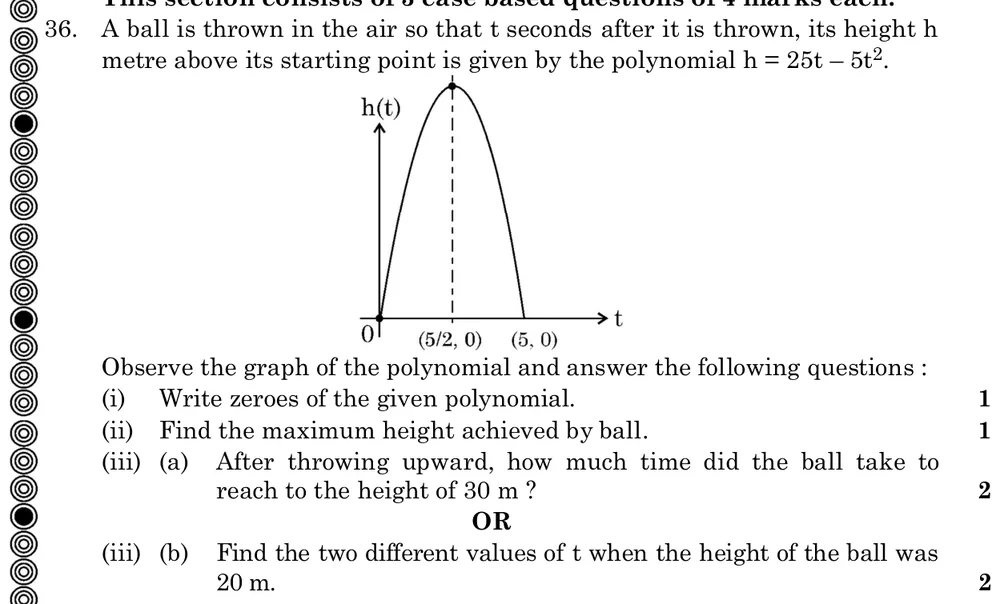
A ball is thrown in the air so that t seconds after it is thrown, its height h metre above its starting point is given by the polynomial h = 25t – 5t^2. Observe the graph of the polynomial and answer the following questions : (i) Write zeroes of the given polynomial. (1) (ii) Find the maximum height achieved by ball. (1) (iii) (a) After throwing upward, how much time did the ball take to reach to the height of 30 m ? (2) OR (iii) (b) Find the two different values of t when the height of the ball was 20 m. (2) Write your answer, send a photo, get it marked in DheeAnswer and marking
- (i) Zeroes are where the graph meets the t-axis. Zeroes are 0 and 5 1 mark
- (ii) The highest point is above t = 5/2; put that value into h. h = 25 × 5/2 − 5 × (5/2)² = 125/2 − 125/4 = 125/4 = 31.25 m 1 mark
- (iii)(a) Put the height equal to 30. −5t² + 25t = 30 0.5 marks
- Bring all terms to one side and divide by −5. t² − 5t + 6 = 0 0.5 marks
- Factorise the quadratic. (t − 2)(t − 3) = 0 0.5 marks
- The ball reaches 30 m first on the way up, at the smaller time. t = 2 s (t ≠ 3) 0.5 marks
- (iii)(b) Put the height equal to 20. −5t² + 25t = 20 0.5 marks
- Bring all terms to one side and divide by −5. t² − 5t + 4 = 0 0.5 marks
- Factorise the quadratic. (t − 4)(t − 1) = 0 0.5 marks
- Both times are answers: once going up, once coming down. t = 1 s and t = 4 s 0.5 marks
Answer: (i) 0 and 5 (ii) 31.25 m (iii) (a) 2 s / (b) 1 s and 4 s
Marks: (i) 1 · (ii) 1 · (iii) 2
For full marks: In (iii)(a) say why you pick t = 2 — the ball first reaches 30 m on the way up.
Where students lose marks: In (ii), writing 5 × (5/2)² as 5 × 5/2 and getting the wrong maximum height.
CBSE marking scheme
(i) Zeroes 0 and 5 (1). (ii) At t = 5/2: h = 25 × 5/2 – 5 × (5/2)2 = 125/4 = 31.25 m (½+½). (iii)(a) –5t2 + 25t = 30 ⇒ t2 – 5t + 6 = 0 ⇒ (t – 2)(t – 3) = 0 (½+½+½); first reaches 30 m at t = 2 s (t ≠ 3) (½). OR (iii)(b) –5t2 + 25t = 20 ⇒ t2 – 5t + 4 = 0 ⇒ (t – 4)(t – 1) = 0 ⇒ t = 1 s and 4 s (½ × 4).
- Q10 Case study · 4 marks CBSE · 2023
Case: rainbow as a parabola
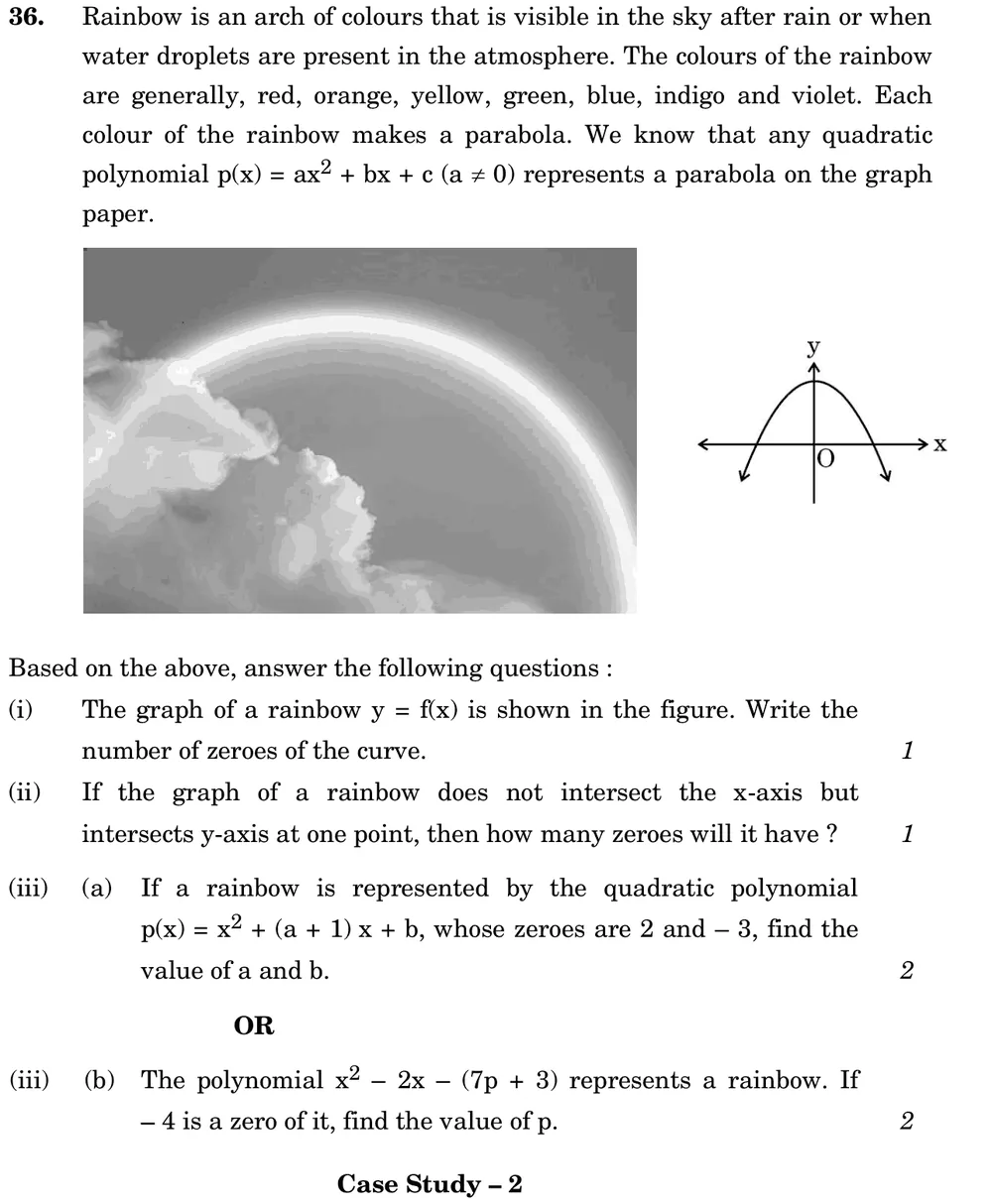
Rainbow is an arch of colours that is visible in the sky after rain or when water droplets are present in the atmosphere. The colours of the rainbow are generally red, orange, yellow, green, blue, indigo and violet. Each colour of the rainbow makes a parabola. We know that any quadratic polynomial p(x) = ax^2 + bx + c (a ≠ 0) represents a parabola on the graph paper. (i) The graph of a rainbow y = f(x) is shown in the figure. Write the number of zeroes of the curve. (1) (ii) If the graph of a rainbow does not intersect the x-axis but intersects y-axis at one point, then how many zeroes will it have? (1) (iii) (a) If a rainbow is represented by the quadratic polynomial p(x) = x^2 + (a + 1)x + b, whose zeroes are 2 and −3, find the value of a and b. (2) OR (iii) (b) The polynomial x^2 − 2x − (7p + 3) represents a rainbow. If −4 is a zero of it, find the value of p. (2) Write your answer, send a photo, get it marked in DheeAnswer and marking
- (i) Count the points where the rainbow curve cuts the x-axis. The curve cuts the x-axis at 2 points ⇒ two zeroes 1 mark
- (ii) Zeroes are only where the graph meets the x-axis. No point on the x-axis ⇒ 0 zeroes 1 mark
- (iii)(a) Put x = 2 and x = −3 in p(x); each must give 0. 4 + 2(a + 1) + b = 0 ⇒ 2a + b = −6 ; 9 − 3(a + 1) + b = 0 ⇒ −3a + b = −6 1 mark
- Subtract the two equations to find a, then find b. 5a = 0 ⇒ a = 0 ; b = −6 1 mark
- (iii)(b) A zero makes the polynomial 0, so put x = −4. p(−4) = 16 + 8 − 7p − 3 = 0 ⇒ 21 − 7p = 0 1 mark
- Solve for p. 7p = 21 ⇒ p = 3 1 mark
Answer: (i) Two (ii) No zero (iii) (a) a = 0, b = −6 / (b) p = 3
Marks: (i) 1 · (ii) 1 · (iii) 2
For full marks: In (iii)(a) write both equations, 2a + b = −6 and −3a + b = −6 — each one earns ½.
Where students lose marks: In (iii)(b), writing −2(−4) as −8 instead of +8, giving the wrong value of p.
CBSE marking scheme
(i) Two zeroes (1). (ii) 0 / no zero (1). (iii)(a) 2a + b = −6 and −3a + b = −6 (½+½); a = 0, b = −6 (½+½). OR (iii)(b) p(−4) = 0 ⇒ 21 − 7p = 0 (1) ⇒ p = 3 (1).
Free 10-question test: Polynomials
MCQ and Assertion–Reason questions from CBSE papers. About 10 minutes. Your score shows straight away.
Common mistakes in Polynomials
Mistake In 'find the zeroes and verify', finding the zeroes and then stopping.
Fix The verify part has its own marks (1 or 2 of the 3). Write two lines: sum of zeroes = −(coefficient of x)/(coefficient of x²), and product of zeroes = (constant term)/(coefficient of x²). Work out both sides of each line and show they are equal.
Mistake Getting the sign wrong in α + β.
Fix First write a, b and c with their signs. Then α + β = −b/a and αβ = c/a. For kx² − 30x + 45k, b = −30, so α + β = 30/k, not −30/k.
Mistake Writing the new polynomial as x² + (sum)x + product.
Fix The form is x² − (sum)x + (product). The scheme also accepts k times this, so you may multiply by a number to clear fractions.
Mistake For new zeroes like 1/α and 1/β, trying to find α and β first.
Fix Write α + β and αβ first. Then write 1/α + 1/β = (α + β)/αβ and 1/α × 1/β = 1/(αβ), and put in the values. Each of these lines earns marks.
Mistake Counting turning points, or points on the y-axis, as zeroes on a graph.
Fix Count only the points where the graph meets the x-axis, crossing or just touching. A point on the y-axis counts only if it is also on the x-axis (the origin).
Mistake In Assertion–Reason, choosing 'R explains A' because both are true.
Fix Check A and R on their own first. Then ask: does R give the reason for A? 'At most two' is not the same as 'exactly two'. Remember a parabola can cut the x-axis at two points, touch it at one point (equal zeroes), or not meet it.
How to write for full marks
- Factorise by splitting the middle term, write each factor = 0, then write the zeroes clearly before you verify.
- Write α + β = −b/a and αβ = c/a with the numbers put in. The scheme often gives ½ mark for each.
- End with the polynomial in the form x² − (sum)x + (product), or k times it.
- In a case study, write p(x) with the value put in, like p(2) = −(2)² + 6(2) − 5, then the answer with its unit (m).
Not in the 2026-27 exam
Leave these out of your revision.
- Zeros and coefficients of cubic polynomials
- Division algorithm for polynomials (removed from the syllabus)
Questions students ask
Which Polynomials questions are most important for the Class 10 board exam 2027?
Expect MCQs on zeroes, graphs and finding k, a 3-mark 'find zeroes and verify', and 2- or 3-mark questions to form a quadratic from its zeroes. The 10 questions on this page are real CBSE board questions from 2023–2026, chosen across the chapter's topics and question types.
How many marks does Polynomials carry in the Class 10 board exam?
Polynomials is part of the Algebra unit, which carries 4 of the 80 theory marks in the CBSE Class 10 Maths paper.
Are these real CBSE previous year questions?
Yes. Each question is printed as it appeared in a CBSE board paper or sample paper, with its source, and the answer follows CBSE's official marking scheme.
Questions and answers: CBSE board papers, sample papers and official marking schemes, 2023–2026. Worked steps and tips: Dhee.