Chapter 9 · CBSE Board 2027
Light – Reflection and Refraction Class 10 important questions with answers
The 10 questions to practise first, picked from every CBSE board paper 2023–2026. Each one has the official answer and how to write it for full marks. Then try the free 10-question test.
What comes in the exam
- Light – Reflection and Refraction is in the Natural Phenomena unit, worth 12 marks.
- All question types come: 1-mark MCQs most, then 2-, 3- and 5-mark questions and 4-mark case studies; Assertion–Reason is rare.
- Almost every year you get mirror formula and lens formula sums, images formed by a convex lens, magnification, refraction and Snell's law, refractive index and the speed of light, and the power of a lens.
- Many of these ask for a ray diagram.
- Uses of concave mirrors and images in convex mirrors also come almost every year.
- A table of u and v for a convex lens comes often.
Top 10 Light – Reflection and Refraction questions from board papers
Real CBSE questions, printed as they appeared. Open each answer to see the marking and the steps.
- Q1 Short answer · 3 marks CBSE · 2023
Power of lens f = −10 cm, image
Define power of a lens. The focal length of a lens is −10 cm. Write the nature of the lens and find its power. If an object is placed at a distance of 20 cm from the optical centre of this lens, according to the New Cartesian Sign Convention, what will be the sign of magnification in this case?
Write your answer, send a photo, get it marked in DheeAnswer and marking
- Define power as the lens's bending ability. Power: degree of convergence or divergence of light by a lens ; P = 1/f (f in metres) 1 mark
- A negative focal length means a diverging lens. Concave (diverging) lens 0.5 marks
- With f in cm, use P = 100/f. P = 100/f = 100/(−10) 0.5 marks
- Work out the value with its unit. P = −10 D 0.5 marks
- A concave lens always gives a virtual, erect image. Magnification is positive (+) 0.5 marks
Answer: Concave lens ; P = −10 D ; magnification positive
Marks: Definition 1 · Nature ½ · Power 1 · Sign ½
For full marks: Write the unit 'D' with the minus sign: '−10 D' carries its own ½.
Where students lose marks: Writing P = 1/(−10) = −0.1 D by forgetting to change 10 cm into 0.1 m.
CBSE marking scheme
Power: degree of convergence/divergence of light by a lens, or reciprocal of focal length in metres (1). Diverging / concave lens (½). P = 100/f(cm) = 100/(−10) (½) = −10 D (½). Magnification is positive (+) (½).
- Q2 Short answer · 3 marks CBSE · 2025
Place object for magnified image
If we want to obtain a virtual and magnified image of an object by using a concave mirror of focal length 18 cm, where should the object be placed? Use mirror formula to determine the object distance for an image of magnification +2 produced by this mirror to justify your answer.
Write your answer, send a photo, get it marked in DheeAnswer and marking
- A concave mirror gives a virtual, enlarged image only when the object is very close. Object between F and P, i.e. less than 18 cm from the mirror 1 mark
- Write the mirror formula. 1/v + 1/u = 1/f 0.5 marks
- Use m = +2 to link v and u, and put f negative. m = −v/u = +2, so v = −2u ; f = −18 cm 1 mark
- Substitute and solve for u. 1/(−2u) + 1/u = 1/(−18) ⇒ 1/(2u) = −1/18 ⇒ u = −9 cm 0.5 marks
Answer: u = −9 cm (object 9 cm in front, between P and F)
Marks: Position 1 · Formula ½ · v = −2u, f = −18 1 · u ½
For full marks: Write 'v = −2u' and 'f = −18 cm' with their signs — that line carries a full mark.
Where students lose marks: Taking f = +18 cm, which gives u = +9 cm, an object behind the mirror.
CBSE marking scheme
Object between F and P, i.e. less than 18 cm from the mirror (1). 1/v + 1/u = 1/f (½); m = −v/u = +2 so v = −2u, f = −18 cm (1); 1/(−2u) + 1/u = 1/(−18) → 1/(2u) = −1/18 → u = −9 cm (½).
- Q3 Case study · 4 marks CBSE · 2026
Case: convex lens u and v table
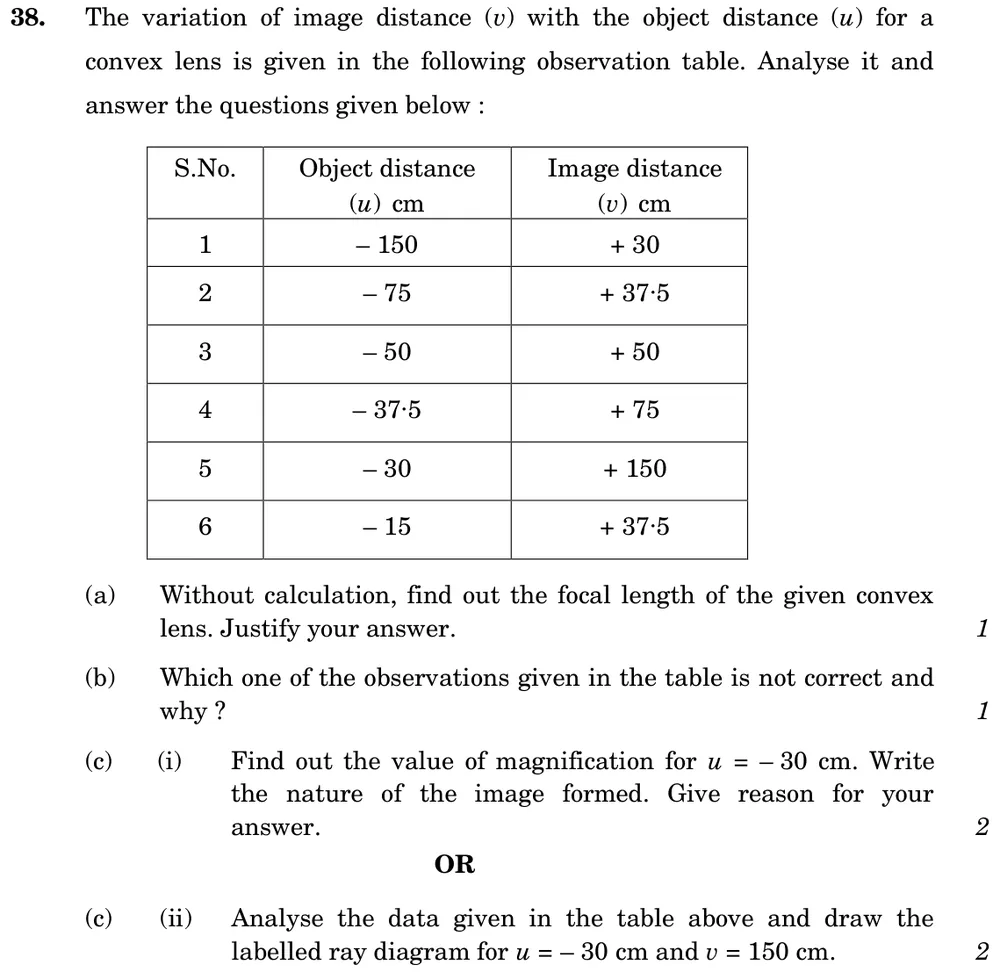
The variation of image distance (v) with the object distance (u) for a convex lens is given in the following observation table. Analyse it and answer the questions given below: S.No. | u (cm) | v (cm) 1 | -150 | +30 2 | -75 | +37.5 3 | -50 | +50 4 | -37.5 | +75 5 | -30 | +150 6 | -15 | +37.5 (a) Without calculation, find out the focal length of the given convex lens. Justify your answer. (1) (b) Which one of the observations given in the table is not correct and why? (1) (c) (i) Find out the value of magnification for u = -30 cm. Write the nature of the image formed. Give reason for your answer. (2) OR (c) (ii) Analyse the data given in the table above and draw the labelled ray diagram for u = -30 cm and v = 150 cm. (2) Write your answer, send a photo, get it marked in DheeAnswer and marking
- (a) Find where object and image distances are equal; that is 2F. Observation 3: u and v are both 50 cm, so the object is at 2F ; 2f = 50 cm, f = 25 cm 1 mark
- (b) Find the object placed inside the focal length. Observation 6 is not correct 0.5 marks
- Explain why its image distance is impossible. Object at 15 cm is between F and O, so the image is virtual, on the same side ; v should be negative 0.5 marks
- (c)(i) Use the lens magnification formula with the signs. m = v/u = 150/(−30) = −5 1 mark
- State the nature. Image is real and inverted 0.5 marks
- Give the reason from the sign. Because m is negative 0.5 marks
- OR (c)(ii) Place the object between F₁ and 2F₁ and draw two rays. Ray parallel to axis → through F₂ ; ray through O straight ; real, inverted, enlarged image beyond 2F₂ (v = 150 cm), arrows on rays 2 marks
Answer: (a) f = 25 cm ; (b) observation 6 ; (c) m = −5, real and inverted / OR image beyond 2F₂
Marks: (a) 1 · (b) 1 · (c) 2
For full marks: In (c)(i) add 'because m is negative' after 'real and inverted' — the reason is its own ½.
Where students lose marks: Using m = −v/u (the mirror formula), which gives +5 and a wrong 'virtual, erect'.
CBSE marking scheme
(a) In observation 3, |u| = |v| = 50 cm, which happens only when the object is at 2F; so f = 25 cm (1). (b) Observation 6 (½): object between F and O gives a virtual image on the same side, so v should be negative (½). (c)(i) m = v/u = 150/(-30) = -5 (1); real and inverted (½) because m is negative (½). OR (c)(ii) Ray diagram with object between F1 and 2F1 and a real, inverted, enlarged image beyond 2F2 (2; deduct ½ for missing/incorrect ray directions).
- Q4 Case study · 4 marks CBSE · 2026
Case: lens images and distances
Read the following passage and answer the questions given: Lenses can form different types of images depending upon their focal length and position of object. A convex lens can create real, inverted or virtual, erect images, while a concave lens forms only virtual and diminished images. The focal length determines the power of lens. Convex lenses have positive focal length while concave lenses have negative focal length by convention. When lenses are placed together, their combined power is determined by the sum of their individual powers. Ray diagrams help to visualize how light converges or diverges through lens to form an image. (i) A convex lens of focal length 20 cm is used to form an image. If an object is placed at 40 cm from the lens, what will be the position and nature of image? (1) (ii) Illustrate the formation of image with the help of ray diagram, when the object is placed between the optical centre and principal focus of concave lens. (1) (iii) (a) A lens combination consists of a convex lens of focal length 30 cm and a concave lens of focal length 15 cm placed together. Find the equivalent focal length and power of this lens combination. (2) OR (iii) (b) Two lenses are placed in contact. One is a concave lens with focal length 2 m and the other is a convex lens with focal length 1.5 m. What type of lens will the combination behave as (convex or concave)? Give reason. (2)
Write your answer, send a photo, get it marked in DheeAnswer and marking
- (i) Object at 40 cm is at 2F for f = 20 cm, so the image is at 2F too. Image at 40 cm on the other side of the lens (at 2F) 0.5 marks
- State the nature of an image at 2F. Real and inverted 0.5 marks
- (ii) Draw the two rays through a concave lens and extend them back. Ray diagram: virtual, erect, diminished image between F and O on the object side 1 mark
- (iii) Change each focal length to metres, find each power, then add. P1 = 1/0.3 = +3.33 D ; P2 = −1/0.15 = −6.67 D ; P = P1 + P2 = −3.33 D 1 mark
- Focal length is 1 ÷ power, in metres. f = 1/P = −0.3 m = −30 cm 1 mark
- (iii) Decide by the sign of the total power. The combination behaves as a convex lens. 1 mark
- Add the two powers and see the sign. P = −1/2 + 1/1.5 = +1/6 D ; f = +6 m, positive 1 mark
Answer: (i) at 2F (40 cm) on the other side, real and inverted ; (ii) virtual, erect, diminished image between F and O ; (iii)(a) P = −3.33 D, f = −30 cm / (b) convex, P = +1/6 D
Marks: (i) 1 · (ii) 1 · (iii) 2
For full marks: In (iii)(b) show P = +1/6 D; the positive sign is the reason that earns the second mark.
Where students lose marks: Forgetting the minus sign on the concave lens power, which gives a wrong total and wrong type.
CBSE marking scheme
(i) Object at 2F: image at 40 cm on the other side (at 2F) (½), real and inverted (½). (ii) Ray diagram: virtual, erect, diminished image between F and O on the object side (1). (iii)(a) P1 = 1/0.3 = +3.33 D, P2 = −1/0.15 = −6.67 D; P = P1 + P2 = −3.33 D (1); f = 1/P = −0.3 m = −30 cm (1). OR (iii)(b) Behaves as convex lens (1): P = −1/2 + 1/1.5 = +1/6 D, f = +6 m, positive (1).
- Q5 Case study · 4 marks CBSE · 2024
Case: three concave mirrors
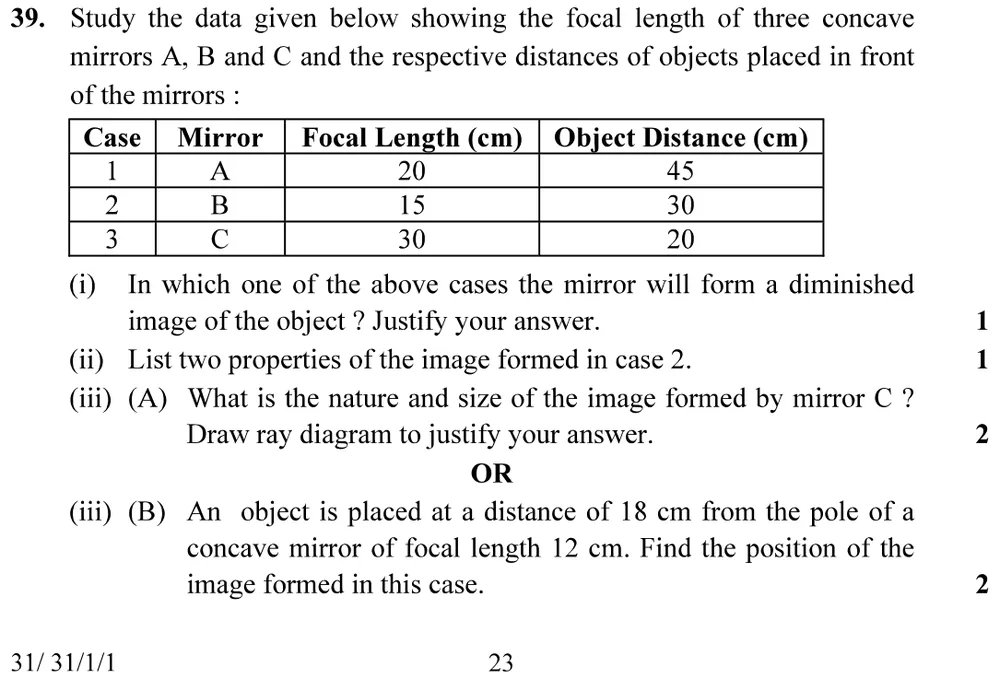
Study the data given below showing the focal length of three concave mirrors A, B and C and the respective distances of objects placed in front of the mirrors: Case 1: Mirror A, focal length 20 cm, object distance 45 cm Case 2: Mirror B, focal length 15 cm, object distance 30 cm Case 3: Mirror C, focal length 30 cm, object distance 20 cm (i) In which one of the above cases the mirror will form a diminished image of the object? Justify your answer. (1) (ii) List two properties of the image formed in case 2. (1) (iii) (A) What is the nature and size of the image formed by mirror C? Draw ray diagram to justify your answer. (2) OR (iii) (B) An object is placed at a distance of 18 cm from the pole of a concave mirror of focal length 12 cm. Find the position of the image formed in this case. (2) Write your answer, send a photo, get it marked in DheeAnswer and marking
- (i) A concave mirror gives a smaller image only when the object is beyond C. Mirror A (Case 1) 0.5 marks
- Find C = 2f for mirror A and compare with the object distance. R = 2 × 20 = 40 cm ; object at 45 cm is beyond the centre of curvature 0.5 marks
- (ii) In case 2, object at 30 cm = 2f, so it is at C; write two image properties. Any two: same size, real, inverted 1 mark
- (iii) Mirror C: object at 20 cm is between P and F (f = 30 cm). Image is virtual and erect 0.5 marks
- State the size too, since the question asks for it. Image is magnified (enlarged) 0.5 marks
- Draw two rays from the object top and extend them behind the mirror. Ray diagram: object between P and F; reflected rays produced behind the mirror meet to give a virtual, erect, enlarged image; arrows on rays 1 mark
- (iii) Write the values with signs: both are in front of a concave mirror. f = −12 cm, u = −18 cm 0.5 marks
- Rearrange the mirror formula for 1/v and substitute. 1/v = 1/f − 1/u = −1/12 + 1/18 = −1/36 0.5 marks
- Invert and say where the image is. v = −36 cm, i.e. 36 cm in front of the mirror 1 mark
Answer: (i) Mirror A ; (ii) real, inverted, same size ; (iii)(A) virtual, erect, magnified / (B) v = −36 cm, 36 cm in front of the mirror
Marks: (i) 1 · (ii) 1 · (iii) 2
For full marks: In (i) write the reason with numbers: 45 cm is beyond C at 40 cm; the second ½ needs it.
Where students lose marks: Forgetting arrows on the rays in (iii)(A) loses ½ even when the diagram is otherwise right.
CBSE marking scheme
(i) Mirror A (½); object (45 cm) is beyond the centre of curvature (40 cm) (½). (ii) Any two: same size, real, inverted (½+½). (iii)(A) Virtual and erect (½), magnified (½) + ray diagram (1); deduct ½ if ray directions not marked. OR (B) f = -12 cm, u = -18 cm (½); 1/v = 1/f - 1/u = -1/12 + 1/18 (½); v = -36 cm, i.e. 36 cm in front of the mirror (1).
- Q6 Case study · 4 marks CBSE · 2023
Case: optical density, index
The ability of a medium to refract light is expressed in terms of its optical density. Optical density has a definite connotation. It is not the same as mass density. On comparing two media, the one with the large refractive index is optically denser medium than the other. The other medium with a lower refractive index is optically rarer. Also the speed of light through a given medium is inversely proportional to its optical density. (i) Determine the speed of light in diamond if the refractive index of diamond with respect to vacuum is 2.42. Speed of light in vacuum is 3×10⁸ m/s. (1) (ii) Refractive indices of glass, water and carbon disulphide are 1.5, 1.33 and 1.62 respectively. If a ray of light is incident in these media at the same angle (say θ), then write the increasing order of the angle of refraction in these media. (1) (iii) (A) The speed of light in glass is 2×10⁸ m/s and in water is 2.25×10⁸ m/s. (a) Which one of the two is optically denser and why ? (b) A ray of light is incident normally at the water-glass interface when it enters a thick glass container filled with water. What will happen to the path of the ray after entering the glass ? Give reason. (2) OR (iii) (B) The absolute refractive indices of water and glass are 4/3 and 3/2 respectively. If the speed of light in glass is 2×10⁸ m/s, find the speed of light in (i) vacuum and (ii) water. (2)
Write your answer, send a photo, get it marked in DheeAnswer and marking
- (i) Refractive index is speed in vacuum over speed in the medium. n = c/v 0.5 marks
- Rearrange for v and divide. v = c/n = 3×10⁸ / 2.42 ≈ 1.24×10⁸ m/s 0.5 marks
- (ii) Higher refractive index bends light more, so the angle of refraction is smaller. r in carbon disulphide < r in glass < r in water 1 mark
- (iii)(A)(a) Slower light means optically denser. Glass is optically denser 0.5 marks
- Give the reason. Light is slower in glass (higher refractive index) 0.5 marks
- (b) A ray along the normal is not bent. It goes straight, undeviated, since ∠i = 0 so ∠r = 0 1 mark
- (iii)(B) Find c from glass first. c = n_glass × v_glass = 3/2 × 2×10⁸ = 3×10⁸ m/s 1 mark
- Then divide c by water's refractive index. v_water = c/n_water = 3×10⁸ ÷ 4/3 = 2.25×10⁸ m/s 1 mark
Answer: (i) ≈ 1.24×10⁸ m/s ; (ii) CS₂ < glass < water ; (iii)(A) glass, goes undeviated / (B) 3×10⁸ m/s, 2.25×10⁸ m/s
Marks: (i) 1 · (ii) 1 · (iii) 2
For full marks: In (iii)(A)(b) write '∠i = 0 so ∠r = 0' — the reason earns the mark with 'undeviated'.
Where students lose marks: In (ii) giving the order of refractive index (water < glass < CS₂) instead of the angles of refraction.
CBSE marking scheme
(i) n = c/v, v = 3×10⁸ / 2.42 = 1.23×10⁸ m/s (1/2, 1/2). (ii) r in carbon disulphide < r in glass < r in water (1). (iii)(A) (a) Glass: light is slower in glass / higher refractive index (1/2, 1/2); (b) goes straight undeviated since ∠i = 0 so ∠r = 0 (1). OR (iii)(B) c = n_glass × v_glass = 3/2 × 2×108 = 3×10⁸ m/s (1); v_water = c/n_water = 3×10⁸ ÷ 4/3 = 2.25×10⁸ m/s (1).
- Q7 Long answer · 5 marks CBSE · 2025
Lens power −2.5 D, defect, more
(i) The power of a lens 'X' is −2.5 D. Name the lens and determine its focal length in cm. For which eye defect of vision will an optician prescribe this type of lens as a corrective lens? (ii) "The value of magnification 'm' for a lens is −2." Using new Cartesian sign convention and considering that an object is placed at a distance of 20 cm from the optical centre of this lens, state: (I) the nature of the image formed; (II) size of the image compared to the size of the object; (III) position of the image; and (IV) sign of the height of the image. (iii) The numerical values of the focal lengths of two lenses A and B are 10 cm and 20 cm respectively. Which one of the two will show higher degree of convergence/divergence? Give reason to justify your answer.
Write your answer, send a photo, get it marked in DheeAnswer and marking
- (i) Negative power means a diverging lens. Concave lens 0.5 marks
- Use P = 1/f with f in metres. f = 1/P = 1/(−2.5) = −0.4 m 0.5 marks
- Change metres to centimetres, keeping the sign. f = −40 cm 0.5 marks
- Name the defect a concave lens corrects. Myopia (near-sightedness) 0.5 marks
- (ii) Negative m means real and inverted; size 2 means twice as big. (I) real and inverted ; (II) magnified, twice the size of the object ; (III) beyond 2F on the other side (v = +40 cm) ; (IV) negative 2 marks
- (iii) Pick the lens with the smaller focal length. Lens A (10 cm) 0.5 marks
- Give the reason using power = 1/f. Smaller focal length means greater power, so more converging or diverging. 0.5 marks
Answer: (i) concave lens, f = −40 cm, myopia ; (ii) real, inverted, twice the size, v = +40 cm beyond 2F, height negative ; (iii) lens A
Marks: (i) 2 · (ii) 2 · (iii) 1
For full marks: In (i) write f = −40 cm with its minus sign and the unit; that conversion line earns its own ½.
Where students lose marks: In (ii)(IV) writing the image height as positive: an inverted image has a negative height.
CBSE marking scheme
(i) Concave lens (½); P = 1/f(m) ⇒ f = 1/(−2.5) = −0.4 m (½) = −40 cm (½); myopia (½). (ii) (I) real and inverted; (II) magnified, twice the size of object; (III) beyond 2F on the other side of the lens (v = +40 cm); (IV) negative (½×4). (iii) Lens A (10 cm) (½); smaller focal length means more converging/diverging power (½).
- Q8 Long answer · 5 marks CBSE · 2025
Concave mirror and candle flame
(i) A student wishes to study the image formation by a concave mirror using candle flame as object. State the type of the image formed by the mirror and mention the change in the image formed, if any, that he observes when the candle flame is gradually moved away from the pole of the mirror. Draw a ray diagram to show the image formation when the object distance is nearly equal to the radius of curvature of the mirror. (ii) A convex mirror used for rear-view on an automobile has a focal length of 3.0 m. If a bus is located at 6.0 m from this mirror, use mirror formula to find the position of the image of the bus as seen in the mirror.
Write your answer, send a photo, get it marked in DheeAnswer and marking
- (i) The type depends on where the flame is: beyond F or inside F. Real and inverted (object beyond F) ; virtual and erect (object between P and F) 1 mark
- Say how the image changes as the flame moves farther away. The image gets smaller (diminished) as the object moves away from the pole. 1 mark
- Draw the two rays for an object at C and mark where they meet. Object at C: ray parallel to axis reflects through F ; ray through F reflects parallel ; image at C, real, inverted, same size 1 mark
- (ii) For a convex mirror f is positive; write values and the formula. u = −6.0 m, f = +3.0 m ; 1/v + 1/u = 1/f 0.5 marks
- Make 1/v the subject and substitute. 1/v = 1/3 + 1/6 = 3/6 0.5 marks
- Invert and say where the image is. v = +2.0 m ; image 2 m behind the mirror 1 mark
Answer: (ii) v = +2.0 m, image 2 m behind the mirror
Marks: Type 1 · Change 1 · Diagram 1 · Image position 2
For full marks: End (ii) with 'image 2 m behind the mirror'; half of the last mark is for saying where.
Where students lose marks: Taking f = −3.0 m for the convex mirror, which gives a negative v and a wrong position.
CBSE marking scheme
(i) Real and inverted (object beyond F) / virtual and erect (object between P and F) (1); image gets diminished as the object moves away from the pole (1); ray diagram for object at C: real, inverted, same-size image at C (1). (ii) u = –6.0 m, f = +3.0 m; 1/v + 1/u = 1/f (½); 1/v = 1/3 + 1/6 = 3/6 (½); v = +2.0 m, image 2 m behind the mirror (½+½).
- Q9 Long answer · 5 marks CBSE · 2025
Convex lens table, no sums
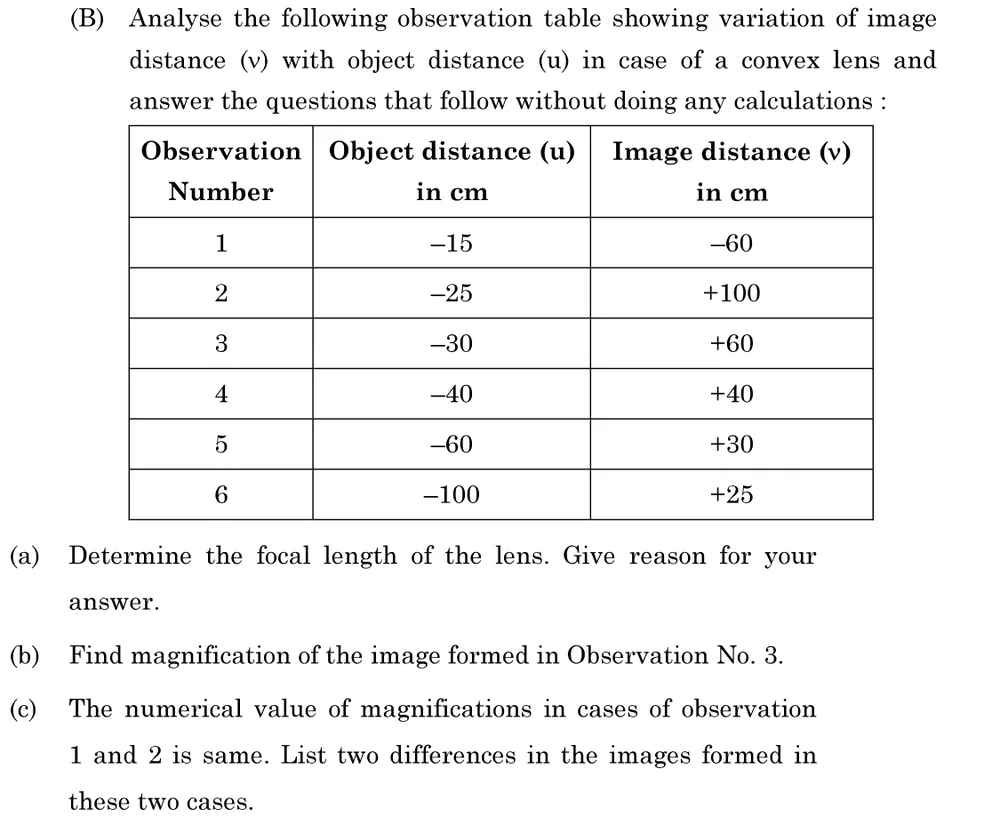
Analyse the following observation table showing variation of image distance (v) with object distance (u) in case of a convex lens and answer the questions that follow without doing any calculations : (a) Determine the focal length of the lens. Give reason for your answer. (b) Find magnification of the image formed in Observation No. 3. (c) The numerical value of magnifications in cases of observation 1 and 2 is same. List two differences in the images formed in these two cases. Write your answer, send a photo, get it marked in DheeAnswer and marking
- (a) Find the row where u and v are equal in size. Obs. 4: u = −40 cm, v = +40 cm ⇒ 2f = 40 cm ⇒ f = 20 cm 1 mark
- Give the reason: why equal u and v means 2F. An object at 2F of a convex lens forms a real image at 2F on the other side. 1 mark
- (b) Use lens magnification with the signs from the table. m = v/u = +60/−30 = −2 1 mark
- (c) Use the sign of v in each case to tell the nature. Obs. 1: virtual and erect (v negative) ; Obs. 2: real and inverted 2 marks
Answer: (a) f = 20 cm ; (b) m = −2 ; (c) Obs. 1 virtual, erect ; Obs. 2 real, inverted
Marks: (a) 2 · (b) 1 · (c) 2
For full marks: In (a) state the reason: object at 2F gives the image at 2F; it carries a separate mark.
Where students lose marks: In (b) dropping the minus sign: m = −2 tells the image is inverted.
CBSE marking scheme
(a) In obs. 4, u = −40 cm gives v = +40 cm, so 2f = 40 cm and f = 20 cm (1); reason: object at 2F of a convex lens forms a real image at 2F on the other side (1). (b) m = v/u = +60/−30 = −2 (1). (c) Obs. 1: image virtual and erect (v negative); obs. 2: image real and inverted (1+1).
- Q10 Long answer · 5 marks CBSE · 2024
Concave lens rays; calculation
(i) Draw a ray diagram to show the path of the refracted ray in each of the following cases: A ray of light incident on a concave lens (1) parallel to its principal axis, and (2) is directed towards its principal focus. (ii) A 4 cm tall object is placed perpendicular to the principal axis of convex lens of focal length 24 cm. The distance of object from the lens is 16 cm. Find the position and size of image formed.
Write your answer, send a photo, get it marked in DheeAnswer and marking
- (i)(1) Draw the parallel ray spreading out, dotted back to the focus. Ray parallel to the axis diverges after refraction, appearing to come from the focus on the incident side 1 mark
- (i)(2) Draw the ray aimed at the focus on the far side. Ray directed towards the principal focus on the other side emerges parallel to the axis; arrows on rays 1 mark
- (ii) Write the values with signs and the lens formula. u = −16 cm, f = +24 cm ; 1/v − 1/u = 1/f 0.5 marks
- Make 1/v the subject and substitute. 1/v = 1/24 − 1/16 = −1/48 0.5 marks
- Invert and say which side the image is on. v = −48 cm: image on the same side as the object 1 mark
- Use the lens magnification to get the image height. h'/h = v/u ⇒ h'/4 = −48/−16 ⇒ h' = 12 cm 1 mark
Answer: (ii) v = −48 cm (same side as object), image 12 cm tall
Marks: Diagrams 2 · Image position 2 · Image size 1
For full marks: Write 'image on the same side as the object' next to v = −48 cm; the full mark is for the position.
Where students lose marks: Missing arrows in the (i) diagrams costs ½ even when the rays bend correctly.
CBSE marking scheme
(i) (1) Ray parallel to axis diverges, appearing to come from the focus on the incident side (NCERT 9.13b) (1). (2) Ray directed towards the principal focus on the other side emerges parallel to the axis (NCERT 9.14b) (1); deduct ½ if ray directions not shown. (ii) u = -16 cm, f = +24 cm; 1/v - 1/u = 1/f (½) gives 1/v = 1/24 - 1/16 = -1/48 (½), v = -48 cm, image on the same side as the object (1); h'/h = v/u: h'/4 = -48/-16, h' = 12 cm (1).
Free 10-question test: Light – Reflection and Refraction
MCQ and Assertion–Reason questions from CBSE papers. About 10 minutes. Your score shows straight away.
Common mistakes in Light – Reflection and Refraction
Mistake Drawing ray diagrams without arrows.
Fix Put an arrow on every ray to show which way the light goes. The scheme cuts ½ mark when arrows are missing. In a refraction diagram, also draw the normal and mark the angles i and r.
Mistake Using the wrong signs, or the mirror formula for a lens.
Fix Measure every distance from the pole or the optical centre; u is negative. f is negative for a concave mirror and a concave lens, and positive for a convex mirror and a convex lens. Mirror: 1/v + 1/u = 1/f, m = −v/u. Lens: 1/v − 1/u = 1/f, m = v/u.
Mistake Putting f in centimetres into P = 1/f.
Fix Change f to metres first, or use P = 100/f with f in cm. Write the unit D and keep the sign: a negative power means a concave lens. The scheme gives ½ mark for each of these steps.
Mistake Reading a table of u and v without giving a reason.
Fix Find the row where u and v are equal in size: there the object is at 2F, so f is half that distance. A row showing a real image for an object nearer than F is the wrong one. Write the reason too; it carries marks of its own.
Mistake Writing a unit with magnification, or ignoring its sign.
Fix Magnification is a ratio, so it has no unit. A negative m means a real, inverted image; a positive m means a virtual, erect image. Write this reason when the question asks for the nature of the image.
Mistake Writing Snell's law only as a formula.
Fix State it in words: the ratio of the sine of the angle of incidence to the sine of the angle of refraction is constant, for light of a given colour and a given pair of media. Only sin i / sin r = constant gets ½ mark for this law.
How to write for full marks
- Write the formula first, then the values with signs (like u = −30 cm), then put them in, then the answer with its unit. The formula and the substitution carry ½ mark each.
- End a sum with the image in words: how far it is, whether it is in front of or behind the mirror (or on which side of the lens), and its nature.
- In a ray diagram, use two standard rays, mark P, F and C (or O, F and 2F), and draw the image where the rays meet or seem to come from.
- For a glass slab, draw the normal at both faces. The ray bends towards the normal going into glass and away from it coming out, and the emergent ray is parallel to the incident ray.
- For refractive index, write which way the ratio goes: n₂₁ = speed of light in medium 1 / speed of light in medium 2.
Not in the 2026-27 exam
Leave these out of your revision.
- Derivation of the mirror formula and the lens formula
- Information in the NCERT boxes
Questions students ask
Which Light – Reflection and Refraction questions are most important for the Class 10 board exam 2027?
Expect MCQs on mirror and lens images, 3-mark formula and power sums, 4-mark lens case studies, and a 5-mark question with a ray diagram. The 10 questions on this page are real CBSE board questions from 2023–2026, chosen across the chapter's topics and question types.
How many marks does Light – Reflection and Refraction carry in the Class 10 board exam?
Light – Reflection and Refraction is part of the Natural Phenomena unit, which carries 7 of the 80 theory marks in the CBSE Class 10 Science paper.
Are these real CBSE previous year questions?
Yes. Each question is printed as it appeared in a CBSE board paper or sample paper, with its source, and the answer follows CBSE's official marking scheme.
Questions and answers: CBSE board papers, sample papers and official marking schemes, 2023–2026. Worked steps and tips: Dhee.