Chapter 10 · CBSE Board 2027
The Human Eye and the Colourful World Class 10 important questions with answers
The 10 questions to practise first, picked from every CBSE board paper 2023–2026. Each one has the official answer and how to write it for full marks. Then try the free 10-question test.
What comes in the exam
- The Human Eye and the Colourful World is in the Natural Phenomena unit.
- The unit is worth 12 marks, shared with the chapter on light.
- 2-mark questions come most, then 3-mark questions, MCQs and some Assertion–Reason.
- Almost every year you get the eye defects: myopia, hypermetropia and presbyopia, with their causes, the lens that corrects them and a ray diagram.
- Power of accommodation comes almost every year too.
- On the colour side, expect the ray diagram through a prism with the angle of deviation, dispersion, the rainbow, and scattering: the Tyndall effect, the blue sky and red danger lights.
- A 4-mark case study on the prism or rainbow comes often.
Top 10 The Human Eye and the Colourful World questions from board papers
Real CBSE questions, printed as they appeared. Open each answer to see the marking and the steps.
- Q1 Very short answer · 2 marks CBSE · 2026
Explain spectrum in nature
With the help of a ray diagram, explain any phenomenon of formation of spectrum in nature.
Write your answer, send a photo, get it marked in DheeAnswer and marking
- Draw one raindrop and follow a sunlight ray through it. Ray diagram: sunlight enters a raindrop, is refracted and split into colours, is reflected internally at the back, and is refracted again as it comes out with the colours spread apart 1 mark
- Explain the diagram in the order the light meets each surface. The rainbow forms because sunlight entering tiny water droplets is dispersed by refraction, internally reflected, and refracted again on coming out. 1 mark
Answer: Rainbow: dispersion, internal reflection and refraction of sunlight in raindrops
Marks: Ray diagram 1 · Explanation 1
For full marks: Name all three: refraction with dispersion, internal reflection, refraction on coming out — the explanation mark needs the whole path.
Where students lose marks: Leaving out the internal reflection at the back of the drop, as if the drop were a prism.
CBSE marking scheme
Ray diagram of rainbow formation in a raindrop (1). Sunlight entering tiny water droplets is dispersed (refracted), internally reflected and refracted again on emerging, forming a rainbow (1). (Any other natural spectrum accepted.)
- Q2 Very short answer · 2 marks CBSE · 2026
Eye lens focal length, distance
How does the focal length of eye lens change as the distance of the object from the eyes is altered? Explain.
Write your answer, send a photo, get it marked in DheeAnswer and marking
- For a far object, say what the muscles and the lens do. Object farther: ciliary muscles relax, the lens becomes thin, its focal length increases. 1 mark
- For a near object, say the opposite. Object nearer: ciliary muscles contract, the lens becomes thick, its focal length decreases. 1 mark
Answer: Far object: longer focal length ; near object: shorter focal length
Marks: Distant object 1 · Near object 1
For full marks: In each case write all three: muscles, lens thickness and focal length.
Where students lose marks: Saying the lens becomes thicker for distant objects, which reverses both cases.
CBSE marking scheme
Object farther: ciliary muscles relax, lens becomes thin, focal length increases (1). Object nearer: ciliary muscles contract, lens becomes thick, focal length decreases (1).
- Q3 Very short answer · 2 marks CBSE · 2026
Eye lens curvature; accommodate
(i) How does the change in curvature of the eye lens helps us in the process of seeing the nearby objects clearly ? (ii) State the range of the power of accommodation of a normal human eye.
Write your answer, send a photo, get it marked in DheeAnswer and marking
- (i) For a near object, say what the muscles, lens shape and focal length do. For nearby objects the ciliary muscles contract, the eye lens becomes thicker (more curved) and its focal length decreases. 1 mark
- (ii) Give the nearest and farthest points a normal eye can see clearly. From 25 cm (near point) to infinity (far point) 1 mark
Answer: (i) Lens thicker, focal length shorter (ii) 25 cm to infinity
Marks: (i) Change in lens 1 · (ii) Range 1
For full marks: In (i) end with 'focal length decreases' — that is the result that lets the eye focus near objects.
Where students lose marks: Saying the ciliary muscles relax for near objects; they relax for distant objects.
CBSE marking scheme
(i) For nearby objects the ciliary muscles contract, the eye lens becomes thicker (curvature increases) and its focal length decreases (1). (ii) From 25 cm (near point) to infinity (far point) (1).
- Q4 Very short answer · 2 marks CBSE · 2025
Presbyopia: lens and its design
Name the type of lenses required by the persons for the correction of their defect of vision called presbyopia. Write the structure of the lenses commonly used for the correction of this defect giving reason for such designs.
Write your answer, send a photo, get it marked in DheeAnswer and marking
- Name the lens that treats both near and far problems. Bifocal lens 0.5 marks
- Describe its two parts. Upper part is a concave lens, lower part is a convex lens. 1 mark
- Give the reason for this design. The upper part gives distant vision and the lower part gives near vision. 0.5 marks
- If only near vision is weak, name the single lens. Convex lens 0.5 marks
- Describe its shape. Thicker at the middle than at the edges 1 mark
- Give the reason for this design. It helps the eye see nearby objects clearly. 0.5 marks
Answer: (a) Bifocal lens: concave upper, convex lower / (b) Convex lens, thicker at the middle
Marks: Lens ½ · Structure 1 · Reason ½
For full marks: For a bifocal, write 'upper concave for distant, lower convex for near' — the structure line is worth 1 mark.
Where students lose marks: Swapping the parts, putting the convex part at the top and the concave part at the bottom.
CBSE marking scheme
Bifocal lens (½); upper part concave, lower part convex (1); to give distant and near vision respectively (½). OR: convex lens (½), thicker at the middle than the edges (1), to aid near vision (½).
- Q5 Short answer · 3 marks CBSE · 2025, 2023 Asked in 2025, 2023
What is a rainbow? Draw it
What is a rainbow? Draw a labelled diagram to show its formation.
Write your answer, send a photo, get it marked in DheeAnswer and marking
- Define a rainbow in one line: what it is and when you see it. A rainbow is a natural spectrum appearing in the sky after a rain shower. 1 mark
- Draw one raindrop and trace sunlight in, around the back and out, with labels and arrows. Labelled diagram: sunlight enters a raindrop, refracts and disperses, reflects internally, refracts out; red and violet shown reaching the observer, arrows on rays. 2 marks
Answer: A natural spectrum in the sky after rain; labelled raindrop diagram showing refraction, dispersion, internal reflection and refraction.
Marks: Definition 1 · Labelled diagram 2
For full marks: Put arrows on every ray in the raindrop diagram; a diagram without arrows loses half a mark.
Where students lose marks: Drawing the light reflecting off the front of the drop instead of entering, reflecting at the back, then leaving.
CBSE marking scheme
A rainbow is a natural spectrum appearing in the sky after a rain shower (1). Labelled diagram: sunlight entering a raindrop, refraction and dispersion, internal reflection, refraction out; red and violet to observer (2; deduct ½ if arrows not marked).
- Q6 Short answer · 3 marks CBSE · 2026
Eye defect diagram: image site
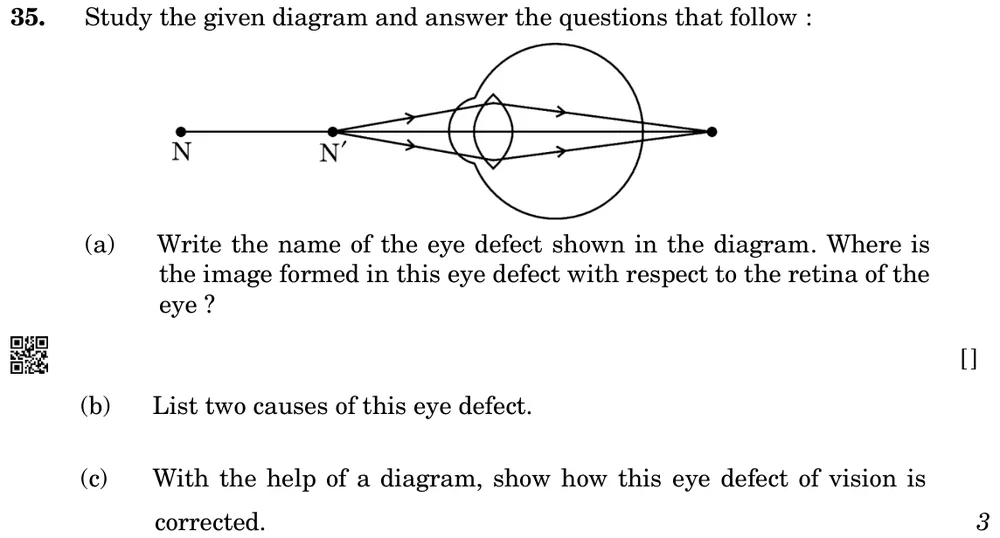
Study the given diagram and answer the questions that follow: (a) Write the name of the eye defect shown in the diagram. Where is the image formed in this eye defect with respect to the retina of the eye? (b) List two causes of this eye defect. (c) With the help of a diagram, show how this eye defect of vision is corrected. Write your answer, send a photo, get it marked in DheeAnswer and marking
- (a) Rays from a near object meet behind the retina, so name that defect. Hypermetropia (far-sightedness) 0.5 marks
- Read the image position straight from the figure. The image is formed behind the retina. 0.5 marks
- (b) First cause: the eye lens bends light too little. The focal length of the eye lens is too long. 0.5 marks
- Second cause: the eyeball itself is the wrong size. The eyeball has become too small. 0.5 marks
- (c) Put a converging lens in front of the eye to bring the image forward. Diagram: convex lens of suitable power in front of the eye ; rays from a near object focus on the retina ; arrows on rays 1 mark
Answer: (a) Hypermetropia, image behind the retina (b) Long focal length, small eyeball (c) Convex lens
Marks: (a) Defect and image 1 · (b) Two causes 1 · (c) Corrected diagram 1
For full marks: In (a) answer both parts: name the defect and write 'behind the retina'.
Where students lose marks: Drawing a concave lens in (c), which pushes the image even further behind the retina.
CBSE marking scheme
(a) Hypermetropia/far-sightedness (½); image formed behind the retina (½). (b) Focal length of eye lens too long (½); eyeball too small (½). (c) Diagram showing a convex lens of suitable power bringing the image of a near object onto the retina (1).
- Q7 Short answer · 3 marks CBSE · 2026
Scattering vs reflection
What is scattering of light? How is scattering of light different from reflection of light? Explain.
Write your answer, send a photo, get it marked in DheeAnswer and marking
- Define scattering by saying what happens to light when it meets tiny particles. Scattering of light is the spreading of light in different directions when it interacts with the particles of the medium. 1 mark
- Compare the direction of the light in the two cases, then the colour. Reflected light goes back in one fixed direction, while scattered light spreads in all directions ; the colour of scattered light depends on particle size, but reflection does not change the colour. 2 marks
Answer: Scattering spreads light in all directions from particles; reflection sends it back in one fixed direction and does not depend on particle size.
Marks: Definition 1 · Difference 2
For full marks: State the difference as a clear contrast: 'reflected light goes in a fixed direction, scattered light spreads in all directions'.
Where students lose marks: Defining scattering but writing only one side of the difference, without saying what reflection does.
CBSE marking scheme
Scattering: spreading of light in different directions on interaction with particles of the medium (1). Difference: reflected light goes back in a fixed direction, scattered light spreads in all directions / colour of scattered light depends on particle size, reflection does not (2).
- Q8 Short answer · 3 marks CBSE · 2026
Prism diagram; reversed ray
(a) Draw the ray diagram for refraction of light through a glass prism and mark angle of refraction and angle of deviation. (b) When the path of a light ray refracted through a glass prism is reversed how will the angle of deviation change ? Explain.
Write your answer, send a photo, get it marked in DheeAnswer and marking
- (a) Draw the prism with the ray going in, through and out. Diagram: triangular glass prism with the incident ray, refracted ray inside and emergent ray. 1 mark
- Mark the angle the refracted ray makes with the normal inside the prism. Angle of refraction r marked between the refracted ray and the normal at the first face. 0.5 marks
- Extend the incident and emergent rays until they meet, and mark the angle between them. Angle of deviation D marked between the extended incident ray and the emergent ray. 0.5 marks
- (b) Think what happens when light just runs back along the same path. The angle of deviation will not change. 0.5 marks
- Give the reason in one line. The ray retraces its original path. 0.5 marks
Answer: (a) Prism diagram with r and D marked (b) Deviation does not change; the ray retraces its path.
Marks: Diagram 1 · Angles marked 1 · Answer ½ · Reason ½
For full marks: Draw the dotted extensions of the incident and emergent rays; D is marked where they meet.
Where students lose marks: Marking r from the prism face instead of from the normal; all angles are measured from the normal.
CBSE marking scheme
(a) Ray diagram through a triangular glass prism showing incident, refracted and emergent rays (1); angle of refraction r and angle of deviation D marked (½+½). (b) Angle of deviation will not change (½); the ray retraces its original path (½).
- Q9 Case study · 4 marks CBSE · 2026
Case: glass slab and prism
Read the following passage and answer the questions that follow : Two students, A and B were performing an activity on refraction through glass slab and refraction through prism respectively. Student 'A' observed that the emergent light ray is parallel to the direction of incident ray, while student 'B' observed that the emergent ray is making a certain angle with respect to the direction of the incident ray in the prism, called angle of deviation. He also noted that the angle of deviation is different for different colours of light. (a) When white light passes through a glass slab, it does not show dispersion, while it shows dispersion when it passes through a glass prism. Why ? (1) (b) Why do we get spectrum when white light passes through tiny water droplets present in air ? (1) (c) (i) For a given pair of mediums, if we change the angle of incidence gradually, will it change the speed of light in that medium ? Explain. (2) OR (c) (ii) Calculate the speed of light in a given medium if angle of incidence in air is 60° and angle of refraction in the medium is 30°. Given that speed of light in air is 3 × 10⁸ m/s. (2)
Write your answer, send a photo, get it marked in DheeAnswer and marking
- (a) Compare the two shapes: a slab has parallel faces, a prism does not. In a slab the colours separated at the first face recombine at the parallel second face and emerge as white light ; in a prism the colours bend through different angles, so dispersion is seen. 1 mark
- (b) Think of each droplet as a tiny prism. Tiny water droplets act like prisms; they refract and disperse sunlight, giving a spectrum. 1 mark
- (c)(i) Ask what stays fixed for a pair of media when only the angle changes. No. The angle of refraction changes with the angle of incidence, but the refractive index (speed in air ÷ speed in medium) stays constant, so the speed in the medium is unchanged. 2 marks
- (c)(ii) Find the refractive index from the two angles first. n = sin 60°/sin 30° = (√3/2)/(1/2) = √3 1 mark
- Divide the speed in air by n to get the speed in the medium. v = c/n = 3 × 10⁸/√3 = √3 × 10⁸ m/s ≈ 1.73 × 10⁸ m/s 1 mark
Answer: (a) Slab: colours recombine; prism: bend differently (b) droplets act as prisms (c)(i) No, n is constant / (c)(ii) v ≈ 1.73 × 10⁸ m/s
Marks: (a) 1 · (b) 1 · (c) 2
For full marks: In (c)(ii) write n = √3 as its own line before dividing; that line carries a mark.
Where students lose marks: In (c)(ii) dividing sin 30° by sin 60°: n = 1/√3 is less than 1, which would make light faster in the medium than in air.
CBSE marking scheme
(a) In a slab the colours dispersed at the first face recombine at the parallel second face and emerge as white light; in a prism the colours bend through different angles, so dispersion is seen (1). (b) Tiny droplets act like prisms, refracting and dispersing sunlight (1). (c)(i) No: r changes with i but the refractive index (speed in air / speed in medium) stays constant, so the speed in the medium is unchanged (2). OR (c)(ii) n = sin 60°/sin 30° = (√3/2)/(1/2) = √3 (1); v = c/n = 3 × 10⁸/√3 = √3 × 10⁸ m/s ≈ 1.73 × 10⁸ m/s (1).
- Q10 Case study · 4 marks CBSE · 2025
Case: white light through prism
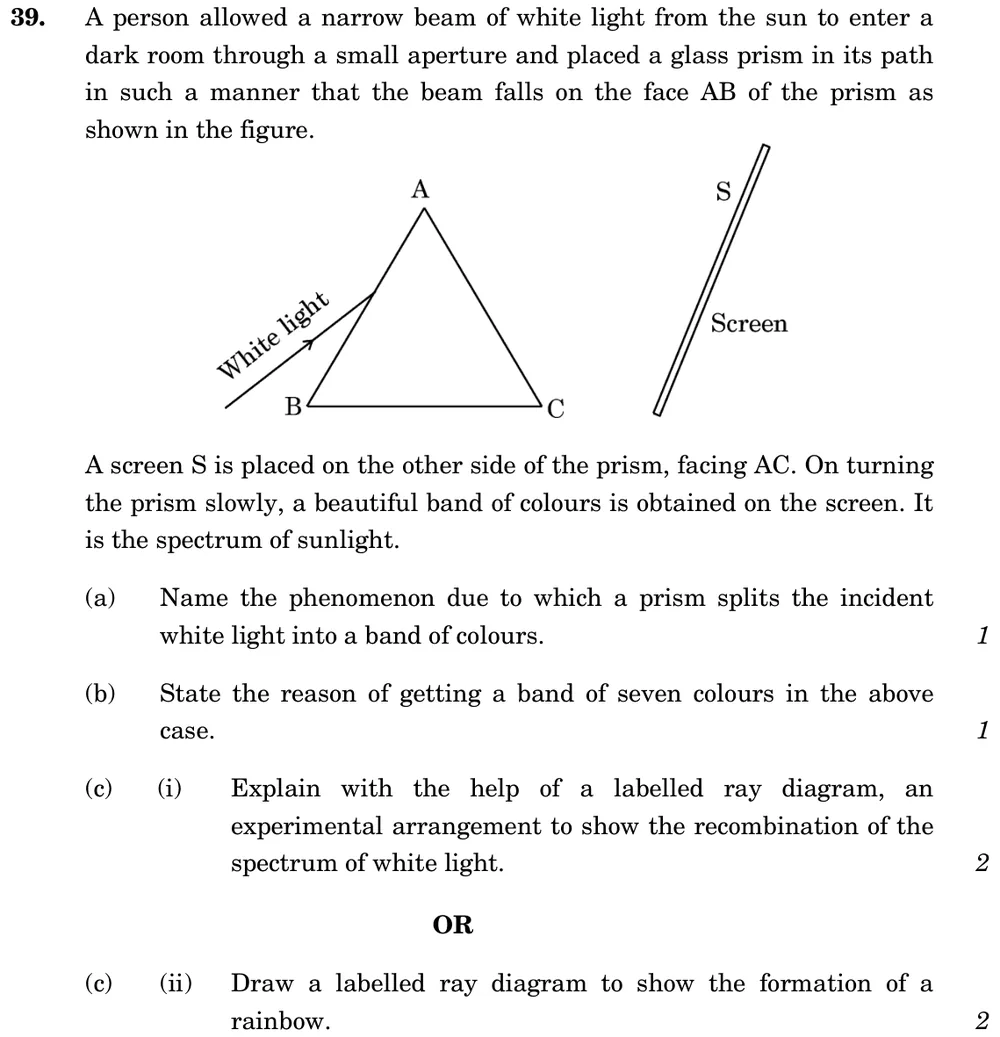
A person allowed a narrow beam of white light from the sun to enter a dark room through a small aperture and placed a glass prism in its path in such a manner that the beam falls on the face AB of the prism as shown in the figure. A screen S is placed on the other side of the prism, facing AC. On turning the prism slowly, a beautiful band of colours is obtained on the screen. It is the spectrum of sunlight. (i) Name the phenomenon due to which a prism splits the incident white light into a band of colours. (1) (ii) State the reason of getting a band of seven colours in the above case. (1) (iii) Explain with the help of a labelled ray diagram, an experimental arrangement to show the recombination of the spectrum of white light. (2) OR (iii) Draw a labelled ray diagram to show the formation of a rainbow. (2) Write your answer, send a photo, get it marked in DheeAnswer and marking
- (i) Name what a prism does to white light. Dispersion of light. 1 mark
- (ii) Explain why the colours separate. Different colours bend through different angles with respect to the incident ray as they pass through the prism. 1 mark
- (iii) Use a second prism turned upside down to undo the first one. Two identical prisms, the second placed inverted with respect to the first ; the spectrum from prism A passes through prism B and white light emerges (labelled diagram). 2 marks
- (iii) Trace sunlight into a raindrop, around the back and out again. Labelled diagram: sunlight enters a raindrop, refracts and disperses, reflects internally, refracts out as colours (red top, violet bottom) to the observer, with arrows on rays. 2 marks
Answer: (i) Dispersion (ii) colours bend through different angles (iii) two identical prisms, one inverted / rainbow ray diagram in a raindrop
Marks: (i) 1 · (ii) 1 · (iii) Labelled diagram 2
For full marks: In (iii) label both prisms and show white light coming out of the second; the labelled diagram can earn the full two marks.
Where students lose marks: In the rainbow diagram, leaving arrows off the rays; arrows must show the direction of light.
CBSE marking scheme
(i) Dispersion of light (1). (ii) Different colours bend through different angles with respect to the incident ray as they pass through the prism (1). (iii) Two identical prisms, the second placed inverted with respect to the first; the spectrum from prism A passes through prism B and white light emerges (2; full marks for labelled diagram alone). OR (iii) Rainbow diagram: sunlight enters a raindrop, refracts and disperses, reflects internally, refracts out as colours (red top, violet bottom) to the observer (2; deduct ½ if arrows not marked).
Free 10-question test: The Human Eye and the Colourful World
MCQ and Assertion–Reason questions from CBSE papers. About 10 minutes. Your score shows straight away.
Common mistakes in The Human Eye and the Colourful World
Mistake Drawing ray diagrams with no arrows on the rays.
Fix Put an arrow on every ray to show which way light travels. The scheme cuts ½ mark when the direction of light is not shown.
Mistake Marking the angle of deviation in the wrong place.
Fix Extend the incident ray forward and the emergent ray backward as dotted lines. The angle between them is ∠D. Mark ∠i between the incident ray and the normal. Each angle marked carries ½ mark.
Mistake Mixing up the causes and lenses for myopia and hypermetropia.
Fix Myopia: eye lens too curved or eyeball too long, image in front of the retina, concave lens. Hypermetropia: focal length too long or eyeball too small, image behind the retina, convex lens. Each cause carries ½ mark.
Mistake Getting accommodation the wrong way round.
Fix Near object: ciliary muscles contract, lens becomes thick, focal length decreases. Far object: muscles relax, lens becomes thin, focal length increases. Write all three parts.
Mistake Saying a prism splits white light because of scattering.
Fix A prism splits light by dispersion: each colour refracts through a different angle. Red bends least, violet bends most. Scattering explains the blue sky and red danger lights.
Mistake Giving the result of scattering with no reason.
Fix Very fine particles scatter mainly blue light, because they scatter shorter wavelengths more. Large particles scatter all colours, so the light looks white. Red has the longest wavelength, so it is scattered least.
How to write for full marks
- For an eye-defect question, write in this order: name of the defect, where the image forms (in front of or behind the retina), two causes, the lens that corrects it, then the diagram. The scheme gives ½ mark for each of the first parts.
- For a correction diagram, show the lens in front of the eye and the rays reaching the retina. For hypermetropia, show rays from an object at 25 cm that seem to come from the person's near point N'.
- For a rainbow diagram, draw one raindrop and mark the three places: refraction and dispersion on entry, internal reflection at the back, refraction on exit. Show red and violet coming out, with arrows.
- For presbyopia, name the bifocal lens and give its structure with the reason: upper part concave for distant vision, lower part convex for near vision.
- For 'give reasons' parts, write the effect and its cause in one sentence each, like 'scattering is not prominent because there is hardly any atmosphere'.
Not in the 2026-27 exam
Leave these out of your revision.
- Colour of the sun at sunrise and sunset
- Information in the NCERT boxes
Questions students ask
Which The Human Eye and the Colourful World questions are most important for the Class 10 board exam 2027?
Expect 2- and 3-mark questions on eye defects and their correction, prism ray diagrams, the rainbow and scattering, plus MCQs on accommodation and dispersion. The 10 questions on this page are real CBSE board questions from 2023–2026, chosen across the chapter's topics and question types.
How many marks does The Human Eye and the Colourful World carry in the Class 10 board exam?
The Human Eye and the Colourful World is part of the Natural Phenomena unit, which carries 5 of the 80 theory marks in the CBSE Class 10 Science paper.
Are these real CBSE previous year questions?
Yes. Each question is printed as it appeared in a CBSE board paper or sample paper, with its source, and the answer follows CBSE's official marking scheme.
Questions and answers: CBSE board papers, sample papers and official marking schemes, 2023–2026. Worked steps and tips: Dhee.