Chapter 12 · CBSE Board 2027
Magnetic Effects of Electric Current Class 10 important questions with answers
The 10 questions to practise first, picked from every CBSE board paper 2023–2026. Each one has the official answer and how to write it for full marks. Then try the free 10-question test.
What comes in the exam
- Magnetic Effects of Electric Current is in the Effects of Current unit.
- The unit is worth 13 marks, shared with Electricity.
- 3-mark questions come most, then Assertion–Reason and MCQs, with some 2- and 5-mark questions.
- Almost every year you get the rules of field lines, the field around a straight wire with the right-hand thumb rule, and the field of a solenoid.
- The force on a current-carrying rod with Fleming's left-hand rule, and fuses with overloading, also come almost every year, and so do house wiring and the earth wire.
- The field of a circular loop comes almost every year too.
- The electromagnet comes often.
Top 10 Magnetic Effects of Electric Current questions from board papers
Real CBSE questions, printed as they appeared. Open each answer to see the marking and the steps.
- Q1 Very short answer · 2 marks CBSE · 2026
Making an electromagnet
How is an electromagnet made? Write any two ways by which the strength of electromagnet can be increased.
Write your answer, send a photo, get it marked in DheeAnswer and marking
- Describe what is wound around what. Wrap insulated copper wire as a coil around a soft iron core and pass a current through it. 1 mark
- Give a first way to make it stronger. Increase the number of turns in the coil. 0.5 marks
- Give a second way. Increase the current through the coil. 0.5 marks
Answer: Coil of insulated wire on soft iron with current; more turns, more current
Marks: Making it 1 · Two ways 1
For full marks: Write 'soft iron core' and 'pass a current' — both are needed for the first mark.
Where students lose marks: Giving 'use a bigger magnet' or 'thicker wire' as a way, which the answer does not accept.
CBSE marking scheme
By wrapping insulated copper wire as a coil around a soft iron core and passing current / placing soft iron inside a current-carrying solenoid (1). Strength increases by increasing the number of turns (½) and the current (½).
- Q2 Very short answer · 2 marks CBSE · 2024
Field lines around straight wire
Draw a labelled diagram to show the pattern of magnetic field lines produced due to a current carrying straight conductor. Mark on it the direction of current in the conductor and the direction of magnetic field lines.
Write your answer, send a photo, get it marked in DheeAnswer and marking
- Draw the wire and the field as circles around it. Diagram: straight conductor with field lines as concentric circles centred on the wire, in a plane perpendicular to it 1 mark
- Put an arrow on the wire for current. Arrow on the wire marking the direction of current 0.5 marks
- Use the right-hand thumb rule to arrow the circles. Arrows on the circles in the direction given by the right-hand thumb rule (thumb along current, fingers curl along the field) 0.5 marks
Answer: Concentric circles around the wire, directions by the right-hand thumb rule
Marks: Field pattern 1 · Current direction ½ · Field direction ½
For full marks: Arrow the circles to match your current arrow — each direction earns its own ½.
Where students lose marks: Drawing straight parallel lines beside the wire, or arrowing the circles opposite to the right-hand thumb rule.
CBSE marking scheme
Diagram of concentric circles around the straight wire (NCERT Fig. 12.6a) (1); direction of current (½) and of field lines by right-hand thumb rule (½).
- Q3 Short answer · 3 marks CBSE · 2026
Precautions against accidents
(A) Write any two precautions to be taken to avoid electrical accidents. (B) State how these precautions prevent possible damage to the electric circuit.
Write your answer, send a photo, get it marked in DheeAnswer and marking
- (A) Give a first safety device. Use a fuse of appropriate rating. 0.5 marks
- Give a second one. Use an earth wire in the circuit. 0.5 marks
- (B) Say what the fuse does during overloading. During overloading the fuse melts and protects the appliances. 1 mark
- Say how the earth wire protects the user. The earth wire provides a low-resistance path for leaked current from the metal body, protecting us from shock. 1 mark
Answer: (A) Fuse, earth wire; (B) fuse melts on overload; earth wire carries leaked current to earth
Marks: Two precautions 1 · How each works 2
For full marks: Write 'low-resistance path' for the earth wire — that phrase earns the last mark.
Where students lose marks: Saying the earth wire stops overloading, mixing up the jobs of the fuse and the earth wire.
CBSE marking scheme
(A) Use a fuse of appropriate rating (½); use an earth wire in the circuit (½). (B) During overloading the fuse melts and protects the appliances (1); the earth wire provides a low-resistance path for leaked current from the metal body, protecting us from shock (1).
- Q4 Short answer · 3 marks CBSE · 2026
Fuse vs earth wire; higher fuse
What is the use of fuse in domestic electric circuits ? How is its role different from the role of a green coloured wire given in domestic electric circuits ? What will happen if an electrician installs a fuse with higher-rated value than prescribed for a given electric circuit ?
Write your answer, send a photo, get it marked in DheeAnswer and marking
- Say what the fuse does. The fuse protects circuits and appliances from overloading and short-circuiting by melting. 1 mark
- Say what the green earth wire does instead. The green wire is the earth wire: a low-resistance path to earth for leaked current from a metal body, preventing electric shock. 1 mark
- Think about when a bigger fuse would melt. A higher-rated fuse will not melt during overloading, so it will not protect the circuit. 1 mark
Answer: Fuse protects against overload; earth wire prevents shock; higher-rated fuse gives no protection
Marks: Fuse 1 · Earth wire 1 · Higher rating 1
For full marks: Write 'will not melt' for the higher-rated fuse — that is what the last mark pays for.
Where students lose marks: Saying the green wire is the live or neutral wire instead of the earth wire.
CBSE marking scheme
Fuse protects circuits and appliances from overloading / short-circuiting by melting (1). Green wire is the earth wire: a low-resistance path to earth for any current leaking to an appliance's metal body, preventing electric shock (1). A higher-rated fuse will not melt and so will not protect the circuit during overloading (1).
- Q5 Short answer · 3 marks CBSE · 2026
Rod AB when key is closed
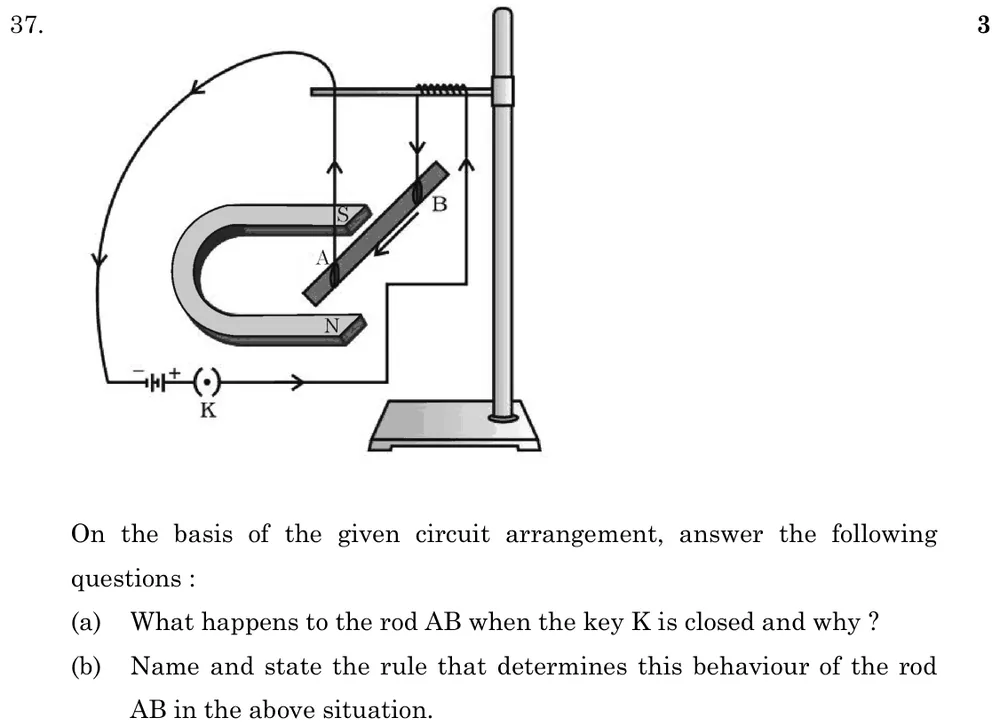
On the basis of the given circuit arrangement, answer the following questions: (a) What happens to the rod AB when the key K is closed and why? (b) Name and state the rule that determines this behaviour of the rod AB in the above situation. Write your answer, send a photo, get it marked in DheeAnswer and marking
- (a) Say what the rod does. Rod AB gets displaced from its position. 0.5 marks
- Give the reason. A current-carrying conductor experiences a force in a magnetic field. 0.5 marks
- (b) Name the rule. Fleming's left-hand rule 1 mark
- State it with each finger's meaning. Stretch the thumb, forefinger and middle finger of the left hand mutually perpendicular ; forefinger = field, middle finger = current, thumb = force (motion) 1 mark
Answer: (a) AB is displaced; (b) Fleming's left-hand rule
Marks: Displacement and reason 1 · Rule name 1 · Statement 1
For full marks: Say 'mutually perpendicular' and match each finger — the statement mark needs all three.
Where students lose marks: Naming the right-hand thumb rule or Fleming's right-hand rule instead of the left-hand rule.
CBSE marking scheme
(a) Rod AB gets displaced from its position (½) because a current-carrying conductor experiences a force in a magnetic field (½). (b) Fleming's left-hand rule (1): stretch thumb, forefinger and middle finger of left hand mutually perpendicular; forefinger = field, middle finger = current, thumb = direction of motion/force (1).
- Q6 Short answer · 3 marks CBSE · 2026
Force on wire; electron beam
(a) Describe an activity to show that a current carrying conductor, placed in an external magnetic field experiences a force. (b) Imagine that you are sitting in a chamber with your back to one wall. An electron beam, moving horizontally towards the front wall from the back wall, is deflected by a strong magnetic field to your right side. Find the direction of the magnetic field.
Write your answer, send a photo, get it marked in DheeAnswer and marking
- (a) Set up the rod between the magnet's poles. Hang an aluminium rod AB horizontally between the poles of a strong horseshoe magnet, perpendicular to the field (or draw the set-up) 1 mark
- Pass a current and watch the rod. Connect AB in series with a battery and key and pass a current: the rod is displaced, showing a force acts on it. 1 mark
- (b) The electron moves forward, so current flows backward; use Fleming's left-hand rule. The magnetic field is vertically downwards. 1 mark
Answer: (b) Vertically downwards
Marks: Set-up 1 · Observation 1 · Field direction 1
For full marks: Write 'the rod is displaced' — the second mark is for what you see.
Where students lose marks: Taking the current along the electron's motion, which gives the field vertically upwards instead of downwards.
CBSE marking scheme
(a) Hang an aluminium rod AB horizontally between the poles of a strong horseshoe magnet, perpendicular to the field; connect in series with battery and key, pass current (1+1, or diagram); the rod is displaced. (b) Field is vertically downwards (1).
- Q7 Case study · 4 marks CBSE · 2025
Case: bar magnet field lines
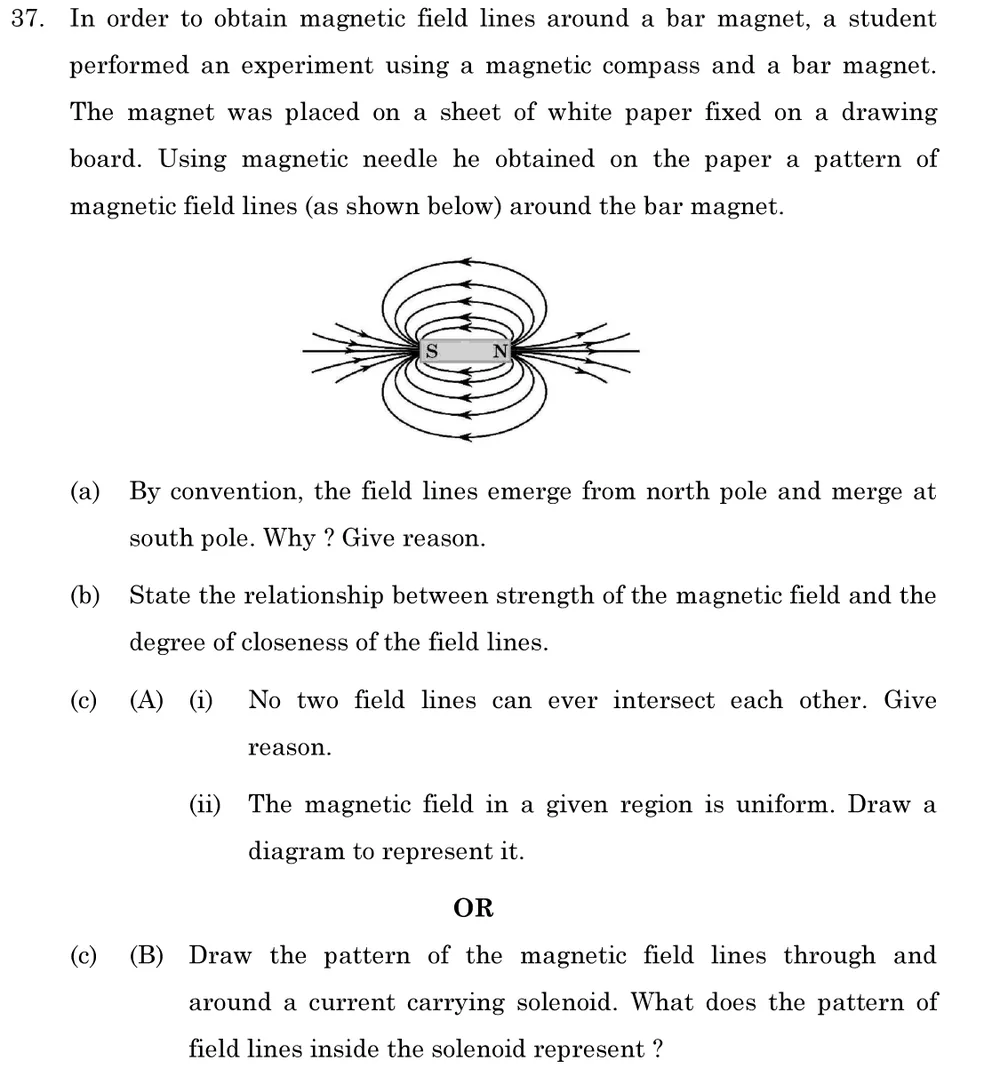
In order to obtain magnetic field lines around a bar magnet, a student performed an experiment using a magnetic compass and a bar magnet. The magnet was placed on a sheet of white paper fixed on a drawing board. Using magnetic needle he obtained on the paper a pattern of magnetic field lines (as shown below) around the bar magnet. (i) By convention, the field lines emerge from north pole and merge at south pole. Why ? Give reason. (ii) State the relationship between strength of the magnetic field and the degree of closeness of the field lines. (iii) (A) (a) No two field lines can ever intersect each other. Give reason. (b) The magnetic field in a given region is uniform. Draw a diagram to represent it. OR (iii) (B) Draw the pattern of the magnetic field lines through and around a current carrying solenoid. What does the pattern of field lines inside the solenoid represent ? Write your answer, send a photo, get it marked in DheeAnswer and marking
- (i) Recall how the direction of a field line is defined. The direction of the field is taken as the direction in which the north pole of a compass needle moves ; it moves away from N and towards S, so lines emerge from N and merge at S 1 mark
- (ii) Look at the figure: lines are crowded near the poles. The closer the field lines, the stronger the magnetic field 1 mark
- (iii)(A)(a) Imagine a compass placed where two lines cross. At the crossing point the compass needle would point in two directions at once, which is impossible 1 mark
- (b) Uniform means the same strength and direction everywhere. Diagram: equally spaced, parallel straight lines with arrows all in the same direction 1 mark
- (iii)(B) Draw the solenoid with arrows on all the field lines. Diagram: outside, the lines look like those of a bar magnet ; inside the solenoid, the lines are straight and parallel 1 mark
- Read the inside pattern: parallel, equally spaced lines mean the same field. Inside the solenoid the field is uniform (the same at all points) 1 mark
Answer: (i) A compass north pole moves away from N, towards S (ii) Closer lines, stronger field (iii)(A) A needle cannot point two ways; parallel equidistant lines / (B) Uniform field inside
Marks: (i) Reason 1 · (ii) Relation 1 · (iii) Two points 2
For full marks: In (iii)(B), finish with 'the field inside is uniform' — that sentence is a full mark by itself.
Where students lose marks: In (iii)(A)(b), drawing parallel lines that are not equally spaced, which shows a non-uniform field.
CBSE marking scheme
(i) Field direction is taken as the direction in which the north pole of a compass needle moves; it moves away from N and towards S (1). (ii) The closer the field lines, the stronger the field (1). (iii)(A)(a) At an intersection a compass needle would point in two directions, which is impossible (1); (b) equidistant parallel straight lines (marks also if shown inside a solenoid) (1). OR (B) Diagram: field lines like a bar magnet outside, straight parallel lines inside the solenoid (1); inside it represents a uniform magnetic field (1).
- Q8 Case study · 4 marks CBSE · 2025
Case: domestic mains supply
In our homes, we receive the supply of electric power through a main supply also called mains, either supported through overhead electric poles or by underground cables. In our country the potential difference between the two wires (live wire and neutral wire) of this supply is 220 V. (a) Write the colours of the insulation covers of the line wires through which supply comes to our homes. (1) (b) What should be the current rating of the electric circuit (220 V) so that an electric iron of 1 kW power rating can be operated? (1) (c) (i) What is the function of the earth wire? State the advantage of the earth wire in domestic electric appliances such as electric iron. (2) OR (c) (ii) List two precautions to be taken to avoid electrical accidents. State how these precautions prevent possible damage to the circuit/appliance. (2)
Write your answer, send a photo, get it marked in DheeAnswer and marking
- (a) Recall the colour of insulation used for each supply wire. Live wire: red insulation 0.5 marks
- The return wire has the other colour. Neutral wire: black insulation 0.5 marks
- (b) Use power = voltage × current to find the current the iron draws. I = P/V = 1000 W / 220 V = 4.54 A 0.5 marks
- Choose the next standard rating above that current. Current rating of the circuit = 5 A 0.5 marks
- (c)(i) Say what path the earth wire gives the leaking current. The earth wire gives a low-resistance path to earth for any leakage current, keeping the metal body at earth's potential 1 mark
- Then state what this means for the person using the iron. So the user does not get a severe electric shock 1 mark
- (c)(ii) Name two safety devices used in house wiring. Precautions: use a fuse ; use an earth wire 1 mark
- Say how the fuse protects. The fuse prevents damage to the circuit and appliance due to overloading or short-circuit 0.5 marks
- Say how the earth wire protects. The earth wire prevents electric shock due to leakage current 0.5 marks
Answer: (a) Live red, neutral black (b) 5 A (c)(i) Low-resistance path to earth, so no severe shock / (ii) Fuse and earth wire
Marks: (a) Colours 1 · (b) Current and rating 1 · (c) Two points 2
For full marks: In (b), show I = P/V with 1 kW written as 1000 W, then give the rating '5 A'.
Where students lose marks: Using P = 1 instead of 1000 W gives I = 0.0045 A, so the 5 A rating cannot be found.
CBSE marking scheme
(a) Live wire — red (½); neutral wire — black (½). (b) I = P/V = 1000/220 = 4.54 A (½); rating 5 A (½). (c)(i) Earth wire gives a low-resistance path for leakage current, keeping the metal body at earth potential (1); so the user does not get a severe electric shock (1). OR (c)(ii) Fuse wire and earth wire (½+½); fuse prevents damage due to overloading/short-circuit (½); earth wire prevents shock due to leakage current (½).
- Q9 Long answer · 5 marks CBSE · 2025
Field of two opposite currents
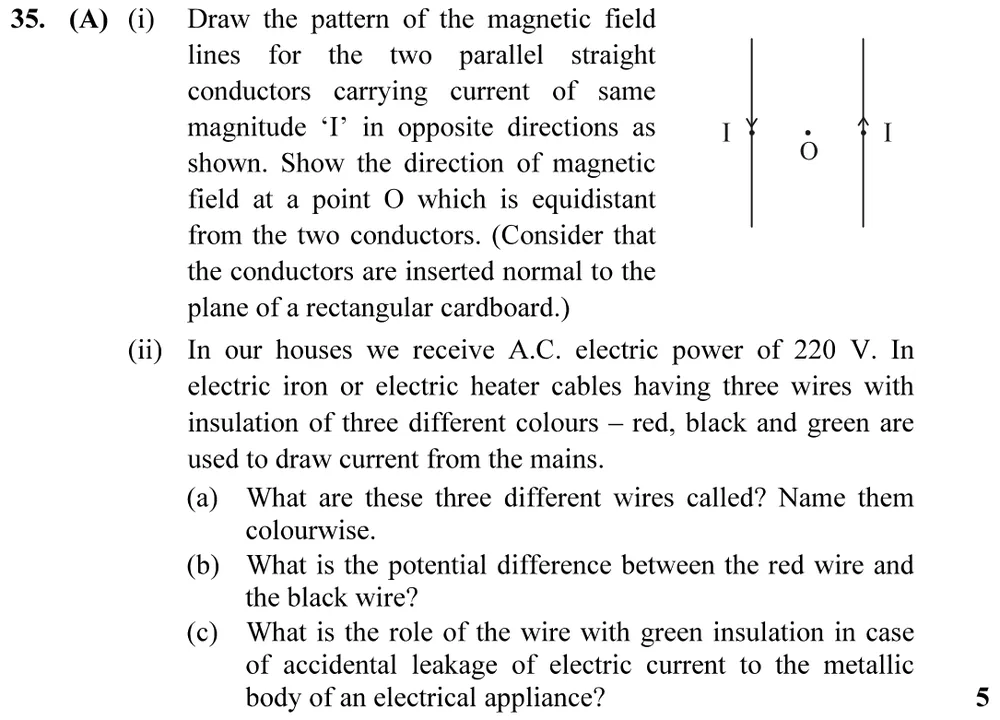
(i) Draw the pattern of the magnetic field lines for the two parallel straight conductors carrying current of same magnitude 'I' in opposite directions as shown. Show the direction of magnetic field at a point O which is equidistant from the two conductors. (Consider that the conductors are inserted normal to the plane of a rectangular cardboard.) (ii) In our houses we receive A.C. electric power of 220 V. In electric iron or electric heater cables having three wires with insulation of three different colours – red, black and green are used to draw current from the mains. (a) What are these three different wires called? Name them colourwise. (b) What is the potential difference between the red wire and the black wire? (c) What is the role of the wire with green insulation in case of accidental leakage of electric current to the metallic body of an electrical appliance? Write your answer, send a photo, get it marked in DheeAnswer and marking
- (i) Draw circles around each wire, with arrows by the right-hand thumb rule. Diagram: concentric circular field lines around each conductor ; opposite sense of rotation around the two wires 1 mark
- Check the arrows of both sets of circles at the midpoint O. At O both fields point in the same direction, so they add up 1 mark
- (ii)(a) Give each colour its wire name. Red: live wire ; black: neutral wire ; green: earth wire 1.5 marks
- (b) The mains voltage is between live and neutral. Potential difference between red and black = 220 V 0.5 marks
- (c) Say where leaked current goes and why the user is safe. The earth wire keeps the metal body at earth's potential, so leaked current flows to earth and the user does not get a severe shock 1 mark
Answer: (i) Fields add at O (ii)(a) Red live, black neutral, green earth (b) 220 V (c) Leaked current goes to earth; no severe shock
Marks: Field pattern 1 · Direction at O 1 · Wires and voltage 2 · Earth wire 1
For full marks: In (c), write 'keeps the metal body at earth's potential' and 'the user does not get a severe shock'.
Where students lose marks: Drawing arrows the same way round both wires; currents are opposite, so the circles must turn opposite ways.
CBSE marking scheme
(i) Correct pattern of concentric field lines around each conductor (1) and correct direction at O - the fields of the two wires add up at O (1). (ii)(a) Red - live, black - neutral, green - earth wire (½ × 3). (b) 220 V (½). (c) Safety: earth wire keeps the metal body at earth potential so leaked current flows to earth and the user does not get a severe shock (1).
- Q10 Long answer · 5 marks CBSE · 2025
Solenoid: define, field pattern
(i) Define the term solenoid. Draw the pattern of the magnetic field lines in and around a current carrying straight solenoid. Mark on the pattern the (i) direction of current, (ii) direction of field lines near the ends of the solenoid, and (iii) region where the magnetic field is uniform. (ii) How would you make an electromagnet using a current carrying solenoid ?
Write your answer, send a photo, get it marked in DheeAnswer and marking
- (i) Define it by what it is made of and its shape. A solenoid is a coil of many turns of insulated copper wire wrapped closely in the shape of a cylinder 1 mark
- Draw the solenoid and its field lines inside and outside. Diagram: straight, parallel lines inside ; outside, lines curve from one end to the other like a bar magnet 1.5 marks
- Show which way the current flows in the turns. Mark arrows for the direction of current in the turns 0.5 marks
- Label the ends to show the field direction there. Mark N and S at the ends ; field lines leave the N end and enter the S end 0.5 marks
- Point out where the lines are parallel and evenly spaced. Mark the region inside the solenoid as the uniform magnetic field 0.5 marks
- (ii) Say what you place inside the coil. Place a piece of magnetic material such as soft iron inside the current-carrying solenoid ; it becomes an electromagnet 1 mark
Answer: (i) Coil of many closely wound turns shaped like a cylinder (ii) Put soft iron inside the current-carrying solenoid
Marks: Definition 1 · Diagram 1½ · Three markings 1½ · Electromagnet 1
For full marks: Label all three things in the diagram: current arrows, N and S ends, and 'uniform field' inside. Each is half a mark.
Where students lose marks: Drawing curved or unevenly spaced lines inside the solenoid; inside they must be straight and parallel.
CBSE marking scheme
(i) Solenoid: a coil of many turns of insulated copper wire wrapped closely in the shape of a cylinder (1). Diagram of field lines (1½), marking current direction, field direction at the ends (N/S) and uniform parallel field inside (½×3). (ii) Place a piece of magnetic material such as soft iron inside the current-carrying solenoid (1).
Free 10-question test: Magnetic Effects of Electric Current
MCQ and Assertion–Reason questions from CBSE papers. About 10 minutes. Your score shows straight away.
Common mistakes in Magnetic Effects of Electric Current
Mistake Drawing field lines with no arrows, or arrows that do not match the current.
Fix Mark the current on the wire and put arrows on the field lines. Use the right-hand thumb rule to check them. The scheme cuts ½ mark if the direction of the current or the field is not marked.
Mistake Getting the direction of field lines wrong in a magnet or a solenoid.
Fix Outside a magnet, lines go from N to S. Inside, they go from S to N. Inside a solenoid the lines are straight, parallel and equally spaced: the field is uniform. A compass points along the field where it is kept.
Mistake Using the wrong rule.
Fix The right-hand thumb rule gives the direction of the field around a current. Fleming's left-hand rule gives the direction of the force on a current in a field. A compass cannot give the direction of the force.
Mistake Taking the direction of an electron beam as the current.
Fix Current flows opposite to the way electrons move. Turn the electron direction round first, then apply Fleming's left-hand rule.
Mistake Mixing up the wire colours.
Fix Live wire: red. Neutral wire: black. Earth wire: green. Between live and neutral there is 220 V. These are the book's colours for the exam. Never touch or open any wire at home: no wire is safe to touch.
Mistake Calling the fuse and the earth wire the same kind of safety, or saying any fuse will do.
Fix A fuse melts during overloading or a short circuit and protects the circuit and appliances. The earth wire takes leaked current from a metal body to the earth and protects you from a severe shock. A fuse of higher rating than needed will not melt, so it does not protect.
How to write for full marks
- For 'name and state the rule', write the name, then the full statement: thumb, forefinger and middle finger of the left hand at right angles; forefinger = field, middle finger = current, thumb = force. The name and the statement carry separate marks.
- For a solenoid diagram, draw closely wound turns, lines like a bar magnet outside and straight parallel lines inside. Mark the current direction, N and S at the ends, and the region where the field is uniform. Each marking carries ½ mark.
- For a fuse question, write I = P/V, change kW to W, find the current in A, then compare it with the fuse rating in a full sentence.
- For 'two precautions', name both (fuse, earth wire) for ½ mark each, then say how each one protects for 1 mark each.
- When asked how the force can be reversed, give the two ways as two separate points: reverse the current, or reverse the magnetic field.
Not in the 2026-27 exam
Leave these out of your revision.
- Electric motor, electromagnetic induction, generator: school assessment only
- Information in the NCERT boxes
Questions students ask
Which Magnetic Effects of Electric Current questions are most important for the Class 10 board exam 2027?
Expect 3-mark questions and Assertion–Reason on field lines, the solenoid, the right-hand thumb rule, Fleming's left-hand rule, fuses and the earth wire. The 10 questions on this page are real CBSE board questions from 2023–2026, chosen across the chapter's topics and question types.
How many marks does Magnetic Effects of Electric Current carry in the Class 10 board exam?
Magnetic Effects of Electric Current is part of the Effects of Current unit, which carries 6 of the 80 theory marks in the CBSE Class 10 Science paper.
Are these real CBSE previous year questions?
Yes. Each question is printed as it appeared in a CBSE board paper or sample paper, with its source, and the answer follows CBSE's official marking scheme.
Questions and answers: CBSE board papers, sample papers and official marking schemes, 2023–2026. Worked steps and tips: Dhee.