Chapter 11 · CBSE Board 2027
Electricity Class 10 important questions with answers
The 10 questions to practise first, picked from every CBSE board paper 2023–2026. Each one has the official answer and how to write it for full marks. Then try the free 10-question test.
What comes in the exam
- Electricity is in the Effects of Current unit.
- The unit is worth 13 marks, shared with Magnetic Effects of Electric Current.
- MCQs come most, then 2-, 3- and 5-mark questions in about equal numbers, and some 4-mark case studies.
- Almost every year you get circuit problems with resistors in series, in parallel or mixed, where you find the total resistance, the current and a potential difference.
- Resistivity with R = ρl/A, Ohm's law with its circuit or V–I graph, Joule's law of heating and electric power (P = VI = I²R = V²/R) also come almost every year, and most 5-mark questions come from these.
- The kilowatt hour comes often.
Top 10 Electricity questions from board papers
Real CBSE questions, printed as they appeared. Open each answer to see the marking and the steps.
- Q1 Short answer · 3 marks CBSE · 2026
Plot V-I graph, find resistance
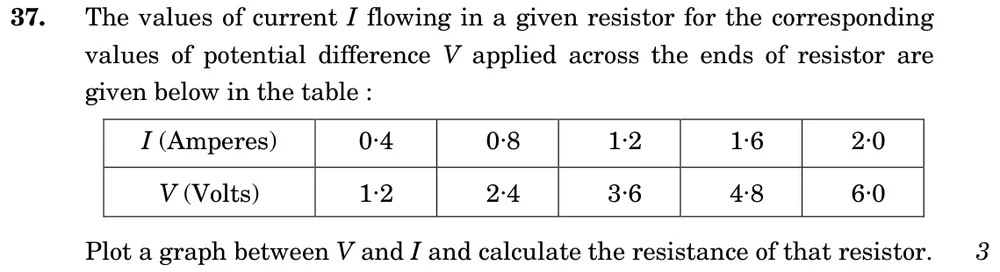
The values of current I flowing in a given resistor for the corresponding values of potential difference V applied across the ends of resistor are given below in the table. Plot a graph between V and I and calculate the resistance of that resistor. Write your answer, send a photo, get it marked in DheeAnswer and marking
- Plot the five points with V on the y-axis and I on the x-axis, and join them. Graph: a straight line through the origin, from (0.4 A, 1.2 V) to (2.0 A, 6.0 V) 2 marks
- The slope of a V–I graph gives the resistance. R = slope = (6.0 − 1.2)/(2.0 − 0.4) 0.5 marks
- Divide to get R in ohms. R = 4.8/1.6 = 3 Ω 0.5 marks
Answer: Straight line through the origin; R = 3 Ω
Marks: Graph 2 · Slope ½ · Answer ½
For full marks: Write 'R = slope' before the numbers — the slope line carries its own ½.
Where students lose marks: Taking ΔI/ΔV as the resistance: that gives 1/3, not 3 Ω; R = ΔV/ΔI.
CBSE marking scheme
Straight-line V-I graph through origin (2). R = slope = (6.0 - 1.2)/(2.0 - 0.4) (½) = 4.8/1.6 = 3 Ω (½).
- Q2 Short answer · 3 marks CBSE · 2026
Bulb dims when heater is on
(a) Why does an electric bulb become dim when an electric heater in parallel circuit is switched ON ? (b) How to connect three resistors each of resistance 8 Ω, so that the equivalent resistance of the combination is 12 Ω ? Draw diagram of the combination and justify your answer.
Write your answer, send a photo, get it marked in DheeAnswer and marking
- (a) The heater takes a lot of current from the same supply. (a) The heater draws a large current, so the current through the bulb decreases and it glows dim 1 mark
- (b) Join two resistors in parallel, add the third in series, and draw it. (b) Diagram: two 8 Ω in parallel, in series with the third 8 Ω 1 mark
- Justify by working out the total resistance. 1/R₁ = 1/8 + 1/8 ⇒ R₁ = 4 Ω ; Req = 4 + 8 = 12 Ω 1 mark
Answer: (a) The heater draws a large current, so the bulb's current falls (b) Two 8 Ω in parallel + one 8 Ω in series = 12 Ω
Marks: Dim bulb 1 · Diagram 1 · Justification 1
For full marks: Write the check 'Req = 4 + 8 = 12 Ω' — the justification mark is for that calculation, separate from the diagram.
Where students lose marks: Putting all three in series (24 Ω) or all in parallel (8/3 Ω): only two in parallel plus one in series gives 12 Ω.
CBSE marking scheme
(a) The heater draws a large current, so the current through the bulb decreases and it glows dim (1). (b) Two 8 Ω in parallel, in series with the third 8 Ω - diagram (1); 1/R1 = 1/8 + 1/8, R1 = 4 Ω; Req = 4 + 8 = 12 Ω (1).
- Q3 Short answer · 3 marks CBSE · 2026
Circuit: R total, I, p.d. P to Q
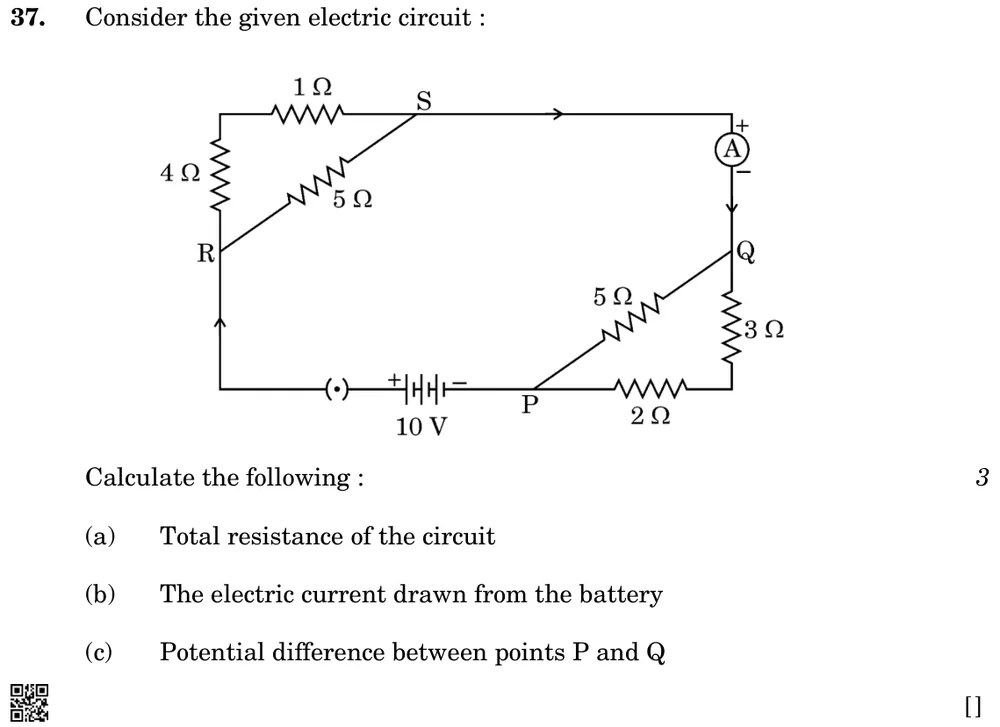
Consider the given electric circuit. Calculate the following: (a) Total resistance of the circuit (b) The electric current drawn from the battery (c) Potential difference between points P and Q Write your answer, send a photo, get it marked in DheeAnswer and marking
- (a) Work out each block: series pair first, then parallel with 5 Ω, then add blocks. (a) 4 + 1 = 5 Ω, parallel with 5 Ω ⇒ R₁ = 5/2 Ω ; 2 + 3 = 5 Ω, parallel with 5 Ω ⇒ R₂ = 5/2 Ω ; R = 5/2 + 5/2 = 5 Ω 1 mark
- (b) Use Ohm's law for the whole circuit. (b) I = V/R = 10/5 = 2 A 1 mark
- (c) The whole current flows through the P–Q block. (c) V_PQ = I × R₂ = 2 × 5/2 = 5 V 1 mark
Answer: (a) 5 Ω (b) 2 A (c) 5 V
Marks: Total resistance 1 · Current 1 · P.d. across PQ 1
For full marks: Show R₁ = 5/2 Ω and R₂ = 5/2 Ω before adding — the resistance mark is for the two block values.
Where students lose marks: Using the total 5 Ω in (c) and getting 10 V: only the P–Q block's 5/2 Ω lies between P and Q.
CBSE marking scheme
(a) 4 Ω + 1 Ω = 5 Ω, in parallel with 5 Ω between R and S: R1 = 5/2 Ω; 2 Ω + 3 Ω = 5 Ω in parallel with 5 Ω between P and Q: R2 = 5/2 Ω; total R = 5 Ω (1). (b) I = V/R = 10/5 = 2 A (1). (c) VPQ = I × R2 = 2 × 5/2 = 5 V (1).
- Q4 Short answer · 3 marks CBSE · 2025
1 volt meaning; circuit symbols
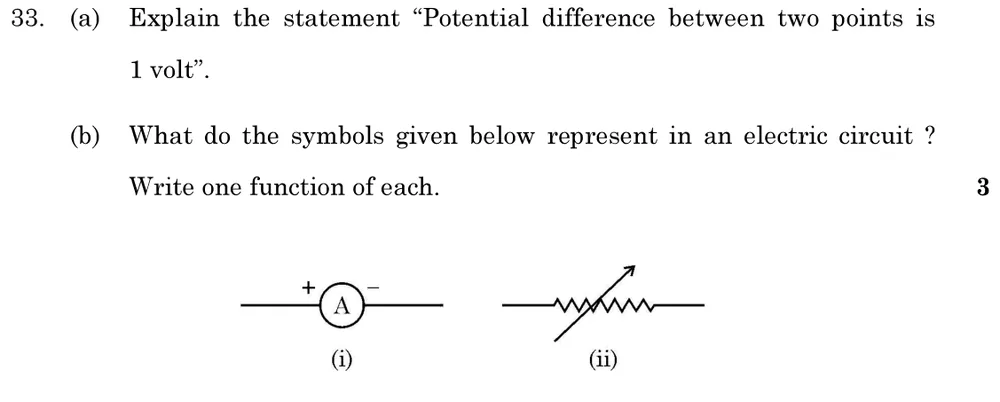
(a) Explain the statement "Potential difference between two points is 1 volt". (b) What do the symbols given below represent in an electric circuit? Write one function of each. (i) a circle with 'A' marked + and − (ii) a zig-zag resistor with an arrow drawn across it Write your answer, send a photo, get it marked in DheeAnswer and marking
- (a) Use V = W/Q with 1 joule and 1 coulomb. (a) 1 joule of work is done to move a charge of 1 coulomb from one point to the other 1 mark
- (b)(i) A circle with the letter A is a meter. (b)(i) Ammeter 0.5 marks
- Now give its job in the circuit. It measures electric current 0.5 marks
- (ii) An arrow across a resistor means its value can be changed. (ii) Rheostat (variable resistance) 0.5 marks
- Now give its job in the circuit. It varies the resistance, and so the current, in the circuit 0.5 marks
Answer: (a) 1 J of work moves 1 C between the points (b)(i) Ammeter: measures current (ii) Rheostat: varies resistance and current
Marks: 1 volt 1 · Ammeter 1 · Rheostat 1
For full marks: In (a) write both '1 joule of work' and '1 coulomb of charge' — the mark needs work done per unit charge.
Where students lose marks: Calling the zig-zag with an arrow a plain resistor: the arrow makes it a rheostat (variable resistance).
CBSE marking scheme
(a) 1 joule of work is done to move a charge of 1 coulomb from one point to the other (1). (b) (i) Ammeter (½) – measures electric current (½). (ii) Rheostat / variable resistance (½) – varies the resistance (and so the current) in the circuit (½).
- Q5 Case study · 4 marks CBSE · 2026
Case: heat from a refrigerator
Read the following passage and answer the questions that follow: Swati, a class 10 student, observes that when she passes close to the refrigerator in her kitchen, she feels the heat, although the things kept inside the refrigerator are cool. (i) Describe the cause of heating in the above-mentioned case. (1) (ii) A current I flows through a resistor of resistance R when the potential difference across it is V. Applying Ohm's law, write the formula for amount of heat produced by the resistor in time t. (1) (iii) (A) Write any two practical applications of heating effect of electric current. (2) OR (B) Define the commercial unit of electric energy and express it in Joules (J). (2)
Write your answer, send a photo, get it marked in DheeAnswer and marking
- (i) Not all the electrical energy becomes useful work. (i) Part of the electrical energy does useful work; the rest is dissipated as heat, raising the gadget's temperature 1 mark
- (ii) Start from H = VIt and replace V using V = IR. (ii) H = VIt = I²Rt = (V²/R)t 1 mark
- (iii)(A) Name a device that works on heat from current. (iii)(A) Electric iron 1 mark
- Name a second, different one. Electric heater (or toaster, oven, bulb filament) 1 mark
- (iii)(B) Define the unit using 1 kW for 1 hour. (iii)(B) 1 kWh: the energy used when 1 kW of power is used for 1 hour 1 mark
- Change it into joules, the SI unit of energy. 1 kWh = 3.6 × 10⁶ J 1 mark
Answer: (i) Part of the electrical energy is dissipated as heat (ii) H = I²Rt (iii)(A) Electric iron, heater / (B) 1 kWh = 3.6 × 10⁶ J
Marks: (i) Cause 1 · (ii) Formula 1 · (iii) Two points 2
For full marks: In (B) write '1 kWh = 3.6 × 10⁶ J' as its own line — the second mark is for the value in joules.
Where students lose marks: Defining kWh as '1 kW per hour': it is the energy used when 1 kW of power is used for 1 hour.
CBSE marking scheme
(i) Part of the electrical energy does useful work and the rest is dissipated as heat, raising the gadget's temperature (1). (ii) H = VIt = I²Rt = (V²/R)t (1). (iii)(A) Any two: electric heater, oven, electric iron, toaster, bulb filament (1+1). OR (B) 1 kWh = energy used when 1 kW of power is used for 1 hour (1); 1 kWh = 3.6 × 10⁶ J (1).
- Q6 Case study · 4 marks CBSE · 2026
Case: what affects resistance
Three students Shweta, Ayesha and Samridhi were performing an experiment to understand the factors on which the resistance of a conductor depends. Each one of them completed electric circuit with the help of a cell, an ammeter, a plug key and wire. Shweta put nichrome wire of length 'l' in the circuit and after plugging the key, noted current in the ammeter. Ayesha put nichrome wire of same thickness but twice the length i.e. '2l' in the circuit and after plugging the key, noted current in the ammeter. Samridhi took copper wire of length 'l' and same thickness in the circuit and after plugging the key, noted current in the ammeter. (i) If the ammeter reading is X ampere with nichrome wire of length 'l', then what will be the ammeter reading if the length of nichrome wire is doubled with same area of cross-section ? (1) (ii) What happens to the ammeter reading if the area of cross-section of nichrome wire is doubled, keeping the length of wire 'l' the same ? (1) (iii) Define 'resistivity'. Write its SI unit. Compare the resistivity of an alloy with its constituents metals. (2) OR (iii) Give reason : (I) Tungsten is used almost exclusively for making the filament of electric lamps. (II) Conductors of bread-toasters are made of an alloy rather than a pure metal. (2)
Write your answer, send a photo, get it marked in DheeAnswer and marking
- (i) Resistance grows with length, and current falls as resistance rises. Length doubled ⇒ R doubles ⇒ reading = X/2 1 mark
- (ii) A thicker wire has less resistance, so more current flows. Area doubled ⇒ R halves ⇒ reading = 2X 1 mark
- (iii) Give the definition using unit length and unit area. Resistivity is the resistance of a conductor of unit length and unit area of cross-section 1 mark
- Write its SI unit. SI unit of resistivity = Ω m 0.5 marks
- Compare an alloy with the metals it is made from. Resistivity of an alloy is higher than that of its constituent metals 0.5 marks
- (iii)(I) A lamp filament gets very hot, so it must not melt. (I) Tungsten has a high melting point 1 mark
- (II) Give the alloy property that suits a heating element. (II) An alloy has higher resistivity than its constituent metals and does not oxidise (burn) readily at high temperatures 1 mark
Answer: (i) X/2 (ii) 2X (iii) (a) resistance of unit length and unit area, Ω m, alloy higher / (b) high melting point; alloy has higher resistivity and does not oxidise
Marks: (i) Current 1 · (ii) Current 1 · (iii) Definition or reason I 1 · (iii) Unit + comparison or reason II 1
For full marks: Write the unit as 'Ω m' (ohm metre), not 'Ω' or 'Ω/m' — that ½ is often lost.
Where students lose marks: Saying the reading doubles when length doubles: a longer wire has more resistance, so the current halves to X/2.
CBSE marking scheme
(i) Resistance doubles, so reading becomes X/2 (halved) (1). (ii) Resistance halves, so reading becomes 2X (doubled) (1). (iii) Resistivity = resistance of a conductor of unit length and unit area of cross-section (1); SI unit Ω m (½); resistivity of an alloy is higher than that of its constituent metals (½). OR (iii)(I) Tungsten has a high melting point (1). (II) Alloys have higher resistivity than constituent metals / do not oxidise (burn) readily at high temperatures (1).
- Q7 Case study · 4 marks CBSE · 2025
Case: V-I readings and graphs
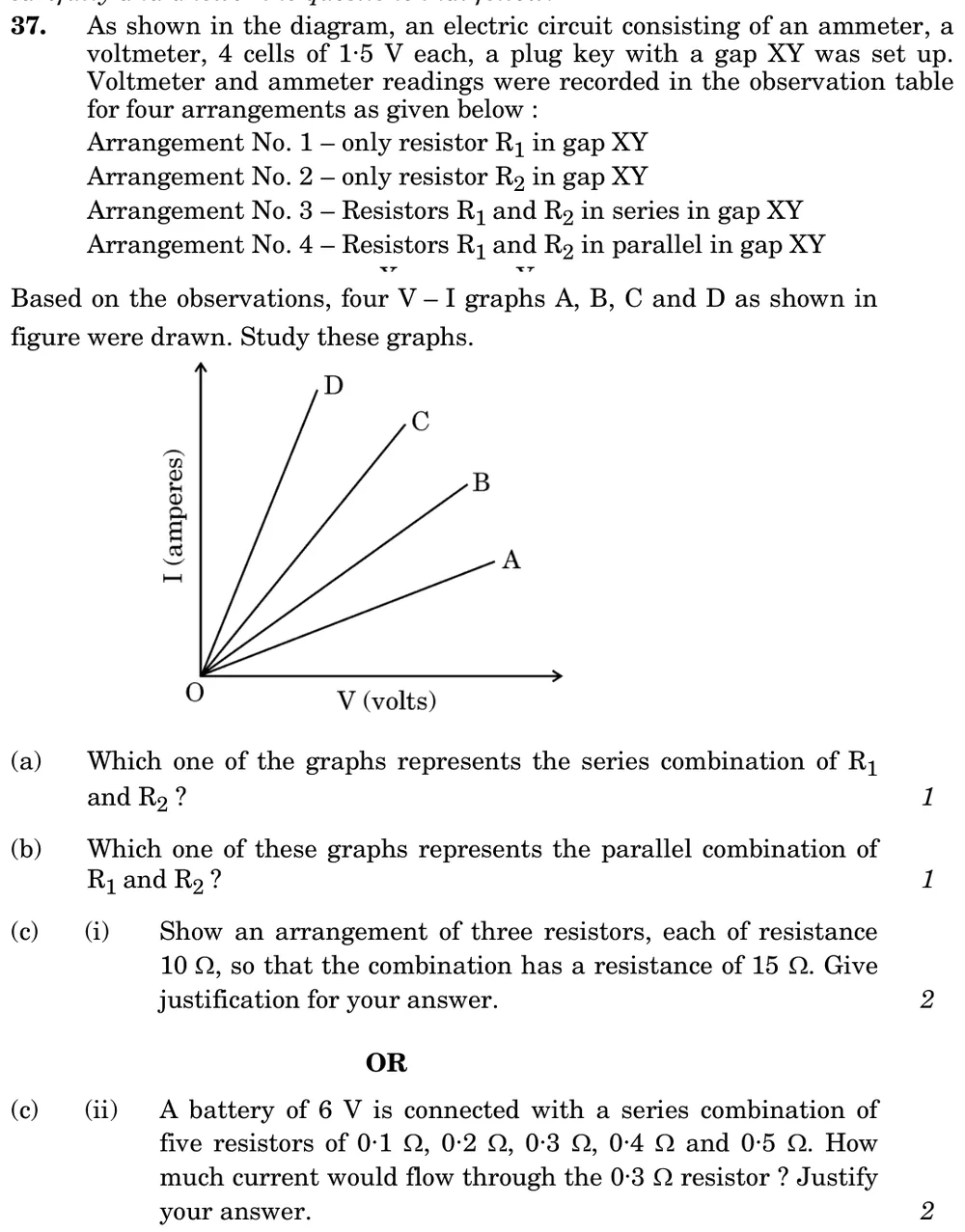
As shown in the diagram, an electric circuit consisting of an ammeter, a voltmeter, 4 cells of 1.5 V each, a plug key with a gap XY was set up. Voltmeter and ammeter readings were recorded in the observation table for four arrangements: Arrangement 1 – only resistor R1 in gap XY; Arrangement 2 – only resistor R2 in gap XY; Arrangement 3 – resistors R1 and R2 in series in gap XY; Arrangement 4 – resistors R1 and R2 in parallel in gap XY. Based on the observations, four V–I graphs A, B, C and D as shown in figure were drawn. (i) Which one of the graphs represents the series combination of R1 and R2? (1) (ii) Which one of these graphs represents the parallel combination of R1 and R2? (1) (iii) Show an arrangement of three resistors, each of resistance 10 Ω, so that the combination has a resistance of 15 Ω. Give justification for your answer. (2) OR A battery of 6 V is connected with a series combination of five resistors of 0.1 Ω, 0.2 Ω, 0.3 Ω, 0.4 Ω and 0.5 Ω. How much current would flow through the 0.3 Ω resistor? Justify your answer. (2) Write your answer, send a photo, get it marked in DheeAnswer and marking
- (i) The series pair has the largest resistance, so its line rises least steeply. Graph A — least slope I/V, so largest resistance 1 mark
- (ii) The parallel pair has the smallest resistance, so its line is the steepest. Graph D — steepest slope I/V, so least resistance 1 mark
- (iii) Put two resistors side by side, then join the third after them. Two 10 Ω resistors in parallel, and this pair in series with the third 10 Ω (draw the diagram) 1 mark
- Find the parallel pair first, then add the series resistor. 1/Rp = 1/10 + 1/10 ⇒ Rp = 5 Ω ; R = 5 + 10 = 15 Ω 1 mark
- (iii) Add the five resistances, then use Ohm's law for the current. R = 0.1 + 0.2 + 0.3 + 0.4 + 0.5 = 1.5 Ω ; I = V/R = 6/1.5 = 4 A 1 mark
- Explain why the 0.3 Ω resistor gets this same current. In series the same current flows through every resistor, so current through 0.3 Ω = 4 A 1 mark
Answer: (i) Graph A (ii) Graph D (iii) (a) two 10 Ω in parallel, in series with 10 Ω = 15 Ω / (b) 4 A
Marks: (i) Graph 1 · (ii) Graph 1 · (iii) Arrangement or current 1 · (iii) Justification 1
For full marks: In the OR part, write 'the same current flows through every resistor in series' — that sentence earns the second mark.
Where students lose marks: Picking graph D as series: on an I–V graph the steepest line has the least resistance, so D is the parallel pair.
CBSE marking scheme
(i) Graph A (least slope I/V, largest resistance) (1). (ii) Graph D (steepest, least resistance) (1). (iii) Two 10 Ω in parallel (= 5 Ω) in series with the third 10 Ω: R = 5 + 10 = 15 Ω (diagram 1, calculation 1). OR I = V/R = 6 V/(0.1+0.2+0.3+0.4+0.5) Ω = 6/1.5 = 4.0 A (1); same current flows through every resistor in series (1).
- Q8 Case study · 4 marks CBSE · 2024
Case: circuit between A, B, C
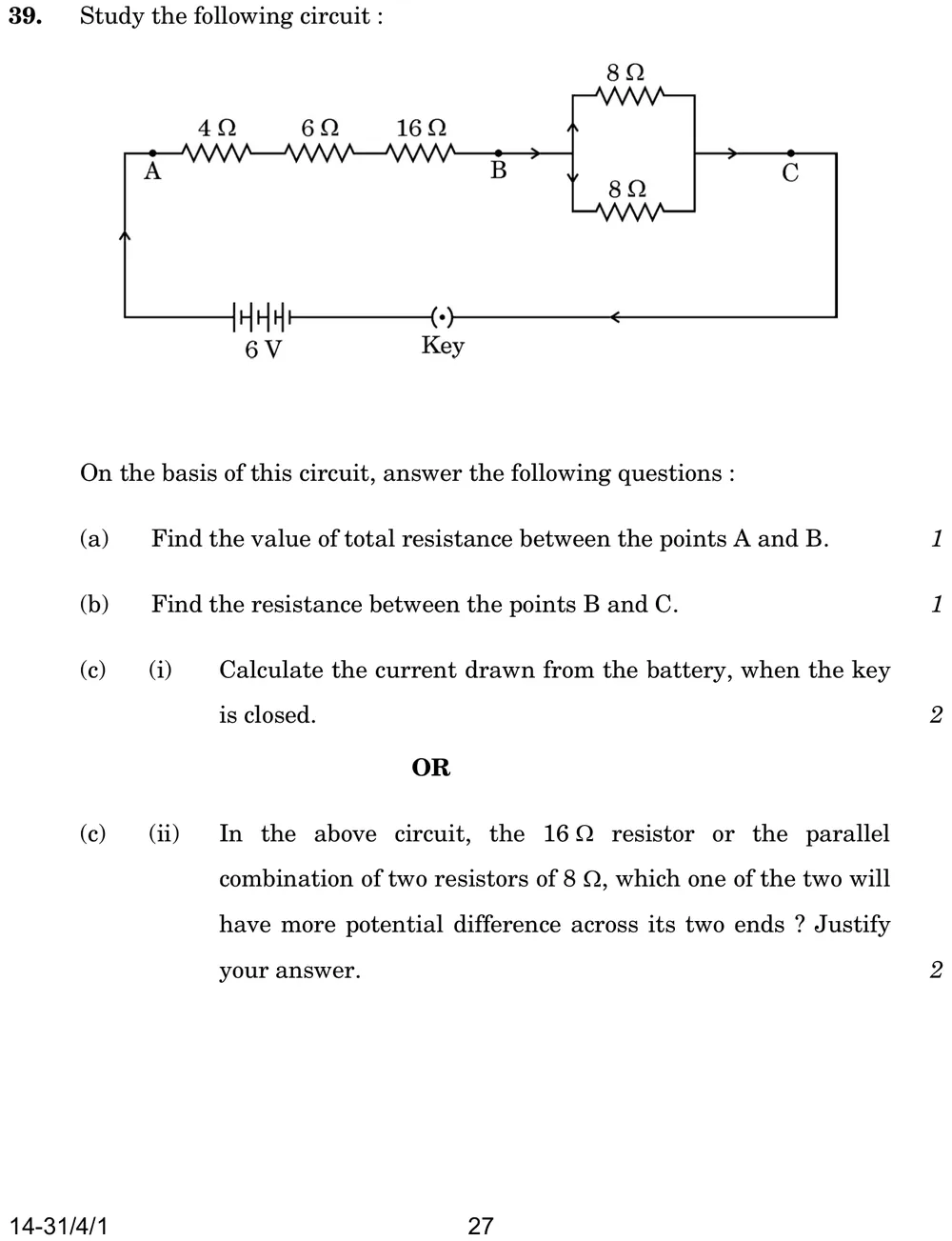
Study the following circuit and answer the questions: (i) Find the value of total resistance between the points A and B. (1) (ii) Find the resistance between the points B and C. (1) (iii) Calculate the current drawn from the battery, when the key is closed. (2) OR (iii) In the above circuit, the 16 Ω resistor or the parallel combination of two resistors of 8 Ω, which one of the two will have more potential difference across its two ends? Justify your answer. (2) Write your answer, send a photo, get it marked in DheeAnswer and marking
- (i) The three resistors between A and B are in series, so add them. (i) Rs = 4 + 6 + 16 = 26 Ω 1 mark
- (ii) The two equal resistors between B and C are in parallel. (ii) 1/Rp = 1/8 + 1/8 = 1/4 ⇒ Rp = 4 Ω 1 mark
- (iii) The two parts are in series, so add them. (iii) R = 26 + 4 = 30 Ω, V = 6 V 1 mark
- Now use Ohm's law. I = V/R = 6/30 = 0.2 A 1 mark
- (iii) Compare the 16 Ω resistor with the 4 Ω parallel pair. (iii) The 16 Ω resistor has more potential difference 1 mark
- The same current flows through both, so more resistance means more p.d. V = IR: 0.2 × 16 = 3.2 V, while 0.2 × 4 = 0.8 V 1 mark
Answer: (i) 26 Ω (ii) 4 Ω (iii)(a) I = 0.2 A / (b) the 16 Ω resistor (3.2 V against 0.8 V)
Marks: (i) A–B resistance 1 · (ii) B–C resistance 1 · (iii) Working and answer 2
For full marks: In the OR part write 'the same current flows through both' — the second mark is for that justification.
Where students lose marks: Comparing 16 Ω with 8 Ω: the two 8 Ω resistors in parallel act as 4 Ω, so compare with 4 Ω.
CBSE marking scheme
(i) Rs = 4 + 6 + 16 = 26 Ω (1). (ii) 1/Rp = 1/8 + 1/8 = 1/4, Rp = 4 Ω (1). (iii) R = 26 + 4 = 30 Ω, V = 6 V (1); I = V/R = 6/30 = 0.2 A (1). OR (iii) 16 Ω resistor (1): same current flows, so the larger resistance has the larger p.d. — 0.2 × 16 = 3.2 V vs 0.2 × 4 = 0.8 V (1).
- Q9 Long answer · 5 marks CBSE · 2023
Ohm's law circuit; V-I graphs
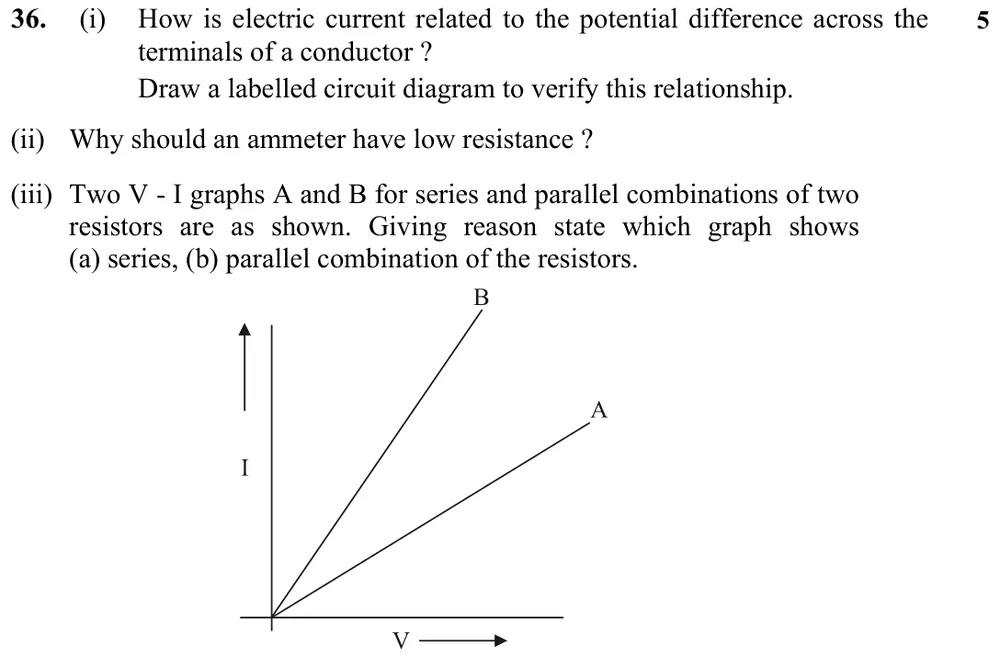
(i) How is electric current related to the potential difference across the terminals of a conductor ? Draw a labelled circuit diagram to verify this relationship. (ii) Why should an ammeter have low resistance ? (iii) Two V - I graphs A and B for series and parallel combinations of two resistors are as shown. Giving reason state which graph shows (a) series, (b) parallel combination of the resistors. Write your answer, send a photo, get it marked in DheeAnswer and marking
- (i) State Ohm's law as a proportion. Current is directly proportional to potential difference: V ∝ I (Ohm's law) 1 mark
- Draw the circuit and label every part. Cell, key, ammeter and rheostat in series with the resistor ; voltmeter connected across the resistor 1 mark
- (ii) Think about where the ammeter sits in the circuit. Ammeter is connected in series, so it must have low resistance and not reduce the current it measures 1 mark
- (iii)(a) Less slope on an I–V graph means more resistance. Series: graph A ; less slope, so more resistance 1 mark
- (b) More slope on an I–V graph means less resistance. Parallel: graph B ; more slope, so less resistance 1 mark
Answer: (i) I ∝ V (Ohm's law) (ii) low resistance so the full current flows (iii) (a) series = A (b) parallel = B
Marks: Law + circuit 2 · Ammeter reason 1 · Series 1 · Parallel 1
For full marks: For each graph write the reason — 'less slope, so more resistance' — the reason carries half of each mark.
Where students lose marks: Choosing B as series: here I is on the vertical axis, so the steeper line B has less resistance, which is the parallel pair.
CBSE marking scheme
(i) Current is directly proportional to potential difference, V ∝ I (Ohm's law) (1); labelled circuit with cell, key, ammeter in series, voltmeter across resistor, rheostat (1). (ii) Ammeter is in series, so it must not add resistance / must let full current flow (1). (iii) Series: graph A, less slope so more resistance (1/2, 1/2); parallel: graph B, more slope so less resistance (1/2, 1/2).
- Q10 Long answer · 5 marks CBSE · 2023
Resistance: definition, factors
(i) What is meant by resistance of a conductor? Define its SI unit. (ii) List two factors on which the resistance of a rectangular conductor depends. (iii) How will the resistance of a wire be affected if its (1) length is doubled, and (2) radius is also doubled? Give justification for your answer.
Write your answer, send a photo, get it marked in DheeAnswer and marking
- (i) Say what resistance does to the flow of charge. Resistance is the property of a conductor to oppose the flow of charge through it 1 mark
- Define the ohm using 1 V and 1 A. 1 ohm is the resistance of a conductor when a potential difference of 1 V across it drives a current of 1 A ; 1 Ω = 1 V/1 A 1 mark
- (ii) Name any two factors. Length of the conductor ; area of cross-section (also: nature of material, temperature) 1 mark
- (iii) Write R with area πr², then double both l and r. R = ρl/(πr²) ; R' = ρ(2l)/(π(2r)²) = ρ(2l)/(4πr²) 1 mark
- Simplify and state the effect. R' = (1/2) × ρl/(πr²) = R/2, so the resistance becomes half 1 mark
Answer: (i) opposition to flow of charge; 1 Ω = 1 V/1 A (ii) length, area of cross-section (iii) resistance becomes half
Marks: Meaning + ohm 2 · Two factors 1 · Justification + result 2
For full marks: Define the ohm with 'a potential difference of 1 V drives a current of 1 A' — that definition is a full mark.
Where students lose marks: Forgetting to square the doubled radius: (2r)² = 4r², so R becomes R/2, not unchanged.
CBSE marking scheme
(i) Property of a conductor to oppose flow of charge (1); 1 ohm = resistance when 1 V across it drives 1 A (1). (ii) Any two: length, area of cross-section, nature of material, temperature (½+½). (iii) R = ρl/(πr²); R' = ρ(2l)/(π(2r)²) = R/2, so resistance becomes half (2).
Free 10-question test: Electricity
MCQ and Assertion–Reason questions from CBSE papers. About 10 minutes. Your score shows straight away.
Common mistakes in Electricity
Mistake Putting the radius in cm straight into R = ρl/A.
Fix Change every length to metres first: 0.01 cm = 1 × 10⁻⁴ m. Then A = πr². The scheme gives ½ mark for writing the values in SI units and ½ for A = πr².
Mistake Adding parallel resistors like series ones, or forgetting to turn 1/Rp over.
Fix Write 1/Rp = 1/R₁ + 1/R₂ + …, add the fractions, then flip to get Rp. In a mixed circuit, solve the inner group first, then add the series parts.
Mistake Using the total voltage to find the p.d. across one part.
Fix In series the same current flows through every resistor. Find I = V/R for the whole circuit, then the p.d. across one part = I × that part's resistance.
Mistake Using the rated power when the voltage changes.
Fix The resistance stays the same. First find R from the rating (R = V/I or R = V²/P). Then use P = V²/R with the new voltage. The scheme gives 1 mark for R, ½ for the formula and ½ for the answer.
Mistake Reading a V–I graph the wrong way.
Fix Check which quantity is on which axis. Resistance = V/I. If I is on the y-axis, the line with less slope has more resistance, so it is the series one. To find R, take two points on the line and write R = ΔV/ΔI.
Mistake Mixing up resistance and resistivity.
Fix Resistance depends on length, area of cross-section and material, not on shape. Resistivity depends only on the material and its temperature. Its SI unit is Ω m, not Ω.
How to write for full marks
- Write the formula first, then put in the values with units, then the answer with its unit (Ω, A, V, W or J). The scheme gives ½ mark for the formula line.
- In a circuit problem, name each step as you go: 'R of parallel part = …', 'total R = …', 'I = V/R = …', 'p.d. across PQ = I × R = …'. Each step carries its own mark.
- For 'how would you join' questions, draw the circuit diagram and show the working that gives the required value. The scheme gives a mark for the diagram and a mark for the calculation.
- For Ohm's law, state it (V ∝ I at constant temperature) and draw the circuit: cell, key, ammeter and rheostat in series with the resistor, voltmeter across the resistor.
- For a V–I graph, label both axes with units, plot the points, and draw one straight line through the origin. The graph alone carries 2 marks in a 3-mark question.
Not in the 2026-27 exam
Leave these out of your revision.
- Information in the NCERT boxes
Questions students ask
Which Electricity questions are most important for the Class 10 board exam 2027?
Expect circuit problems on series, parallel and mixed resistors, resistivity and power calculations, and Ohm's law with its graph, as MCQs, 2-, 3- and 5-mark questions. The 10 questions on this page are real CBSE board questions from 2023–2026, chosen across the chapter's topics and question types.
How many marks does Electricity carry in the Class 10 board exam?
Electricity is part of the Effects of Current unit, which carries 7 of the 80 theory marks in the CBSE Class 10 Science paper.
Are these real CBSE previous year questions?
Yes. Each question is printed as it appeared in a CBSE board paper or sample paper, with its source, and the answer follows CBSE's official marking scheme.
Questions and answers: CBSE board papers, sample papers and official marking schemes, 2023–2026. Worked steps and tips: Dhee.