Chapter 11 · CBSE Board 2027
Areas Related to Circles Class 10 important questions with answers
The 10 questions to practise first, picked from every CBSE board paper 2023–2026. Each one has the official answer and how to write it for full marks. Then try the free 10-question test.
What comes in the exam
- Areas Related to Circles is in the Mensuration unit, worth 10 marks together with Surface Areas and Volumes.
- MCQs (1 mark) come most, then 3-mark and 2-mark questions, and often a 4-mark case study.
- Almost every year there are questions on the length of an arc and the area of a sector: MCQs that find the angle or the radius, and 2- or 3-mark sums on car wipers, clock hands or a lighthouse beam.
- The area of a segment (for 60°, 90° or 120°) and the area or perimeter of a shaded region also come almost every year, as 2- or 3-mark questions.
Top 10 Areas Related to Circles questions from board papers
Real CBSE questions, printed as they appeared. Open each answer to see the marking and the steps.
- Q1 Short answer · 3 marks CBSE · 2024, 2023 Asked in 2024, 2023
Area cleaned by two wipers
A car has two wipers which do not overlap. Each wiper has a blade of length 21 cm sweeping through an angle of 120°. Find the area cleaned at each sweep of the blades.
Write your answer, send a photo, get it marked in DheeAnswer and marking
- Note the radius and the angle of each sector. r = 21 cm, θ = 120° 0.5 marks
- Use the sector area formula for one wiper. Area of one sweep = (120/360) × (22/7) × 21 × 21 1 mark
- Work it out. = 462 cm² 0.5 marks
- There are two wipers that do not overlap, so double it. Total = 2 × 462 = 924 cm² 1 mark
Answer: 924 cm²
Marks: Data ½ · Sector formula 1 · One wiper ½ · Two wipers 1
For full marks: Write 'Total = 2 × 462' — the last full mark is for counting both wipers.
Where students lose marks: Giving 462 cm² as the answer, forgetting there are two wipers.
CBSE marking scheme
r = 21 cm, θ = 120° (½); one wiper = (120/360) × (22/7) × 21 × 21 (1) = 462 cm2 (½); total for two wipers = 2 × 462 = 924 cm2 (1).
- Q2 Short answer · 3 marks CBSE · 2026
Arc AB for chord at 120°, r = 21
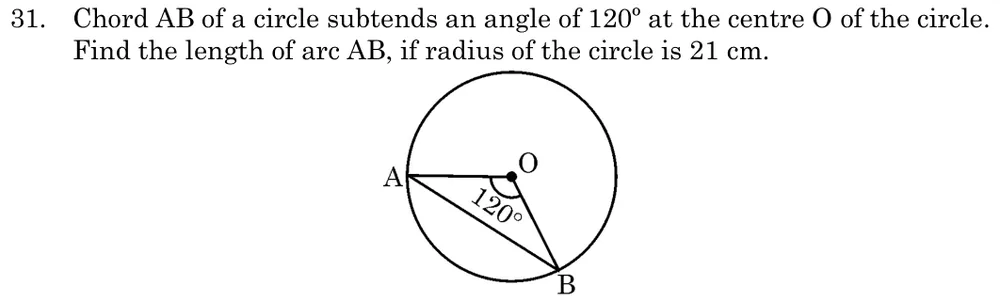
Chord AB of a circle subtends an angle of 120° at the centre O of the circle. Find the length of arc AB, if radius of the circle is 21 cm. Write your answer, send a photo, get it marked in DheeAnswer and marking
- Use the arc-length formula with θ = 120° and r = 21 cm. Arc AB = (120/360) × 2 × (22/7) × 21 2 marks
- Cancel and simplify. = 44 cm 1 mark
Answer: 44 cm
Marks: Formula with values 2 · Answer 1
For full marks: Write the whole line (120/360) × 2 × (22/7) × 21 — it earns 2 of the 3 marks.
Where students lose marks: Using πr² instead of 2πr gives 462 cm², an area instead of the arc length.
CBSE marking scheme
Arc AB = (120/360) × 2 × (22/7) × 21 (2) = 44 cm (1).
- Q3 Short answer · 3 marks CBSE · 2026
Major sector perimeter, segment
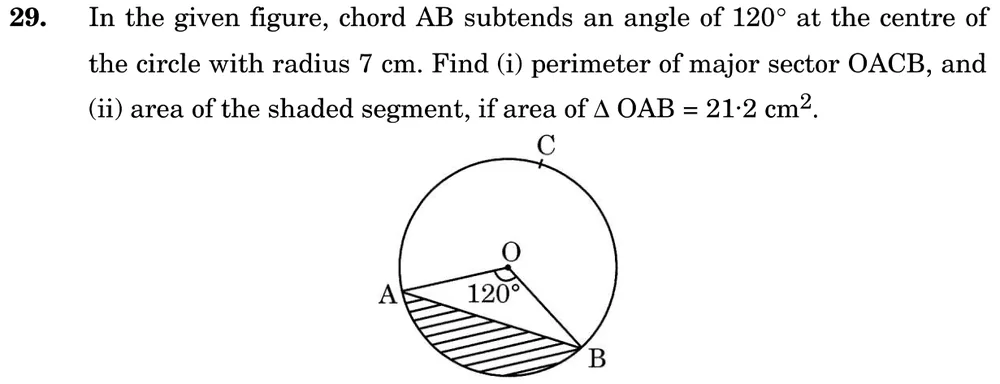
In the given figure, chord AB subtends an angle of 120° at the centre of the circle with radius 7 cm. Find (i) perimeter of major sector OACB, and (ii) area of the shaded segment, if area of △OAB = 21.2 cm^2. Write your answer, send a photo, get it marked in DheeAnswer and marking
- (i) Use the major angle 240° for the arc, then add the two radii. Perimeter = major arc + 2r = (240/360) × 2 × (22/7) × 7 + 14 1 mark
- Simplify. = 88/3 + 14 = 130/3 cm ≈ 43.3 cm 0.5 marks
- (ii) Take the given triangle area away from the 120° minor sector. Area of segment = minor sector − △OAB = (120/360) × (22/7) × 7 × 7 − 21.2 1 mark
- Calculate. = 154/3 − 21.2 ≈ 51.33 − 21.2 = 30.1 cm² 0.5 marks
Answer: (i) 130/3 cm ≈ 43.3 cm · (ii) ≈ 30.1 cm²
Marks: Perimeter 1½ · Segment area 1½
For full marks: In (i) write 'major arc + 2r' with '+ 14' — the first mark needs both radii in the perimeter.
Where students lose marks: In (ii) using the 240° major sector gives 102.67 − 21.2 ≈ 81.5 cm²; the shaded segment is on the 120° side.
CBSE marking scheme
(i) Perimeter = major arc + 2r = (240/360) × 2 × (22/7) × 7 + 14 (1) = 130/3 cm ≈ 43.3 cm (½). (ii) Segment = minor sector − △OAB = (120/360) × (22/7) × 7 × 7 − 21.2 (1) = 30.1 cm2 (½).
- Q4 Case study · 4 marks CBSE · 2026
Case: fencing a circular field
Vaibhav installed a fence around a circular field, with the total cost amounting to ₹6,000 at a rate of ₹30 per m. He now plans to plough the field. (i) What is the perimeter of the field ? (1) (ii) What is the radius of the field ? (1) (iii) (a) What is the area of the field ? (2) OR (iii) (b) Find the cost of ploughing the field at the rate of ₹0.50 per m2. (2)
Write your answer, send a photo, get it marked in DheeAnswer and marking
- (i) Divide the total fencing cost by the rate per metre. Perimeter = 6000/30 = 200 m 1 mark
- (ii) The fence length is the circumference, so solve for r. 2πr = 200 ⇒ r = 350/11 m ≈ 31.8 m 1 mark
- (iii)(a) Use area = πr² with r = 350/11 m. Area = (22/7) × (350/11)² 1 mark
- Calculate. Area ≈ 3181.8 m² 1 mark
- (iii)(b) First find the field's area with r = 350/11 m. Area = (22/7) × (350/11)² ≈ 3181.8 m² 1 mark
- Multiply the area by the rate of ₹0.50 per m². Cost = 3181.8 × 0.50 ≈ ₹1590.90 1 mark
Answer: (i) 200 m · (ii) 350/11 m ≈ 31.8 m · (iii) (a) ≈ 3181.8 m² / (b) ≈ ₹1590.90
Marks: Perimeter 1 · Radius 1 · Part three 2
For full marks: In (ii) write '2πr = 200' before solving — it shows the fence length is the circumference.
Where students lose marks: Forgetting the 2 (πr = 200) gives r ≈ 63.6 m, and the area comes out four times too big.
CBSE marking scheme
(i) 6000/30 = 200 m (1). (ii) 2πr = 200 ⇒ r = 350/11 ≈ 31.8 m (1). (iii)(a) area = (22/7)(350/11)2 ≈ 3181.8 m2 (1 + 1). OR (iii)(b) area ≈ 3181.8 m2 (1); cost = 3181.8 × 0.50 ≈ ₹1590.90 (½ + ½).
- Q5 Case study · 4 marks CBSE · 2025
Case: brooch design
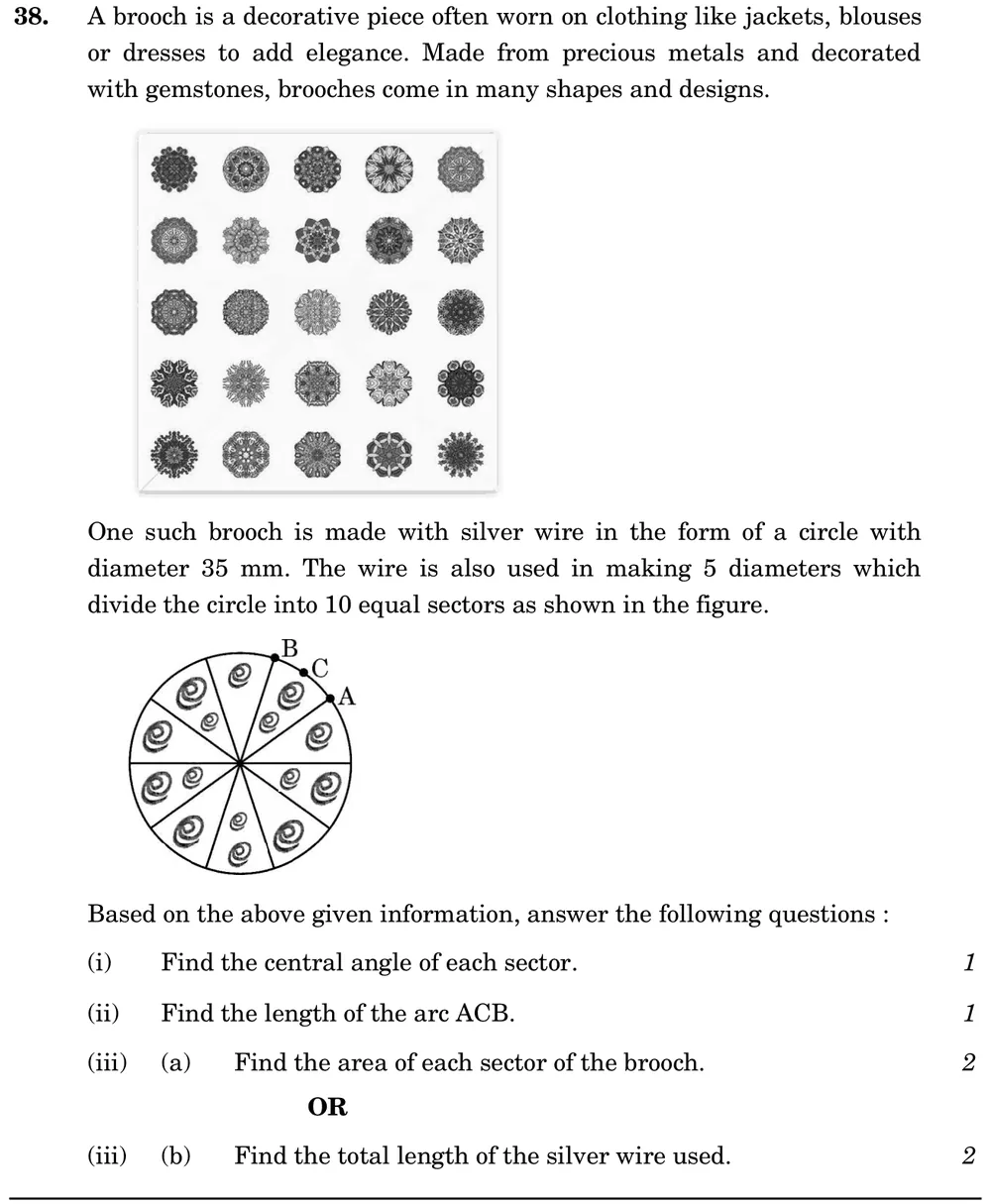
Case Study 2: A brooch is a decorative piece often worn on clothing like jackets, blouses or dresses to add elegance. Made from precious metals and decorated with gemstones, brooches come in many shapes and designs. One such brooch is made with silver wire in the form of a circle with diameter 35 mm. The wire is also used in making 5 diameters which divide the circle into 10 equal sectors as shown in the figure. (i) Find the central angle of each sector. (1) (ii) Find the length of the arc ACB. (1) (iii) (a) Find the area of each sector of the brooch. (2) OR (iii) (b) Find the total length of the silver wire used. (2) Write your answer, send a photo, get it marked in DheeAnswer and marking
- (i) Ten equal sectors share the full 360° at the centre. Central angle = 360°/10 = 36° 1 mark
- (ii) Arc ACB is one-tenth of the circumference, with radius 35/2 mm. Arc ACB = (1/10) × 2 × (22/7) × (35/2) = 11 mm 1 mark
- (iii)(a) Each sector is one-tenth of the circle's area. Area of each sector = (1/10) × (22/7) × (35/2) × (35/2) 1 mark
- Simplify. = 385/4 mm² = 96.25 mm² 1 mark
- (iii)(b) The wire makes the circle's rim and also five diameters. Wire = 2 × (22/7) × (35/2) + 5 × 35 1 mark
- Work out each part and add. = 110 + 175 = 285 mm 1 mark
Answer: (i) 36° · (ii) 11 mm · (iii) (a) 96.25 mm² / (b) 285 mm
Marks: Angle 1 · Arc 1 · Part three 2
For full marks: In (iii)(b) write '+ 5 × 35' — the wire includes the five diameters, not just the rim.
Where students lose marks: Using r = 35 mm (the diameter) instead of 35/2 mm doubles the arc to 22 mm and makes the sector four times too big.
CBSE marking scheme
(i) 360°/10 = 36° (1). (ii) arc ACB = (1/10) × 2 × (22/7) × (35/2) = 11 mm (1). (iii)(a) area of each sector = (1/10) × (22/7) × (35/2) × (35/2) (1) = 385/4 mm2 = 96.25 mm2 (1). OR (iii)(b) wire = 2 × (22/7) × (35/2) + 5 × 35 (1) = 110 + 175 = 285 mm (1).
- Q6 Case study · 4 marks CBSE · 2023
Case: memento prize base
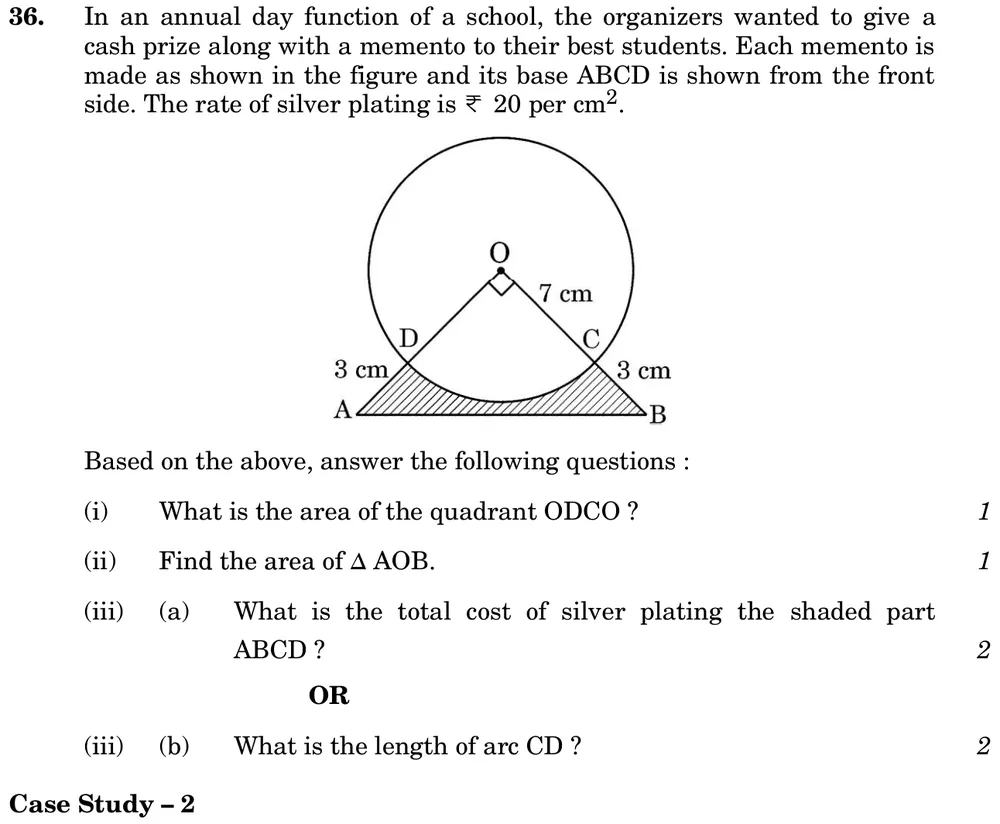
Case Study: In an annual day function of a school, the organizers wanted to give a cash prize along with a memento to their best students. Each memento is made as shown in the figure and its base ABCD is shown from the front side. The rate of silver plating is ₹20 per cm^2. (i) What is the area of the quadrant ODCO? (1) (ii) Find the area of △AOB. (1) (iii) (a) What is the total cost of silver plating the shaded part ABCD? (2) OR (iii) (b) What is the length of arc CD? (2) Write your answer, send a photo, get it marked in DheeAnswer and marking
- (i) Write the quadrant area with r = 7 cm. Area of quadrant ODCO = (22/7) × 7 × 7 × 90/360 0.5 marks
- Simplify. = 77/2 = 38.5 cm² 0.5 marks
- (ii) The angle at O is 90°, so OA and OB are the base and height. ar(△AOB) = (1/2) × 10 × 10 = 50 cm² 1 mark
- (iii)(a) The shaded part is the triangle minus the quadrant. Shaded area = 50 − 38.5 = 11.5 cm² 1 mark
- Multiply the shaded area by ₹20 per cm². Cost = (50 − 38.5) × 20 = ₹230 1 mark
- (iii)(b) Arc CD is a quarter of the circumference of radius 7 cm. Arc CD = (90/360) × 2 × (22/7) × 7 1 mark
- Simplify. = 11 cm 1 mark
Answer: (i) 38.5 cm² · (ii) 50 cm² · (iii) (a) ₹230 / (b) 11 cm
Marks: Quadrant 1 · Triangle 1 · Part three 2
For full marks: In (iii)(a) write 'Shaded area = 50 − 38.5' as its own line — it earns a mark before the cost.
Where students lose marks: Using 10 cm as the quadrant's radius: OA = 10 cm reaches the base, but the circle's radius is 7 cm.
CBSE marking scheme
(i) Area of quadrant ODCO = (22/7) × 7 × 7 × 90/360 = 77/2 = 38.5 cm2 (½ + ½). (ii) ar(△AOB) = (1/2) × 10 × 10 = 50 cm2 (1). (iii)(a) Cost = (50 − 38.5) × 20 = ₹230 (1 + 1). OR (iii)(b) Arc CD = (90/360) × 2 × (22/7) × 7 = 11 cm (1 + 1).
- Q7 Case study · 4 marks CBSE · 2023
Case: badge circle in a square
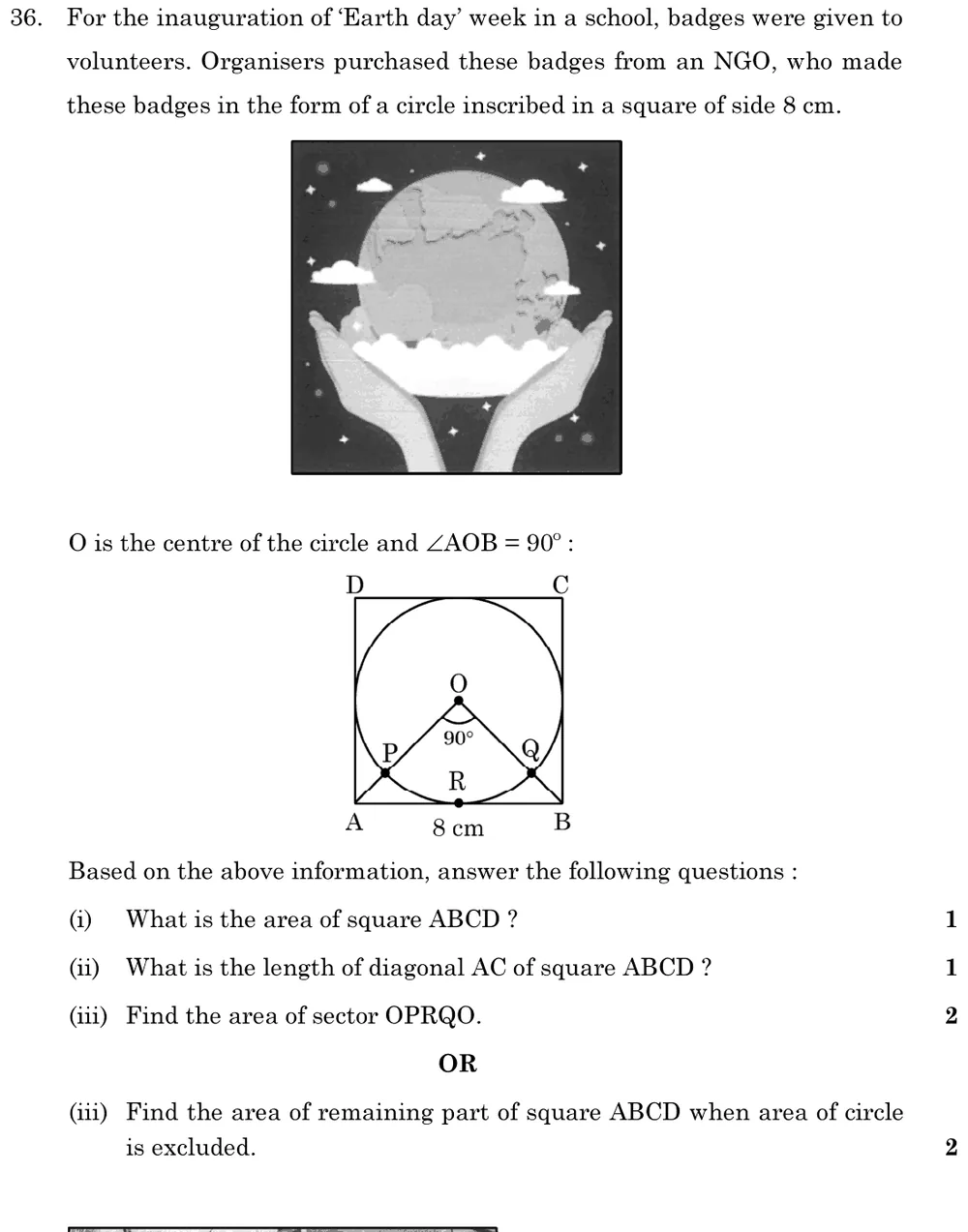
For the inauguration of 'Earth day' week in a school, badges were given to volunteers. Organisers purchased these badges from an NGO, who made these badges in the form of a circle inscribed in a square of side 8 cm. O is the centre of the circle and ∠AOB = 90°. Based on the above information, answer the following questions: (i) What is the area of square ABCD? (1) (ii) What is the length of diagonal AC of square ABCD? (1) (iii) Find the area of sector OPRQO. (2) OR (iii) Find the area of remaining part of square ABCD when area of circle is excluded. (2) Write your answer, send a photo, get it marked in DheeAnswer and marking
- (i) The area of a square is side squared. Area of square ABCD = 8² = 64 cm² 1 mark
- (ii) Use Pythagoras in right △ABC. AC = √(8² + 8²) = √128 = 8√2 cm 1 mark
- (iii) The inscribed circle's radius is half the side, and the sector angle is 90°. r = 4 cm, ∠AOB = 90° ; Area of sector OPRQO = (22/7) × 4 × 4 × 90/360 1 mark
- Simplify. = 88/7 cm² 1 mark
- (iii) OR: find the area of the inscribed circle with r = 4 cm. Area of circle = (22/7) × 16 = 352/7 cm² 1 mark
- Take the circle away from the square. Remaining area = 64 − 352/7 = 96/7 cm² 1 mark
Answer: (i) 64 cm² · (ii) 8√2 cm · (iii) (a) 88/7 cm² / (b) 96/7 cm²
Marks: Square 1 · Diagonal 1 · Part three 2
For full marks: In (iii) write 'r = 4 cm' first — the circle inside a square of side 8 cm has radius half the side.
Where students lose marks: Taking r = 8 cm (the side) instead of 4 cm makes the sector 352/7 cm², four times too big.
CBSE marking scheme
(i) 8² = 64 cm² (1). (ii) AC = √(8² + 8²) = √128 = 8√2 cm (1). (iii) r = 4, ∠AOB = 90°: sector = (22/7) × 4 × 4 × 90/360 (1) = 88/7 cm² (1). OR (iii) circle = (22/7) × 16 = 352/7 cm² (1); remaining = 64 − 352/7 = 96/7 cm² (1).
- Q8 Long answer · 5 marks CBSE · 2023
Horse grazing in square field
A horse is tied to a peg at one corner of a square shaped grass field of side 15 m by means of a 5 m long rope. Find the area of that part of the field in which the horse can graze. Also, find the increase in grazing area if length of rope is increased to 10 m. (Use π = 3.14)
Write your answer, send a photo, get it marked in DheeAnswer and marking
- A horse tied at a square's corner grazes a quadrant, here of radius 5 m. Grazing area (r = 5 m) = ¼ × 3.14 × 5² 1 mark
- Simplify. = ¼ × 3.14 × 25 = 19.625 m² 1 mark
- With a 10 m rope the quadrant has radius 10 m. Grazing area (r = 10 m) = ¼ × 3.14 × 10² 1 mark
- Simplify. = ¼ × 3.14 × 100 = 78.5 m² 1 mark
- Take the old area away from the new one. Increase in grazing area = 78.5 − 19.625 = 58.875 m² 1 mark
Answer: 19.625 m²; increase = 58.875 m²
Marks: Area with short rope 2 · Area with long rope 2 · Increase 1
For full marks: Write 'Increase = 78.5 − 19.625' as a separate line — the last mark is for the difference, not the new area.
Where students lose marks: Using a full circle πr² instead of a quadrant gives 78.5 m² for the 5 m rope; the corner allows only a quarter.
CBSE marking scheme
Quadrant r = 5: ¼ × 3.14 × 25 = 19.625 m2 (1 + 1); r = 10: ¼ × 3.14 × 100 = 78.5 m2 (1 + 1); increase = 58.875 m2 (1).
- Q9 Long answer · 5 marks CBSE · 2023
Minor and major segment, r = 14
A chord of a circle of radius 14 cm subtends an angle of 60° at the centre. Find the area of the corresponding minor segment of the circle. Also find the area of the major segment of the circle.
Write your answer, send a photo, get it marked in DheeAnswer and marking
- With a 60° angle the triangle is equilateral, so subtract it from the sector with r = 14 cm. Minor segment = area of sector − area of triangle = (60/360)(22/7)(14)² − (√3/4)(14)² 2 marks
- Simplify, taking √3 ≈ 1.73. = (308/3 − 49√3) cm² ≈ 17.9 cm² 1 mark
- Take the minor segment away from the whole circle. Major segment = (22/7)(14)² − (308/3 − 49√3) 1 mark
- Open the bracket and simplify. = (1540/3 + 49√3) cm² ≈ 598.1 cm² 1 mark
Answer: Minor segment (308/3 − 49√3) ≈ 17.9 cm²; major segment (1540/3 + 49√3) ≈ 598.1 cm²
Marks: Minor segment expression 2 · Minor segment value 1 · Major segment 2
For full marks: Write 'area of sector − area of triangle' before the numbers — the first 2 marks pay for this setup.
Where students lose marks: Subtracting without the bracket, 616 − 308/3 − 49√3, gives about 428.6 cm² instead of 598.1 cm².
CBSE marking scheme
Minor segment = (60/360)(22/7)(14)2 − (√3/4)(14)2 (1 + 1) = (308/3 − 49√3) cm2 ≈ 17.9 cm2 (1). Major segment = (22/7)(14)2 − (308/3 − 49√3) (1) = (1540/3 + 49√3) cm2 ≈ 598.1 cm2 (1).
- Q10 Long answer · 5 marks CBSE · 2023
Shaded area and minor arc, r = 7
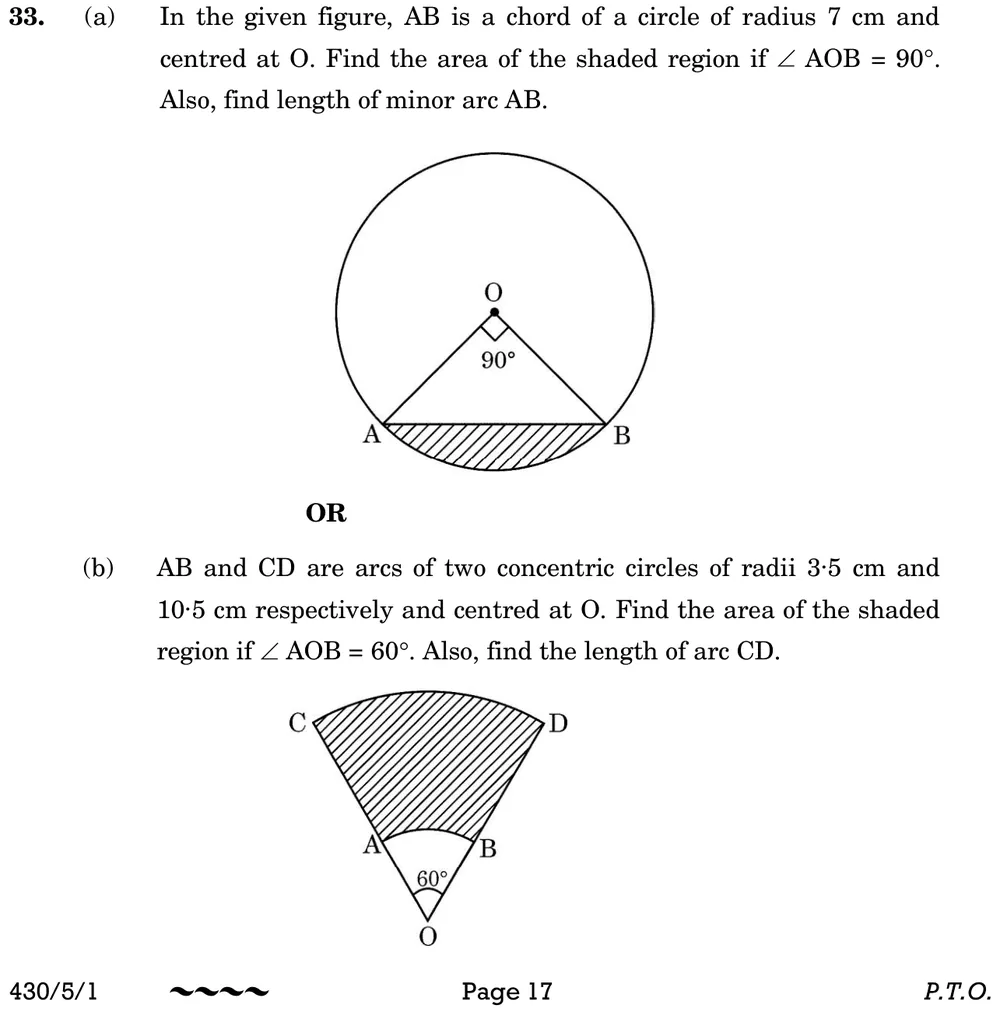
In the given figure, AB is a chord of a circle of radius 7 cm and centred at O. Find the area of the shaded region if ∠AOB = 90°. Also, find length of minor arc AB. Write your answer, send a photo, get it marked in DheeAnswer and marking
- Write the 90° sector area with r = 7 cm. Area of sector = 22/7 × 7 × 7 × 90/360 1 mark
- Simplify. = 77/2 cm² 0.5 marks
- The angle at O is 90°, so the radii are the base and height. Area of △AOB = ½ × 7 × 7 = 49/2 cm² 1 mark
- The shaded part is the minor segment, so take the triangle away from the sector. Shaded area = 77/2 − 49/2 = 14 cm² 1 mark
- Use the arc-length formula with the same angle and radius. Arc AB = 2 × 22/7 × 7 × 90/360 = 11 cm 1.5 marks
Answer: Shaded area 14 cm²; minor arc AB = 11 cm
Marks: Sector 1½ · Triangle 1 · Shaded area 1 · Arc 1½
For full marks: Write the arc line 2 × 22/7 × 7 × 90/360 in full — it carries 1½ marks.
Where students lose marks: Giving the sector 77/2 cm² as the shaded area, forgetting to subtract the triangle's 49/2 cm².
CBSE marking scheme
Sector = 22/7 × 7 × 7 × 90/360 (1) = 77/2 cm² (½); △AOB = ½ × 7 × 7 = 49/2 cm² (1); shaded (minor segment) = 77/2 − 49/2 = 14 cm² (1); arc AB = 2 × 22/7 × 7 × 90/360 = 11 cm (1½).
Free 10-question test: Areas Related to Circles
MCQ and Assertion–Reason questions from CBSE papers. About 10 minutes. Your score shows straight away.
Common mistakes in Areas Related to Circles
Mistake Mixing up the arc length and sector area formulas.
Fix Arc length = (θ/360) × 2πr, in cm. Area of sector = (θ/360) × πr², in cm². Write the one you need before you put in numbers.
Mistake With two wipers, giving the area for only one.
Fix Find the area for one wiper, then read the question again. 'Two wipers which do not overlap' means you multiply by 2. That last step carries 1 mark.
Mistake Taking the wrong angle for a clock hand.
Fix Write the angle as its own step. The minute hand turns 360/60 = 6° each minute. The hour hand turns 360/12 = 30° each hour. Count the minutes or hours from the question.
Mistake Giving only the arc as the perimeter of a sector or shaded region.
Fix Perimeter of a sector = arc + 2r. Perimeter of a segment = arc + chord. If the major sector is asked, use 360° − θ for the arc.
Mistake Giving the sector area when the segment is asked.
Fix Write 'area of segment = area of sector − area of △OAB' first (½ mark). Then find each area. For 90°, △OAB = ½ × r × r. For 60°, △OAB is equilateral, so its area is (√3/4)r².
Mistake Using a different π from the one the question gives.
Fix Use π = 3.14 or 22/7 as the question says. If it says 'in terms of π', keep π in the answer, like 12π cm².
How to write for full marks
- Write r and θ at the start, like 'r = 21 cm, θ = 120°'. The scheme gives ½ mark for this line.
- Write the formula, then the numbers in it, like (60/360) × 2 × (22/7) × 14. This substitution line often carries the most marks.
- For a shaded region, write the plan in words first, like 'shaded area = area of rectangle − 2 × area of circle'.
- Cancel before you multiply: θ/360 first, then 22/7 against 7 or 21. It keeps the numbers small and the answer exact.
- Write cm for lengths and cm² for areas in the final line.
Not in the 2026-27 exam
Leave these out of your revision.
- Segment areas for angles other than 60°, 90° and 120°
Questions students ask
Which Areas Related to Circles questions are most important for the Class 10 board exam 2027?
Expect MCQs on arc length and sector area, 2- or 3-mark sector sums (wipers, clock hands), segment areas, and shaded-region questions. The 10 questions on this page are real CBSE board questions from 2023–2026, chosen across the chapter's topics and question types.
How many marks does Areas Related to Circles carry in the Class 10 board exam?
Areas Related to Circles is part of the Mensuration unit, which carries 5 of the 80 theory marks in the CBSE Class 10 Maths paper.
Are these real CBSE previous year questions?
Yes. Each question is printed as it appeared in a CBSE board paper or sample paper, with its source, and the answer follows CBSE's official marking scheme.
Questions and answers: CBSE board papers, sample papers and official marking schemes, 2023–2026. Worked steps and tips: Dhee.