Chapter 10 · CBSE Board 2027
Circles Class 10 important questions with answers
The 10 questions to practise first, picked from every CBSE board paper 2023–2026. Each one has the official answer and how to write it for full marks. Then try the free 10-question test.
What comes in the exam
- Circles is in the Geometry unit, worth 15 marks together with Triangles.
- MCQs (1 mark) come most, then 3-mark and 2-mark questions, with some Assertion–Reason.
- A 4-mark case study or a 5-mark question comes sometimes.
- Almost every year there is a 3-mark proof that a parallelogram drawn around a circle is a rhombus.
- Proofs that tangents from an outside point are equal, that tangents at the ends of a diameter are parallel, and about the angle between two tangents also come almost every year, as 2- or 3-mark questions.
- MCQs use tangent ⟂ radius and equal tangents to find angles and lengths.
Top 10 Circles questions from board papers
Real CBSE questions, printed as they appeared. Open each answer to see the marking and the steps.
- Q1 Assertion–Reason · 1 mark CBSE · 2023
A-R: tangent and radius
Assertion (A): A tangent to a circle is perpendicular to the radius through the point of contact. Reason (R): The lengths of tangents drawn from the external point to a circle are equal.
- (A) Both Assertion (A) and Reason (R) are true and Reason (R) is the correct explanation of Assertion (A).
- (B) Both Assertion (A) and Reason (R) are true but Reason (R) is not the correct explanation of Assertion (A).
- (C) Assertion (A) is true, but Reason (R) is false.
- (D) Assertion (A) is false, but Reason (R) is true.
Write your answer, send a photo, get it marked in DheeAnswer and marking
Correct option: (B) Both Assertion (A) and Reason (R) are true but Reason (R) is not the correct explanation of Assertion (A).
- Check A: this is the theorem on tangent and radius. tangent ⟂ radius at the point of contact ⇒ A is true
- Check R: this is the theorem on tangents from an outside point. tangents from an external point are equal ⇒ R is true
- Equal tangent lengths do not tell us why the angle is 90°. R does not explain A ⇒ option (B) 1 mark
Answer: (B) Both A and R are true, but R is not the correct explanation of A.
Marks: Correct option 1
For full marks: Ask: does R give the reason for A? Equal tangent lengths say nothing about the 90° angle.
Where students lose marks: Picking (A): both are true tangent theorems, so students assume one explains the other.
CBSE marking scheme
Both statements are true theorems, but equal tangent lengths do not explain why tangent ⟂ radius ⇒ (B).
- Q2 Very short answer · 2 marks CBSE · 2025, 2024, 2023 Asked in 2025, 2024, 2023
Prove diameter tangents parallel
Prove that the tangents drawn at the ends of a diameter of a circle are parallel.
Write your answer, send a photo, get it marked in DheeAnswer and marking
- Draw the diameter AB and the tangents at both ends. Figure: circle centre O, diameter AB, tangent PQ at A and tangent RS at B 0.5 marks
- Name the tangents and use that each radius is perpendicular to its tangent. Let AB be a diameter, PQ the tangent at A and RS the tangent at B ; ∠OAP = ∠OBR = 90° (tangent ⟂ radius) 0.5 marks
- Add the two angles; they lie on the same side of AB. ∠OAP + ∠OBR = 90° + 90° = 180° ; co-interior angles are supplementary 0.5 marks
- Conclude from the co-interior angles. ⇒ PQ ∥ RS 0.5 marks
Answer: PQ ∥ RS, so the tangents at the ends of a diameter are parallel
Marks: Figure ½ · Right angles ½ · Co-interior angles ½ · Conclusion ½
For full marks: Write 'co-interior angles are supplementary' as the reason before PQ ∥ RS — that reason earns its own ½.
Where students lose marks: Picking angles on opposite sides of AB and calling their sum 180° co-interior; check P and R are on the same side.
CBSE marking scheme
Correct figure (1/2). Let AB be a diameter with tangents PQ at A and RS at B; ∠OAP = ∠OBR = 90° (tangent ⟂ radius) (1/2); ∠OAP + ∠OBR = 180°, co-interior angles supplementary (1/2) ⇒ PQ ∥ RS (1/2).
- Q3 Very short answer · 2 marks CBSE · 2026, 2024 Asked in 2026, 2024
Is ∠BAC = ∠DCA? Justify
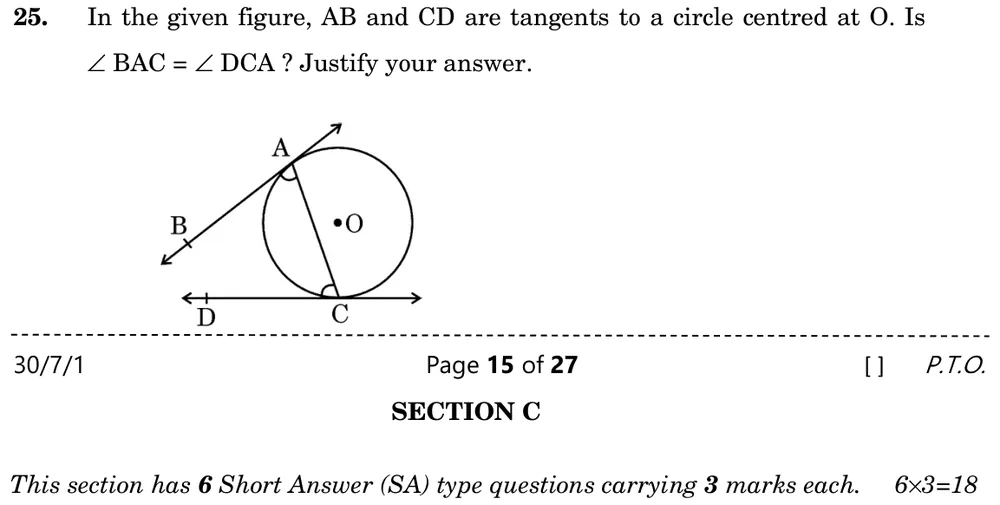
In the given figure, AB and CD are tangents to a circle centred at O. Is ∠BAC = ∠DCA ? Justify your answer. Write your answer, send a photo, get it marked in DheeAnswer and marking
- Join OA and OC; the radii are equal, so triangle OAC is isosceles. Yes ; join OA, OC ; OA = OC ⇒ ∠OAC = ∠OCA 1 mark
- Each tangent is perpendicular to its radius; subtract from 90°. Tangent ⟂ radius ⇒ ∠BAC = 90° − ∠OAC = 90° − ∠OCA = ∠DCA 1 mark
Answer: Yes, ∠BAC = ∠DCA
Marks: Isosceles triangle 1 · Right angles 1
For full marks: Write 'Yes' first, then the line ∠BAC = 90° − ∠OAC = 90° − ∠OCA = ∠DCA.
Where students lose marks: Saying 'yes' because the angles look equal, without joining OA and OC; no radii, no reason, no marks.
CBSE marking scheme
Yes. Join OA, OC; OA = OC ⇒ ∠OAC = ∠OCA (½+½); tangent ⟂ radius ⇒ ∠BAC = 90° − ∠OAC = 90° − ∠OCA = ∠DCA (1).
- Q4 Short answer · 3 marks CBSE · 2026, 2025, 2024, 2023 Asked in 2026, 2025, 2024, 2023
Prove circumscribed ▱ is rhombus
Prove that the parallelogram circumscribing a circle is a rhombus.
Write your answer, send a photo, get it marked in DheeAnswer and marking
- Name the touching points and write the four pairs of equal tangents. Let the circle touch AB, BC, CD, DA at S, P, Q, R ; tangents from an external point are equal ⇒ AS = AR, BS = BP, CQ = CP, DQ = DR 1 mark
- Add the four pairs so each side is built from two tangent pieces. AS + BS + CQ + DQ = AR + BP + CP + DR ⇒ AB + CD = AD + BC 1 mark
- Use that opposite sides of a parallelogram are equal, then conclude. AB = CD and AD = BC ⇒ 2AB = 2AD ⇒ AB = AD ; all sides are equal, so ABCD is a rhombus 1 mark
Answer: AB = BC = CD = DA, so the parallelogram ABCD is a rhombus
Marks: Equal tangents 1 · Adding 1 · Conclusion 1
For full marks: End with 'so ABCD is a rhombus' after AB = AD — the last mark needs that conclusion stated.
Where students lose marks: Writing AB + CD = AD + BC and stopping; without AB = CD, AD = BC you have not shown adjacent sides equal.
CBSE marking scheme
Tangents from an external point are equal: AS = AR, BS = BP, CQ = CP, DQ = DR (1); adding: AB + CD = AD + BC (1); opposite sides equal ⇒ 2AB = 2AD ⇒ AB = AD, so ABCD is a rhombus (1).
- Q5 Short answer · 3 marks CBSE · 2026, 2025, 2024 Asked in 2026, 2025, 2024
Opposite sides: angles at centre
Prove that opposite sides of a quadrilateral circumscribing a circle subtend supplementary angles at the centre of the circle.
Write your answer, send a photo, get it marked in DheeAnswer and marking
- Draw the figure, join O to every vertex and contact point, and number the eight angles at O. Figure: PQRS touches the circle at A on PQ, B on QR, C on RS, D on SP ; ∠1 = ∠DOS, ∠2 = ∠SOC, ∠3 = ∠COR, ∠4 = ∠ROB, ∠5 = ∠BOQ, ∠6 = ∠QOA, ∠7 = ∠AOP, ∠8 = ∠POD 0.5 marks
- Show the two triangles at S are congruent, then repeat at the other vertices. △OCS ≅ △ODS (OC = OD, OS common, SC = SD) ⇒ ∠1 = ∠2 ; similarly ∠3 = ∠4, ∠5 = ∠6, ∠7 = ∠8 1 mark
- The eight angles go once around O, so they add to 360°. ∠1 + ∠2 + … + ∠8 = 360° ⇒ 2(∠1 + ∠8 + ∠4 + ∠5) = 360° ⇒ ∠1 + ∠8 + ∠4 + ∠5 = 180° 1 mark
- Group the angles into the angles at O made by opposite sides. (∠2 + ∠3) + (∠6 + ∠7) = 180° ⇒ ∠SOR + ∠POQ = 180° ; similarly ∠POS + ∠ROQ = 180° 0.5 marks
Answer: ∠SOR + ∠POQ = 180° and ∠POS + ∠ROQ = 180°, so opposite sides subtend supplementary angles at O
Marks: Figure ½ · Congruent pairs 1 · Angle sum 1 · Conclusion ½
For full marks: Write 'similarly ∠POS + ∠ROQ = 180°' — the final ½ needs both pairs of opposite sides covered.
Where students lose marks: Not stating why △OCS ≅ △ODS; without the equal tangents and radii, ∠1 = ∠2 is just assumed.
CBSE marking scheme
Correct figure (½). PQRS touches the circle at A, B, C, D; join O to the vertices and contact points. △OCS ≅ △ODS ⇒ ∠1 = ∠2; similarly ∠3 = ∠4, ∠5 = ∠6, ∠7 = ∠8 (1); sum of all 8 angles = 360° ⇒ 2(∠1 + ∠8 + ∠4 + ∠5) = 360° (1) ⇒ ∠SOR + ∠POQ = 180°, similarly ∠POS + ∠ROQ = 180° (½).
- Q6 Short answer · 3 marks CBSE · 2026, 2024, 2023 Asked in 2026, 2024, 2023
Prove tangents are equal
Prove that the lengths of tangents drawn from an external point to a circle are equal.
Write your answer, send a photo, get it marked in DheeAnswer and marking
- Draw the circle with centre O and two tangents from P. Figure: circle centre O ; tangents PQ and PR from external point P touching at Q and R 1 mark
- Write what is given and what you must prove. Given: PQ and PR are tangents from P to a circle with centre O ; To prove: PQ = PR 0.5 marks
- Join the radii and OP, then compare the two triangles. Join OP, OQ, OR ; in △OQP and △ORP: ∠OQP = ∠ORP = 90°, OQ = OR (radii), OP common 1 mark
- Name the congruence rule and read off the equal sides. △OQP ≅ △ORP (RHS) ⇒ PQ = PR (CPCT) 0.5 marks
Answer: PQ = PR: tangents from an external point are equal
Marks: Figure 1 · Given and to prove ½ · Proof 1½
For full marks: Write the 'Given' and 'To prove' lines — the examiner gives ½ just for them.
Where students lose marks: Leaving out why ∠OQP = 90°; say 'tangent ⟂ radius', or the right angle is unsupported.
CBSE marking scheme
Correct figure (1); Given/To prove (½); proof: join OP, OQ, OR; ∠OQP = ∠ORP = 90°, OQ = OR, OP common, so △OQP ≅ △ORP (RHS) and PQ = PR (1½).
- Q7 Short answer · 3 marks CBSE · 2026, 2023 Asked in 2026, 2023
Prove parallelogram is rhombus
Prove that a parallelogram circumscribing a circle, is a rhombus.
Write your answer, send a photo, get it marked in DheeAnswer and marking
- Draw parallelogram ABCD around the circle, touching AB, BC, CD, DA at P, Q, R, S. Figure: parallelogram ABCD with points of contact P, Q, R, S 0.5 marks
- Tangents from each corner are equal. AP = AS, BP = BQ, CR = CQ, DR = DS 1 mark
- Add them and group into whole sides. (AP + BP) + (CR + DR) = (AS + DS) + (BQ + CQ) ⇒ AB + CD = AD + BC 1 mark
- Use that opposite sides of a parallelogram are equal. AB = CD, AD = BC ⇒ 2AB = 2BC ⇒ AB = BC ; so ABCD is a rhombus 0.5 marks
Answer: ABCD is a rhombus (AB = BC).
Marks: Figure ½ · Equal tangents 1 · Adding 1 · Conclusion ½
For full marks: Write 'AB = BC, so ABCD is a rhombus' — the last ½ is for naming adjacent sides equal.
Where students lose marks: Stopping at AB + CD = AD + BC without using the parallelogram's equal opposite sides.
CBSE marking scheme
Correct figure (½); tangents from a point are equal: AP = AS, BP = BQ, CR = CQ, DR = DS (1); adding, AB + CD = AD + BC (1); AB = CD, AD = BC ⇒ AB = BC, so ABCD is a rhombus (½).
- Q8 Long answer · 5 marks CBSE · 2026
Find AB and PA, tangents OP = 13
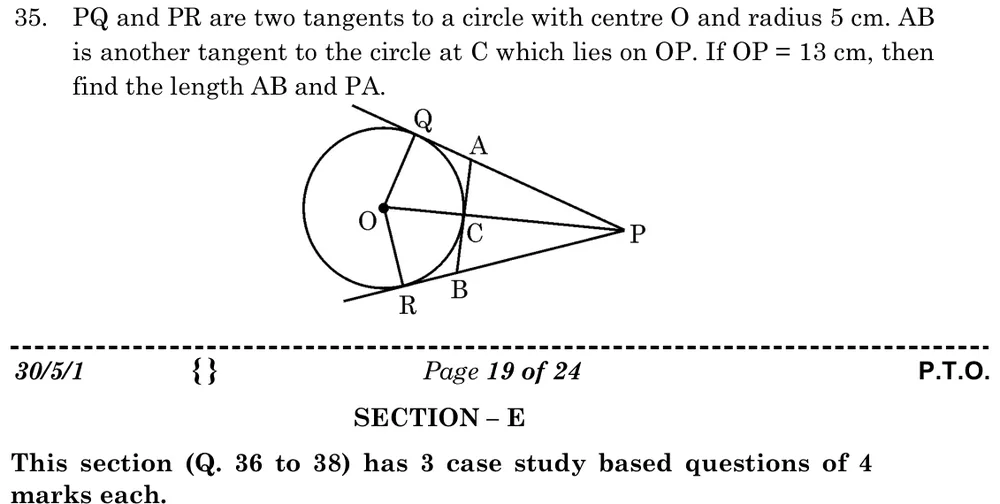
PQ and PR are two tangents to a circle with centre O and radius 5 cm. AB is another tangent to the circle at C which lies on OP. If OP = 13 cm, then find the length AB and PA. Write your answer, send a photo, get it marked in DheeAnswer and marking
- Radius OQ is perpendicular to tangent PQ, so use Pythagoras in triangle OQP. PQ = √(OP² − OQ²) = √(169 − 25) = 12 cm 1 mark
- Tangents from A are equal, so call each of them x. AC = AQ = x 1 mark
- Write PC and PA, then use Pythagoras in right triangle ACP. PC = 13 − 5 = 8 cm, PA = 12 − x ; AC ⟂ OP ⇒ (12 − x)² = x² + 8² 1 mark
- Expand and solve. 144 − 24x = 64 ⇒ x = 10/3 1 mark
- AB is twice AC. AB = 2AC = 20/3 cm 0.5 marks
- Subtract x from PQ. PA = 12 − 10/3 = 26/3 cm 0.5 marks
Answer: AB = 20/3 cm, PA = 26/3 cm
Marks: PQ 1 · Equal tangents 1 · Equation and x 2 · AB and PA 1
For full marks: Write AC = AQ = x — the examiner gives a full mark for naming these equal tangents.
Where students lose marks: Taking PC = 13 cm instead of 13 − 5 = 8 cm, forgetting C lies on the circle.
CBSE marking scheme
PQ = √(169 − 25) = 12 cm (1); AC = AQ = x (1); PC = 13 − 5 = 8, PA = 12 − x; AC ⊥ OP ⇒ (12 − x)2 = x2 + 82 (1) ⇒ x = 10/3 (1); AB = 2AC = 20/3 cm (½); PA = 26/3 cm (½).
- Q9 Long answer · 5 marks CBSE · 2024
PB from chord AB = 6, r = 5
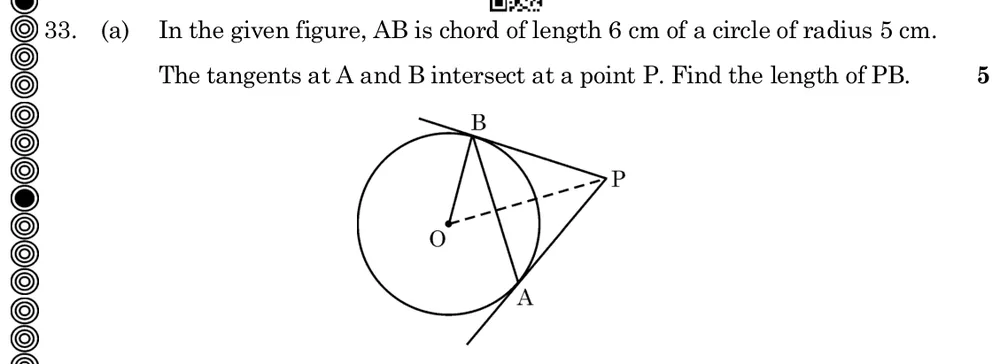
In the given figure, AB is chord of length 6 cm of a circle of radius 5 cm. The tangents at A and B intersect at a point P. Find the length of PB. Write your answer, send a photo, get it marked in DheeAnswer and marking
- OP is perpendicular to AB and bisects it at Q. OP ⊥ AB ⇒ BQ = QA = 6/2 = 3 cm 1 mark
- Use Pythagoras in triangle OQB. OQ = √(5² − 3²) = 4 cm 0.5 marks
- Let PQ = x and PB = y, and use Pythagoras in triangle PQB. x² + 3² = y² ⇒ x² + 9 = y² 1 mark
- Angle OBP is 90°, so use Pythagoras in triangle OBP. OP² = PB² + OB² ⇒ (x + 4)² = y² + 25 1 mark
- Subtract the first equation from the second. 8x + 16 = 34 ⇒ x = 9/4 1 mark
- Put x back into x² + 9 = y². y² = 81/16 + 9 = 225/16 ⇒ PB = y = 15/4 cm 0.5 marks
Answer: PB = 15/4 cm = 3.75 cm
Marks: Half chord and OQ 1½ · Two equations 2 · Solving 1½
For full marks: Write (x + 4)² = y² + 25 from right △OBP — the second equation earns its own mark.
Where students lose marks: Taking PB as the hypotenuse of △OBP, writing y² = (x + 4)² + 25, which gives x = −4, a negative length.
CBSE marking scheme
OP ⊥ AB and bisects it at Q: BQ = QA = 3 cm (1); in △OQB, OQ = 4 cm (½). Let PQ = x, PB = y: from △PQB and △OBP, x2 + 9 = y2 and (x + 4)2 = y2 + 25 (1+1). Solving, x = 9/4, PB = y = 15/4 cm (1+½).
- Q10 Long answer · 5 marks CBSE · 2023
Sides of △ABC from area 90 cm²
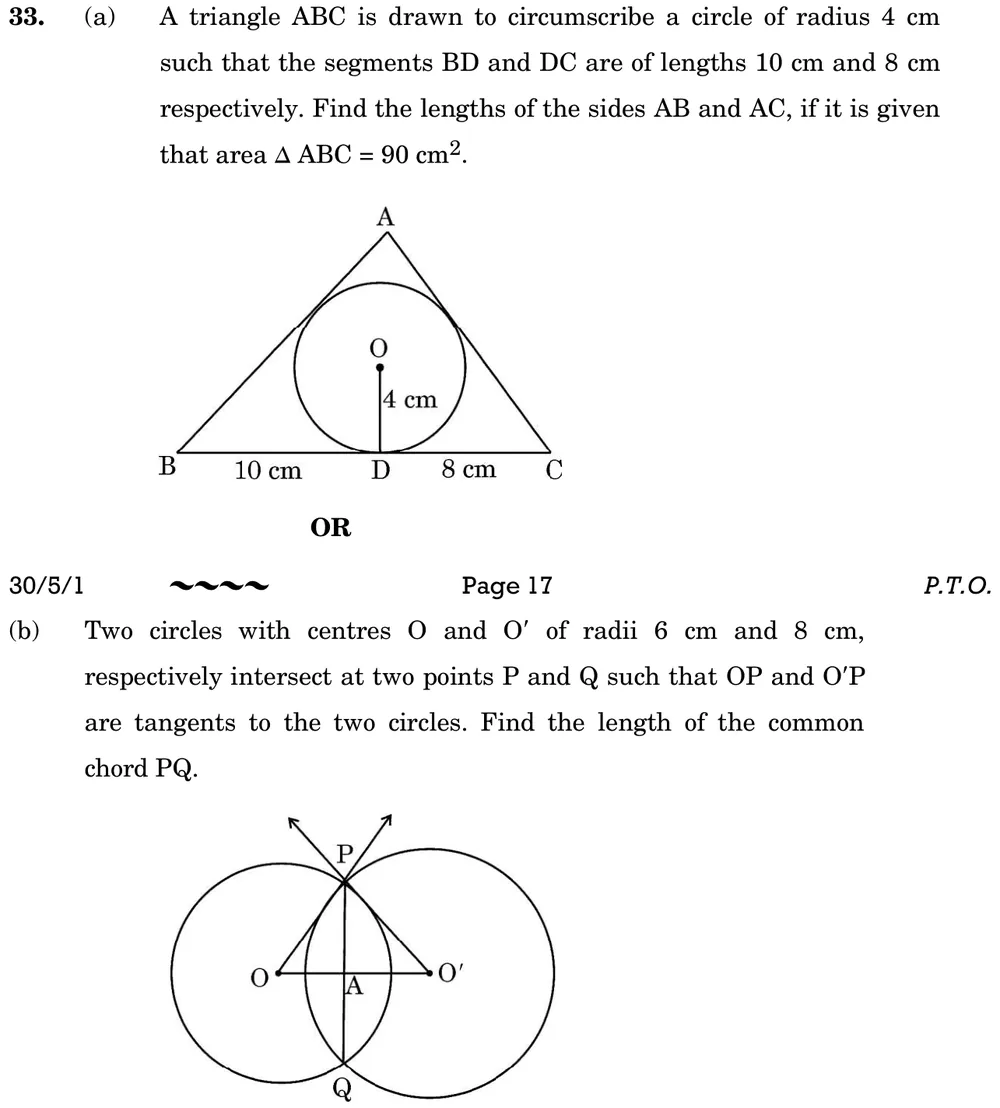
A triangle ABC is drawn to circumscribe a circle of radius 4 cm such that the segments BD and DC are of lengths 10 cm and 8 cm respectively. Find the lengths of the sides AB and AC, if it is given that area △ABC = 90 cm^2. Write your answer, send a photo, get it marked in DheeAnswer and marking
- Join OA, OB, OC and use equal tangents from each corner, calling the tangents from A x. Join OA, OB, OC ; BF = BD = 10 cm, CE = CD = 8 cm, AF = AE = x 1.5 marks
- Split triangle ABC into three triangles with height = radius 4 cm. ar ABC = ar BOC + ar COA + ar AOB = ½ × 4 × (BC + CA + AB) 1.5 marks
- Put in area 90 and the sides in terms of x, then solve. 90 = 2(18 + (8 + x) + (10 + x)) ⇒ 90 = 72 + 4x ⇒ x = 4.5 1 mark
- Add x to the tangent lengths from B and C. AB = 10 + 4.5 = 14.5 cm, AC = 8 + 4.5 = 12.5 cm 1 mark
Answer: AB = 14.5 cm, AC = 12.5 cm
Marks: Tangent lengths 1½ · Area split 1½ · Solving for x 1 · Sides 1
For full marks: Write ar ABC = ar BOC + ar COA + ar AOB — the 1½ is for splitting the area this way.
Where students lose marks: Using ½ × 4 × (perimeter) but forgetting x appears twice, getting 90 = 2(36 + x) and x = 9.
CBSE marking scheme
Join OA, OB, OC; BF = 10, CE = 8, AF = AE = x (1½); ar ABC = ar BOC + ar COA + ar AOB = ½ × 4 × (perimeter) (1½); 90 = 2(18 + 8 + x + 10 + x) ⇒ x = 4.5 (1); AB = 14.5 cm, AC = 12.5 cm (1).
Free 10-question test: Circles
MCQ and Assertion–Reason questions from CBSE papers. About 10 minutes. Your score shows straight away.
Common mistakes in Circles
Mistake Starting a proof with no figure, or a rough one with no labels.
Fix Draw a neat figure first and label the centre O, the points of contact and the tangents. The figure carries ½ mark in most tangent proofs, and up to 1 mark in the equal-tangents proof.
Mistake In the equal-tangents proof, skipping 'Given / To prove' or not naming the congruence.
Fix Write Given, To prove, and 'Join OP, OQ, OR'. List the three parts: OQ = OR (radii), OP common, ∠OQP = ∠ORP = 90°. Write 'congruent by RHS', then 'PQ = PR (CPCT)'. Each of these lines carries marks.
Mistake In the rhombus proof, writing only one or two pairs of equal tangents.
Fix Write all four pairs, like AS = AR, BS = BP, CQ = CP, DQ = DR (1 mark). Add them to get AB + CD = AD + BC (1 mark). Then use AB = CD and AD = BC to get AB = AD (1 mark).
Mistake Writing 90° or 180° without saying why.
Fix Give the reason each time: '∠OAP = 90°, tangent ⟂ radius' (½ mark). For parallel tangents, end with 'co-interior angles add up to 180°, so PQ ∥ RS' (½ mark).
Mistake In '∠PTQ = 2∠OPQ', jumping to the result.
Fix Start from TP = TQ, so ∠TPQ = ∠TQP and ∠PTQ = 180° − 2∠TPQ. Call it (i). Then OP ⟂ PT gives ∠OPQ = 90° − ∠TPQ. Call it (ii). Combine (i) and (ii) in the last line.
Mistake In Assertion–Reason, choosing 'R explains A' because both are true.
Fix Check A and R on their own first. Then ask: does R give the reason for A? Two true facts about tangents need not explain each other.
How to write for full marks
- Set out every proof as: figure, Given, To prove, Construction (like 'Join OA, OB'), then the proof.
- Write the reason beside each step: radii, tangent ⟂ radius, tangents from an external point are equal, RHS, CPCT.
- Number the results you will use, (i) and (ii), and write 'from (i) and (ii)' when you combine them.
- In length questions, mark the 90° at the point of contact and use Pythagoras, like OP² = OT² + PT². Write the unit in the final answer.
- For a quadrilateral drawn around a circle, write AB + CD = AD + BC from the equal tangents before you put in numbers.
Questions students ask
Which Circles questions are most important for the Class 10 board exam 2027?
Expect MCQs on angles and lengths with tangents, a 3-mark rhombus proof, and 2- or 3-mark proofs on equal, parallel and angle-between tangents. The 10 questions on this page are real CBSE board questions from 2023–2026, chosen across the chapter's topics and question types.
How many marks does Circles carry in the Class 10 board exam?
Circles is part of the Geometry unit, which carries 7 of the 80 theory marks in the CBSE Class 10 Maths paper.
Are these real CBSE previous year questions?
Yes. Each question is printed as it appeared in a CBSE board paper or sample paper, with its source, and the answer follows CBSE's official marking scheme.
Questions and answers: CBSE board papers, sample papers and official marking schemes, 2023–2026. Worked steps and tips: Dhee.