Chapter 12 · CBSE Board 2027
Surface Areas and Volumes Class 10 important questions with answers
The 10 questions to practise first, picked from every CBSE board paper 2023–2026. Each one has the official answer and how to write it for full marks. Then try the free 10-question test.
What comes in the exam
- Surface Areas and Volumes is in the Mensuration unit, worth 10 marks together with Areas Related to Circles.
- MCQs (1 mark) come most, then 5-mark questions, and a 4-mark case study is often there.
- Almost every year there is a solid made of two shapes, like a cone on a hemisphere, or a cylinder with a hemisphere on top.
- You find its total surface area, its volume, or both.
- A 5-mark question on a shape scooped out of a block, like a hemisphere drilled out of a cube, also comes almost every year.
- MCQs ask for heights, ratios and curved surface areas.
Top 10 Surface Areas and Volumes questions from board papers
Real CBSE questions, printed as they appeared. Open each answer to see the marking and the steps.
- Q1 Short answer · 3 marks CBSE · 2026
TSA of cone on hollow bowl
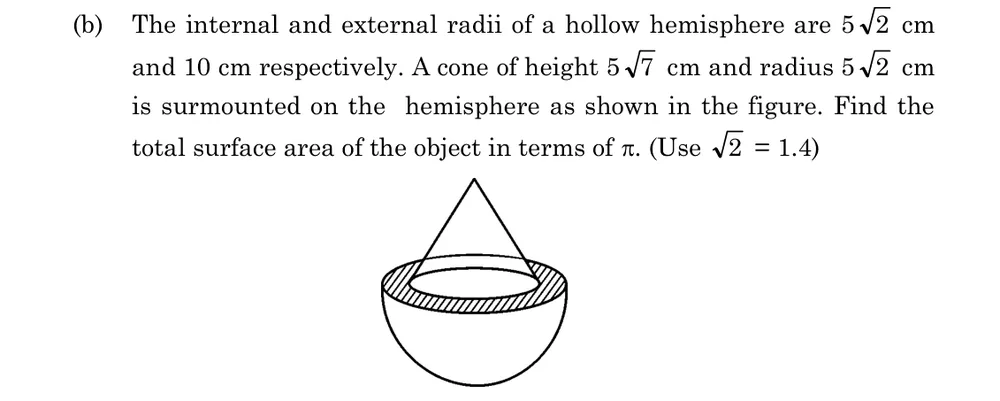
The internal and external radii of a hollow hemisphere are 5√2 cm and 10 cm respectively. A cone of height 5√7 cm and radius 5√2 cm is surmounted on the hemisphere as shown in the figure. Find the total surface area of the object in terms of π. (Use √2 = 1.4) Write your answer, send a photo, get it marked in DheeAnswer and marking
- Find the cone's slant height from its radius and height. l = √((5√2)² + (5√7)²) = √(50 + 175) = 15 cm 1 mark
- Add the outer hemisphere, the cone's curved surface and the flat ring at the rim. TSA = 2πr₂² + πr₁l + π(r₂² − r₁²), r₂ = 10, r₁ = 5√2 1 mark
- Put in the values and use √2 = 1.4. = π(200 + 75√2 + 100 − 50) = π(250 + 105) = 355π cm² 1 mark
Answer: Total surface area = 355π cm²
Marks: Slant height 1 · Formula 1 · Answer 1
For full marks: Write the ring term 'π(r₂² − r₁²)' in the TSA line; it is the shaded rim in the figure.
Where students lose marks: Leaving out the ring π(10² − 50) = 50π, which gives 305π cm² instead of 355π cm².
CBSE marking scheme
Slant height l = √((5√2)2 + (5√7)2 = 15 cm (1); TSA = 2πr22 + πr1·l + π(r22 − r12 (1) = π(200 + 75√2 + 100 − 50) = 355π cm2 (1).
- Q2 Short answer · 3 marks CBSE · 2025
Cylinder with two cones removed
From each end of a solid cylinder of height 20 cm and base radius 7 cm, a cone of base radius 2.1 cm and height 5 cm is scooped out. Find the volume of the remaining solid.
Write your answer, send a photo, get it marked in DheeAnswer and marking
- Find the volume of the full cylinder. Cylinder = (22/7)(7)(7)(20) = 3080 cm³ 1 mark
- One cone is scooped from each end, so find two cones. Two cones = 2 × (1/3)(22/7)(2.1)²(5) = 46.2 cm³ 1 mark
- Subtract the cones from the cylinder. Remaining = 3080 − 46.2 = 3033.8 cm³ 1 mark
Answer: Volume of remaining solid = 3033.8 cm³
Marks: Cylinder 1 · Two cones 1 · Remaining 1
For full marks: Write '2 ×' in front of the cone volume; there is a cone at each end.
Where students lose marks: Subtracting only one cone (23.1 cm³), which gives 3056.9 cm³ instead of 3033.8 cm³.
CBSE marking scheme
Cylinder = (22/7)(7)(7)(20) = 3080 cm3 (1); two cones = 2 × (1/3)(22/7)(2.1)2(5) = 46.2 cm3 (1); remaining = 3033.8 cm3 (1).
- Q3 Case study · 4 marks CBSE · 2026
Case: wall lamp and bulb
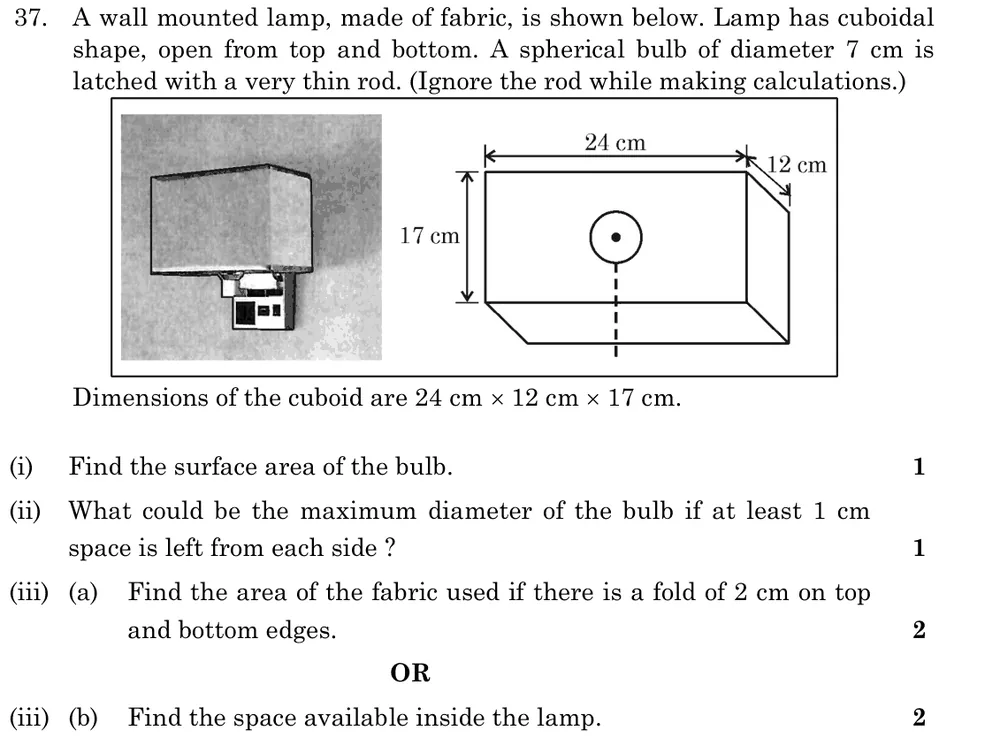
A wall mounted lamp, made of fabric, has cuboidal shape, open from top and bottom. A spherical bulb of diameter 7 cm is latched with a very thin rod (ignore the rod while making calculations). Dimensions of the cuboid are 24 cm × 12 cm × 17 cm. (i) Find the surface area of the bulb. [1] (ii) What could be the maximum diameter of the bulb if at least 1 cm space is left from each side? [1] (iii) (a) Find the area of the fabric used if there is a fold of 2 cm on top and bottom edges. [2] OR (iii) (b) Find the space available inside the lamp. [2] Write your answer, send a photo, get it marked in DheeAnswer and marking
- (i) The bulb is a sphere of radius 7/2 cm. Surface area = 4 × 22/7 × 7/2 × 7/2 = 154 cm² 1 mark
- (ii) The smallest side is 12 cm, so leave 1 cm on each side. Maximum diameter = 12 − 2 = 10 cm 1 mark
- (iii)(a) Add the 2 cm folds at top and bottom to the height. Height with folds = 17 + 2 + 2 = 21 cm 1 mark
- The fabric covers the four sides only, as top and bottom are open. Fabric = 2 × 21 × (24 + 12) = 1512 cm² 1 mark
- (iii)(b) Take the bulb's volume away from the cuboid's volume. Space = 24 × 12 × 17 − 4/3 × 22/7 × (7/2)³ 1 mark
- Work out both parts and subtract. = 4896 − 539/3 = 14149/3 ≈ 4716.3 cm³ 1 mark
Answer: (i) 154 cm² ; (ii) 10 cm ; (iii) (a) 1512 cm² / (b) 14149/3 ≈ 4716.3 cm³
Marks: (i) Bulb area 1 · (ii) Diameter 1 · (iii) Working and answer 2
For full marks: In (iii)(a) write 'Height with folds = 17 + 2 + 2 = 21 cm'; that line earns a full mark.
Where students lose marks: In (ii) taking 24 − 2 = 22 cm; the bulb must fit the narrowest side, 12 cm.
CBSE marking scheme
(i) 4 × 22/7 × 7/2 × 7/2 = 154 cm2 (1). (ii) 12 − 2 = 10 cm (1). (iii)(a) height with folds 17 + 2 + 2 = 21 cm (1); fabric = 2 × 21 × (24 + 12) = 1512 cm2 (1). OR (iii)(b) 24 × 12 × 17 − 4/3 × 22/7 × (7/2)3 (1) = 4896 − 539/3 = 14149/3 ≈ 4716.3 cm3 (1).
- Q4 Case study · 4 marks CBSE · 2026
Case: tumbler and straw
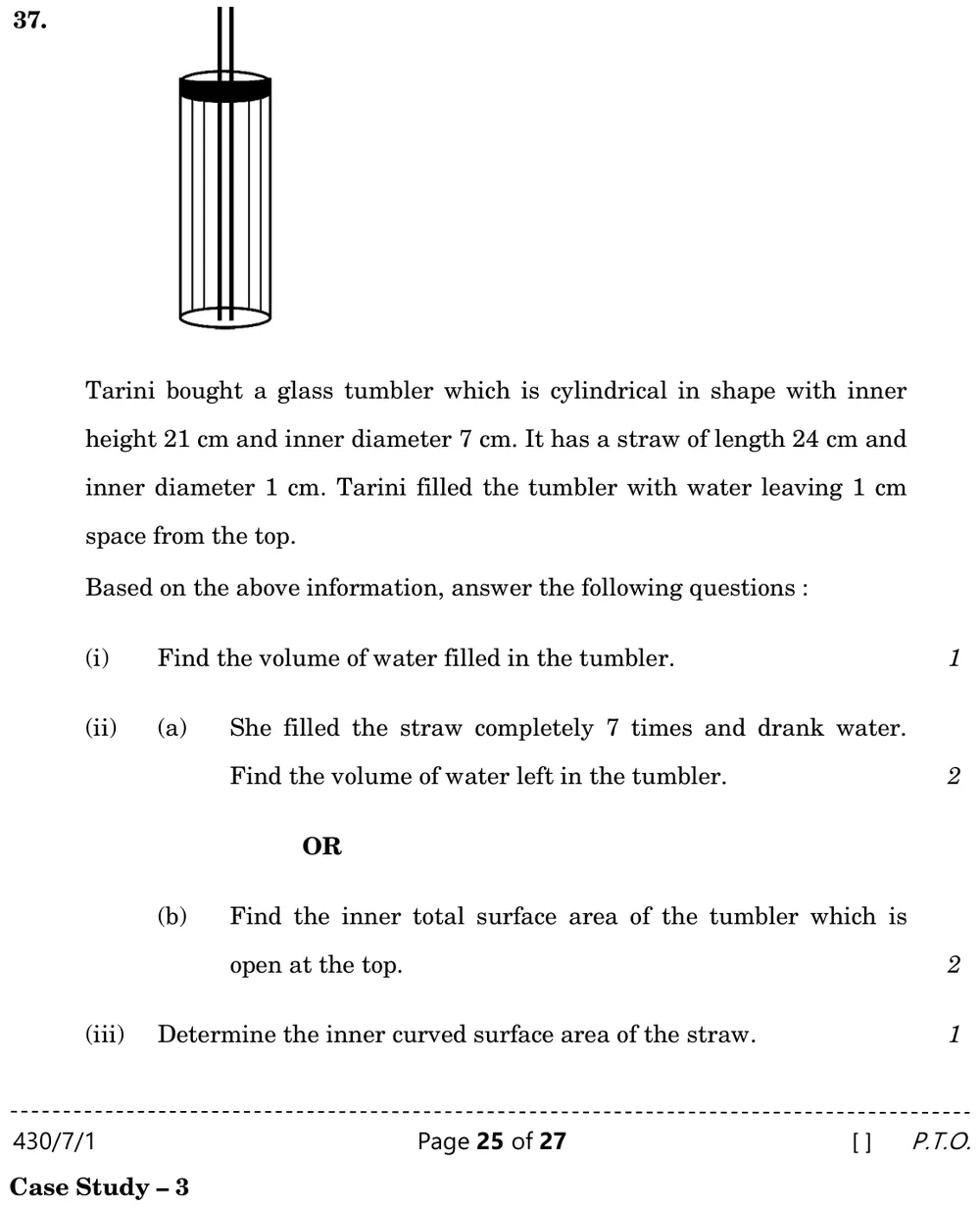
Tarini bought a glass tumbler which is cylindrical in shape with inner height 21 cm and inner diameter 7 cm. It has a straw of length 24 cm and inner diameter 1 cm. Tarini filled the tumbler with water leaving 1 cm space from the top. (i) Find the volume of water filled in the tumbler. (1) (ii) (a) She filled the straw completely 7 times and drank water. Find the volume of water left in the tumbler. (2) OR (ii) (b) Find the inner total surface area of the tumbler which is open at the top. (2) (iii) Determine the inner curved surface area of the straw. (1) Write your answer, send a photo, get it marked in DheeAnswer and marking
- (i) Water fills the tumbler up to 21 − 1 = 20 cm. Volume = (22/7) × (7/2)² × (21 − 1) = 770 cm³ 1 mark
- (ii)(a) Find seven strawfuls, using the straw's radius 1/2 cm. Water drunk = 7 × (22/7) × (1/2)² × 24 = 132 cm³ 1 mark
- Take it away from the water filled. Left = 770 − 132 = 638 cm³ 1 mark
- (ii)(b) The tumbler is open at the top: add the curved surface and the base. Inner TSA = 2 × (22/7) × (7/2) × 21 + (22/7) × (7/2)² 1 mark
- Work out both parts and add. = 462 + 38.5 = 500.5 cm² 1 mark
- (iii) The straw is a cylinder of radius 1/2 cm and length 24 cm. Inner CSA of straw = 2 × (22/7) × (1/2) × 24 = 528/7 ≈ 75.43 cm² 1 mark
Answer: (i) 770 cm³ ; (ii) (a) 638 cm³ / (b) 500.5 cm² ; (iii) 528/7 ≈ 75.43 cm²
Marks: (i) Water 1 · (ii) Working and answer 2 · (iii) Straw 1
For full marks: In (i) write '(21 − 1)' for the height; the 1 cm space left at the top changes the volume.
Where students lose marks: In (ii)(b) adding two circles, top and base; the tumbler is open, so only one base, 38.5 cm².
CBSE marking scheme
(i) (22/7) × (7/2)2 × (21 − 1) = 770 cm3 (½+½). (ii)(a) Water drunk = 7 × (22/7) × (1/2)2 × 24 = 132 cm3 (1); left = 770 − 132 = 638 cm3 (1). OR (ii)(b) Inner TSA = 2 × (22/7) × (7/2) × 21 + (22/7) × (7/2)2 = 462 + 38·5 = 500·5 cm2 (1+1). (iii) Inner CSA of straw = 2 × (22/7) × (1/2) × 24 = 528/7 ≈ 75·43 cm2 (1).
- Q5 Case study · 4 marks CBSE · 2026
Case: Gilli Danda game
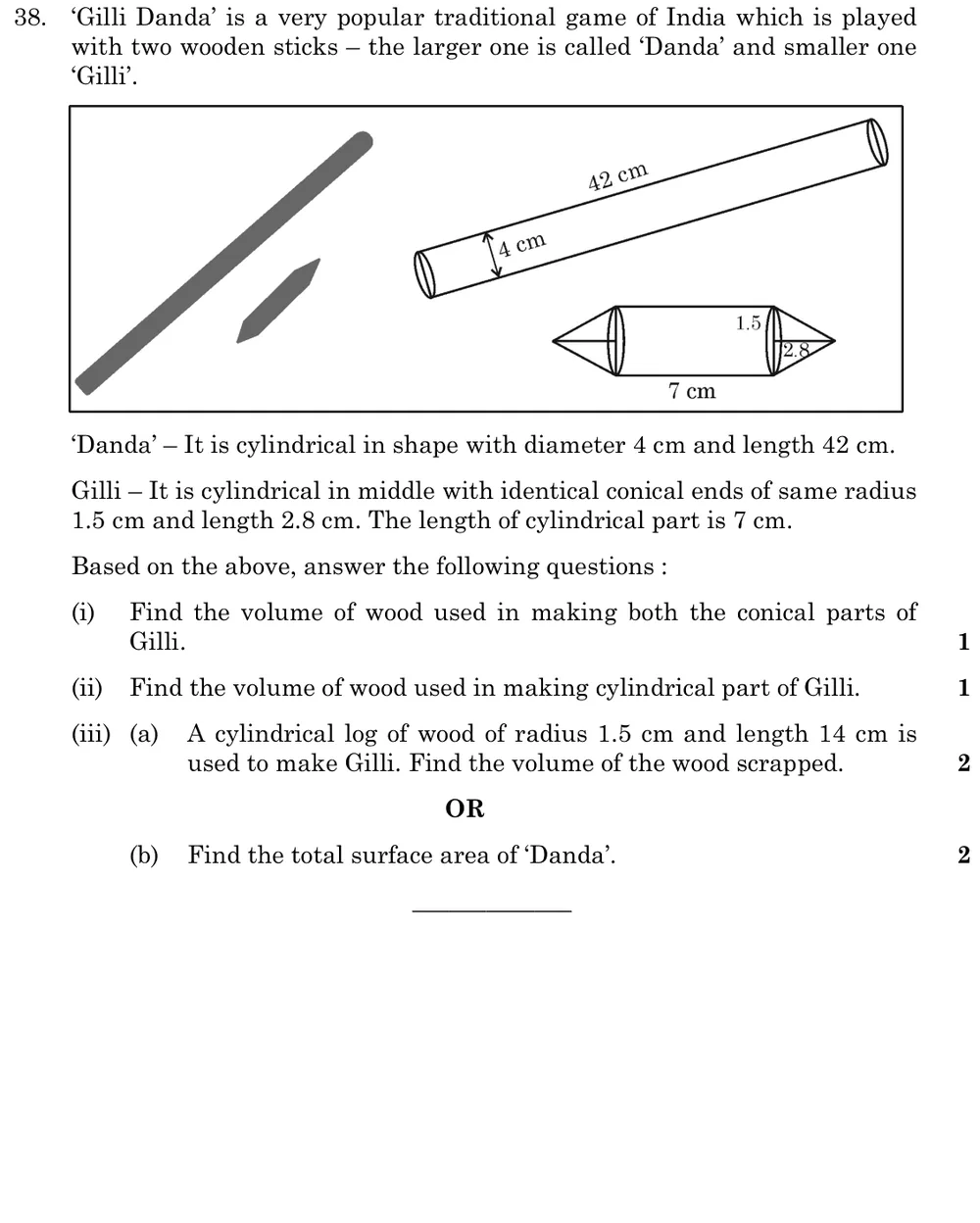
'Gilli Danda' is a very popular traditional game of India which is played with two wooden sticks – the larger one is called 'Danda' and smaller one 'Gilli'. 'Danda' – It is cylindrical in shape with diameter 4 cm and length 42 cm. Gilli – It is cylindrical in middle with identical conical ends of same radius 1.5 cm and length 2.8 cm. The length of cylindrical part is 7 cm. (i) Find the volume of wood used in making both the conical parts of Gilli. (1) (ii) Find the volume of wood used in making cylindrical part of Gilli. (1) (iii) (a) A cylindrical log of wood of radius 1.5 cm and length 14 cm is used to make Gilli. Find the volume of the wood scrapped. (2) OR (iii) (b) Find the total surface area of 'Danda'. (2) Write your answer, send a photo, get it marked in DheeAnswer and marking
- (i) Each end is a cone of radius 1.5 cm and height 2.8 cm, so take two. Two cones = 2 × 1/3 × 22/7 × 1.5 × 1.5 × 2.8 0.5 marks
- Multiply out. = 13.2 cm³ 0.5 marks
- (ii) The middle is a cylinder of radius 1.5 cm and length 7 cm. Cylinder = 22/7 × 1.5 × 1.5 × 7 0.5 marks
- Multiply out. = 49.5 cm³ 0.5 marks
- (iii)(a) Find the volume of the whole log. Log = 22/7 × 1.5 × 1.5 × 14 = 99 cm³ 1 mark
- Add parts (i) and (ii) for the gilli's wood. Gilli = 13.2 + 49.5 = 62.7 cm³ 0.5 marks
- The scrap is the log minus the gilli. Scrapped = 99 − 62.7 = 36.3 cm³ 0.5 marks
- (iii)(b) The danda is a solid cylinder of radius 2 cm: curved surface plus two ends. TSA = 2 × 22/7 × 2 × 42 + 2 × 22/7 × 2² 1 mark
- Work out both parts and add. = 528 + 176/7 = 3872/7 ≈ 553.14 cm² 1 mark
Answer: (i) 13.2 cm³ ; (ii) 49.5 cm³ ; (iii) (a) 36.3 cm³ / (b) 3872/7 ≈ 553.14 cm²
Marks: (i) Cones 1 · (ii) Cylinder 1 · (iii) Working and answer 2
For full marks: In (iii)(a) write 'Gilli = 13.2 + 49.5 = 62.7 cm³' before subtracting; that line earns ½.
Where students lose marks: In (iii)(b) using the diameter 4 cm as the radius, giving four times the end areas and double the curved part.
CBSE marking scheme
(i) 2 × 1/3 × 22/7 × 1.5 × 1.5 × 2.8 (½) = 13.2 cm3 (½). (ii) 22/7 × 1.5 × 1.5 × 7 (½) = 49.5 cm3 (½). (iii)(a) Log = 22/7 × 1.5 × 1.5 × 14 = 99 cm3 (1); gilli = 13.2 + 49.5 = 62.7 cm3 (½); scrapped = 99 − 62.7 = 36.3 cm3 (½). OR (b) TSA = 2 × 22/7 × 2 × 42 + 2 × 22/7 × 22 (1) = 3872/7 ≈ 553.14 cm2 (1).
- Q6 Case study · 4 marks CBSE · 2026
Case: Amanita mushroom
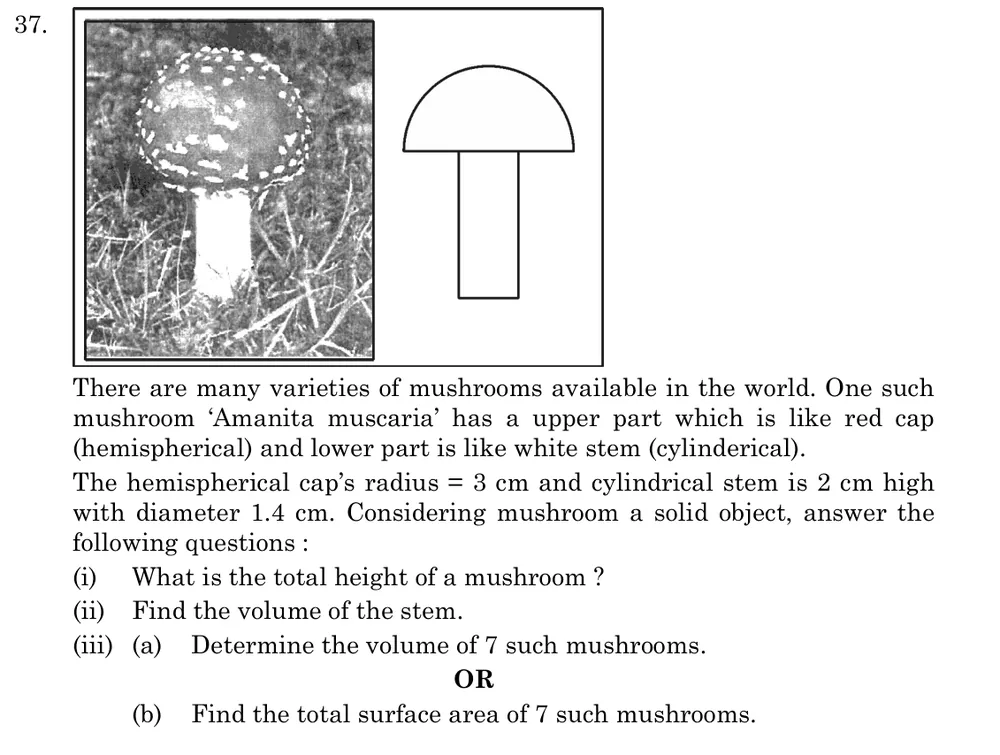
There are many varieties of mushrooms available in the world. One such mushroom ‘Amanita muscaria’ has a upper part which is like red cap (hemispherical) and lower part is like white stem (cylinderical). The hemispherical cap’s radius = 3 cm and cylindrical stem is 2 cm high with diameter 1.4 cm. Considering mushroom a solid object, answer the following questions : (i) What is the total height of a mushroom ? (1) (ii) Find the volume of the stem. (1) (iii) (a) Determine the volume of 7 such mushrooms. (2) OR (iii) (b) Find the total surface area of 7 such mushrooms. (2) Write your answer, send a photo, get it marked in DheeAnswer and marking
- (i) Add the stem's height and the cap's radius. Total height = 2 + 3 = 5 cm 1 mark
- (ii) The stem is a cylinder of radius 0.7 cm and height 2 cm. Stem volume = (22/7) × 0.7² × 2 = 3.08 cm³ 1 mark
- (iii)(a) One mushroom is hemisphere plus stem, so multiply by seven. 7 × [(2/3)πR³ + πr²h], R = 3, r = 0.7, h = 2 ; = 7 × [(2/3)(22/7)(27) + 3.08] 1 mark
- Simplify. = 417.56 cm³ 1 mark
- (iii)(b) Add cap's curve, the ring under the cap, the stem's side and the stem's base. TSA = 7{2πR² + (πR² − πr²) + 2πrh + πr²} = 7(3πR² + 2πrh) 1 mark
- Put R = 3, r = 0.7, h = 2 and π = 22/7. = 655.6 cm² 1 mark
Answer: (i) 5 cm ; (ii) 3.08 cm³ ; (iii) (a) 417.56 cm³ / (b) 655.6 cm²
Marks: (i) Height 1 · (ii) Stem 1 · (iii) Expression and answer 2
For full marks: In (iii)(b) write the ring '(πR² − πr²)'; the cap's underside shows except where the stem joins.
Where students lose marks: In (iii)(b) leaving out the ring under the cap, so the TSA uses 2πR² instead of 3πR².
CBSE marking scheme
(i) Height = 2 + 3 = 5 cm (1). (ii) Stem volume = (22/7) × 0.72 × 2 = 3.08 cm3 (1). (iii)(a) 7 × [(2/3)πR3 + πr2h], R = 3, r = 0.7, h = 2 = 7 × [(2/3)(22/7)(27) + 3.08] (1) = 417.56 cm3 (1). OR (b) TSA = 7{2πR2 + (πR2 − πr2 + 2πrh + πr2} = 7(3πR2 + 2πrh) (1) = 655.6 cm2 (1).
- Q7 Long answer · 5 marks CBSE · 2025, 2023 Asked in 2025, 2023
TSA of cylinder, scooped ends
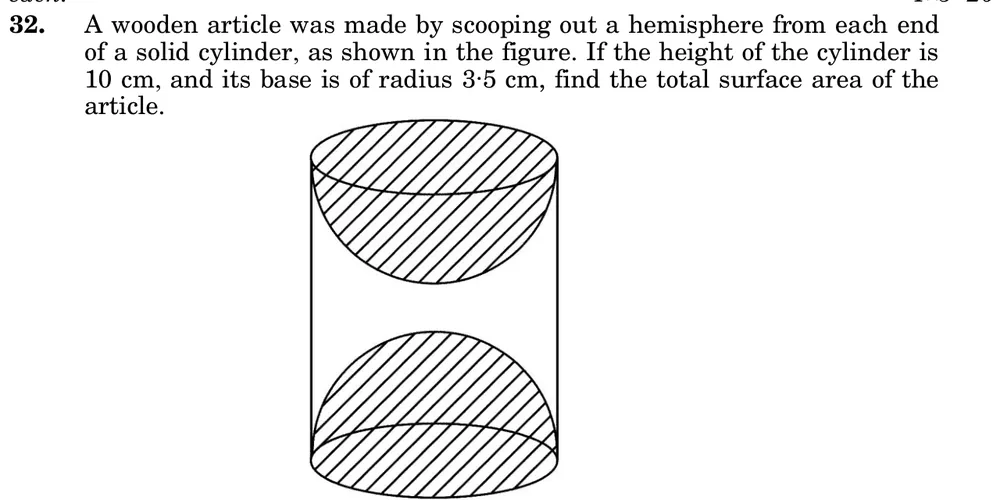
A wooden article was made by scooping out a hemisphere from each end of a solid cylinder, as shown in the figure. If the height of the cylinder is 10 cm, and its base is of radius 3.5 cm, find the total surface area of the article. Write your answer, send a photo, get it marked in DheeAnswer and marking
- Write down h and r, then find the cylinder's curved surface with 2πrh. h = 10 cm, r = 7/2 cm ; CSA of cylinder = 2πrh = 2 × (22/7) × (7/2) × 10 = 220 cm² 2 marks
- Each scooped bowl has inner surface 2πr², and there are two of them. Inner surface of the two hemispherical cavities = 2 × 2πr² = 4 × (22/7) × (49/4) = 154 cm² 2 marks
- Add the two areas. TSA = 220 + 154 = 374 cm² 1 mark
Answer: Total surface area of the article = 374 cm²
Marks: Cylinder curved surface 2 · Two cavities 2 · Total 1
For full marks: Write 'Inner surface of the two hemispherical cavities = 2 × 2πr²' — the examiner pays two marks for it.
Where students lose marks: Adding the two flat ends (2πr²) as well: they were scooped out, so only the bowls' inner surfaces count.
CBSE marking scheme
h = 10 cm, r = 7/2 cm; CSA of cylinder = 2πrh = 2 × (22/7) × (7/2) × 10 = 220 cm2 (2); inner surface of two hemispherical cavities = 2 × 2πr2 = 154 cm2 (2); TSA = 220 + 154 = 374 cm2 (1).
- Q8 Long answer · 5 marks CBSE · 2026, 2024 Asked in 2026, 2024
Cube with hemisphere drilled out
The largest possible hemisphere is drilled out of a wooden cubical block of side 21 cm such that the base of the hemisphere is on one of the faces of the cube. Then, find (i) the volume of the wood left in the block. (ii) the total surface area of the remaining solid.
Write your answer, send a photo, get it marked in DheeAnswer and marking
- The largest hemisphere has its diameter equal to the cube's side. a = 21 cm, r = 21/2 cm 0.5 marks
- (i) Wood left is the cube minus the hemisphere. V = a³ − (2/3)πr³ 0.5 marks
- Put in the values. = 9261 − (2/3)(22/7)(21/2)³ 1 mark
- Simplify. = 9261 − 2425.5 = 6835.5 cm³ 0.5 marks
- (ii) Remove the circle from the top face and add the hemisphere's curved inside. TSA = 6a² − πr² + 2πr² = 6a² + πr² 1.5 marks
- Put in the values and add. = 2646 + 346.5 = 2992.5 cm² 1 mark
Answer: (i) 6835.5 cm³ ; (ii) 2992.5 cm²
Marks: Radius ½ · (i) Volume 2 · (ii) Surface area 2½
For full marks: Write 'TSA = 6a² − πr² + 2πr²' in full; it shows the circle taken out and the bowl added.
Where students lose marks: Forgetting the hollow's curved surface and taking TSA as 6a² − πr² = 2299.5 cm².
CBSE marking scheme
a = 21 cm, r = 21/2 cm (½). (i) V = a3 − (2/3)πr3 (½) = 9261 − (2/3)(22/7)(21/2)3 (1) = 6835.5 cm3 (½). (ii) TSA = 6a2 − πr2 + 2πr2 = 6a2 + πr2 (½+1) = 2646 + 346.5 = 2992.5 cm2 (1).
- Q9 Long answer · 5 marks CBSE · 2026
Cost of a green house sheet
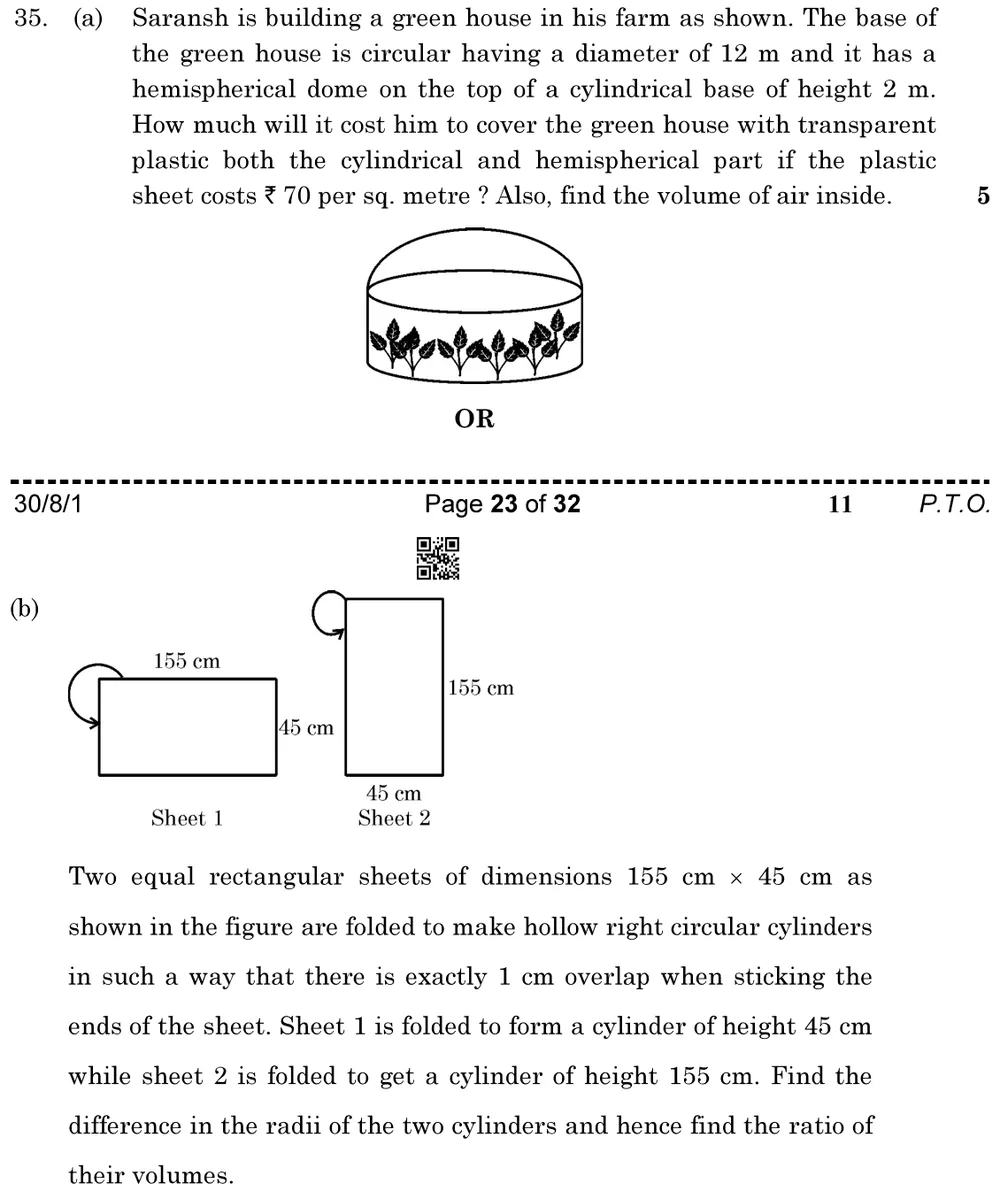
Saransh is building a green house in his farm as shown. The base of the green house is circular having a diameter of 12 m and it has a hemispherical dome on the top of a cylindrical base of height 2 m. How much will it cost him to cover the green house with transparent plastic both the cylindrical and hemispherical part if the plastic sheet costs ₹ 70 per sq. metre? Also, find the volume of air inside. Write your answer, send a photo, get it marked in DheeAnswer and marking
- Halve the diameter to get the radius. r = 12/2 = 6 m 0.5 marks
- The plastic covers the cylinder's curved side and the dome's curved surface. Sheet area = CSA of cylinder + CSA of hemisphere = 2 × (22/7) × 6 × 2 + 2 × (22/7) × 6² 1 mark
- Work out both parts and add. = 528/7 + 1584/7 = 2112/7 m² 0.5 marks
- Multiply the area by ₹70 per square metre. Cost = (2112/7) × 70 = ₹21120 1 mark
- The air fills the cylinder and the hemisphere, so add their volumes. Volume of air = (22/7) × 6² × 2 + (2/3)(22/7) × 6³ 1 mark
- Work out both parts and add. = 1584/7 + 3168/7 = 4752/7 ≈ 678.86 m³ 1 mark
Answer: Cost of plastic = ₹21120; volume of air = 4752/7 ≈ 678.86 m³
Marks: Radius ½ · Sheet area 1½ · Cost 1 · Volume of air 2
For full marks: Write 'Sheet area = CSA of cylinder + CSA of hemisphere' — the examiner pays for naming both curved parts.
Where students lose marks: Adding the floor (πr²) to the plastic area: the base sits on the ground and is not covered.
CBSE marking scheme
r = 6 m (½); sheet area = CSA cylinder + CSA hemisphere = 2 × (22/7) × 6 × 2 + 2 × (22/7) × 62 (1) = 2112/7 m2 (½); cost = (2112/7) × 70 = ₹ 21120 (1); volume of air = (22/7) × 62 × 2 + (2/3)(22/7) × 63 (1) = 4752/7 ≈ 678.85 m3 (1).
- Q10 Long answer · 5 marks CBSE · 2025
Cube with hemisphere on top
A cubical block is surmounted by a hemisphere of radius 3.5 cm. What is the smallest possible length of the edge of the cube so that the hemisphere can totally lie on the cube ? Find the total surface area of the solid so formed.
Write your answer, send a photo, get it marked in DheeAnswer and marking
- The hemisphere's flat face must fit on the cube, so the edge equals its diameter. Edge a = 2 × 3.5 = 7 cm 1 mark
- The hemisphere hides a circle on the top face, so take it off the cube's surface. Cube part = 6a² − πr² 1.5 marks
- Add the hemisphere's curved surface and simplify. TSA = 6a² + 2πr² − πr² = 6a² + πr² 1.5 marks
- Put in a = 7 and r = 3.5. = 294 + 38.5 = 665/2 = 332.5 cm² 1 mark
Answer: Edge = 7 cm ; TSA = 332.5 cm²
Marks: Edge 1 · Surface area formula 3 · Answer 1
For full marks: Write 'TSA = 6a² + 2πr² − πr²' before simplifying; it shows the hidden circle removed.
Where students lose marks: Forgetting to remove the circle under the hemisphere, giving 6a² + 2πr² = 371 cm².
CBSE marking scheme
Edge = 2 × 3.5 = 7 cm (1); TSA = 6a2 + 2πr2 – πr2 = 6a2 + πr2 (1½ + 1½) = 294 + 38.5 = 665/2 = 332.5 cm2 (1).
Free 10-question test: Surface Areas and Volumes
MCQ and Assertion–Reason questions from CBSE papers. About 10 minutes. Your score shows straight away.
Common mistakes in Surface Areas and Volumes
Mistake Adding every surface, even the faces that are hidden or cut away.
Fix Count only what you can touch. When a hemisphere sits on a face or is scooped out of it, take away the flat circle πr² and add the curved part 2πr². Write it in letters first: TSA = 6a² − πr² + 2πr².
Mistake Guessing the radius when the question says 'largest possible'.
Fix Write the size as a step. The largest hemisphere in a cube has diameter = side, so r = a/2 (½ mark). The largest cone in a hemisphere has height = radius.
Mistake Using the height of a cone where its slant height is needed.
Fix Curved surface of a cone = πrl, where l = √(r² + h²). Find l first and write it as its own step. In one board question this step alone carried 1 mark.
Mistake Taking the formula of the wrong solid.
Fix List them before you start: hemisphere volume (2/3)πr³, curved surface 2πr², a solid hemisphere's total surface 3πr²; cone volume (1/3)πr²h; cylinder volume πr²h, curved surface 2πrh.
Mistake Counting a surface that is open or not covered.
Fix Read the words: 'open at the top', 'open from top and bottom', 'a door opening'. Leave those parts out. A greenhouse cover takes only the curved surfaces, not the floor.
Mistake Mixing up units in the final answer.
Fix Surface area is in cm² or m², volume in cm³ or m³. For a cost, multiply the area by the rate and write ₹ in the answer.
How to write for full marks
- Name the parts first, like 'solid = cylinder + hemisphere', and write each formula before you put in numbers.
- Write r, h and l as separate lines (r = 21/2 cm). The scheme gives marks for these lines.
- Write the surface area as a sum of the visible parts in letters, then in numbers, then the answer with its unit.
- Use the value of π the question gives (often 22/7) and cancel early. Write the final answer with cm² or cm³.
- In a case study, use your earlier answers: the volume of a Gilli is its two cone parts plus its cylinder part.
Not in the 2026-27 exam
Leave these out of your revision.
- Solids made of more than two shapes
- Frustum of a cone and changing one solid into another (removed)
Questions students ask
Which Surface Areas and Volumes questions are most important for the Class 10 board exam 2027?
Expect MCQs on heights, ratios and areas, a 5-mark solid made of two shapes or a scooped-out block, and often a 4-mark case study. The 10 questions on this page are real CBSE board questions from 2023–2026, chosen across the chapter's topics and question types.
How many marks does Surface Areas and Volumes carry in the Class 10 board exam?
Surface Areas and Volumes is part of the Mensuration unit, which carries 5 of the 80 theory marks in the CBSE Class 10 Maths paper.
Are these real CBSE previous year questions?
Yes. Each question is printed as it appeared in a CBSE board paper or sample paper, with its source, and the answer follows CBSE's official marking scheme.
Questions and answers: CBSE board papers, sample papers and official marking schemes, 2023–2026. Worked steps and tips: Dhee.