Chapter 5 · CBSE Board 2027
Arithmetic Progressions Class 10 important questions with answers
The 10 questions to practise first, picked from every CBSE board paper 2023–2026. Each one has the official answer and how to write it for full marks. Then try the free 10-question test.
What comes in the exam
- Arithmetic Progressions is in the Algebra unit, which is worth 20 marks in all.
- MCQs (1 mark) come most, then 3-mark questions, 4-mark case studies and 5-mark questions, with a few 2-mark and Assertion–Reason.
- Almost every year there are MCQs on the nth term and on finding a and d.
- A 4-mark case study on a real AP (instalments, production, a ladder, rounds of a race) comes almost every year too.
- Also almost every year: 3- or 5-mark questions to find the AP from two terms and then a sum, or the number of terms from a sum, and questions where Sn is given and you find the nth term.
Top 10 Arithmetic Progressions questions from board papers
Real CBSE questions, printed as they appeared. Open each answer to see the marking and the steps.
- Q1 Assertion–Reason · 1 mark CBSE · 2025, 2024 Asked in 2025, 2024
AR: difference of 5, 1, −3
Assertion (A) : Common difference of the AP : 5, 1, −3, −7, ... is 4. Reason (R) : Common difference of the AP : a1, a2, a3, ..., an is obtained by d = an − a(n−1).
- (A) Both Assertion (A) and Reason (R) are true and Reason (R) is the correct explanation of the Assertion (A).
- (B) Both Assertion (A) and Reason (R) are true, but Reason (R) is not the correct explanation of the Assertion (A).
- (C) Assertion (A) is true, but Reason (R) is false.
- (D) Assertion (A) is false, but Reason (R) is true.
Write your answer, send a photo, get it marked in DheeAnswer and marking
Correct option: (D) Assertion (A) is false, but Reason (R) is true.
- Test the Assertion: subtract the first term from the second. d = 1 − 5 = −4 ≠ 4 ⇒ A is false
- Test the Reason: any term minus the term before it gives d. d = aₙ − aₙ₋₁ ⇒ R is true
- A false and R true matches option (D). A false, R true ⇒ option (D) 1 mark
Answer: (D) A is false, but R is true
Marks: Correct option 1
For full marks: Write d = 1 − 5 = −4 — the order of subtraction decides the sign.
Where students lose marks: Picking (A) by subtracting 5 − 1 = 4; d is the later term minus the earlier, so −4.
CBSE marking scheme
d = 1 − 5 = −4, so A is false; R is the correct rule, so R is true.
- Q2 MCQ · 1 mark CBSE · 2025, 2024 Asked in 2025, 2024
Middle term of three AP numbers
Three numbers in AP have the sum 30. What is its middle term ?
- (A) 4
- (B) 10
- (C) 16
- (D) 8
Write your answer, send a photo, get it marked in DheeAnswer and marking
Correct option: (B) 10
- Take the three terms as a − d, a, a + d. (a − d) + a + (a + d) = 30
- The d cancels; solve for the middle term. 3a = 30 ⇒ a = 10 ⇒ option (B) 1 mark
Answer: (B) 10
Marks: Correct option 1
For full marks: Write the terms as a − d, a, a + d so d cancels.
Where students lose marks: Taking the terms as a, a + d, a + 2d leaves two unknowns, so students guess (A) 4 or (D) 8; use a − d, a, a + d.
CBSE marking scheme
a − d + a + a + d = 3a = 30 ⇒ middle term a = 10.
- Q3 Short answer · 3 marks CBSE · 2024, 2023 Asked in 2024, 2023
AP: first 5, last 45, sum 400
The first term of an A.P. is 5, the last term is 45 and the sum of all the terms is 400. Find the number of terms and the common difference of the A.P.
Write your answer, send a photo, get it marked in DheeAnswer and marking
- You know the first and last terms, so use the sum formula with them. Sn = (n/2)(a + l) ⇒ (n/2)(5 + 45) = 400 1 mark
- Solve for n. 25n = 400 ⇒ n = 16 1 mark
- The last term is the 16th term, so use the nth term formula. a16 = a + 15d ⇒ 5 + 15d = 45 0.5 marks
- Solve for d and simplify the fraction. 15d = 40 ⇒ d = 40/15 = 8/3 0.5 marks
Answer: n = 16, d = 8/3
Marks: Sum equation 1 · n 1 · Term equation ½ · d ½
For full marks: Write 'Sn = (n/2)(a + l)' with a = 5, l = 45 — it gets n in one line.
Where students lose marks: Writing 5 + 16d = 45 instead of 5 + 15d = 45; the 16th term has (n − 1) = 15 differences.
CBSE marking scheme
(n/2)(5 + 45) = 400 (1) ⇒ n = 16 (1); 5 + 15d = 45 (½) ⇒ d = 40/15 = 8/3 (½).
- Q4 Case study · 4 marks CBSE · 2026
Case: foldable ladder steps (AP)
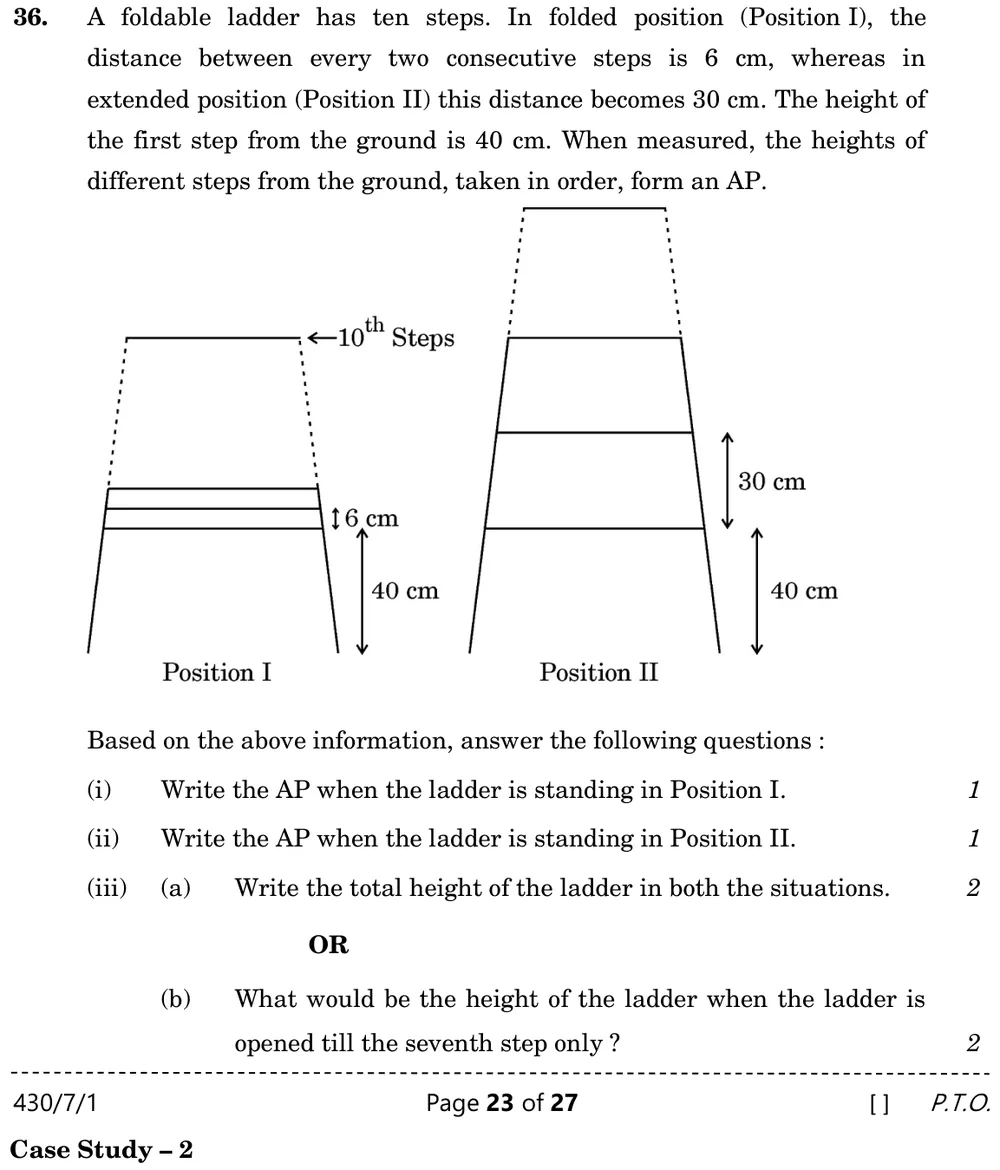
A foldable ladder has ten steps. In folded position (Position I), the distance between every two consecutive steps is 6 cm, whereas in extended position (Position II) this distance becomes 30 cm. The height of the first step from the ground is 40 cm. When measured, the heights of different steps from the ground, taken in order, form an AP. (i) Write the AP when the ladder is standing in Position I. (1) (ii) Write the AP when the ladder is standing in Position II. (1) (iii) (a) Write the total height of the ladder in both the situations. (2) OR (iii) (b) What would be the height of the ladder when the ladder is opened till the seventh step only ? (2) Write your answer, send a photo, get it marked in DheeAnswer and marking
- (i) Start at 40 cm and add 6 cm for each next step. 40, 46, 52, 58, … 1 mark
- (ii) Start at 40 cm and add 30 cm for each next step. 40, 70, 100, 130, … 1 mark
- (iii)(a) The ladder's height is the 10th step's height; find it in Position I. Position I: a10 = 40 + 9 × 6 = 94 cm 1 mark
- Now find the 10th step's height in Position II. Position II: a10 = 40 + 9 × 30 = 310 cm 1 mark
- (iii)(b) Up to the 7th step the gaps are 30 cm, so find the 7th step's height. Height up to 7th step = 40 + 6 × 30 = 220 cm 1.5 marks
- The last 3 steps stay folded, so add three 6 cm gaps. Remaining 3 gaps = 3 × 6 = 18 cm ; total height = 220 + 18 = 238 cm 0.5 marks
Answer: (i) 40, 46, 52, 58, … (ii) 40, 70, 100, 130, … (iii) (a) 94 cm and 310 cm / (b) 238 cm
Marks: (i) 1 · (ii) 1 · (iii) (a) or (b) 2
For full marks: In (iii)(b) add the folded part, '3 × 6 = 18 cm', to 220 cm — the last ½ is for 238 cm.
Where students lose marks: Using 10 × 6 instead of 9 × 6; ten steps have only nine gaps above the first step.
CBSE marking scheme
(i) 40, 46, 52, 58, … (1). (ii) 40, 70, 100, 130, … (1). (iii)(a) Position I: a10 = 40 + 9 × 6 = 94 cm (1); Position II: a10 = 40 + 9 × 30 = 310 cm (1). OR (iii)(b) Height up to 7th step = 40 + 6 × 30 = 220 cm (1½); remaining 3 folded gaps add 18 cm, total 238 cm (½).
- Q5 Case study · 4 marks CBSE · 2026
Case: car loan instalments (AP)
Case Study: Your elder brother wants to buy a car and plans to take a loan from a bank for his car. He repays his total loan of ₹1,18,000 by paying every month, starting with the first instalment of ₹1,000 and he increases the instalment by ₹100 every month. (i) Find the amount paid by him in the 30th instalment. (1) (ii) If the total number of instalments is 40, what is the amount paid in the last instalment? (1) (iii) (a) What amount does he still have to pay after the 30th instalment? (2) OR (iii) (b) Find the ratio of the tenth instalment to the last instalment. (2)
Write your answer, send a photo, get it marked in DheeAnswer and marking
- (i) Write a = 1000, d = 100 and use the nth term formula. a = 1000, d = 100 ; a30 = 1000 + 29(100) = ₹3900 1 mark
- (ii) The last instalment is the 40th term. a40 = 1000 + 39(100) = ₹4900 1 mark
- (iii)(a) Add the first 30 instalments with the sum formula. S30 = (30/2)[2000 + 29 × 100] = 15[2000 + 2900] = 73500 1 mark
- Subtract the amount paid from the total loan. Still to pay = 118000 − 73500 = ₹44500 1 mark
- (iii)(b) Write the 10th and 40th instalments as a fraction. a10/a40 = (1000 + 900)/(1000 + 3900) 1 mark
- Simplify the fraction to a ratio. = 1900/4900 = 19 : 49 1 mark
Answer: (i) ₹3900 (ii) ₹4900 (iii) (a) ₹44500 / (b) 19 : 49
Marks: (i) 1 · (ii) 1 · (iii) (a) or (b) 2
For full marks: In (iii)(b) write 'a10/a40 = 1900/4900' before simplifying — the first mark is for that line.
Where students lose marks: Stopping at S30 = 73500 in (iii)(a) and boxing the amount paid instead of the amount left.
CBSE marking scheme
a = 1000, d = 100. (i) a30 = 1000 + 29(100) = ₹3900 (1). (ii) a40 = 1000 + 39(100) = ₹4900 (1). (iii)(a) S30 = 15[2000 + 2900] = 73500 (1); still to pay 118000 − 73500 = ₹44500 (1). OR (iii)(b) a10/a40 = (1000 + 900)/(1000 + 3900) (1) = 1900/4900 = 19 : 49 (1).
- Q6 Case study · 4 marks CBSE · 2026
Case: kolam dot pattern (AP)
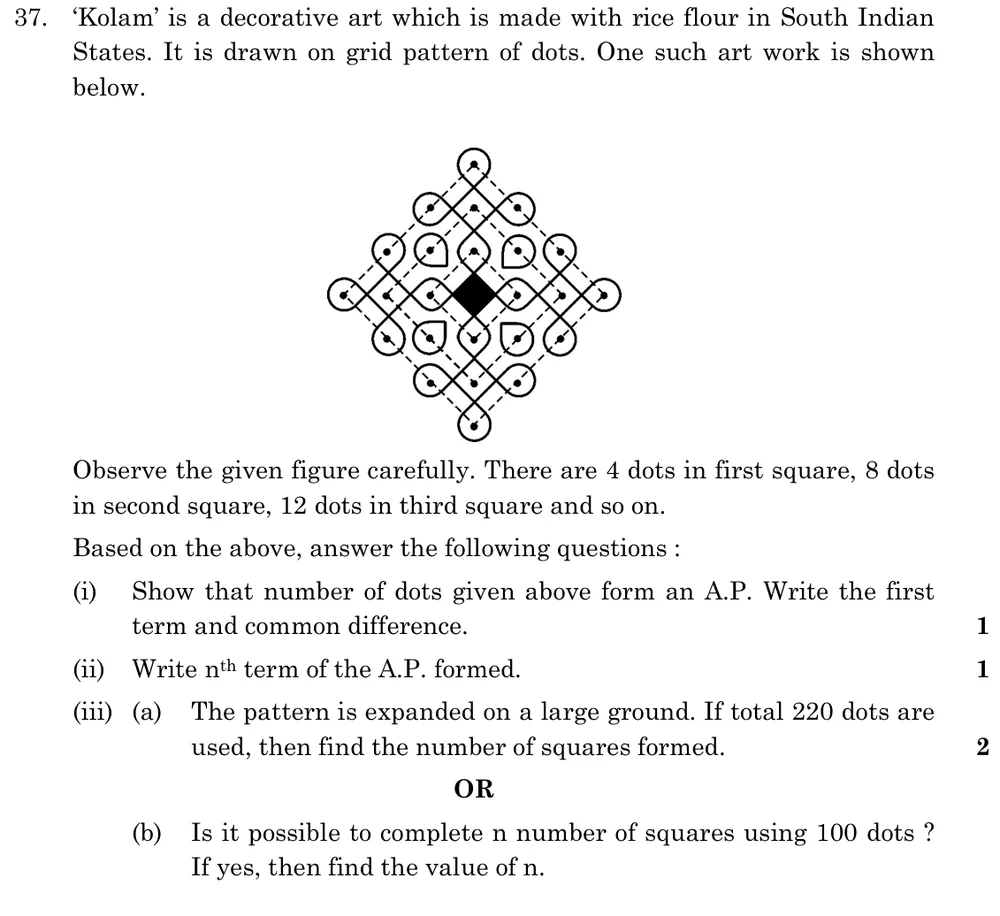
'Kolam' is a decorative art which is made with rice flour in South Indian States. It is drawn on grid pattern of dots. One such art work is shown below. Observe the given figure carefully. There are 4 dots in first square, 8 dots in second square, 12 dots in third square and so on. Based on the above, answer the following questions: (i) Show that number of dots given above form an A.P. Write the first term and common difference. (1) (ii) Write nth term of the A.P. formed. (1) (iii) (a) The pattern is expanded on a large ground. If total 220 dots are used, then find the number of squares formed. (2) OR (iii) (b) Is it possible to complete n number of squares using 100 dots? If yes, then find the value of n. (2) Write your answer, send a photo, get it marked in DheeAnswer and marking
- (i) Check the differences between terms are equal, then state a and d. 4, 8, 12, … : 8 − 4 = 12 − 8 = 4, so it is an AP ; a = 4, d = 4 1 mark
- (ii) Use the nth term formula and simplify. an = 4 + (n − 1)4 = 4n 1 mark
- (iii)(a) Set the sum of n terms equal to 220 and simplify. 220 = (n/2)(8 + 4(n − 1)) ⇒ n(n + 1) = 110 0.5 marks
- Write it as a quadratic and factorise. n² + n − 110 = 0 ⇒ (n + 11)(n − 10) = 0 0.5 marks
- The number of squares must be positive, so keep n = 10. n = 10 squares 1 mark
- (iii)(b) Set the sum of n terms equal to 100. 100 = (n/2)(8 + 4(n − 1)) = 2n(n + 1) 0.5 marks
- Simplify to a quadratic. n² + n − 50 = 0 0.5 marks
- Solve with the quadratic formula and check if n is a natural number. n = (−1 ± √201)/2, not a natural number ⇒ not possible 1 mark
Answer: (i) a = 4, d = 4 (ii) an = 4n (iii) (a) 10 squares / (b) Not possible
Marks: (i) 1 · (ii) 1 · (iii) (a) or (b) 2
For full marks: In (iii)(b) write 'not a natural number, so not possible' — the last mark is for that conclusion.
Where students lose marks: Using the nth term, 4n = 220 giving n = 55, instead of the sum of dots, in (iii)(a).
CBSE marking scheme
(i) 4, 8, 12, …: 8 − 4 = 12 − 8 = 4 so AP; a = 4, d = 4 (½ + ½). (ii) a_n = 4 + (n − 1)4 = 4n (1). (iii)(a) 220 = (n/2)(8 + 4(n − 1)) ⇒ n(n + 1) = 110 (½) ⇒ (n + 11)(n − 10) = 0 (½) ⇒ n = 10 squares (1). OR (b) 100 = 2n(n + 1) ⇒ n2 + n − 50 = 0 (½ + ½) ⇒ n = (−1 ± √201)/2, not a natural number ⇒ not possible (1).
- Q7 Case study · 4 marks CBSE · 2025
Case: cable car poles (AP)
Cable cars at hill stations are one of the major tourist attractions. On a hill station, the length of cable car ride from base point to top most point on the hill is 5000 m. Poles are installed at equal intervals on the way to provide support to the cables on which car moves. The distance of first pole from base point is 200 m and subsequent poles are installed at equal interval of 150 m. Further, the distance of last pole from the top is 300 m. Based on above information, answer the following questions using Arithmetic Progression: (i) Find the distance of 10th pole from the base. (ii) Find the distance between 15th pole and 25th pole. (iii) (a) Find the time taken by cable car to reach 15th pole from the top if it is moving at the speed of 5 m/sec and coming from top. OR (iii) (b) Find the total number of poles installed along the entire journey.
Write your answer, send a photo, get it marked in DheeAnswer and marking
- (i) The pole distances form an AP with a = 200, d = 150. AP: 200, 350, 500, … ; a10 = 200 + 9 × 150 = 1550 m 1 mark
- (ii) Subtract the 15th pole's distance from the 25th's. a25 − a15 = 10 × 150 = 1500 m 1 mark
- (iii)(a) From the top, poles start at 300 m and are 150 m apart. 15th pole from top = 300 + 14 × 150 = 2400 m from top 1 mark
- Time is distance divided by speed. Time = 2400/5 = 480 s = 8 min 1 mark
- (iii)(b) The last pole is 300 m below the top. Last pole at 5000 − 300 = 4700 m from base 0.5 marks
- Set the nth pole's distance equal to 4700. 200 + (n − 1)150 = 4700 1 mark
- Solve for n. n − 1 = 30 ⇒ n = 31 poles 0.5 marks
Answer: (i) 1550 m (ii) 1500 m (iii) (a) 480 s (8 min) / (b) 31 poles
Marks: (i) 1 · (ii) 1 · (iii) (a) or (b) 2
For full marks: In (iii)(a) count from the top: '300 + 14 × 150 = 2400 m' earns the first mark.
Where students lose marks: Using 5000 m as the last pole's distance in (iii)(b), forgetting the last pole is 300 m below the top.
CBSE marking scheme
AP 200, 350, 500, … (i) a10 = 200 + 9 × 150 = 1550 m (1). (ii) a25 − a15 = 10 × 150 = 1500 m (1). (iii)(a) 15th pole from top is 300 + 14 × 150 = 2400 m from top (1); time = 2400/5 = 480 s = 8 min (1). OR (iii)(b) last pole at 5000 − 300 = 4700 m (½); 200 + (n − 1)150 = 4700 (1) ⇒ n = 31 (½).
- Q8 Long answer · 5 marks CBSE · 2026
Which term is zero? n for Sn
The third and ninth term of an A.P. are 4 and −8 respectively. (i) Which term of the A.P. is zero? (ii) Find the value of n if S_n = −36.
Write your answer, send a photo, get it marked in DheeAnswer and marking
- (i) Write the 3rd term with a and d. a + 2d = 4 0.5 marks
- Write the 9th term the same way. a + 8d = −8 0.5 marks
- Subtract the equations to get d, then find a. 6d = −12 ⇒ d = −2 ; a = 4 + 4 = 8 1 mark
- Set aₙ = 0 and solve for n. aₙ = 0 ⇒ 8 + (n − 1)(−2) = 0 ⇒ n = 5 ; the 5th term is zero 1 mark
- (ii) Put a = 8, d = −2 into the sum formula and set it to −36. Sₙ = −36 ⇒ (n/2)[16 + (n − 1)(−2)] = −36 1 mark
- Simplify to a quadratic in n. n(18 − 2n) = −72 ⇒ n² − 9n − 36 = 0 0.5 marks
- Factorise and drop the negative root, since n counts terms. (n − 12)(n + 3) = 0 ⇒ n = 12 (n = −3 rejected) 0.5 marks
Answer: (i) 5th term ; (ii) n = 12
Marks: (i) equations 1 + a, d 1 + term 1 · (ii) equation 1 + quadratic ½ + n ½
For full marks: Write 'n = −3 rejected' before n = 12; the last ½ is for choosing the right root.
Where students lose marks: Sign slip with d = −2: writing 16 + 2(n − 1) gives the wrong quadratic.
CBSE marking scheme
(i) a + 2d = 4 (½), a + 8d = −8 (½); solving to get d = −2, a = 8 (½ + ½); a_n = 0 ⇒ 8 + (n − 1)(−2) = 0 ⇒ n = 5, i.e. 5th term is zero (1). (ii) S_n = −36 ⇒ n/2 [16 + (n − 1)(−2)] = −36 (1) ⇒ n2 − 9n − 36 = 0 (½) ⇒ (n − 12)(n + 3) = 0 ⇒ n = 12 (rejecting n = −3) (½).
- Q9 Long answer · 5 marks CBSE · 2024
AP from sum and product of terms
The sum of first and eighth terms of an A.P. is 32 and their product is 60. Find the first term and common difference of the A.P. Hence, also find the sum of its first 20 terms.
Write your answer, send a photo, get it marked in DheeAnswer and marking
- Write the first and eighth terms and add them to 32. a + (a + 7d) = 32 ⇒ 2a + 7d = 32 1 mark
- Now write their product as 60. a(a + 7d) = 60 1 mark
- Use a + 7d = 32 − a in the product and solve for a. a(32 − a) = 60 ⇒ a² − 32a + 60 = 0 ⇒ (a − 2)(a − 30) = 0 ⇒ a = 2 or 30 1 mark
- Find d for each value of a from 2a + 7d = 32. a = 2, d = 4 or a = 30, d = −4 1 mark
- Find S₂₀ = 10(2a + 19d) for the first pair. For a = 2, d = 4: S₂₀ = 10(4 + 76) = 800 0.5 marks
- Do the same for the second pair. For a = 30, d = −4: S₂₀ = 10(60 − 76) = −160 0.5 marks
Answer: a = 2, d = 4, S₂₀ = 800 ; or a = 30, d = −4, S₂₀ = −160
Marks: Two equations 2 · a and d 2 · Both sums 1
For full marks: Write 2a + 7d = 32 and a(a + 7d) = 60 as two separate lines; each equation is worth 1 mark.
Where students lose marks: Stopping at a = 2, d = 4 and losing the second answer a = 30, d = −4 with its sum.
CBSE marking scheme
2a + 7d = 32 (1); a(a + 7d) = 60 (1); solving: a = 2, d = 4 or a = 30, d = −4 (2). For a = 2, d = 4: S20 = 10(4 + 76) = 800 (½); for a = 30, d = −4: S20 = 10(60 − 76) = −160 (½).
- Q10 Long answer · 5 marks CBSE · 2023
Ratio a₅ : a₂₁ from a₁₁ : a₁₇
The ratio of the 11th term to 17th term of an A.P. is 3 : 4. Find the ratio of 5th term to 21st term of the same A.P. Also, find the ratio of the sum of first 5 terms to that of first 21 terms.
Write your answer, send a photo, get it marked in DheeAnswer and marking
- Write the 11th and 17th terms with a and d and set their ratio to 3/4. (a + 10d)/(a + 16d) = 3/4 1 mark
- Cross-multiply and collect terms to link a and d. 4a + 40d = 3a + 48d ⇒ a = 8d 1 mark
- Write a₅ and a₂₁ with a and d, then put a = 8d. a₅/a₂₁ = (a + 4d)/(a + 20d) = 12d/28d = 3/7 ; ratio = 3 : 7 1 mark
- Write S₅ and S₂₁ with Sₙ = (n/2)[2a + (n − 1)d]. S₅/S₂₁ = (5/2)(2a + 4d) / [(21/2)(2a + 20d)] 1 mark
- Put a = 8d, cancel d and simplify the fraction. = (5 × 20d)/(21 × 36d) = 100/756 = 25/189 ; ratio = 25 : 189 1 mark
Answer: a₅ : a₂₁ = 3 : 7 ; S₅ : S₂₁ = 25 : 189
Marks: Ratio equation 1 · a = 8d 1 · a₅ : a₂₁ 1 · S₅ : S₂₁ 2
For full marks: Write 'a = 8d' as a separate line; it is a whole mark and both ratios come from it.
Where students lose marks: Taking S₅ : S₂₁ = a₅ : a₂₁ (3 : 7) — sums need the sum formula, not the terms.
CBSE marking scheme
(a + 10d)/(a + 16d) = 3/4 (1) ⇒ a = 8d (1). a5/a21 = (a + 4d)/(a + 20d) = 12d/28d = 3 : 7 (1). S5/S21 = (5/2)(2a + 4d)/[(21/2)(2a + 20d)] = (5 × 20d)/(21 × 36d) = 25 : 189 (2).
Free 10-question test: Arithmetic Progressions
MCQ and Assertion–Reason questions from CBSE papers. About 10 minutes. Your score shows straight away.
Common mistakes in Arithmetic Progressions
Mistake Finding d as the earlier term minus the later term.
Fix d = a2 − a1, the later term minus the earlier one. For 10, 7, 4, … d is negative. Check with one more pair of terms.
Mistake Using n in place of (n − 1) in an = a + (n − 1)d.
Fix The 10th term has 9 gaps after the first term. In a ladder of 10 steps there are 9 gaps between steps. From the end, the nth term is l − (n − 1)d.
Mistake Not seeing d in an AP with roots, like √5, √20, √45.
Fix Simplify each term first: √20 = 2√5, √45 = 3√5. Then d is clear, and you can write the answer back in the form the options use.
Mistake Mixing up a term and a sum in a case study.
Fix 'In the 30th month' or 'on the 31st day' asks for a term, an. 'Total', 'in all' or 'till the 11th' asks for a sum, Sn. Write which one you are finding.
Mistake When Sn is given as a formula, treating it as the nth term.
Fix Sn is the sum, not an. Find a = S1, then a2 = S2 − S1, then d = a2 − a1. The scheme gives marks for each of these steps.
Mistake Keeping a negative or fraction value of n.
Fix n counts terms, so it must be a natural number. Write a line like 'n = … is rejected, as n cannot be negative' (½ mark). If n comes out as a fraction, write that the number is not a term of the AP.
How to write for full marks
- Write 'a = …, d = …' at the start. The scheme often gives a mark for this line.
- Write the formula before you put in numbers: an = a + (n − 1)d, Sn = n/2 [2a + (n − 1)d] or Sn = n/2 (a + l).
- When two terms are given, write each as an equation, like a + 2d = 16 and a + 6d = …. Each earns ½ mark.
- If asked to 'form the AP', write its first three terms.
- In case studies, end with the unit and the words of the question: '₹ … in the 30th instalment', '… cm high'.
Questions students ask
Which Arithmetic Progressions questions are most important for the Class 10 board exam 2027?
Expect MCQs on the nth term, a 4-mark AP case study, and 3- or 5-mark questions on finding the AP and its sum. The 10 questions on this page are real CBSE board questions from 2023–2026, chosen across the chapter's topics and question types.
How many marks does Arithmetic Progressions carry in the Class 10 board exam?
Arithmetic Progressions is part of the Algebra unit, which carries 5 of the 80 theory marks in the CBSE Class 10 Maths paper.
Are these real CBSE previous year questions?
Yes. Each question is printed as it appeared in a CBSE board paper or sample paper, with its source, and the answer follows CBSE's official marking scheme.
Questions and answers: CBSE board papers, sample papers and official marking schemes, 2023–2026. Worked steps and tips: Dhee.