Chapter 4 · CBSE Board 2027
Quadratic Equations Class 10 important questions with answers
The 10 questions to practise first, picked from every CBSE board paper 2023–2026. Each one has the official answer and how to write it for full marks. Then try the free 10-question test.
What comes in the exam
- Quadratic Equations is in the Algebra unit, which is worth 20 marks in all.
- 5-mark long answers come most, then 1-mark MCQs; 3-mark and 2-mark questions are fewer, and case studies and Assertion–Reason are rare.
- Almost every year there is a 5-mark word problem: train speed and time, numbers and fractions, areas and right triangles, or ages.
- Cost problems (cloth, a tour) come often.
- MCQs almost every year ask about the nature of roots from the discriminant, or the value of k for equal roots.
- You may also get a 3- or 5-mark 'write in standard form and solve'.
Top 10 Quadratic Equations questions from board papers
Real CBSE questions, printed as they appeared. Open each answer to see the marking and the steps.
- Q1 MCQ · 1 mark CBSE · 2025
Spot the non-quadratic equation
Which of the following is not a quadratic equation?
- (A) (x + 2)2 = 2(x + 3)
- (B) x2 + 3x = (−1)(1 − 3x2
- (C) (x + 2)(x − 1) = x2 − 2x − 3
- (D) x3 − x2 + 2x + 1 = (x + 1)3
Write your answer, send a photo, get it marked in DheeAnswer and marking
Correct option: (C) (x + 2)(x − 1) = x2 − 2x − 3
- Simplify option (C): expand the left side. (x + 2)(x − 1) = x² + x − 2 = x² − 2x − 3
- The x² terms cancel, leaving a linear equation. 3x + 1 = 0 ⇒ degree 1
- The others reduce to quadratics, so (C) is the answer. Answer: (C) 1 mark
Answer: (C) (x + 2)(x − 1) = x² − 2x − 3
Marks: Correct option 1
For full marks: Simplify each option fully; an equation with x² on both sides can turn linear.
Where students lose marks: Students pick (D) because of x³, but the x³ terms cancel, leaving 4x² + x = 0, a quadratic.
CBSE marking scheme
(A) x2 + 2x − 2 = 0, (B) 2x2 − 3x − 1 = 0, (D) 4x2 + x = 0 are quadratic; (C) reduces to 3x + 1 = 0, not quadratic.
- Q2 Short answer · 3 marks CBSE · 2026
Solve 4/x − 3 = 5/(2x + 3)
Solve for x: 4/x − 3 = 5/(2x + 3), x ≠ 0, −3/2.
Write your answer, send a photo, get it marked in DheeAnswer and marking
- Move the terms so both fractions are on one side and 3 on the other. 4/x − 5/(2x + 3) = 3 1 mark
- Take the common denominator x(2x + 3) and simplify. 4(2x + 3) − 5x = 3x(2x + 3) ⇒ 3x + 12 = 6x² + 9x ⇒ 6x² + 6x − 12 = 0, i.e. x² + x − 2 = 0 1 mark
- Factorise and find both roots; both are allowed values. (x + 2)(x − 1) = 0 ⇒ x = −2, 1 1 mark
Answer: x = −2, 1
Marks: Rearranging 1 · Quadratic form 1 · Roots 1
For full marks: Show the line 6x² + 6x − 12 = 0 before dividing by 6 — the quadratic form carries a full mark.
Where students lose marks: Multiplying only one side by x(2x + 3), or dropping the 3 on the right, gives a wrong quadratic.
CBSE marking scheme
4/x − 5/(2x + 3) = 3 (1) ⇒ 6x2 + 6x − 12 = 0, i.e. x2 + x − 2 = 0 (1) ⇒ (x + 2)(x − 1) = 0 ⇒ x = −2, 1 (1).
- Q3 Short answer · 3 marks CBSE · 2026
Consecutive negative integers
Find two consecutive negative integers, sum of whose squares is 481.
Write your answer, send a photo, get it marked in DheeAnswer and marking
- Let the integers be x and x + 1, and add their squares. x² + (x + 1)² = 481 1 mark
- Expand and simplify to standard form. 2x² + 2x + 1 = 481 ⇒ x² + x − 240 = 0 0.5 marks
- Find two numbers that multiply to −240 and add to 1. (x + 16)(x − 15) = 0 ⇒ x = −16 or 15 1 mark
- Keep only the negative value, then write both integers. x = 15 is rejected (not negative) ; integers are −16 and −15 0.5 marks
Answer: −16 and −15
Marks: Equation 1 · Standard form ½ · Roots 1 · Answer ½
For full marks: Write 'x = 15 rejected as it is not negative' and give both integers — that line carries the last ½.
Where students lose marks: Giving 15 and 16 — the question asks for negative integers, so x must be −16.
CBSE marking scheme
Let x, x + 1: x2 + (x + 1)2 = 481 (1) ⇒ x2 + x − 240 = 0 (½) ⇒ (x + 16)(x − 15) = 0 ⇒ x = −16 or 15 (1); x = 15 rejected (not negative), integers are −16 and −15 (½).
- Q4 Case study · 4 marks CBSE · 2026
Case: zoo enclosures with wire
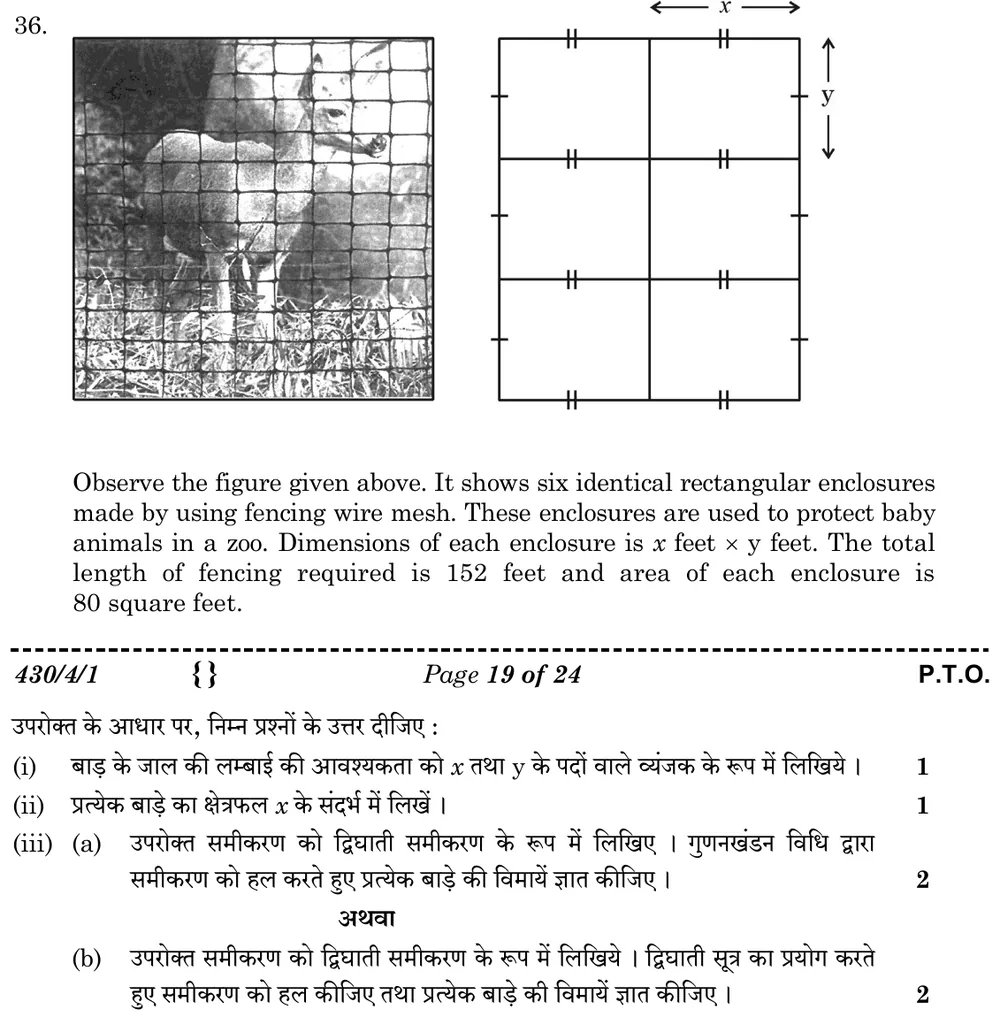
Six identical rectangular enclosures are made by using fencing wire mesh (see figure: 2 columns × 3 rows). These enclosures are used to protect baby animals in a zoo. Dimensions of each enclosure is x feet × y feet. The total length of fencing required is 152 feet and area of each enclosure is 80 square feet. (i) Write an expression for length of fencing required in terms of x and y. (1) (ii) Write the area of each enclosure in terms of x. (1) (iii) (a) Write the above equation in quadratic equation form and thus find the dimensions of each enclosure using factorisation method. (2) OR (iii) (b) Using above equation in quadratic form, solve the equation and find the dimensions of each enclosure using quadratic formula. (2) Write your answer, send a photo, get it marked in DheeAnswer and marking
- (i) Count the fencing: 4 horizontal lines of 2x and 3 vertical lines of 3y. 8x + 9y = 152 1 mark
- (ii) Area is x × y; replace y using (i). y = (152 − 8x)/9 ; Area = x(152 − 8x)/9 = 80 1 mark
- (iii)(a) Multiply by 9 and rearrange into standard form. 152x − 8x² = 720 ⇒ x² − 19x + 90 = 0 0.5 marks
- Find two numbers that multiply to 90 and add to −19. (x − 10)(x − 9) = 0 0.5 marks
- Set each factor to zero. x = 10 or 9 0.5 marks
- Use xy = 80 to find y for each x and write the dimensions. y = 8 or 80/9 ; enclosure 10 ft × 8 ft or 9 ft × 80/9 ft 0.5 marks
- (iii)(b) Use the formula with a = 1, b = −19, c = 90. x = [19 ± √(361 − 360)]/2 1 mark
- Simplify the square root and find both values. = (19 ± 1)/2 = 10 or 9 0.5 marks
- Use xy = 80 to find y for each x. y = 8 or 80/9 ; enclosure 10 ft × 8 ft or 9 ft × 80/9 ft 0.5 marks
Answer: (i) 8x + 9y = 152 (ii) x(152 − 8x)/9 = 80 (iii)(a) 10 ft × 8 ft or 9 ft × 80/9 ft / (b) 10 ft × 8 ft or 9 ft × 80/9 ft
Marks: Fencing (i) 1 · Area (ii) 1 · Quadratic and dimensions (iii) 2
For full marks: In (iii) find y for each value of x and write the dimensions — the last ½ is for y = 8 or 80/9.
Where students lose marks: Counting the fencing as 6x + 6y — the shared walls count once, giving 4 lines of 2x and 3 of 3y.
CBSE marking scheme
(i) 8x + 9y = 152 (1). (ii) Area = x(152 − 8x)/9 = 80 (1). (iii)(a) x2 − 19x + 90 = 0 (½); (x − 10)(x − 9) = 0 (½); x = 10 or 9 (½); y = 8 or 80/9, i.e. 10 ft × 8 ft or 9 ft × 80/9 ft (½). OR (b) x = [19 ± √(361 − 360)]/2 (1) = 10 or 9 (½); y = 8 or 80/9 (½).
- Q5 Case study · 4 marks CBSE · 2025
Case: lawn with a walkway
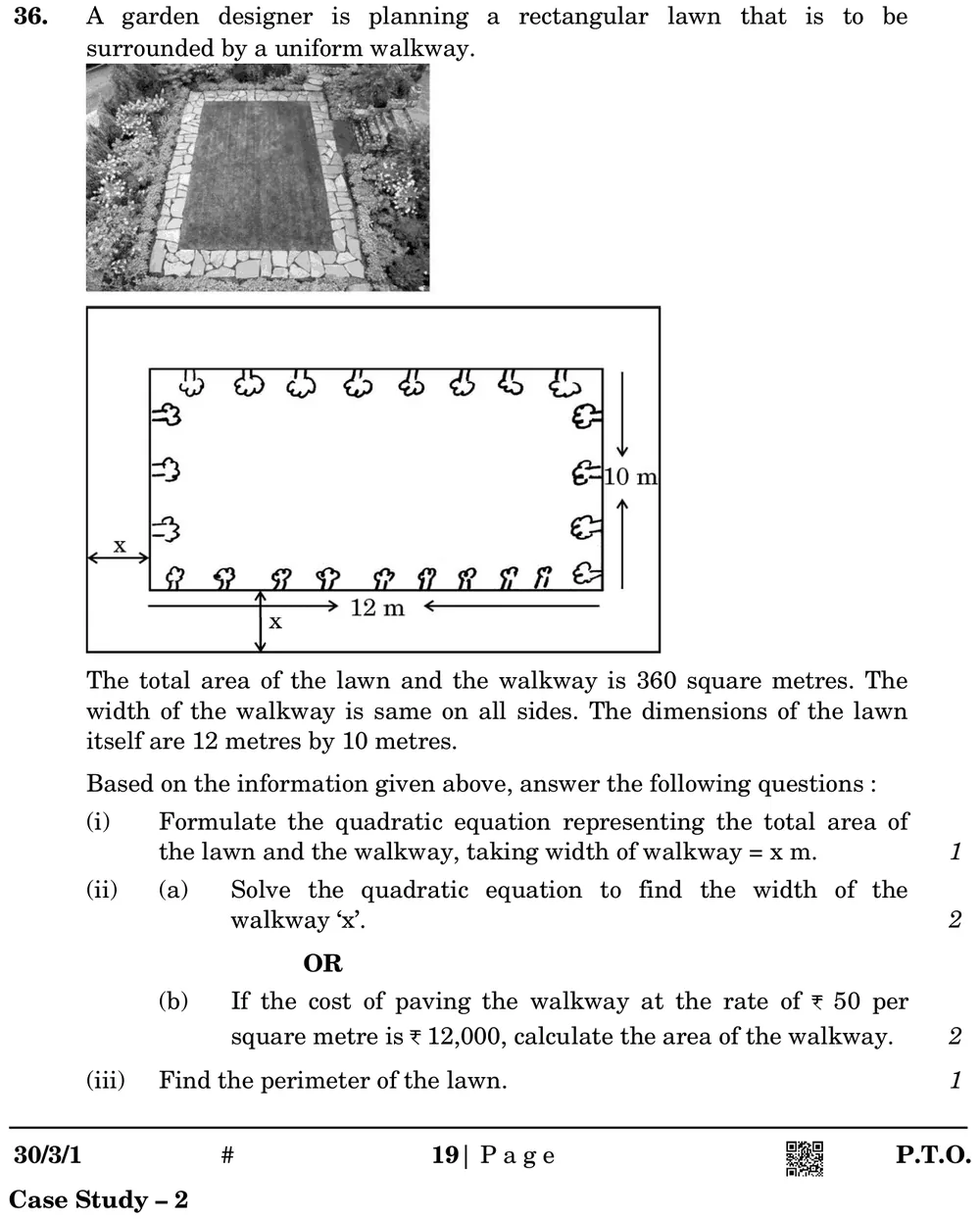
A garden designer is planning a rectangular lawn that is to be surrounded by a uniform walkway. The total area of the lawn and the walkway is 360 square metres. The width of the walkway is same on all sides. The dimensions of the lawn itself are 12 metres by 10 metres. (i) Formulate the quadratic equation representing the total area of the lawn and the walkway, taking width of walkway = x m. (1) (ii) (a) Solve the quadratic equation to find the width of the walkway 'x'. (2) OR (ii) (b) If the cost of paving the walkway at the rate of ₹50 per square metre is ₹12,000, calculate the area of the walkway. (2) (iii) Find the perimeter of the lawn. (1) Write your answer, send a photo, get it marked in DheeAnswer and marking
- (i) The outer rectangle is (12 + 2x) by (10 + 2x); its area is 360. (12 + 2x)(10 + 2x) = 360 0.5 marks
- Expand, then divide by 4 to get standard form. 4x² + 44x − 240 = 0 ⇒ x² + 11x − 60 = 0 0.5 marks
- (ii)(a) Find two numbers that multiply to −60 and add to 11. (x + 15)(x − 4) = 0 1 mark
- A width cannot be negative, so reject x = −15. x ≠ −15 ; width of walkway x = 4 m 1 mark
- (ii)(b) Area = total cost ÷ rate per square metre. Area of walkway = 12000/50 1 mark
- Divide and give the unit. = 240 m² 1 mark
- (iii) The lawn is 12 m by 10 m; use 2(l + b). Perimeter of lawn = 2(12 + 10) = 44 m 1 mark
Answer: (i) x² + 11x − 60 = 0 (ii)(a) x = 4 m / (b) 240 m² (iii) 44 m
Marks: Equation (i) 1 · Width or walkway area (ii) 2 · Perimeter (iii) 1
For full marks: In (ii)(a) write 'x ≠ −15' before 'width of walkway x = 4 m' — the width line carries its own mark.
Where students lose marks: Using (12 + x)(10 + x) = 360, forgetting the walkway is on both sides, which ruins (i) and (ii)(a).
CBSE marking scheme
(i) (12 + 2x)(10 + 2x) = 360 ⇒ x2 + 11x − 60 = 0 (½ + ½). (ii)(a) (x + 15)(x − 4) = 0 (1) ⇒ width x = 4 m (1). OR (ii)(b) area of walkway = 12000/50 = 240 m2 (1 + 1). (iii) perimeter of lawn = 2(12 + 10) = 44 m (1).
- Q6 Case study · 4 marks CBSE · 2024
Case: tiling a floor
A rectangular floor area can be completely tiled with 200 square tiles. If the side length of each tile is increased by 1 unit, it would take only 128 tiles to cover the floor. (i) Assuming the original length of each side of a tile be x units, make a quadratic equation from the above information. (ii) Write the corresponding quadratic equation in standard form. (iii) (a) Find the value of x, the length of side of a tile by factorisation. OR (iii) (b) Solve the quadratic equation for x, using quadratic formula.
Write your answer, send a photo, get it marked in DheeAnswer and marking
- (i) Floor area stays the same: 200 small tiles equal 128 bigger tiles. 200x² = 128(x + 1)² 1 mark
- (ii) Divide by 8, expand and bring all terms to one side. 25x² = 16x² + 32x + 16 ⇒ 9x² − 32x − 16 = 0 1 mark
- (iii)(a) Split −32x as −36x + 4x and factorise. (9x + 4)(x − 4) = 0 1 mark
- A side length cannot be negative, so reject −4/9. x ≠ −4/9, so x = 4 1 mark
- (iii)(b) Use the formula with a = 9, b = −32, c = −16. x = (32 ± √(1024 + 576))/18 = (32 ± 40)/18 1 mark
- Work out both values and reject the negative one. x = 72/18 = 4 or −8/18 = −4/9 ; x ≠ −4/9, so x = 4 1 mark
Answer: (i) 200x² = 128(x + 1)² (ii) 9x² − 32x − 16 = 0 (iii)(a) x = 4 units / (b) x = 4 units
Marks: Equation (i) 1 · Standard form (ii) 1 · Solving and rejecting (iii) 2
For full marks: Write 'x ≠ −4/9' with the reason before x = 4 — rejecting the negative root carries a full mark.
Where students lose marks: Writing 200x = 128(x + 1), forgetting each tile's area is the side squared.
CBSE marking scheme
(i) 200x2 = 128(x + 1)2 (1). (ii) 25x2 = 16x2 + 32x + 16 ⇒ 9x2 − 32x − 16 = 0 (1). (iii)(a) (9x + 4)(x − 4) = 0 (1); x ≠ −4/9, so x = 4 (1). OR (b) x = (32 ± √(1024 + 576))/18 = (32 ± 40)/18 (1); x ≠ −4/9, so x = 4 (1).
- Q7 Long answer · 5 marks CBSE · 2026, 2025 Asked in 2026, 2025
Train 480 km, speed cut by 8
A train travels a distance of 480 km at a uniform speed. If the speed had been 8 km/h less, then it would have taken 3 hours more to cover the same distance. Find the original speed of the train.
Write your answer, send a photo, get it marked in DheeAnswer and marking
- Let the speed be x; the slower trip takes 3 hours more. Speed = x km/h ; 480/(x − 8) − 480/x = 3 2 marks
- Take the LCM, cancel, and simplify. 480 × 8 = 3x(x − 8) ⇒ x² − 8x − 1280 = 0 1 mark
- Factorise: product −1280, sum −8. (x − 40)(x + 32) = 0 1 mark
- A speed cannot be negative. x = 40 (x = −32 rejected) ; original speed = 40 km/h 1 mark
Answer: Original speed of the train is 40 km/h
Marks: Equation 2 · Quadratic 1 · Factorising 1 · Answer 1
For full marks: Write the equation 480/(x − 8) − 480/x = 3 in full — it carries 2 of the 5 marks.
Where students lose marks: Writing 480/x − 480/(x − 8) = 3 — the slower speed x − 8 takes more time, so it comes first.
CBSE marking scheme
Speed x km/h: 480/(x − 8) − 480/x = 3 (2) ⇒ x2 − 8x − 1280 = 0 (1) ⇒ (x − 40)(x + 32) = 0 (1) ⇒ x = 40 km/h (1).
- Q8 Long answer · 5 marks CBSE · 2023
Train 360 km, 5 km/h faster
A train travels 360 km at a uniform speed. If the speed had been 5 km/h more, it would have taken 1 hour less for the same journey. Find the speed of the train.
Write your answer, send a photo, get it marked in DheeAnswer and marking
- Let the speed be x km/h. Speed = x km/h 0.5 marks
- Time = distance ÷ speed. Time = 360/x hours 0.5 marks
- Faster speed × shorter time still covers 360 km. (x + 5)(360/x − 1) = 360 1 mark
- Expand, multiply by x and simplify. 360 − x + 1800/x − 5 = 360 ⇒ x² + 5x − 1800 = 0 1 mark
- Factorise the quadratic. (x + 45)(x − 40) = 0 1 mark
- Speed cannot be negative, so keep the positive root. x = −45 rejected (speed cannot be negative) ⇒ x = 40 ; speed = 40 km/h 1 mark
Answer: Speed of the train = 40 km/h
Marks: Speed and time 1 · Equation 1 · Quadratic and factors 2 · Answer 1
For full marks: Write 'speed cannot be negative' before x = 40 km/h; the last mark needs it.
Where students lose marks: Writing 360/x + 1 instead of 360/x − 1: the faster train takes one hour less.
CBSE marking scheme
Speed x km/h (1/2); time 360/x (1/2); (x + 5)(360/x − 1) = 360 (1) ⇒ x2 + 5x − 1800 = 0 (1) ⇒ (x + 45)(x − 40) = 0 (1) ⇒ x = 40 (speed cannot be negative); speed = 40 km/h (1).
- Q9 Long answer · 5 marks CBSE · 2026
Father and son ages, sum 45
The sum of ages of a father and his son is 45 years. Five years ago, the product of their ages (in years) was 124. Determine their ages respectively after five years.
Write your answer, send a photo, get it marked in DheeAnswer and marking
- Let the son's present age be x; the father's age is what is left of 45. Son's present age = x years ; father's present age = (45 − x) years 1 mark
- Five years ago, take 5 from each age and multiply. (x − 5)(45 − x − 5) = 124 1 mark
- Open the brackets and bring everything to one side. (x − 5)(40 − x) = 124 ⇒ x² − 45x + 324 = 0 1 mark
- Factorise, then keep only the answer that fits a son. (x − 9)(x − 36) = 0 ⇒ x = 9 or 36 ; x = 36 rejected (son cannot be 36 when father is 9) 1 mark
- The question asks for ages after five years, so add 5. After 5 years: son = 14 years, father = 41 years 1 mark
Answer: Son 14 years, father 41 years (after five years)
Marks: Ages in terms of x 1 · Equation 1 · Quadratic 1 · Roots + rejection 1 · Final ages 1
For full marks: Write 'x = 36 rejected' with the reason, then add 5 — the last mark is for the ages after five years.
Where students lose marks: Stopping at present ages 9 and 36 — the question asks for ages after five years, so the last mark is lost.
CBSE marking scheme
Son's present age x, father's 45 − x (1); (x − 5)(45 − x − 5) = 124 (1); x2 − 45x + 324 = 0 (1); x = 9 or 36, reject 36 as son's age (1); after 5 years: son 14 years, father 41 years (1).
- Q10 Long answer · 5 marks CBSE · 2026
Cloth price with 2 m free
The total cost of certain piece of cloth was ₹ 2,100. During special sale time, the shopkeeper offered 2 m extra cloth for free thus reducing the price of cloth per metre by ₹ 120. What was the original per metre price of cloth and its length?
Write your answer, send a photo, get it marked in DheeAnswer and marking
- Let the length be x m; price per metre = total cost ÷ length, and it drops by 120. Length = x m ; 2100/x − 2100/(x + 2) = 120 2 marks
- Take the LCM, cancel, and simplify. 4200 = 120x(x + 2) ⇒ x² + 2x − 35 = 0 1 mark
- Factorise the quadratic. (x + 7)(x − 5) = 0 1 mark
- A length cannot be negative. x = 5 (x = −7 rejected) 0.5 marks
- Find the original price per metre. Price = 2100/5 = ₹ 420 per metre ; length = 5 m 0.5 marks
Answer: Original price ₹ 420 per metre; length 5 m
Marks: Equation 2 · Quadratic 1 · Factorising 1 · Root + answer 1
For full marks: End with both answers: '₹ 420 per metre' and '5 m' — the last ½ needs both.
Where students lose marks: Giving only the length 5 m and forgetting the price 2100/5 = ₹ 420 per metre.
CBSE marking scheme
Let length = x m; 2100/x − 2100/(x + 2) = 120 (2) ⇒ x2 + 2x − 35 = 0 (1) ⇒ (x + 7)(x − 5) = 0 (1) ⇒ x = 5 (½); original price ₹ 420 per metre, length 5 m (½).
Free 10-question test: Quadratic Equations
MCQ and Assertion–Reason questions from CBSE papers. About 10 minutes. Your score shows straight away.
Common mistakes in Quadratic Equations
Mistake Keeping or dropping a root without checking it against the story.
Fix Test each root. A speed, length or age cannot be negative, and a border width cannot make a side negative. Write a line like 'the negative value is rejected, as speed cannot be negative' (½ mark). But if the question only says 'integers', a negative pair may also be correct.
Mistake Setting up the speed–time equation the wrong way round.
Fix Time = distance ÷ speed. The slower speed takes more time, so write: time at slower speed − time at faster speed = the difference. Change minutes to hours first (30 minutes = 30/60 h). This equation carries 2 marks.
Mistake Slipping on signs in the discriminant, or reading it wrong.
Fix Write D = b² − 4ac with brackets for negative numbers. D > 0: two distinct real roots. D = 0: two equal real roots. D < 0: no real roots. If b is missing, b = 0. Rational roots need D to be a perfect square.
Mistake Giving only one value of k when k² equals a number.
Fix k² = a number gives two values, + and −. The scheme gives ½ mark for each. Then check any extra condition, like 'positive roots', and keep only the value that fits.
Mistake Jumping to factorising before the equation is in standard form.
Fix With fractions, take the LCM, cross-multiply, and bring every term to one side: ax² + bx + c = 0. In 'express in standard form and solve', this line carries 1 or 2 marks.
Mistake Answering a different thing from what was asked.
Fix Read the last line again. If it asks ages after five years, add 5. If it asks the price per metre and the length, give both, with units.
How to write for full marks
- Start with 'Let … = x', with the unit, and write the other quantity in terms of x (x − 10 km/h, 45 − x years).
- Write the equation from the story, then the standard form ax² + bx + c = 0 on its own line. Both steps carry marks.
- Factorise by splitting the middle term. If you use the formula, first write D = b² − 4ac with its value (1 mark), then x = (−b ± √D)/(2a).
- For nature of roots, write D = b² − 4ac, put in the numbers, and say which case it is.
- End with a sentence and units: 'speed of the train = … km/h'.
Not in the 2026-27 exam
Leave these out of your revision.
- Solving by completing the square
- Roots that are not real numbers (you only say 'no real roots')
Questions students ask
Which Quadratic Equations questions are most important for the Class 10 board exam 2027?
Expect a 5-mark word problem (speed, numbers, area or ages) and MCQs on the discriminant and k for equal roots. The 10 questions on this page are real CBSE board questions from 2023–2026, chosen across the chapter's topics and question types.
How many marks does Quadratic Equations carry in the Class 10 board exam?
Quadratic Equations is part of the Algebra unit, which carries 5 of the 80 theory marks in the CBSE Class 10 Maths paper.
Are these real CBSE previous year questions?
Yes. Each question is printed as it appeared in a CBSE board paper or sample paper, with its source, and the answer follows CBSE's official marking scheme.
Questions and answers: CBSE board papers, sample papers and official marking schemes, 2023–2026. Worked steps and tips: Dhee.