Chapter 6 · CBSE Board 2027
Triangles Class 10 important questions with answers
The 10 questions to practise first, picked from every CBSE board paper 2023–2026. Each one has the official answer and how to write it for full marks. Then try the free 10-question test.
What comes in the exam
- Triangles is in the Geometry unit, worth 15 marks.
- MCQs (1 mark) and 5-mark questions come most, then 2-mark questions.
- 3-mark questions, Assertion–Reason and case studies are few.
- Almost every year a 5-mark question asks you to prove the Basic Proportionality Theorem (BPT), and sometimes a short sum comes after the proof.
- Also almost every year: MCQs and 2-mark sums that use BPT, 2- and 5-mark proofs that two triangles are similar by AA or SAS, a 5-mark proof about medians of similar triangles, MCQs on matching the corners, and using the converse of BPT to show two lines are parallel.
Top 10 Triangles questions from board papers
Real CBSE questions, printed as they appeared. Open each answer to see the marking and the steps.
- Q1 MCQ · 1 mark CBSE · 2026, 2025 Asked in 2026, 2025
Which statement is not true? (△)
If in two triangles DEF and PQR, ∠D = ∠Q and ∠R = ∠E, then which of the following is not true ?
- (A) EF/PR = DF/PQ
- (B) DE/PQ = EF/RP
- (C) DE/QR = DF/PQ
- (D) EF/RP = DE/QR
Write your answer, send a photo, get it marked in DheeAnswer and marking
Correct option: (B) DE/PQ = EF/RP
- Match equal angles to write the correct similarity. ∠D = ∠Q, ∠E = ∠R ⇒ △DEF ∼ △QRP
- Write the side ratios in the same order. DE/QR = EF/RP = DF/QP
- Check each option; only (B) pairs DE with PQ. DE/PQ = EF/RP is not true ⇒ option (B) 1 mark
Answer: (B) DE/PQ = EF/RP
Marks: Correct option 1
For full marks: Write the similarity in matching order, △DEF ∼ △QRP, before reading ratios.
Where students lose marks: Choosing (C) DE/QR = DF/PQ; it looks odd but is true, since PQ = QP.
CBSE marking scheme
△DEF ~ △QRP (D↔Q, E↔R, F↔P), so DE/QR = EF/RP = DF/QP; DE/PQ = EF/RP is not true.
- Q2 Very short answer · 2 marks CBSE · 2025, 2023 Asked in 2025, 2023
Prove △PQS ~ △TQR (∠1 = ∠2)
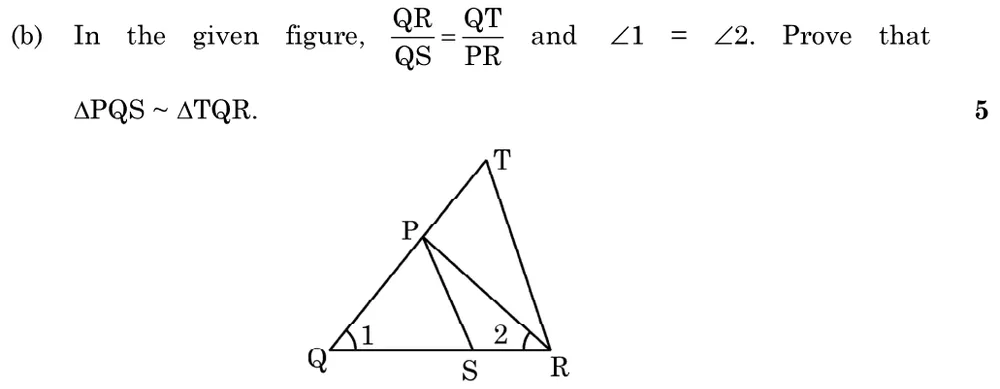
In the given figure, QR/QS = QT/PR and ∠1 = ∠2. Prove that △PQS ~ △TQR. Write your answer, send a photo, get it marked in DheeAnswer and marking
- In triangle PQR, the angles at Q and R are equal, so the sides opposite them are equal. ∠1 = ∠2 ⇒ PQ = PR 0.5 marks
- Put PQ for PR in the given ratio, then flip both sides. QR/QS = QT/PQ ⇒ QS/QR = QP/QT 1 mark
- The angle at Q is in both triangles, so use SAS. ∠Q is common ; so △PQS ∼ △TQR (SAS similarity) 0.5 marks
Answer: △PQS ∼ △TQR (SAS)
Marks: Equal sides ½ · Ratio 1 · Common angle and SAS ½
For full marks: Write 'PQ = PR' first; the ratio line only works after you replace PR with PQ.
Where students lose marks: Writing the ratio as QR/QS = QT/PR and using it unchanged does not match the triangles' sides, so SAS fails.
CBSE marking scheme
∠1 = ∠2 gives PQ = PR (½); so QR/QS = QT/PQ, i.e. QS/QR = QP/QT (½+½); ∠Q common (½); △PQS ~ △TQR by SAS similarity.
- Q3 Very short answer · 2 marks CBSE · 2024, 2023 Asked in 2024, 2023
Prove AM/AN = AB/AD
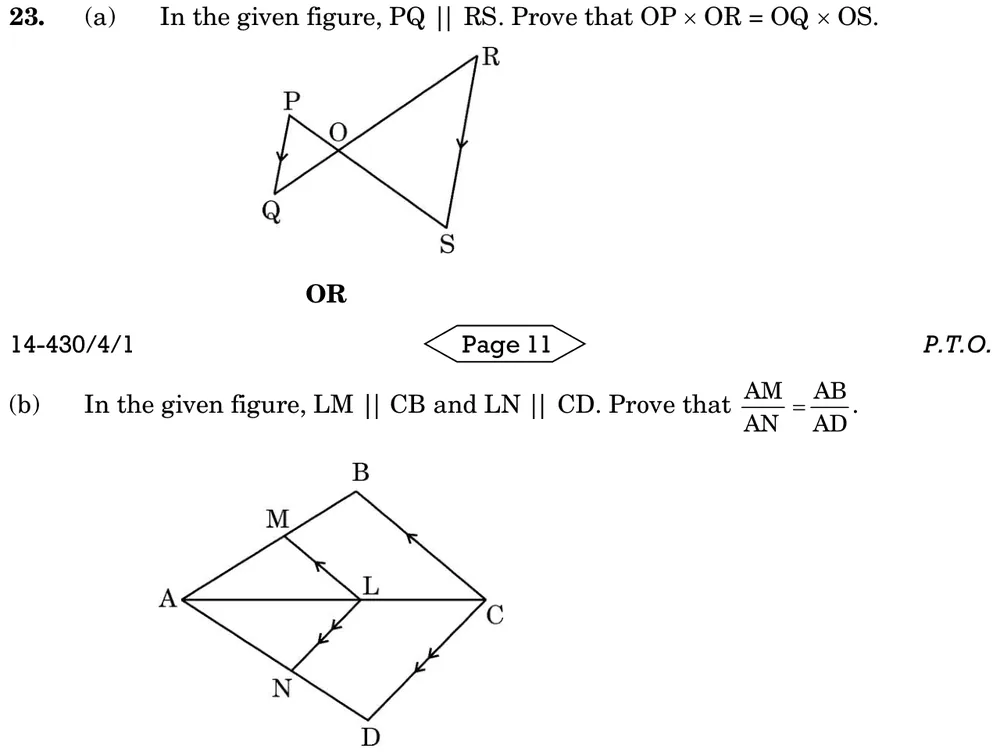
In the given figure, LM || CB and LN || CD. Prove that AM/AN = AB/AD. Write your answer, send a photo, get it marked in DheeAnswer and marking
- In triangle ABC, LM is parallel to CB, so use the Basic Proportionality Theorem. In △ABC, LM ∥ CB ⇒ AM/AB = AL/AC … (i) 0.5 marks
- In triangle ADC, LN is parallel to CD, so do the same. In △ADC, LN ∥ CD ⇒ AN/AD = AL/AC … (ii) 1 mark
- Both ratios equal AL/AC, so set them equal and rearrange. From (i) and (ii), AM/AB = AN/AD ⇒ AM/AN = AB/AD 0.5 marks
Answer: AM/AN = AB/AD
Marks: First ratio ½ · Second ratio 1 · Conclusion ½
For full marks: Label the ratios (i) and (ii) and write 'From (i) and (ii)'; the last ½ is for joining them.
Where students lose marks: Using AM/MB = AL/LC and then mixing it with AN/AD gives ratios that do not match.
CBSE marking scheme
In △ABC, LM || CB: AM/AB = AL/AC (BPT) …(i) (½). In △ADC, LN || CD: AN/AD = AL/AC …(ii) (1). From (i) and (ii), AM/AB = AN/AD, i.e. AM/AN = AB/AD (½).
- Q4 Very short answer · 2 marks CBSE · 2026, 2023 Asked in 2026, 2023
Prove BF/FE = BE/EC
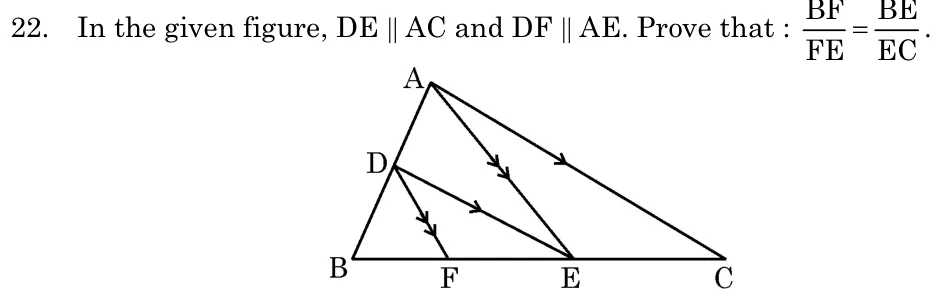
In the given figure, DE ∥ AC and DF ∥ AE. Prove that: BF/FE = BE/EC. Write your answer, send a photo, get it marked in DheeAnswer and marking
- Use the triangle where FD is parallel to EA and apply the Basic Proportionality Theorem. In △BEA, FD ∥ EA ⇒ BF/FE = BD/DA …(1) 1 mark
- Now use the bigger triangle, where ED is parallel to CA. In △BCA, ED ∥ CA ⇒ BE/EC = BD/DA …(2) 0.5 marks
- Both ratios equal BD/DA, so set them equal. From (1) and (2), BF/FE = BE/EC. Hence proved. 0.5 marks
Answer: BF/FE = BE/EC (both equal BD/DA).
Marks: First BPT ratio 1 · Second BPT ratio ½ · Conclusion ½
For full marks: Name the triangle each time — 'In △BEA, FD ∥ EA' — so the examiner sees which parallel line you used.
Where students lose marks: Writing BF/BE = BD/DA in △BEA mixes part with whole on one side only and loses the first mark.
CBSE marking scheme
In △BEA, FD ∥ EA ⇒ BF/FE = BD/DA (1). In △BCA, ED ∥ CA ⇒ BE/EC = BD/DA (½). Hence BF/FE = BE/EC (½).
- Q5 Very short answer · 2 marks CBSE · 2026, 2025 Asked in 2026, 2025
Prove △ADE ~ △ABC
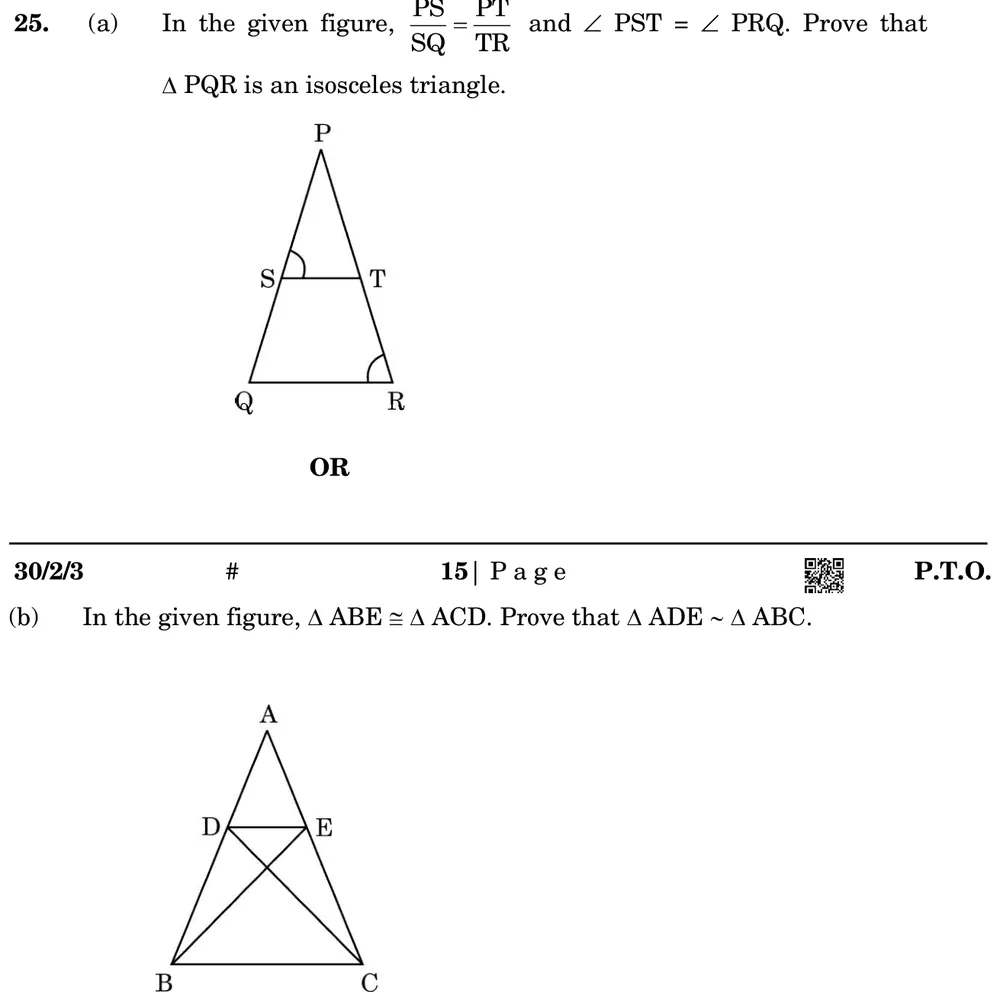
In the given figure, △ABE ≅ △ACD. Prove that △ADE ~ △ABC. Write your answer, send a photo, get it marked in DheeAnswer and marking
- Matching parts of congruent triangles are equal. △ABE ≅ △ACD ⇒ AB = AC and AE = AD (CPCT) 1 mark
- Divide the two equalities to get equal ratios. ⇒ AD/AB = AE/AC 0.5 marks
- The angle at A is common, so use SAS similarity. ∠A common ⇒ △ADE ∼ △ABC (SAS) 0.5 marks
Answer: △ADE ∼ △ABC (proved)
Marks: Equal sides (CPCT) 1 · Ratio ½ · SAS ½
For full marks: Write '∠A is common' before naming SAS — the last ½ is for the included angle.
Where students lose marks: Stopping at AB = AC and AE = AD without forming the ratio AD/AB = AE/AC.
CBSE marking scheme
△ABE ≅ △ACD ⇒ AB = AC and AE = AD (CPCT) (1) ⇒ AD/AB = AE/AC, and ∠A is common ⇒ △ADE ~ △ABC (SAS) (½ + ½).
- Q6 Case study · 4 marks CBSE · 2024
Case: folding table legs
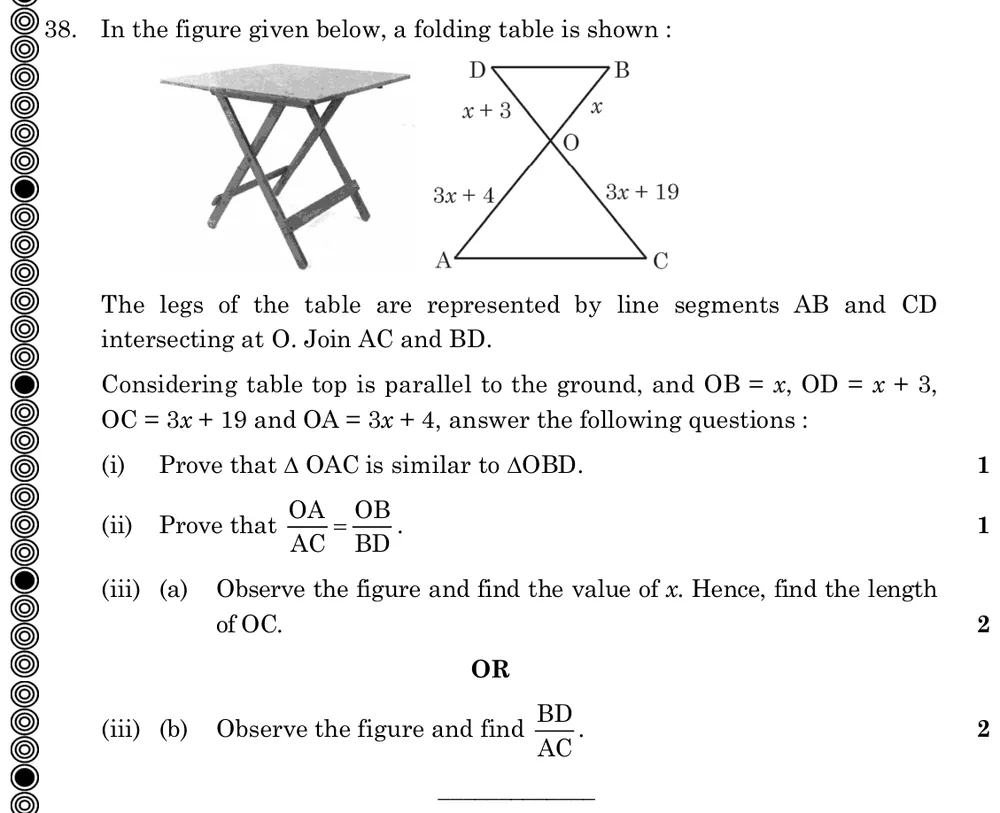
In the figure given below, a folding table is shown. The legs of the table are represented by line segments AB and CD intersecting at O. Join AC and BD. Considering table top is parallel to the ground, and OB = x, OD = x + 3, OC = 3x + 19 and OA = 3x + 4, answer the following questions : (i) Prove that △OAC is similar to △OBD. (ii) Prove that OA/AC = OB/BD. (iii) (a) Observe the figure and find the value of x. Hence, find the length of OC. OR (iii) (b) Observe the figure and find BD/AC. Write your answer, send a photo, get it marked in DheeAnswer and marking
- (i) The table top is parallel to the ground, so look for equal alternate angles. DB ∥ AC ⇒ ∠D = ∠C and ∠B = ∠A (alternate interior angles) ; △OAC ∼ △OBD (AA) 1 mark
- (ii) Similar triangles have corresponding sides in the same ratio, so write it and rearrange. OA/OB = AC/BD ⇒ OA/AC = OB/BD 1 mark
- (iii)(a) Use the similarity again to write a ratio with x. OA/OB = OC/OD ⇒ (3x + 4)/x = (3x + 19)/(x + 3) 1 mark
- Cross-multiply, and the x² terms cancel. 3x² + 13x + 12 = 3x² + 19x ⇒ 6x = 12 ⇒ x = 2 0.5 marks
- Put x = 2 into OC. OC = 3(2) + 19 = 25 0.5 marks
- (iii)(b) First find x from the side ratio of the similar triangles. OA/OB = OC/OD ⇒ (3x + 4)/x = (3x + 19)/(x + 3) 1 mark
- Cross-multiply, and the x² terms cancel. 3x² + 13x + 12 = 3x² + 19x ⇒ 6x = 12 ⇒ x = 2 0.5 marks
- BD/AC equals OB/OA by the similarity, so put in x = 2. OB = 2, OA = 3(2) + 4 = 10 ; BD/AC = OB/OA = 2/10 = 1/5 0.5 marks
Answer: (i) △OAC ∼ △OBD (AA); (ii) OA/AC = OB/BD; (iii) (a) x = 2, OC = 25 / (b) BD/AC = 1/5
Marks: (i) Similarity 1 · (ii) Ratio 1 · (iii) Equation and x 1½ · Answer ½
For full marks: Write the ratio OA/OB = OC/OD before putting in x — that line earns the first mark in (iii).
Where students lose marks: Pairing OA with OD (instead of OB) gives a wrong equation, because A matches B, not D, in the similarity.
CBSE marking scheme
(i) DB ∥ AC: ∠D = ∠C and ∠B = ∠A (alternate interior angles), so △OAC ~ △OBD (AA) (1). (ii) Similarity gives OA/OB = AC/BD, i.e. OA/AC = OB/BD (1). (iii)(a) OA/OB = OC/OD: (3x + 4)/x = (3x + 19)/(x + 3) ⇒ x = 2 (1+½); OC = 25 (½). OR (iii)(b) x = 2 (1+½); BD/AC = OB/OA = 2/10 = 1/5 (½).
- Q7 Long answer · 5 marks CBSE · 2026, 2025, 2024, 2023 Asked in 2026, 2025, 2024, 2023
Prove Basic Proportionality Thm
If a line is drawn parallel to one side of a triangle to intersect the other two sides in distinct points, then prove that the other two sides are divided in the same ratio.
Write your answer, send a photo, get it marked in DheeAnswer and marking
- Write what is given and what you must prove, naming the points. Given: In △ABC, DE ∥ BC, D on AB, E on AC ; To prove: AD/DB = AE/EC 1 mark
- Draw the figure and add the extra lines the proof needs. Construction: draw DM ⟂ AC and EN ⟂ AB ; join BE and CD 1 mark
- With EN as the common height, compare the areas of ADE and DBE. ar(ADE)/ar(DBE) = (½ × AD × EN)/(½ × DB × EN) = AD/DB 1 mark
- With DM as the common height, compare the areas of ADE and DCE. ar(ADE)/ar(DCE) = (½ × AE × DM)/(½ × EC × DM) = AE/EC 1 mark
- Triangles DBE and DCE stand on the same base between the same parallels. ar(DBE) = ar(DCE) (same base DE, between the same parallels DE and BC) 0.5 marks
- The two ratios have equal denominators, so they are equal. Hence AD/DB = AE/EC 0.5 marks
Answer: AD/DB = AE/EC, so the two sides are divided in the same ratio.
Marks: Given, to prove, construction, figure 2 · Two area ratios 2 · Equal areas and conclusion 1
For full marks: Write the reason 'same base DE, between the same parallels DE and BC'; that line has its own ½.
Where students lose marks: Leaving out the figure or the construction lines loses up to 2 marks even when the proof is right.
CBSE marking scheme
Correct given, to prove, construction, figure (4 × ½ = 2). DE || BC; draw DM ⟂ AC, EN ⟂ AB, join BE, CD. ar(ADE)/ar(DBE) = AD/DB (1); ar(ADE)/ar(DCE) = AE/EC (1); ar(DBE) = ar(DCE) (same base DE, same parallels) (½); hence AD/DB = AE/EC (½).
- Q8 Long answer · 5 marks CBSE · 2026, 2025, 2024, 2023 Asked in 2026, 2025, 2024, 2023
State and prove BPT
State and prove Basic Proportionality Theorem.
Write your answer, send a photo, get it marked in DheeAnswer and marking
- State the theorem in full sentences. If a line is drawn parallel to one side of a triangle to intersect the other two sides in distinct points, the other two sides are divided in the same ratio. 1 mark
- Write what is given and what you must prove. Given: In △ABC, DE ∥ BC, D on AB, E on AC ; To prove: AD/DB = AE/EC 1 mark
- Draw the figure and the extra lines the proof needs. Construction: join BE and CD ; draw EN ⊥ AB and DM ⊥ AC 1 mark
- Compare areas of triangles sharing a height to get two ratios. ar(ADE)/ar(BDE) = AD/DB ; ar(ADE)/ar(DEC) = AE/EC 1 mark
- Triangles BDE and DEC have the same base and lie between the same parallels. ar(BDE) = ar(DEC) (same base DE, between the same parallels) ⇒ AD/DB = AE/EC 1 mark
Answer: AD/DB = AE/EC (Basic Proportionality Theorem).
Marks: Statement 1 · Given, to prove, construction, figure 2 · Proof 2
For full marks: Write 'ar(BDE) = ar(DEC), same base DE, between the same parallels'; the proof marks depend on this line.
Where students lose marks: Skipping the statement and starting straight with the proof throws away the first mark.
CBSE marking scheme
Statement (1): if a line is drawn parallel to one side of a triangle to intersect the other two sides in distinct points, the other two sides are divided in the same ratio. Given, to prove, construction and figure (2). Correct proof (2) — e.g. join BE, CD, draw EN ⊥ AB, DM ⊥ AC; ar(ADE)/ar(BDE) = AD/DB, ar(ADE)/ar(DEC) = AE/EC, and ar(BDE) = ar(DEC) (same base DE, between the same parallels) ⇒ AD/DB = AE/EC.
- Q9 Long answer · 5 marks CBSE · 2025, 2024, 2023 Asked in 2025, 2024, 2023
Medians of similar triangles
If AD and PM are medians of triangles ABC and PQR respectively, where △ABC ~ △PQR, then prove that AB/PQ = AD/PM.
Write your answer, send a photo, get it marked in DheeAnswer and marking
- Draw both triangles with medians AD and PM, and write what is given. Given: △ABC ∼ △PQR, AD and PM are medians ; To prove: AB/PQ = AD/PM 1 mark
- Use the similar triangles, then halve BC and QR because D and M are mid-points. △ABC ∼ △PQR ⇒ AB/PQ = BC/QR = (½BC)/(½QR) = BD/QM 1 mark
- Look at the smaller triangles ABD and PQM: an equal angle with sides in proportion. In △ABD and △PQM: ∠B = ∠Q and AB/PQ = BD/QM ⇒ △ABD ∼ △PQM (SAS) 2 marks
- Corresponding sides of similar triangles are in the same ratio. Hence AB/PQ = AD/PM 1 mark
Answer: AB/PQ = AD/PM
Marks: Given and figure 1 · BD/QM ratio 1 · SAS similarity 2 · Conclusion 1
For full marks: Write the line (½BC)/(½QR) = BD/QM; it shows why the medians matter and earns a mark.
Where students lose marks: Not stating ∠B = ∠Q before using SAS leaves the similarity unproved and loses 2 marks.
CBSE marking scheme
Given/figure (1). △ABC ~ △PQR ⇒ AB/PQ = BC/QR = (½BC)/(½QR) = BD/QM (1); in △ABD and △PQM, ∠B = ∠Q and AB/PQ = BD/QM ⇒ △ABD ~ △PQM by SAS (2); hence AB/PQ = AD/PM (1).
- Q10 Long answer · 5 marks CBSE · 2025, 2023 Asked in 2025, 2023
Median ratios imply △ABC ~ △PQR
Sides AB and BC and median AD of triangle ABC are respectively proportional to sides PQ and QR and median PM of △PQR. Show that △ABC ~ △PQR.
Write your answer, send a photo, get it marked in DheeAnswer and marking
- Draw both triangles with medians AD and PM. Figure: △ABC with median AD, △PQR with median PM 1 mark
- Write BC and QR as twice BD and QM, since D and M are mid-points. AB/PQ = BC/QR = AD/PM ⇒ AB/PQ = 2BD/2QM = AD/PM 1 mark
- All three sides of ABD and PQM are in the same ratio. AB/PQ = BD/QM = AD/PM ⇒ △ABD ∼ △PQM (SSS) 1.5 marks
- Corresponding angles of similar triangles are equal. ⇒ ∠B = ∠Q 0.5 marks
- Now use the equal angle with the two sides around it in the big triangles. AB/PQ = BC/QR and ∠B = ∠Q ⇒ △ABC ∼ △PQR (SAS) 1 mark
Answer: △ABC ∼ △PQR (SAS)
Marks: Figure 1 · Ratio 1 · SSS 1½ · Angle ½ · SAS 1
For full marks: Write '⇒ ∠B = ∠Q' as its own line; it carries ½ and links the two similarities.
Where students lose marks: Jumping straight to △ABC ∼ △PQR by SSS fails, because AC/PR is not given.
CBSE marking scheme
Correct figure (1). AB/PQ = BC/QR = AD/PM ⇒ AB/PQ = 2BD/2QM = AD/PM (1) ⇒ △ABD ~ △PQM by SSS (1½) ⇒ ∠B = ∠Q (½); AB/PQ = BC/QR and ∠B = ∠Q ⇒ △ABC ~ △PQR by SAS (1).
Free 10-question test: Triangles
MCQ and Assertion–Reason questions from CBSE papers. About 10 minutes. Your score shows straight away.
Common mistakes in Triangles
Mistake Starting the BPT proof straight from the area ratios.
Fix First draw the figure and write Given, To prove and Construction (join BE and CD, draw DM ⟂ AC and EN ⟂ AB). These four parts carry ½ mark each, 2 marks in all.
Mistake Writing ar(DBE) = ar(DCE) with no reason.
Fix Write the reason in brackets: 'triangles on the same base DE and between the same parallels DE and BC'. This line carries ½ mark, and each area-ratio line before it carries 1 mark.
Mistake In 'State and prove BPT', going straight to the proof.
Fix Write the full statement first: 'If a line is drawn parallel to one side of a triangle to meet the other two sides in distinct points, the other two sides are divided in the same ratio.' The statement carries 1 mark.
Mistake Writing the similar triangles in the wrong order, so the side ratios do not match.
Fix Pair the equal angles first, for example ∠A = ∠R and ∠B = ∠P. Then write the triangles in that order: △ABC ~ △RPQ. Now read the ratios off the names: AB/RP = BC/PQ = AC/RQ.
Mistake Mixing a part with a whole in a BPT ratio.
Fix BPT gives AD/DB = AE/EC (part to part) or AD/AB = AE/AC (part to whole). Never mix the two on one line. If AP : AB = 2 : 5, then AP : PB = 2 : 3.
Mistake In a medians proof, skipping the step that halves the sides.
Fix Write BC/QR = (½BC)/(½QR) = BD/QM, because D and M are mid-points (1 mark). Then use SAS with the included angle ∠B = ∠Q (2 marks), and only then write the ratio of the medians.
How to write for full marks
- Draw a neat labelled figure for every 5-mark proof. The scheme gives marks for the figure alone: ½ in the BPT proof, 1 or 2 in many other proofs.
- For each pair of equal angles, write the reason in brackets: (common), (alternate angles, AE ∥ BC), (opposite angles of a parallelogram). Then name the rule: '△ABE ~ △CFB (AA)'.
- When two parallel lines are given, use BPT twice. Name the triangle each time ('In △ABC, LM ∥ CB'), number the results (i) and (ii), then join them.
- In BPT number sums, write the ratio with letters first, then put in the numbers, and write cm with the answer.
Not in the 2026-27 exam
Leave these out of your revision.
- Proofs of the converse of BPT and of the AA, SSS, SAS criteria
- Areas of similar triangles and Pythagoras theorem (removed)
Questions students ask
Which Triangles questions are most important for the Class 10 board exam 2027?
Expect a 5-mark BPT proof, MCQs and 2-mark sums on BPT, and 2- or 5-mark proofs of similar triangles by AA or SAS. The 10 questions on this page are real CBSE board questions from 2023–2026, chosen across the chapter's topics and question types.
How many marks does Triangles carry in the Class 10 board exam?
Triangles is part of the Geometry unit, which carries 8 of the 80 theory marks in the CBSE Class 10 Maths paper.
Are these real CBSE previous year questions?
Yes. Each question is printed as it appeared in a CBSE board paper or sample paper, with its source, and the answer follows CBSE's official marking scheme.
Questions and answers: CBSE board papers, sample papers and official marking schemes, 2023–2026. Worked steps and tips: Dhee.