Chapter 9 · CBSE Board 2027
Some Applications of Trigonometry Class 10 important questions with answers
The 10 questions to practise first, picked from every CBSE board paper 2023–2026. Each one has the official answer and how to write it for full marks. Then try the free 10-question test.
What comes in the exam
- Some Applications of Trigonometry is in the Trigonometry unit, worth 12 marks.
- 5-mark questions come most, then MCQs and 4-mark case studies.
- 2-mark questions and Assertion–Reason are rare.
- Almost every year there is a 5-mark heights-and-distances sum with two angles: a tower and its shadow, two buildings, a tower on a building, two poles across a road, or a ship or car moving closer.
- A case study on ladders, kites or towers comes almost every year too.
- MCQs, also almost every year, ask for a height, a shadow, a string or the Sun's angle.
- Only 30°, 45° and 60° are used.
Top 10 Some Applications of Trigonometry questions from board papers
Real CBSE questions, printed as they appeared. Open each answer to see the marking and the steps.
- Q1 MCQ · 1 mark CBSE · 2024, 2023 Asked in 2024, 2023
Sun's angle: 6 m pole, 2√3 m
If a pole 6 m high casts a shadow 2√3 m long on the ground, then the sun's elevation is
- (A) 30°
- (B) 45°
- (C) 60°
- (D) 90°
Write your answer, send a photo, get it marked in DheeAnswer and marking
Correct option: (C) 60°
- Height over shadow gives tan of the Sun's elevation. tan θ = 6/(2√3) = 3/√3 = √3
- Find the angle whose tangent is √3. θ = 60° ⇒ option (C) 1 mark
Answer: (C) 60°
Marks: Correct option 1
For full marks: Simplify 6/(2√3) to √3 before you look at the table.
Where students lose marks: Picking (A) 30°: dividing shadow by height gives 1/√3, the wrong way round.
CBSE marking scheme
tan θ = 6/(2√3) = √3 ⇒ θ = 60°.
- Q2 MCQ · 1 mark CBSE · 2026, 2024 Asked in 2026, 2024
Angle of elevation of 30 m tower
A car is moving away from the base of a 30 m high tower. The angle of elevation of the top of the tower from the car at an instant, when the car is 10√3 m away from the base of the tower, is:
- (A) 30°
- (B) 45°
- (C) 90°
- (D) 60°
Write your answer, send a photo, get it marked in DheeAnswer and marking
Correct option: (D) 60°
- Tower height over the car's distance gives tan of the elevation. tan θ = 30/(10√3) = 3/√3 = √3
- Find the angle whose tangent is √3. θ = 60° ⇒ option (D) 1 mark
Answer: (D) 60°
Marks: Correct option 1
For full marks: Opposite side = height 30 m, adjacent side = distance 10√3 m; tan θ = opposite/adjacent.
Where students lose marks: Picking (A) 30°: putting the distance on top gives 1/√3 instead of √3.
CBSE marking scheme
tan θ = 30/(10√3) = √3 ⇒ θ = 60°.
- Q3 Case study · 4 marks CBSE · 2026
Case: water tank and building
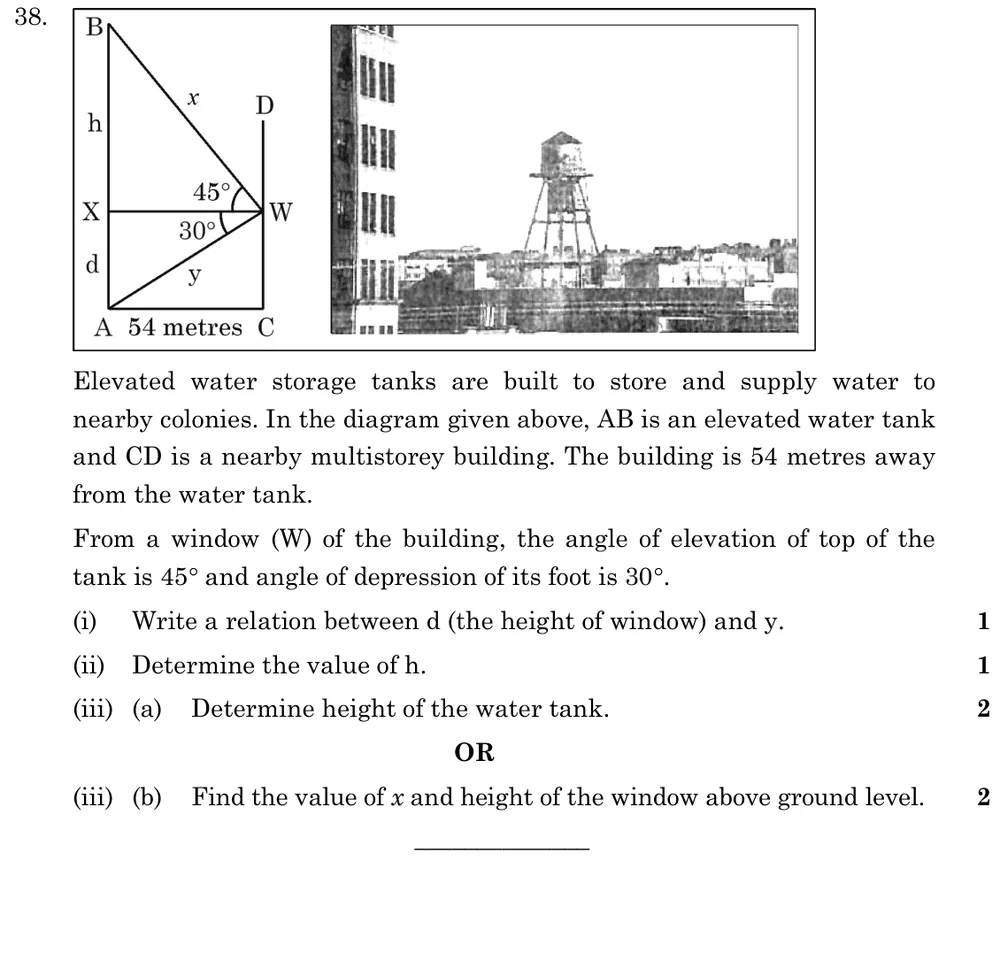
Elevated water storage tanks are built to store and supply water to nearby colonies. In the diagram, AB is an elevated water tank and CD is a nearby multistorey building. The building is 54 metres away from the water tank. From a window (W) of the building, the angle of elevation of top of the tank is 45° and angle of depression of its foot is 30°. (i) Write a relation between d (the height of window) and y. [1] (ii) Determine the value of h. [1] (iii) (a) Determine height of the water tank. [2] OR (iii) (b) Find the value of x and height of the window above ground level. [2] Write your answer, send a photo, get it marked in DheeAnswer and marking
- (i) In triangle WXA, d is opposite 30° and y is the hypotenuse, so use sine. sin 30° = d/y ⇒ 1/2 = d/y ⇒ y = 2d 1 mark
- (ii) WX equals the 54 m gap and h is opposite 45°, so use tan. tan 45° = h/WX = h/54 ⇒ h = 54 m 1 mark
- (iii)(a) Find d from the 30° angle and the 54 m gap. tan 30° = d/54 ⇒ d = 54/√3 = 18√3 m 1 mark
- The tank height is the part above X plus the part below X. Height of tank AB = h + d = (54 + 18√3) m 1 mark
- (iii)(b) ∠WAC equals the 30° depression (alternate angles), so find WC with tan. ∠WAC = 30° ; tan 30° = WC/54 ⇒ WC = 18√3 m 1 mark
- x is the hypotenuse of triangle WXB, so use sin 45°. sin 45° = h/x ⇒ 1/√2 = 54/x ⇒ x = 54√2 m 1 mark
Answer: (i) y = 2d (ii) h = 54 m (iii) (a) (54 + 18√3) m / (b) x = 54√2 m, window 18√3 m above the ground
Marks: Part (i) 1 · Part (ii) 1 · Part (iii) 2
For full marks: In (iii)(a) write 'AB = h + d' — the second mark is for adding the part of the tank below the window.
Where students lose marks: Using tan 30° = d/y in (i): y is the slant line WA, so the ratio with d is sine, not tan.
CBSE marking scheme
(i) sin 30° = 1/2 = d/y ⇒ y = 2d (1). (ii) tan 45° = h/WX = h/54 ⇒ h = 54 m (1). (iii)(a) tan 30° = d/54 ⇒ d = 18√3 m (1); tank height = h + d = (54 + 18√3) m (1). OR (iii)(b) ∠WAC = 30°, tan 30° = WC/54 ⇒ WC = 18√3 m (1); sin 45° = h/x ⇒ x = 54√2 m (1).
- Q4 Case study · 4 marks CBSE · 2026
Case: ladder against a terrace
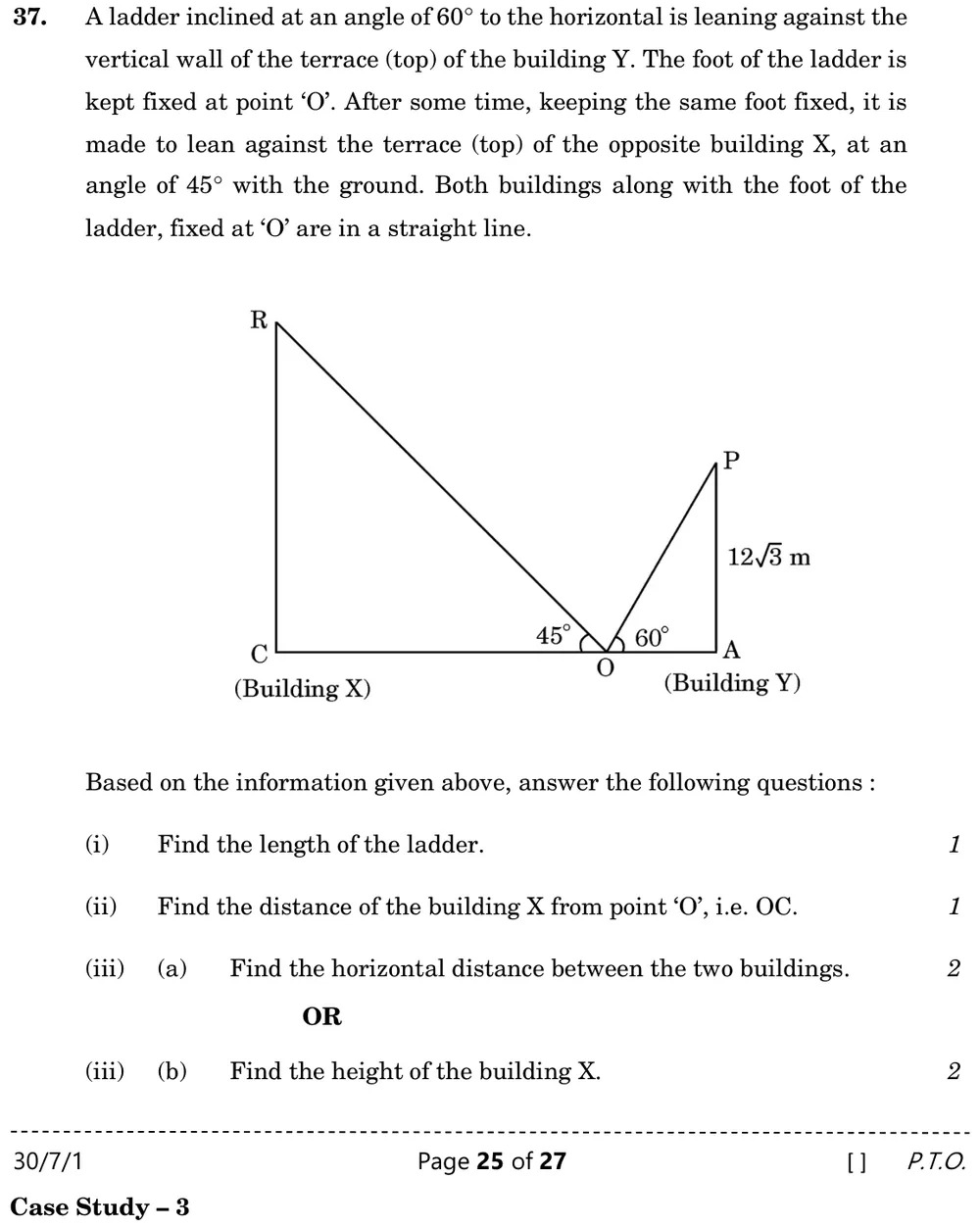
A ladder inclined at an angle of 60° to the horizontal is leaning against the vertical wall of the terrace (top) of the building Y. The foot of the ladder is kept fixed at point 'O'. After some time, keeping the same foot fixed, it is made to lean against the terrace (top) of the opposite building X, at an angle of 45° with the ground. Both buildings along with the foot of the ladder, fixed at 'O' are in a straight line. (i) Find the length of the ladder. (1) (ii) Find the distance of the building X from point 'O', i.e. OC. (1) (iii) (a) Find the horizontal distance between the two buildings. (2) OR (iii) (b) Find the height of the building X. (2) Write your answer, send a photo, get it marked in DheeAnswer and marking
- (i) AP = 12√3 m is opposite 60° and the ladder OP is the hypotenuse. 12√3/OP = sin 60° = √3/2 ⇒ OP = 24 m 1 mark
- (ii) The same ladder now makes 45°, so use cosine with OR = 24 m. OR = 24 m ; OC/24 = cos 45° = 1/√2 ⇒ OC = 12√2 m 1 mark
- (iii)(a) First find OA, the gap from O to building Y, using tan 60°. 12√3/OA = tan 60° = √3 ⇒ OA = 12 m 1 mark
- O lies between the buildings, so add the two distances. Distance CA = OC + OA = 12√2 + 12 = 12(√2 + 1) m 1 mark
- (iii)(b) The height CR is opposite 45° and OC is next to it, so use tan. CR/OC = tan 45° 1 mark
- tan 45° is 1, so the height equals OC. CR = OC × 1 = 12√2 m 1 mark
Answer: (i) 24 m (ii) 12√2 m (iii) (a) 12(√2 + 1) m / (b) 12√2 m
Marks: Part (i) 1 · Part (ii) 1 · Part (iii) 2
For full marks: In (ii) write 'OR = 24 m' — say the ladder length is unchanged before you use cos 45°.
Where students lose marks: In (iii)(a) giving only OC or only OA: the buildings are on opposite sides of O, so both distances add.
CBSE marking scheme
(i) 12√3/OP = sin 60° ⇒ ladder OP = 24 m (½ + ½). (ii) OR = 24, OC/24 = cos 45° ⇒ OC = 12√2 m (½ + ½). (iii)(a) 12√3/OA = tan 60° ⇒ OA = 12 m (1); distance = 12(√2 + 1) m (1). OR (iii)(b) CR/OC = tan 45° ⇒ CR = 12√2 m (1 + 1).
- Q5 Case study · 4 marks CBSE · 2025
Case: lighthouse and observatory
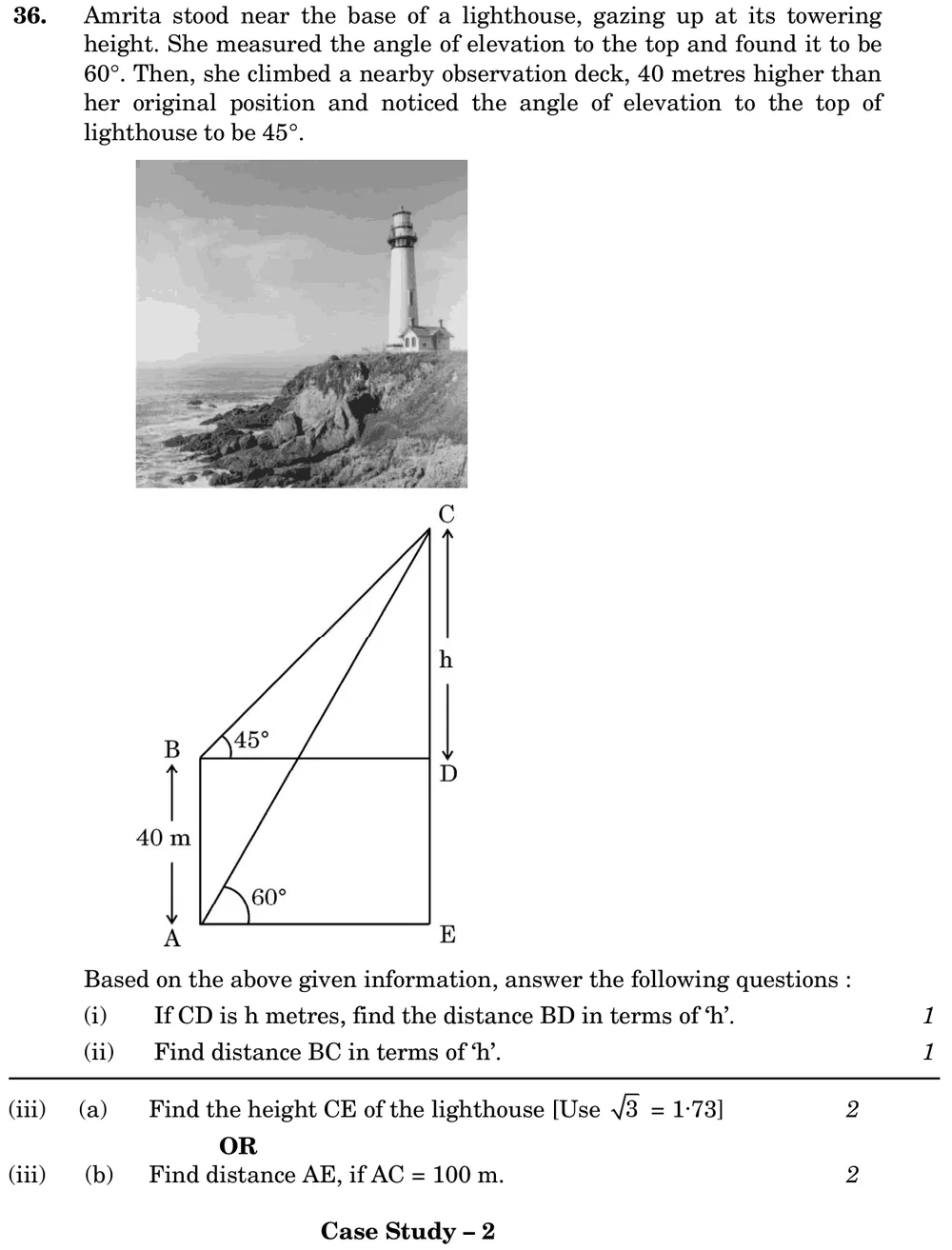
Case Study 3: Amrita stood near the base of a lighthouse, gazing up at its towering height. She measured the angle of elevation to the top and found it to be 60°. Then, she climbed a nearby observation deck, 40 metres higher than her original position and noticed the angle of elevation to the top of lighthouse to be 45°. (i) If CD is h metres, find the distance BD in terms of 'h'. (1) (ii) Find distance BC in terms of 'h'. (1) (iii) (a) Find the height CE of the lighthouse [Use √3 = 1.73] (2) OR (iii) (b) Find distance AE, if AC = 100 m. (2) Write your answer, send a photo, get it marked in DheeAnswer and marking
- (i) In triangle BDC, CD = h is opposite 45° and BD is next to it. h/BD = tan 45° = 1 ⇒ BD = h m 1 mark
- (ii) BC is the hypotenuse of the same triangle, so use sin 45°. h/BC = sin 45° = 1/√2 ⇒ BC = √2h m 1 mark
- (iii)(a) From A the full height is h + 40 and AE = BD = h, so use tan 60°. tan 60° = EC/AE ⇒ √3 = (h + 40)/h 1 mark
- Collect h on one side, rationalise, and use √3 = 1.73. √3h − h = 40 ⇒ h = 40/(√3 − 1) = 20(√3 + 1) = 20 × 2.73 = 54.6 m 0.5 marks
- Add the 40 m below D to get the full height. CE = CD + DE = 54.6 + 40 = 94.6 m 0.5 marks
- (iii)(b) AC is the hypotenuse and AE is next to 60°, so use cosine. cos 60° = AE/AC ⇒ 1/2 = AE/100 1 mark
- Multiply both sides by 100. AE = 50 m 1 mark
Answer: (i) BD = h m (ii) BC = √2h m (iii) (a) CE = 94.6 m / (b) AE = 50 m
Marks: Part (i) 1 · Part (ii) 1 · Part (iii) 2
For full marks: In (iii)(a) write 'CE = 54.6 + 40 = 94.6 m' — the last ½ is for adding DE to h.
Where students lose marks: Giving h = 54.6 m as the lighthouse height: h is only CD, the part above the deck.
CBSE marking scheme
(i) h/BD = tan 45° = 1 ⇒ BD = h m (½+½). (ii) h/BC = sin 45° = 1/√2 ⇒ BC = √2 h m (½+½). (iii)(a) tan 60° = EC/AE ⇒ √3 = (h + 40)/h (1) ⇒ h = 20(√3 + 1) = 54.6 m (½); CE = 54.6 + 40 = 94.6 m (½). OR (iii)(b) cos 60° = AE/AC ⇒ 1/2 = AE/100 (1) ⇒ AE = 50 m (1).
- Q6 Case study · 4 marks CBSE · 2025
Case: ship from a lighthouse
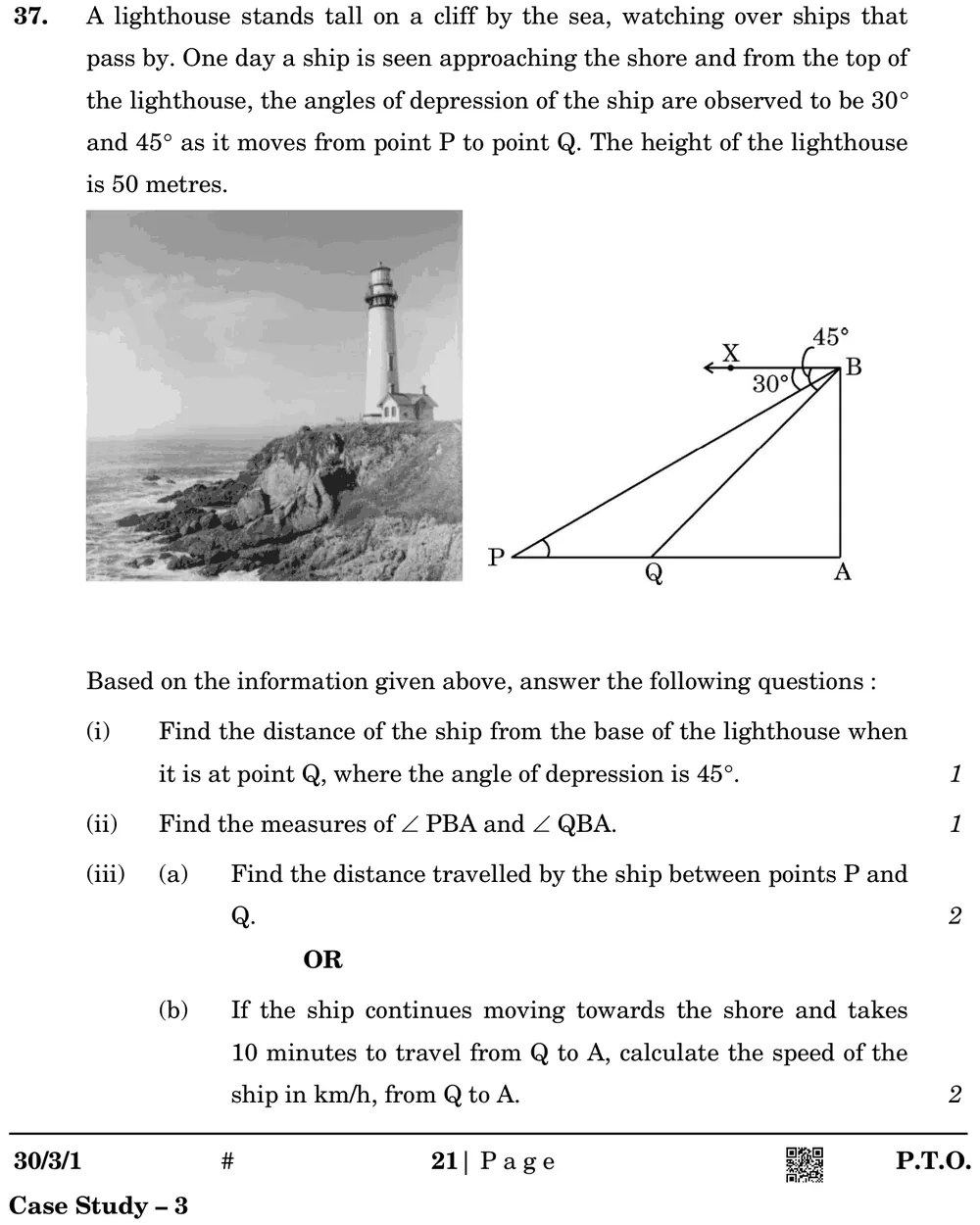
A lighthouse stands tall on a cliff by the sea, watching over ships that pass by. One day a ship is seen approaching the shore and from the top of the lighthouse, the angles of depression of the ship are observed to be 30° and 45° as it moves from point P to point Q. The height of the lighthouse is 50 metres. (i) Find the distance of the ship from the base of the lighthouse when it is at point Q, where the angle of depression is 45°. (1) (ii) Find the measures of ∠PBA and ∠QBA. (1) (iii) (a) Find the distance travelled by the ship between points P and Q. (2) OR (iii) (b) If the ship continues moving towards the shore and takes 10 minutes to travel from Q to A, calculate the speed of the ship in km/h, from Q to A. (2) Write your answer, send a photo, get it marked in DheeAnswer and marking
- (i) The angle at Q equals the 45° depression (alternate angles), so use tan. ∠AQB = 45° ; tan 45° = 50/AQ ⇒ AQ = 50 m 1 mark
- (ii) BA is vertical, so each angle with BA is 90° minus the depression. ∠PBA = 90° − 30° = 60° ; ∠QBA = 90° − 45° = 45° 1 mark
- (iii)(a) The angle at P is 30°, so find AP with tan. tan 30° = 50/AP ⇒ AP = 50√3 m 1 mark
- The ship moved from P to Q, so subtract AQ from AP. PQ = AP − AQ = 50√3 − 50 = 50(√3 − 1) m ≈ 36.5 m 1 mark
- (iii)(b) Speed is the distance QA divided by the time taken. Speed = 50 m / 10 min 1 mark
- Change metres to kilometres and minutes to hours. = (50/1000) km ÷ (10/60) h = 0.05 × 6 = 0.3 km/h 1 mark
Answer: (i) 50 m (ii) ∠PBA = 60°, ∠QBA = 45° (iii) (a) 50(√3 − 1) m ≈ 36.5 m / (b) 0.3 km/h
Marks: Part (i) 1 · Part (ii) 1 · Part (iii) 2
For full marks: In (iii)(b) write 'Speed = 50 m / 10 min' before converting — the first mark is for that line.
Where students lose marks: In (ii), writing ∠PBA = 30°: 30° is measured from the horizontal; the angle with the vertical BA is 60°.
CBSE marking scheme
(i) ∠AQB = 45°, tan 45° = 50/AQ ⇒ AQ = 50 m (½ + ½). (ii) ∠PBA = 60°, ∠QBA = 45° (½ + ½). (iii)(a) tan 30° = 50/AP ⇒ AP = 50√3 m (1); PQ = 50√3 − 50 = 50(√3 − 1) m ≈ 36.5 m (1). OR (iii)(b) speed = 50 m/10 min (1) = 0.3 km/h (1).
- Q7 Long answer · 5 marks CBSE · 2024
Two ships in line, 75 m tower
As observed from the top of a 75 m high lighthouse from the sea level, the angles of depression of two ships are 30° and 45°. If one ship is exactly behind the other on the same side of the lighthouse, find the distance between the two ships. (Use √3 = 1.732)
Write your answer, send a photo, get it marked in DheeAnswer and marking
- Draw the lighthouse and both ships in one line, and mark the two angles. Figure: lighthouse AB = 75 m ; nearer ship y from B (45°) ; farther ship x beyond it (30°) 1 mark
- Use tan 45° in the triangle with the nearer ship. tan 45° = 75/y ⇒ y = 75 m 1 mark
- Use tan 30° in the triangle with the farther ship. tan 30° = 1/√3 = 75/(x + y) ⇒ x + y = 75√3 1.5 marks
- Take away y to get the gap between the ships. x = 75√3 − 75 = 75(√3 − 1) 0.5 marks
- Put √3 = 1.732 and write the distance with its unit. x = 75 × 0.732 = 54.9 m ; distance between the ships = 54.9 m 1 mark
Answer: Distance between the ships = 54.9 m
Marks: Figure 1 · Two tan equations 2½ · Gap and value 1½
For full marks: Write 'distance between the ships = 54.9 m' — the last mark is for the value with its unit.
Where students lose marks: Giving 75√3 ≈ 129.9 m, the farther ship's distance from the lighthouse, without taking away the nearer ship's 75 m.
CBSE marking scheme
Correct figure (1). tan 45° = 75/y ⇒ y = 75 (1). tan 30° = 1/√3 = 75/(x + y) ⇒ x + y = 75√3 (1 + ½). x = 75(√3 − 1) = 75 × 0.732 = 54.9 m (½ + 1). Distance between ships = 54.9 m.
- Q8 Long answer · 5 marks CBSE · 2026
Two poles across an 80 m road
Two poles of equal heights are standing opposite each other on either side of the road, which is 80 m wide. From a point between them on the road, the angles of elevation of the top of the poles are 60° and 30° respectively. Find the height of the poles and the distance of the point from the poles.
Write your answer, send a photo, get it marked in DheeAnswer and marking
- Draw the two equal poles across the 80 m road with the point between them. Figure: poles of height h on both sides of the 80 m road ; point x from one pole and 80 − x from the other ; elevations 60° and 30° 1 mark
- Use tan 60° for the nearer pole. Let height = h, distance to the 60° pole = x ; tan 60° = h/x ⇒ h = √3x 1 mark
- Use tan 30° for the other pole, at 80 − x. tan 30° = h/(80 − x) ⇒ 80 − x = √3h 1 mark
- Put h = √3x into the second equation and solve. 80 − x = √3 × √3x = 3x ⇒ x = 20 m ; h = 20√3 m 1.5 marks
- The other distance is 80 minus x. 80 − 20 = 60 m ; height 20√3 m, distances 20 m and 60 m 0.5 marks
Answer: Height of each pole = 20√3 m; the point is 20 m and 60 m from the poles
Marks: Figure 1 · Two tan equations 2 · Solving 1½ · Other distance ½
For full marks: End with 'distances 20 m and 60 m' — the last ½ is for the second distance, which students forget.
Where students lose marks: Using x for both distances: the second pole is 80 − x away from the point.
CBSE marking scheme
Correct figure (1). Let height h, distance to the 60° pole x. tan 60° = h/x ⇒ h = √3x (1); tan 30° = h/(80 − x) ⇒ 80 − x = h√3 (1). Solving, x = 20 m, h = 20√3 m (1 + ½); other distance 60 m (½). Height 20√3 m; distances 20 m and 60 m.
- Q9 Long answer · 5 marks CBSE · 2026
Kite seen by Ravi on a roof
A kite is flying at a height of 60 m above the ground level. Ravi, standing at the roof of the house is holding the string straight and observes the angle of elevation of kite as 30°. From the bottom of the same building, the angle of elevation of kite is 45°. Find the length of the string and height of roof from the ground. (Use √3 = 1.73)
Write your answer, send a photo, get it marked in DheeAnswer and marking
- Draw the building, the kite K above T, and the level line RS from the roof. Figure: kite K 60 m above T ; building GR (G foot, R roof) ; RS horizontal meeting KT at S ; elevation 30° from R, 45° from G 1 mark
- From the building's foot, use tan 45° to find the ground distance. tan 45° = 60/GT ⇒ GT = 60 m 1 mark
- SR equals GT, so use tan 30° from the roof to find KS. SR = GT = 60 m ; tan 30° = KS/SR ⇒ KS = 60/√3 = 20√3 = 34.6 m 1 mark
- Take KS away from the kite's height to get the roof's height. Roof height = 60 − 34.6 = 25.4 m 1 mark
- The string KR is the hypotenuse, so use sin 30°. sin 30° = KS/KR ⇒ KR = 2 × 20√3 = 40√3 = 69.2 m 1 mark
Answer: Length of string = 40√3 m ≈ 69.2 m; height of roof = 25.4 m
Marks: Figure 1 · Ground distance 1 · Height above roof 1 · Roof and string 2
For full marks: Write 'Roof height = 60 − 34.6 = 25.4 m' as its own line — it carries a full mark.
Where students lose marks: Taking the string from the ground (60/sin 45°): Ravi holds it at the roof, so use KS and 30°.
CBSE marking scheme
Correct figure (1). From the building's foot, tan 45° = 60/GT ⇒ horizontal distance = 60 m (1). From roof, tan 30° = KS/SR ⇒ KS = 60/√3 = 20√3 = 34.6 m (1). Roof height = 60 − 34.6 = 25.4 m (½ + ½). sin 30° = KS/KR ⇒ string KR = 40√3 = 69.2 m (½ + ½).
- Q10 Long answer · 5 marks CBSE · 2026
Tower on a 20 m building
From a point on the ground, the angles of elevation of the bottom and the top of a transmission tower fixed at the top of a 20 m high building are 45° and 60° respectively. Find the height of the tower and distance of point of observation from the tower. (Use √3 = 1·73)
Write your answer, send a photo, get it marked in DheeAnswer and marking
- Draw the building with the tower on top and the point A on the ground. Figure: building BC = 20 m, tower CD = h on top ; A at distance x from B ; elevation 45° to C, 60° to D 1 mark
- Use tan 45° for the tower's bottom to get the distance. tan 45° = 20/x ⇒ x = 20 m = distance from the tower 1.5 marks
- Use tan 60° for the tower's top, with the full height h + 20. tan 60° = (h + 20)/x ⇒ h + 20 = 20√3 1 mark
- Make h the subject and use √3 = 1.73. ⇒ h = 20(√3 − 1) = 20 × 0.73 = 14.6 m = height of tower 1.5 marks
Answer: Height of the tower = 14.6 m; distance from the tower = 20 m
Marks: Figure 1 · Distance 1½ · Height equation 1 · Height 1½
For full marks: Write 'x = 20 m = distance from the tower' — say what 20 m is, since the question asks for it.
Where students lose marks: Using tan 60° = h/x (tower alone): the 60° line reaches the tower top, h + 20 above the ground.
CBSE marking scheme
Correct figure (1). tan 45° = 20/x ⇒ x = 20 m = distance from the tower (1+½). tan 60° = (h + 20)/x ⇒ h + 20 = 20√3 (1) ⇒ h = 20(√3 − 1) = 20 × 0·73 = 14·6 m = height of tower (1+½).
Free 10-question test: Some Applications of Trigonometry
MCQ and Assertion–Reason questions from CBSE papers. About 10 minutes. Your score shows straight away.
Common mistakes in Some Applications of Trigonometry
Mistake Starting the sum without a figure.
Fix Draw the figure first and label it: the height h, the ground distance x, both angles and the right angle. In 5-mark sums the figure alone carries 1 mark.
Mistake Using tan when the question is about a string, ladder, rope or wire.
Fix Height and ground distance → tan. The slanting length (string, ladder, rope, wire) → sin or cos. Before you write, ask: which two sides do I have, and which one do I want?
Mistake Drawing the angle of depression at the wrong place.
Fix The angle of depression is between the horizontal line at your eye and the line looking down. It equals the angle of elevation from the object below (alternate angles), so you can use it inside the triangle on the ground.
Mistake Forgetting to add or take away an extra height.
Fix Add the observer's eye height or the roof height. For a tower on a building, the top is (h + building height) above the ground. For two buildings, the upper triangle's height is the difference of the two heights. Mark these on the figure.
Mistake Not using √3 = 1.73 when the question says so.
Fix Keep √3 until the last line, then put √3 = 1.73 as told and give the decimal answer. The scheme takes away ½ mark if you do not use it.
Mistake Mixing units in speed or time parts.
Fix Write the unit with every length and time. If the answer is asked in km/h, change metres to km and minutes to hours at the end.
How to write for full marks
- Write each ratio as an equation and name the triangle: 'In △ABC, tan 60° = AB/BC ⇒ h = √3x'. Each such equation carries a mark.
- With two angles, make two equations, one from each triangle, then solve them together for h and x.
- Answer every part asked, like both the height and the distance, each with its unit (m).
- In case studies, write the ratio you use in each part, even for 1 mark. The scheme often gives ½ for the ratio and ½ for the answer.
Not in the 2026-27 exam
Leave these out of your revision.
- Problems with more than two right triangles
- Angles other than 30°, 45° and 60°
Questions students ask
Which Some Applications of Trigonometry questions are most important for the Class 10 board exam 2027?
Expect a 5-mark heights-and-distances sum with two angles, a 4-mark case study on ladders, kites or towers, and MCQs on heights and shadows. The 10 questions on this page are real CBSE board questions from 2023–2026, chosen across the chapter's topics and question types.
How many marks does Some Applications of Trigonometry carry in the Class 10 board exam?
Some Applications of Trigonometry is part of the Trigonometry unit, which carries 5 of the 80 theory marks in the CBSE Class 10 Maths paper.
Are these real CBSE previous year questions?
Yes. Each question is printed as it appeared in a CBSE board paper or sample paper, with its source, and the answer follows CBSE's official marking scheme.
Questions and answers: CBSE board papers, sample papers and official marking schemes, 2023–2026. Worked steps and tips: Dhee.