Chapter 7 · CBSE Board 2027
Coordinate Geometry Class 10 important questions with answers
The 10 questions to practise first, picked from every CBSE board paper 2023–2026. Each one has the official answer and how to write it for full marks. Then try the free 10-question test.
What comes in the exam
- Coordinate Geometry is a unit of its own, worth 6 marks.
- MCQs (1 mark) come most, then 2-mark and 3-mark questions, a 4-mark case study and some Assertion–Reason.
- Almost every year you get the distance formula (MCQs on a radius or diameter, 3-mark sums on sides and diagonals), the mid-point formula (MCQs, and the missing vertex of a parallelogram) and the section formula: a point that divides a segment in a given ratio, or the ratio in which an axis or line cuts it.
- A 2-mark question on a point equidistant from two points and a case study on a map or a field also come almost every year.
Top 10 Coordinate Geometry questions from board papers
Real CBSE questions, printed as they appeared. Open each answer to see the marking and the steps.
- Q1 Very short answer · 2 marks CBSE · 2025, 2023 Asked in 2025, 2023
Divide join in ratio 2 : 3
Find the coordinates of the point which divides the join of (–1, 7) and (4, –3) in the ratio 2 : 3.
Write your answer, send a photo, get it marked in DheeAnswer and marking
- Use the section formula with m : n = 2 : 3 for the x-coordinate. x = [2(4) + 3(−1)]/5 = (8 − 3)/5 = 1 1 mark
- Do the same for the y-coordinate and write the point. y = [2(−3) + 3(7)]/5 = (−6 + 21)/5 = 3 ; point is (1, 3) 1 mark
Answer: (1, 3)
Marks: x-coordinate 1 · y-coordinate and point 1
For full marks: Write the substituted line x = [2(4) + 3(−1)]/5 before simplifying; the mark is for putting the numbers in the right places.
Where students lose marks: Multiplying 2 with the first point and 3 with the second, which gives (2, 1) instead of (1, 3).
CBSE marking scheme
x = [2(4) + 3(–1)]/5 = 1 (1); y = [2(–3) + 3(7)]/5 = 3 (1); point (1, 3).
- Q2 Very short answer · 2 marks CBSE · 2023
Ratio y-axis divides the segment
Find the ratio in which y-axis divides the line segment joining the points (5, −6) and (−1, −4).
Write your answer, send a photo, get it marked in DheeAnswer and marking
- Take a point with x = 0 on the y-axis that divides the segment in k : 1. Let P(0, y) divide the segment in k : 1 0.5 marks
- Use the section formula for the x-coordinate. 0 = (−k + 5)/(k + 1) 1 mark
- Solve for k and write the ratio. −k + 5 = 0 ⇒ k = 5 ; ratio = 5 : 1 0.5 marks
Answer: 5 : 1
Marks: Point on y-axis ½ · Section formula 1 · Ratio ½
For full marks: Write 'Let P(0, y) divide it in k : 1'; that first line earns ½ on its own.
Where students lose marks: Setting y = 0 instead of x = 0, mixing up the y-axis with the x-axis.
CBSE marking scheme
Let P(0, y) divide in k : 1 (½); 0 = (−k + 5)/(k + 1) (1) ⇒ k = 5; ratio 5 : 1 (½).
- Q3 Short answer · 3 marks CBSE · 2025
Find k from midpoint condition
If the mid-point of the line segment joining the points A(3, 4) and B(k, 6) is P(x, y) and x + y − 10 = 0, then find the value of k.
Write your answer, send a photo, get it marked in DheeAnswer and marking
- Write the x-coordinate of the mid-point P. x = (3 + k)/2 0.5 marks
- Write the y-coordinate of P and simplify it. y = (4 + 6)/2 = 5 0.5 marks
- Put x and y into the given line equation. (3 + k)/2 + 5 − 10 = 0 1 mark
- Solve for k. (3 + k)/2 = 5 ⇒ 3 + k = 10 ⇒ k = 7 1 mark
Answer: k = 7
Marks: Mid-point coordinates 1 · Substitution 1 · Value of k 1
For full marks: Write the substituted equation (3 + k)/2 + 5 − 10 = 0; it carries a full mark of its own.
Where students lose marks: Forgetting to divide by 2 in the mid-point, so x = 3 + k and k comes out 2.
CBSE marking scheme
x = (3 + k)/2 (½), y = (4 + 6)/2 = 5 (½); (3 + k)/2 + 5 − 10 = 0 (1) ⇒ k = 7 (1).
- Q4 Short answer · 3 marks CBSE · 2026
Find K and chord AB of circle
A circle centered at (2, 1) passes through the points A(5, 6) and B(−3, K). Find the value(s) of K. Hence find length of chord AB.
Write your answer, send a photo, get it marked in DheeAnswer and marking
- Both points lie on the circle, so they are the same distance (the radius) from the centre. OA = OB ⇒ √((5 − 2)² + (6 − 1)²) = √((−3 − 2)² + (K − 1)²) 1 mark
- Square both sides and solve for K. 34 = 25 + (K − 1)² ⇒ (K − 1)² = 9 ⇒ K − 1 = ±3 ⇒ K = −2 or 4 1 mark
- For K = −2, find AB with the distance formula. B(−3, −2): AB = √((5 + 3)² + (6 + 2)²) = √128 = 8√2 units 0.5 marks
- For K = 4, find AB the same way. B(−3, 4): AB = √((5 + 3)² + (6 − 4)²) = √68 = 2√17 units 0.5 marks
Answer: K = −2 or 4; AB = 8√2 units (K = −2) or 2√17 units (K = 4)
Marks: Equation OA = OB 1 · Values of K 1 · Two chords 1
For full marks: Find AB for BOTH values of K — each chord length carries its own ½.
Where students lose marks: Taking only K − 1 = 3 and missing K = −2, which also loses one chord's ½.
CBSE marking scheme
OA = OB: √((5 − 2)2 + (6 − 1)2 = √((−3 − 2)2 + (K − 1)2 (1) ⇒ (K − 1)2 = 9 ⇒ K = −2, 4 (1); K = −2: AB = √128 = 8√2 (½); K = 4: AB = √68 = 2√17 (½).
- Q5 Short answer · 3 marks CBSE · 2026
Right triangle: relate x and y
A(x, y), B(−3, −2) and C(3, 2) are the vertices of a right triangle ABC, right-angled at A. Find the relationship between x and y. Hence, find all the possible values of y for which x = 3.
Write your answer, send a photo, get it marked in DheeAnswer and marking
- The angle at A is 90°, so BC is the hypotenuse and Pythagoras applies. BC² = AB² + AC² 1 mark
- Put in the squared distances and simplify. (3 + 3)² + (2 + 2)² = (x + 3)² + (y + 2)² + (x − 3)² + (y − 2)² ⇒ 52 = 2(x² + y²) + 26 ⇒ x² + y² = 13 1 mark
- Put x = 3 in the relation and solve for y. 9 + y² = 13 ⇒ y² = 4 ⇒ y = 2 or −2 1 mark
Answer: x² + y² = 13; y = 2 or −2
Marks: Pythagoras set-up 1 · Relation 1 · Values of y 1
For full marks: Write 'BC² = AB² + AC²' first — the right angle at A makes BC the hypotenuse, and that line earns 1 mark.
Where students lose marks: Giving only y = 2; y² = 4 has two answers and both are needed.
CBSE marking scheme
BC2 = AB2 + AC2 (1): 36 + 16 = (x − 3)2 + (y − 2)2 + (x + 3)2 + (y + 2)2 ⇒ 52 = 2(x2 + y2 + 26 ⇒ x2 + y2 = 13 (1); x = 3 ⇒ y2 = 4 ⇒ y = 2 or −2 (1).
- Q6 Short answer · 3 marks CBSE · 2026
Trisection point P on x + y = k
The line segment joining the points A(−5, 1) and B(7, 6) is trisected at the points P and Q such that P is nearer to A. If P lies on the line x + y = k, then find the value of k.
Write your answer, send a photo, get it marked in DheeAnswer and marking
- P is the trisection point nearer to A, so it cuts AB in the ratio 1 : 2. AP : PB = 1 : 2 0.5 marks
- Use the section formula with ratio 1 : 2. P = ((1 × 7 + 2 × (−5))/3, (1 × 6 + 2 × 1)/3) = ((7 − 10)/3, (6 + 2)/3) = (−1, 8/3) 1.5 marks
- P lies on the line, so its coordinates satisfy x + y = k. k = −1 + 8/3 = 5/3 1 mark
Answer: k = 5/3
Marks: Ratio ½ · Point P 1½ · Value of k 1
For full marks: State 'AP : PB = 1 : 2' before the formula; the first ½ is for the ratio.
Where students lose marks: Using 2 : 1 for P; that gives Q, the point nearer to B.
CBSE marking scheme
AP : PB = 1 : 2 (½); P = ((7 − 10)/3, (6 + 2)/3) = (−1, 8/3) (1½); k = −1 + 8/3 = 5/3 (1).
- Q7 Case study · 4 marks CBSE · 2026
Case: Jaipur city map
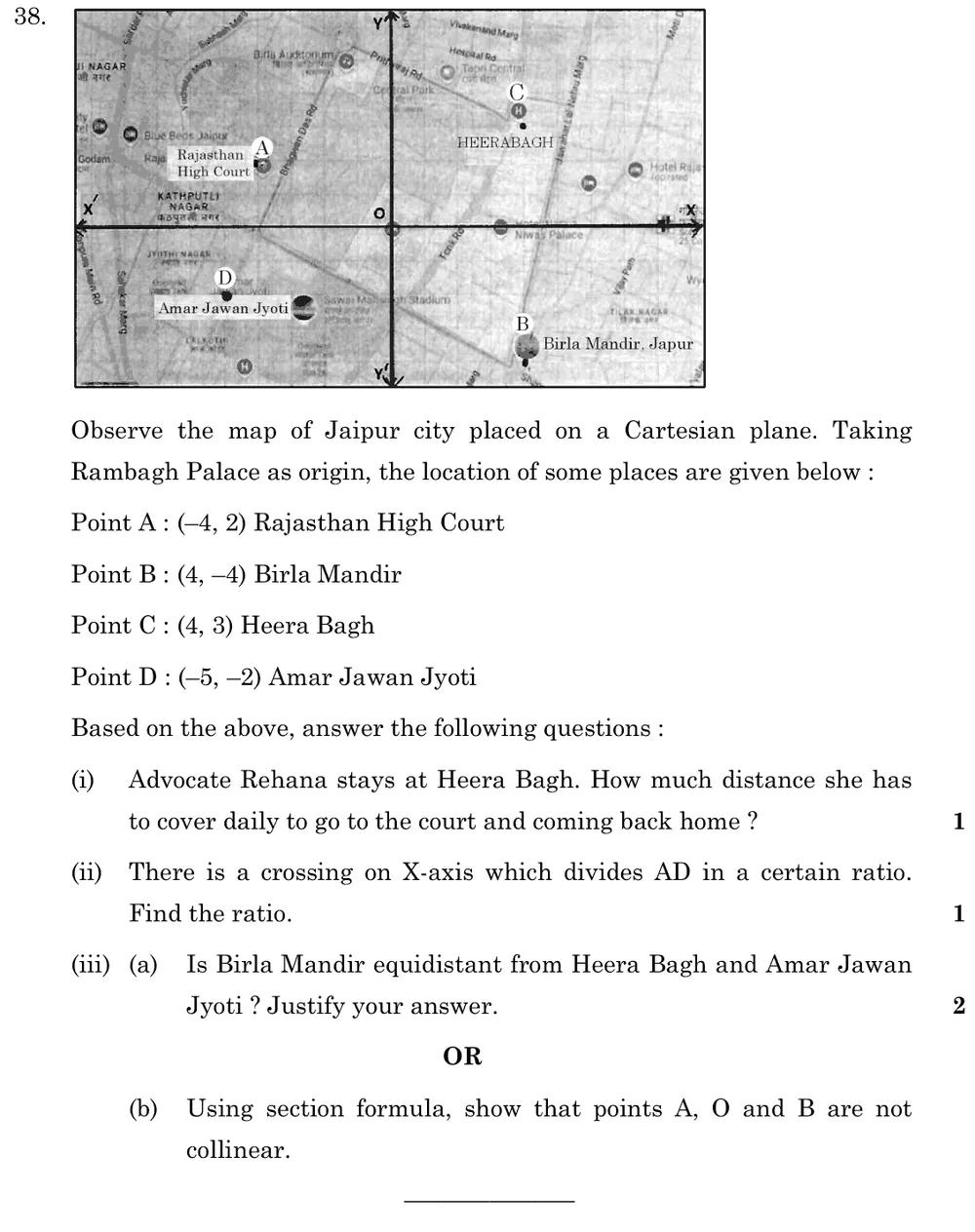
Observe the map of Jaipur city placed on a Cartesian plane. Taking Rambagh Palace as origin, the location of some places are given below: Point A: (−4, 2) Rajasthan High Court Point B: (4, −4) Birla Mandir Point C: (4, 3) Heera Bagh Point D: (−5, −2) Amar Jawan Jyoti Based on the above, answer the following questions: (i) Advocate Rehana stays at Heera Bagh. How much distance she has to cover daily to go to the court and coming back home? (1) (ii) There is a crossing on X-axis which divides AD in a certain ratio. Find the ratio. (1) (iii) (a) Is Birla Mandir equidistant from Heera Bagh and Amar Jawan Jyoti? Justify your answer. (2) OR (iii) (b) Using section formula, show that points A, O and B are not collinear. (2) Write your answer, send a photo, get it marked in DheeAnswer and marking
- (i) She goes to the court and comes back, so double the distance AC. 2AC = 2√((−4 − 4)² + (2 − 3)²) = 2√65 units 1 mark
- (ii) The crossing P(x, 0) is on the x-axis, so its y-coordinate is 0. Let P(x, 0) divide AD in k : 1 ; 0 = (k(−2) + 1(2))/(k + 1) ⇒ k = 1 ; ratio 1 : 1 1 mark
- (iii)(a) Find the distance from Birla Mandir to Heera Bagh. BC = √((4 − 4)² + (3 + 4)²) = √(0 + 49) = 7 units 1 mark
- Find the distance to Amar Jawan Jyoti and compare. BD = √((−5 − 4)² + (−2 + 4)²) = √(81 + 4) = √85 units ; BC ≠ BD, so B is not equidistant 1 mark
- (iii)(b) Suppose O divides AB in some ratio k : 1. Let AO : OB = k : 1 0.5 marks
- O is (0, 0), so set the x-coordinate from the section formula equal to 0. 0 = (4k − 4)/(k + 1) ⇒ k = 1 0.5 marks
- Now do the same with the y-coordinate. 0 = (−4k + 2)/(k + 1) ⇒ k = 1/2 0.5 marks
- The two values of k do not match, so no single ratio works. k = 1 ≠ 1/2 ⇒ A, O and B are not collinear 0.5 marks
Answer: (i) 2√65 units · (ii) 1 : 1 · (iii) (a) No, BC = 7 ≠ BD = √85 / (b) k differs (1 and 1/2), so not collinear
Marks: (i) 1 · (ii) 1 · (iii) 2
For full marks: In (iii)(b) end with 'k = 1 ≠ 1/2 ⇒ A, O and B are not collinear' — the last ½ is for this conclusion.
Where students lose marks: In (i) giving only AC = √65; the question asks for going and coming back, so it is 2√65.
CBSE marking scheme
(i) 2AC = 2√((−4 − 4)2 + (2 − 3)2 = 2√65 units (½ + ½). (ii) P(x, 0) divides AD in k : 1: 0 = (−2k + 2)/(k + 1) ⇒ k = 1, ratio 1 : 1 (½ + ½). (iii)(a) BC = √(0 + 49) = 7, BD = √(81 + 4) = √85 (1 + 1); BC ≠ BD so not equidistant. OR (b) Let AO : OB = k : 1: x gives 0 = (4k − 4)/(k + 1) ⇒ k = 1; y gives 0 = (−4k + 2)/(k + 1) ⇒ k = 1/2; different k ⇒ A, O, B not collinear (½ each).
- Q8 Case study · 4 marks CBSE · 2025
Case: rectangular field race
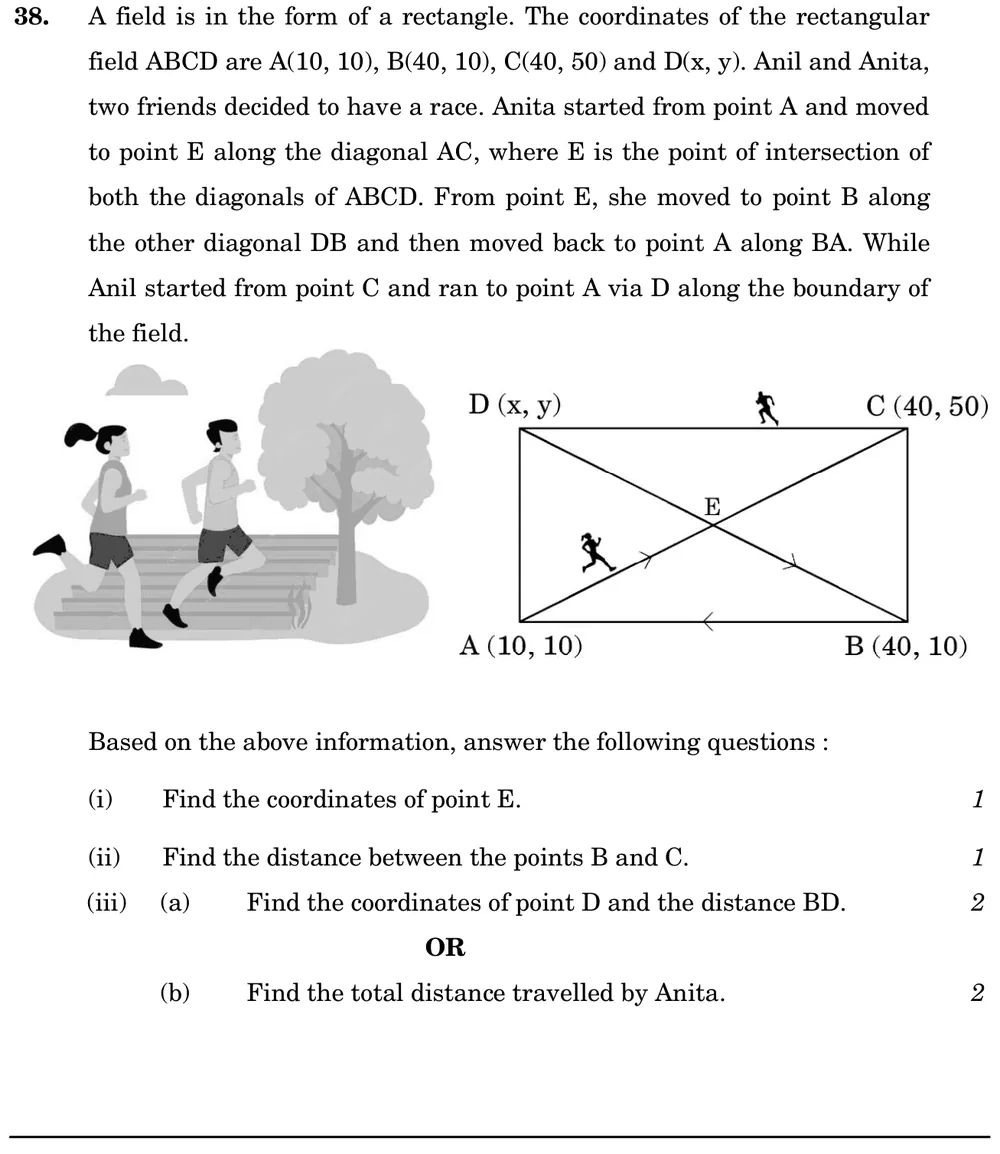
A field is in the form of a rectangle. The coordinates of the rectangular field ABCD are A(10, 10), B(40, 10), C(40, 50) and D(x, y). Anil and Anita, two friends decided to have a race. Anita started from point A and moved to point E along the diagonal AC, where E is the point of intersection of both the diagonals of ABCD. From point E, she moved to point B along the other diagonal DB and then moved back to point A along BA. While Anil started from point C and ran to point A via D along the boundary of the field. Based on the above information, answer the following questions : (i) Find the coordinates of point E. (1) (ii) Find the distance between the points B and C. (1) (iii) (a) Find the coordinates of point D and the distance BD. (2) OR (iii) (b) Find the total distance travelled by Anita. (2) Write your answer, send a photo, get it marked in DheeAnswer and marking
- (i) The diagonals of a rectangle bisect each other, so E is the mid-point of AC. E = ((10 + 40)/2, (10 + 50)/2) = (25, 30) 1 mark
- (ii) Use the distance formula for B and C. BC = √((40 − 40)² + (50 − 10)²) = 40 units 1 mark
- (iii)(a) E is also the mid-point of BD, so compare coordinates to find D. ((x + 40)/2, (y + 10)/2) = (25, 30) ⇒ x = 10, y = 50 ; D(10, 50) 1 mark
- Find BD with the distance formula. BD = √((40 − 10)² + (10 − 50)²) = √(30² + 40²) = 50 units 1 mark
- (iii)(b) Anita runs A to E, E to B, then B to A, so write each length. AE + EB + BA = √(15² + 20²) + √(15² + 20²) + 30 1.5 marks
- Add the three lengths. = 25 + 25 + 30 = 80 units 0.5 marks
Answer: (i) E(25, 30) · (ii) 40 units · (iii) (a) D(10, 50), BD = 50 units / (b) 80 units
Marks: (i) 1 · (ii) 1 · (iii) 2
For full marks: In (iii)(b) write the path 'AE + EB + BA' before the numbers so the examiner sees all three parts.
Where students lose marks: Using Anil's path C → D → A, or adding the whole diagonal AC instead of only AE.
CBSE marking scheme
(i) E = mid-point of AC = (25, 30) (1). (ii) BC = √[(40 − 40)2 + (50 − 10)2] = 40 (1). (iii)(a) E is mid-point of BD: ((x + 40)/2, (y + 10)/2) = (25, 30) ⇒ D(10, 50) (½ + ½); BD = √(302 + 402 = 50 (1). OR (b) AE + EB + BA = √(152 + 202 + √(152 + 202 + 30 (1½) = 25 + 25 + 30 = 80 units (½).
- Q9 Case study · 4 marks CBSE · 2025
Case: trees in a Noida school
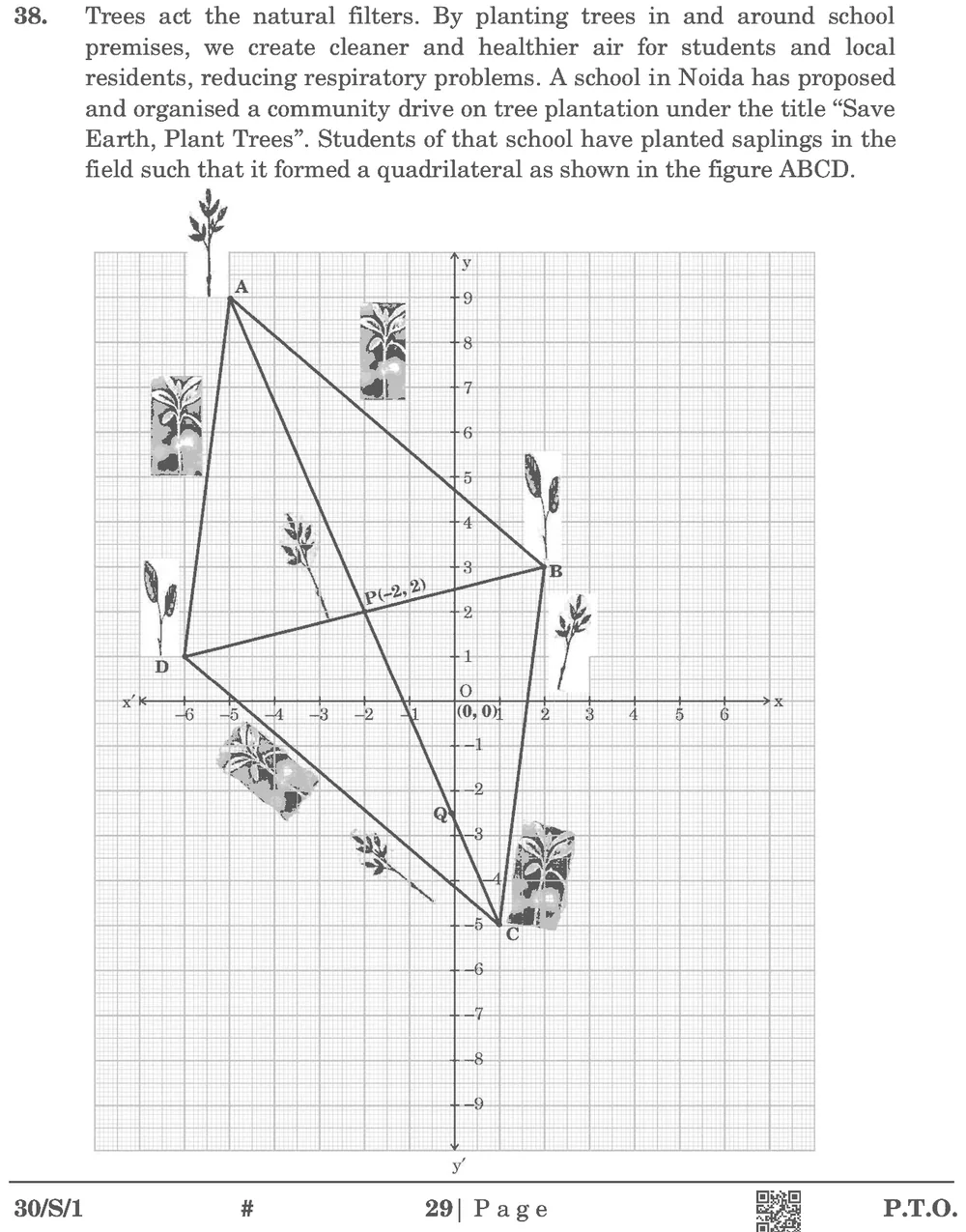
Trees act as natural filters. By planting trees in and around school premises, we create cleaner and healthier air for students and local residents, reducing respiratory problems. A school in Noida has proposed and organised a community drive on tree plantation under the title "Save Earth, Plant Trees". Students of that school have planted saplings in the field such that it formed a quadrilateral as shown in the figure ABCD. (i) Find the distance between the two saplings at A and D. (1) (ii) (a) One student plants one sapling at the mid-point of AD. Then he moves along a straight line parallel to DB and sows another sapling on AB. What are the coordinates of the positions of these two new saplings? (2) OR (ii) (b) A new sapling is kept at a point M on DB such that DM : MB = 3 : 1. Find the coordinates of M. (2) (iii) The line segments AC and BD bisect each other at P(−2, 2). Find the coordinates of C. (1) Write your answer, send a photo, get it marked in DheeAnswer and marking
- (i) Read A and D from the grid and use the distance formula. A(−5, 9), D(−6, 1) ; AD = √((−6 + 5)² + (1 − 9)²) = √(1 + 64) = √65 units 1 mark
- (ii)(a) Find the mid-point of AD for the first new sapling. Mid-point of AD = ((−5 − 6)/2, (9 + 1)/2) = (−11/2, 5) 1 mark
- A line through a side's mid-point, parallel to another side, meets the third side at its mid-point. Line ∥ DB through it meets AB at its mid-point ; B(2, 3) ⇒ ((−5 + 2)/2, (9 + 3)/2) = (−3/2, 6) 1 mark
- (ii)(b) DM : MB = 3 : 1, so use the section formula from D to B. M = ((3 × 2 + 1 × (−6))/4, (3 × 3 + 1 × 1)/4) 1 mark
- Simplify to get M. M = (0/4, 10/4) = (0, 5/2) 1 mark
- (iii) Diagonals bisect each other, so P is the mid-point of AC. ((−5 + x)/2, (9 + y)/2) = (−2, 2) ⇒ x = 1, y = −5 ; C = (1, −5) 1 mark
Answer: (i) √65 units · (ii) (a) (−11/2, 5) and (−3/2, 6) / (b) M(0, 5/2) · (iii) C(1, −5)
Marks: (i) 1 · (ii) 2 · (iii) 1
For full marks: In (ii)(a) write 'line ∥ DB meets AB at its mid-point' — that reason earns the second mark.
Where students lose marks: In (ii)(b) putting the 3 with D instead of B; with DM : MB = 3 : 1, B's coordinates get the 3.
CBSE marking scheme
(i) A(−5, 9), D(−6, 1); AD = √(1 + 64) = √65 (½+½). (ii)(a) mid-point of AD = (−11/2, 5) (1); line ∥ DB through it meets AB at its mid-point; B(2, 3) ⇒ (−3/2, 6) (1). OR (b) M = ((3×2 + 1×(−6))/4, (3×3 + 1×1)/4) = (0, 5/2) (2). (iii) P is mid-point of AC ⇒ C = (1, −5) (1).
- Q10 Case study · 4 marks CBSE · 2024
Case: hexagonal table top
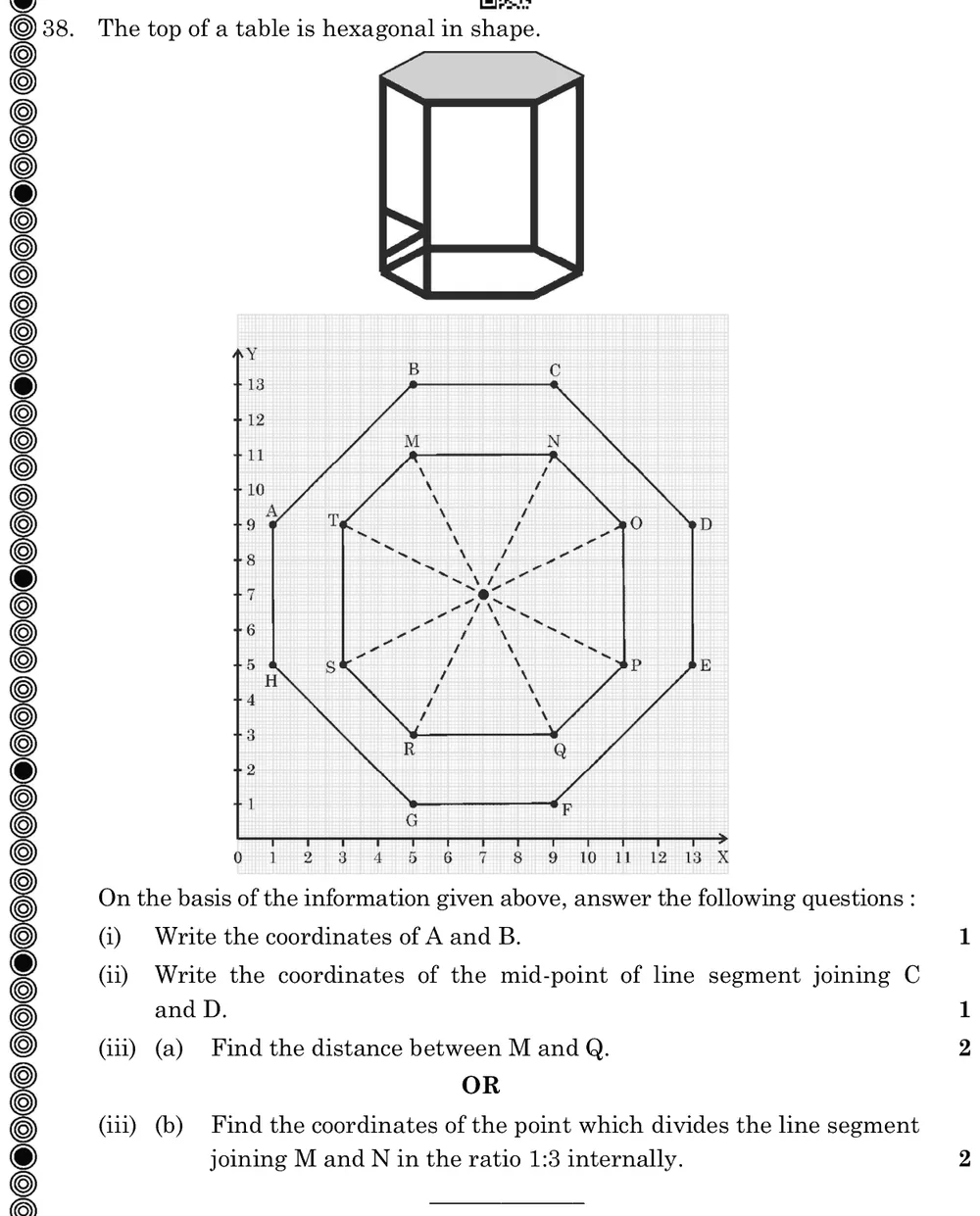
The top of a table is hexagonal in shape. [Figure: the table top drawn on a coordinate grid with outer vertices A–H and inner vertices M–T.] On the basis of the information given above, answer the following questions: (i) Write the coordinates of A and B. (1) (ii) Write the coordinates of the mid-point of line segment joining C and D. (1) (iii) (a) Find the distance between M and Q. (2) OR (iii) (b) Find the coordinates of the point which divides the line segment joining M and N in the ratio 1:3 internally. (2) Write your answer, send a photo, get it marked in DheeAnswer and marking
- (i) Read A and B from the grid. A(1, 9), B(5, 13) 1 mark
- (ii) First read C and D from the grid. C(9, 13), D(13, 9) 0.5 marks
- Average the coordinates of C and D. Mid-point of CD = ((9 + 13)/2, (13 + 9)/2) = (11, 11) 0.5 marks
- (iii)(a) Read M and Q from the grid. M(5, 11), Q(9, 3) 1 mark
- Use the distance formula. MQ = √((9 − 5)² + (3 − 11)²) = √80 = 4√5 units 1 mark
- (iii)(b) Read M and N from the grid. M(5, 11), N(9, 11) 1 mark
- Use the section formula with ratio 1 : 3. Point = ((1 × 9 + 3 × 5)/4, (1 × 11 + 3 × 11)/4) = (6, 11) 1 mark
Answer: (i) A(1, 9), B(5, 13) · (ii) (11, 11) · (iii) (a) MQ = 4√5 units / (b) (6, 11)
Marks: (i) 1 · (ii) 1 · (iii) coordinates 1 · (iii) result 1
For full marks: Write the coordinates you read, like 'M(5, 11), Q(9, 3)', before any formula — reading them correctly earns 1 mark.
Where students lose marks: Misreading a grid point by one square, e.g. Q as (9, 1), which is F.
CBSE marking scheme
(i) A(1, 9), B(5, 13) (½ + ½). (ii) C(9, 13), D(13, 9) (½); mid-point of CD = (11, 11) (½). (iii)(a) M(5, 11), Q(9, 3) (1); MQ = √((9 − 5)2 + (3 − 11)2 = √80 = 4√5 (1). OR (iii)(b) M(5, 11), N(9, 11) (1); point = ((1×9 + 3×5)/4, (1×11 + 3×11)/4) = (6, 11) (1).
Free 10-question test: Coordinate Geometry
MCQ and Assertion–Reason questions from CBSE papers. About 10 minutes. Your score shows straight away.
Common mistakes in Coordinate Geometry
Mistake Putting the ratio the wrong way round in the section formula.
Fix For P dividing AB in m : n, write x = (m x₂ + n x₁)/(m + n): m goes with B's coordinates, n with A's. Do the same for y. In the 2-mark sum, the x and the y each carry 1 mark.
Mistake In 'find the ratio in which the y-axis divides…', not knowing where to start.
Fix Take the ratio k : 1. A point on the y-axis has x = 0, and a point on the x-axis has y = 0. Put that coordinate equal to 0 and solve for k. Give the answer as a ratio, like 2 : 7, and find the point too if it is asked.
Mistake Giving the radius when the diameter is asked, or picking a ± answer.
Fix A distance is never negative, so drop any ± option. Find the radius from the centre to a point on the circle, then read the question again: diameter = 2 × radius.
Mistake Slipping signs while squaring in equidistant-point questions.
Fix Write PA² = PB² first, so there is no √ to carry. A coordinate like −2 gives (a + 2)². Expand both sides fully before you cancel. The scheme gives marks for the squared equation and for the final relation.
Mistake Using the wrong pair of vertices for the diagonals of a parallelogram.
Fix For ABCD taken in order, the diagonals are AC and BD. Write 'mid-point of AC = mid-point of BD' (1 mark). For 'hence check if it is a rectangle', compare the lengths AC and BD.
Mistake Keeping only one value when an equation gives two.
Fix If you get (k − 2)² = 16, write both values of k. Then finish the rest of the question for each value. In the circle-and-chord sum, the chord for each value carries ½ mark.
How to write for full marks
- Write the formula with letters first, then put in the numbers. Find x and y on separate lines: each one carries its own mark.
- Give a point in brackets, like (2, −3), and a ratio as a : b. Write roots in simplest form (√45 = 3√5) and add 'units' or 'sq units'.
- For 'show that' or 'check whether', end with a sentence: 'so P lies on the line', or 'PA = PB, so P is equidistant from A and B'. The scheme marks this step.
- In a case study, answer each part on its own line with its number (i), (ii), (iii). Where a part has an OR, do only one of the two choices.
Not in the 2026-27 exam
Leave these out of your revision.
- Section formula for external division
- Area of a triangle from coordinates
Questions students ask
Which Coordinate Geometry questions are most important for the Class 10 board exam 2027?
Expect MCQs and 2- or 3-mark sums on the distance, mid-point and section formulas, an equidistant-point question and a 4-mark case study. The 10 questions on this page are real CBSE board questions from 2023–2026, chosen across the chapter's topics and question types.
How many marks does Coordinate Geometry carry in the Class 10 board exam?
Coordinate Geometry is part of the Coordinate Geometry unit, which carries 6 of the 80 theory marks in the CBSE Class 10 Maths paper.
Are these real CBSE previous year questions?
Yes. Each question is printed as it appeared in a CBSE board paper or sample paper, with its source, and the answer follows CBSE's official marking scheme.
Questions and answers: CBSE board papers, sample papers and official marking schemes, 2023–2026. Worked steps and tips: Dhee.