Chapter 8 · CBSE Board 2027
Introduction to Trigonometry Class 10 important questions with answers
The 10 questions to practise first, picked from every CBSE board paper 2023–2026. Each one has the official answer and how to write it for full marks. Then try the free 10-question test.
What comes in the exam
- Introduction to Trigonometry is in the Trigonometry unit, worth 12 marks.
- MCQs (1 mark) come most, then 2-mark and 3-mark questions in about equal numbers, and some Assertion–Reason.
- Almost every year there is a 3-mark 'prove that' identity: you combine two fractions, change everything to sin and cos, or multiply to clear a square root.
- Also almost every year: 2-mark questions that work out an expression at 0°, 30°, 45°, 60° and 90°, MCQs that give one ratio, like sin A = 3/5, and ask for another, and 2-mark questions that find A and B from values like sin(A + B).
- 5-mark questions and case studies are rare.
Top 10 Introduction to Trigonometry questions from board papers
Real CBSE questions, printed as they appeared. Open each answer to see the marking and the steps.
- Q1 MCQ · 1 mark CBSE · 2024, 2023 Asked in 2024, 2023
Evaluate 2 tan 30°/(1 − tan²30°)
(2 tan 30°)/(1 − tan2 30°) is equal to
- (A) cos 60°
- (B) sin 60°
- (C) tan 60°
- (D) sin 30°
Write your answer, send a photo, get it marked in DheeAnswer and marking
Correct option: (C) tan 60°
- Put tan 30° = 1/√3 into the expression. (2/√3)/(1 − 1/3) = (2/√3) × (3/2)
- Simplify and match with a standard value. = √3 = tan 60° ⇒ option (C) 1 mark
Answer: (C) tan 60°
Marks: Correct option 1
For full marks: Write 1 − 1/3 = 2/3 as its own step before dividing.
Where students lose marks: Option (B) sin 60°: students mix up √3 with √3/2.
CBSE marking scheme
(2/√3)/(1 − 1/3) = (2/√3)(3/2) = √3 = tan 60°.
- Q2 Assertion–Reason · 1 mark CBSE · 2023
AR: cosec θ ∓ cot θ reciprocals
Assertion (A): For 0 < θ ≤ 90°, cosec θ − cot θ and cosec θ + cot θ are reciprocal of each other. Reason (R): cot2 θ − cosec2 θ = 1
- (A) Both Assertion (A) and Reason (R) are true; and Reason (R) is the correct explanation of Assertion (A).
- (B) Both Assertion (A) and Reason (R) are true, but Reason (R) is not the correct explanation of Assertion (A).
- (C) Assertion (A) is true, but Reason (R) is false.
- (D) Assertion (A) is false, but Reason (R) is true.
Write your answer, send a photo, get it marked in DheeAnswer and marking
Correct option: (C) Assertion (A) is true, but Reason (R) is false.
- Multiply the two expressions in A; it is a difference of squares. (cosec θ − cot θ)(cosec θ + cot θ) = cosec² θ − cot² θ = 1 ⇒ A is true
- Check R against the identity 1 + cot² θ = cosec² θ. cot² θ − cosec² θ = −1, not 1 ⇒ R is false
- A true, R false. Option (C) 1 mark
Answer: (C) A is true, but R is false
Marks: Correct option 1
For full marks: Write the correct value −1 for cot² θ − cosec² θ; that is why R fails.
Where students lose marks: Option (A): students recognise the identity in R but miss that its sign is reversed.
CBSE marking scheme
(cosec θ − cot θ)(cosec θ + cot θ) = cosec²θ − cot²θ = 1, so A is true; R is false (cot²θ − cosec²θ = −1).
- Q3 Very short answer · 2 marks CBSE · 2026, 2025, 2024 Asked in 2026, 2025, 2024
Prove √((1 + sin A)/(1 − sin A))
Prove that: √((1 + sin A)/(1 − sin A)) = sec A + tan A
Write your answer, send a photo, get it marked in DheeAnswer and marking
- Multiply the top and bottom inside the root by (1 + sin A). LHS = √((1 + sin A)(1 + sin A)/((1 − sin A)(1 + sin A))) 0.5 marks
- Simplify the top and the bottom. = √((1 + sin A)²/(1 − sin²A)) 0.5 marks
- Use 1 − sin²A = cos²A and take the square root. = √((1 + sin A)²/cos²A) = (1 + sin A)/cos A 0.5 marks
- Split the fraction. = 1/cos A + sin A/cos A = sec A + tan A = RHS 0.5 marks
Answer: LHS = sec A + tan A = RHS
Marks: Rationalising ½ · Simplify ½ · Square root ½ · Conclusion ½
For full marks: Write the line (1 + sin A)/cos A before splitting — that ½ is for taking the root.
Where students lose marks: Splitting (1 + sin A)/cos A as 1 + tan A instead of 1/cos A + sin A/cos A = sec A + tan A.
CBSE marking scheme
Multiply inside by (1 + sin A)/(1 + sin A) (½): √((1 + sin A)2/(1 − sin2 A)) (½) = (1 + sin A)/cos A (½) = sec A + tan A (½).
- Q4 Very short answer · 2 marks CBSE · 2026, 2023 Asked in 2026, 2023
Find x in 2 cosec² 30° equation
Find the value of x, if : 2 cosec2 30° + x sin2 60° − (3/4) tan2 30° = 10
Write your answer, send a photo, get it marked in DheeAnswer and marking
- Put in cosec 30° = 2, sin 60° = √3/2 and tan 30° = 1/√3. 2 × 4 + x × 3/4 − (3/4)(1/3) = 10 1 mark
- Simplify each term. ⇒ 8 + 3x/4 − 1/4 = 10 0.5 marks
- Move the numbers to the right side and solve for x. ⇒ 3x/4 = 9/4 ⇒ x = 3 0.5 marks
Answer: x = 3
Marks: Substitution 1 · Simplify ½ · Value of x ½
For full marks: Write the substituted equation 2 × 4 + x × 3/4 − (3/4)(1/3) = 10; it carries a full mark.
Where students lose marks: Using cosec²30° = 2 instead of 4, forgetting to square the value.
CBSE marking scheme
2 × 4 + x × 3/4 − (3/4)(1/3) = 10 (1) ⇒ 8 + 3x/4 − 1/4 = 10 (½) ⇒ x = 3 (½).
- Q5 Very short answer · 2 marks CBSE · 2026
sin θ + cos θ when tan θ = 24/7
If tan θ = 24/7, then find the value of sin θ + cos θ.
Write your answer, send a photo, get it marked in DheeAnswer and marking
- Take sides 24 and 7, find the hypotenuse, then write sin θ and cos θ. Hypotenuse = √(24² + 7²) = 25 ; so sin θ = 24/25, cos θ = 7/25 1.5 marks
- Add the two values. sin θ + cos θ = 24/25 + 7/25 = 31/25 0.5 marks
Answer: sin θ + cos θ = 31/25
Marks: Hypotenuse, sin θ and cos θ 1½ · Answer ½
For full marks: Write the hypotenuse = 25 line; without it the values of sin θ and cos θ look unexplained.
Where students lose marks: Swapping the sides: taking sin θ = 7/25 and cos θ = 24/25.
CBSE marking scheme
Hypotenuse = 25, so sin θ = 24/25, cos θ = 7/25 (1½); sin θ + cos θ = 31/25 (½).
- Q6 Short answer · 3 marks CBSE · 2025, 2024, 2023 Asked in 2025, 2024, 2023
Prove tan θ/(1 − cot θ) identity
Prove that : tan θ/(1 − cot θ) + cot θ/(1 − tan θ) = 1 + sec θ cosec θ
Write your answer, send a photo, get it marked in DheeAnswer and marking
- Write tan and cot in terms of sin and cos. LHS = (sin θ/cos θ)/(1 − cos θ/sin θ) + (cos θ/sin θ)/(1 − sin θ/cos θ) 0.5 marks
- Simplify each fraction so both have the factor (sin θ − cos θ). = sin²θ/[cos θ(sin θ − cos θ)] − cos²θ/[sin θ(sin θ − cos θ)] 1 mark
- Take the common denominator. = (sin³θ − cos³θ)/[(sin θ − cos θ) sin θ cos θ] 0.5 marks
- Use a³ − b³ = (a − b)(a² + ab + b²) and sin²θ + cos²θ = 1. = (sin θ − cos θ)(1 + sin θ cos θ)/[(sin θ − cos θ) sin θ cos θ] = (1 + sin θ cos θ)/(sin θ cos θ) 0.5 marks
- Split the fraction to reach the right side. = 1 + 1/(sin θ cos θ) = 1 + sec θ cosec θ = RHS 0.5 marks
Answer: LHS = 1 + sec θ cosec θ = RHS
Marks: sin–cos form ½ · Simplifying 1½ · Factorising ½ · Conclusion ½
For full marks: Write the factorised line (sin θ − cos θ)(1 + sin θ cos θ) before cancelling — that ½ is for using a³ − b³.
Where students lose marks: Missing the minus sign on the second term, which turns sin³θ − cos³θ into a sum that does not factor.
CBSE marking scheme
Write in sin, cos (½): sin2θ/[cos θ(sin θ − cos θ)] − cos2θ/[sin θ(sin θ − cos θ)] (1) = (sin3θ − cos3θ)/[(sin θ − cos θ) sin θ cos θ] (½) = (1 + sin θ cos θ)/(sin θ cos θ) (½) = 1 + sec θ cosec θ (½).
- Q7 Short answer · 3 marks CBSE · 2026, 2024, 2023 Asked in 2026, 2024, 2023
Prove (cosec A − sin A)(sec A −…
Prove that (cosec A − sin A)(sec A − cos A) = 1/(tan A + cot A).
Write your answer, send a photo, get it marked in DheeAnswer and marking
- Write cosec and sec as 1/sin and 1/cos and combine each bracket. LHS = ((1 − sin²A)/sin A)((1 − cos²A)/cos A) 1 mark
- Use 1 − sin²A = cos²A and 1 − cos²A = sin²A, then cancel. = (cos²A/sin A)(sin²A/cos A) = sin A cos A 1 mark
- Divide by sin²A + cos²A, which is 1, and split it into tan and cot. = sin A cos A/(sin²A + cos²A) = 1/(sin A/cos A + cos A/sin A) = 1/(tan A + cot A) = RHS 1 mark
Answer: LHS = 1/(tan A + cot A) = RHS
Marks: Combine brackets 1 · Simplify to sin A cos A 1 · Reach RHS 1
For full marks: Show the line sin A cos A/(sin²A + cos²A) — it is the bridge that earns the last mark.
Where students lose marks: Stopping at sin A cos A without showing how it equals 1/(tan A + cot A).
CBSE marking scheme
LHS = ((1 − sin2 A)/sin A)((1 − cos2 A)/cos A) (1) = (cos2 A/sin A)(sin2 A/cos A) = sin A cos A (1) = sin A cos A/(sin2 A + cos2 A) = 1/(tan A + cot A) = RHS (1).
- Q8 Short answer · 3 marks CBSE · 2025, 2024, 2023 Asked in 2025, 2024, 2023
Prove √((sec A−1)/(sec A+1)) sum
Prove that : √((sec A − 1)/(sec A + 1)) + √((sec A + 1)/(sec A − 1)) = 2 cosec A
Write your answer, send a photo, get it marked in DheeAnswer and marking
- Add the two roots by taking √((sec A − 1)(sec A + 1)) as the common denominator. LHS = (sec A − 1 + sec A + 1)/√((sec A − 1)(sec A + 1)) = (sec A − 1 + sec A + 1)/√(sec²A − 1) 1 mark
- Use sec²A − 1 = tan²A. = 2 sec A/tan A 1 mark
- Write sec A and tan A in sin and cos and simplify. = 2 (1/cos A)(cos A/sin A) = 2/sin A = 2 cosec A = RHS 1 mark
Answer: LHS = 2 cosec A = RHS
Marks: Common denominator 1 · Using tan²A 1 · Reach RHS 1
For full marks: Write the identity line √(sec²A − 1) = tan A — the second mark is for using it.
Where students lose marks: Writing √(sec²A − 1) as sec A − 1, which breaks the whole simplification.
CBSE marking scheme
LHS = (sec A − 1 + sec A + 1)/√(sec2 A − 1) (1) = 2 sec A/tan A (1) = 2 cosec A = RHS (1).
- Q9 Short answer · 3 marks CBSE · 2025, 2024, 2023 Asked in 2025, 2024, 2023
Prove sinθ/(1+cosθ)+… = 2cosecθ
Prove that sin θ/(1 + cos θ) + (1 + cos θ)/sin θ = 2 cosec θ.
Write your answer, send a photo, get it marked in DheeAnswer and marking
- Add the two fractions over the common denominator (1 + cos θ) sin θ. LHS = [sin²θ + (1 + cos θ)²]/[(1 + cos θ) sin θ] 1 mark
- Expand (1 + cos θ)². = (sin²θ + 1 + cos²θ + 2cos θ)/[(1 + cos θ) sin θ] 0.5 marks
- Use sin²θ + cos²θ = 1 in the top. = (2 + 2cos θ)/[(1 + cos θ) sin θ] 1 mark
- Take 2 common, cancel (1 + cos θ), and write 1/sin θ as cosec θ. = 2(1 + cos θ)/[(1 + cos θ) sin θ] = 2/sin θ = 2 cosec θ = RHS 0.5 marks
Answer: sin θ/(1 + cos θ) + (1 + cos θ)/sin θ = 2 cosec θ, hence proved.
Marks: Common denominator 1 · Expand ½ · Identity 1 · Conclusion ½
For full marks: Write the line (2 + 2cos θ)/[(1 + cos θ) sin θ]; using sin²θ + cos²θ = 1 there earns a full mark.
Where students lose marks: Expanding (1 + cos θ)² as 1 + cos²θ and dropping the 2cos θ term, so nothing cancels.
CBSE marking scheme
LHS = [sin²θ + (1 + cos θ)²]/[(1 + cos θ) sin θ] (1) = (sin²θ + 1 + cos²θ + 2cos θ)/[(1 + cos θ) sin θ] (½) = (2 + 2cos θ)/[(1 + cos θ) sin θ] (1) = 2/sin θ = 2 cosec θ = RHS (½).
- Q10 Case study · 4 marks CBSE · 2025
Case: Rahim and Nadeem's plots
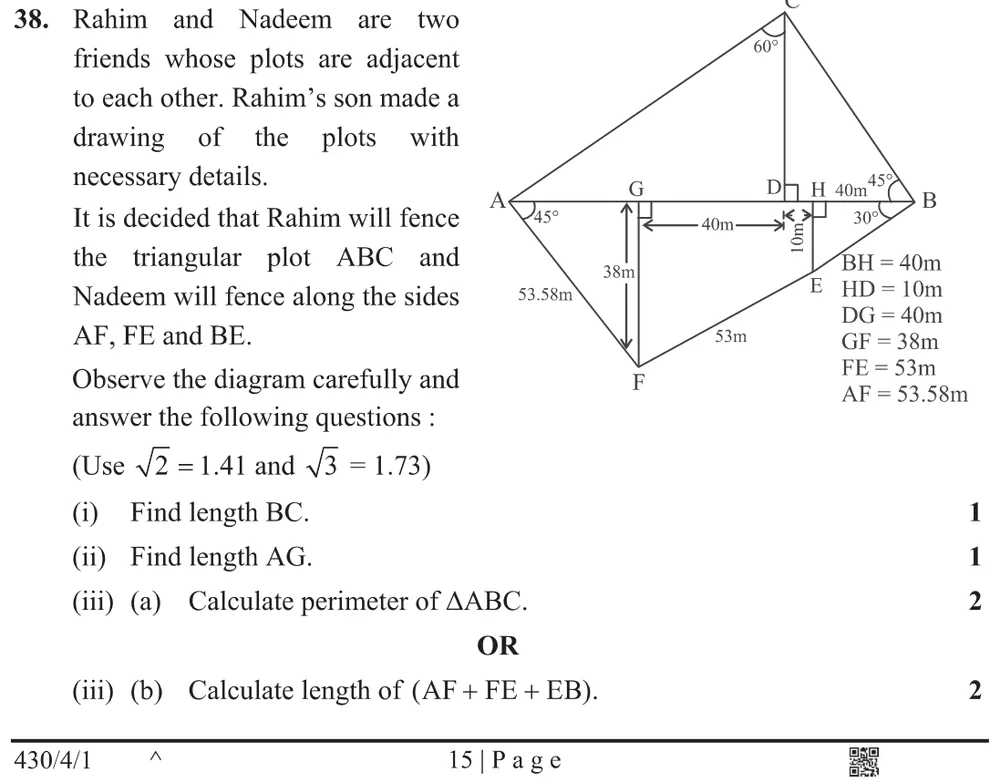
Rahim and Nadeem are two friends whose plots are adjacent to each other. Rahim's son made a drawing of the plots with necessary details. It is decided that Rahim will fence the triangular plot ABC and Nadeem will fence along the sides AF, FE and BE. Observe the diagram carefully and answer the following questions : (Use √2 = 1.41 and √3 = 1.73) (i) Find length BC. (1) (ii) Find length AG. (1) (iii) (a) Calculate perimeter of △ABC. (2) OR (iii) (b) Calculate length of (AF + FE + EB). (2) Write your answer, send a photo, get it marked in DheeAnswer and marking
- (i) In right △CDB, use cos 45° with DB = 50 m. cos 45° = DB/BC = 50/BC ⇒ BC = 50√2 = 50 × 1.41 = 70.5 m 1 mark
- (ii) In right △AGF, use tan 45° with GF = 38 m. tan 45° = GF/AG = 38/AG ⇒ AG = 38 m 1 mark
- (iii)(a) In right △ADC, AD is opposite the 60° angle at C, so use sin 60°. sin 60° = AD/AC = 78/AC ⇒ AC = 156/√3 = 52√3 = 52 × 1.73 = 89.96 m 1 mark
- Add the three sides, with AB = AG + GD + DB. Perimeter = BC + AC + AB = 70.5 + 89.96 + (38 + 40 + 50) = 288.46 m 1 mark
- (iii)(b) In right △BHE, use cos 30° with BH = 40 m. cos 30° = BH/BE = 40/BE ⇒ BE = 80/√3 = 80√3/3 = 46.13 m 1 mark
- Add the three lengths Nadeem fences. AF + FE + EB = 53.58 + 53 + 46.13 = 152.71 m 1 mark
Answer: (i) BC = 70.5 m (ii) AG = 38 m (iii) (a) Perimeter = 288.46 m / (b) AF + FE + EB = 152.71 m
Marks: BC 1 · AG 1 · (iii) ratio and side 1 · (iii) total 1
For full marks: Write the ratio line first, e.g. 'sin 60° = AD/AC = 78/AC'; the mark is for the right ratio with the right sides.
Where students lose marks: Using cos 60° = AD/AC in (iii)(a); AD is opposite the angle at C, so the ratio is sine.
CBSE marking scheme
(i) cos 45° = 50/BC ⇒ BC = 50 × 1.41 = 70.5 m (1). (ii) tan 45° = 38/AG ⇒ AG = 38 m (1). (iii)(a) sin 60° = 78/AC ⇒ AC = 89.96 m (1); perimeter of △ABC = 70.5 + 89.96 + 38 + 50 + 40 = 288.46 m (1). OR (iii)(b) cos 30° = 40/BE ⇒ BE = 46.13 m (1); AF + FE + EB = 53.58 + 53 + 46.13 = 152.71 m (1).
Free 10-question test: Introduction to Trigonometry
MCQ and Assertion–Reason questions from CBSE papers. About 10 minutes. Your score shows straight away.
Common mistakes in Introduction to Trigonometry
Mistake Working on both sides of an identity at once, or moving terms across '='.
Fix Start with 'LHS =' and change only the left side, one step per line, until you reach the right side. End with '= RHS'. Each step the scheme marks is worth ½ or 1 mark.
Mistake Using an identity in the wrong form.
Fix Learn the three: sin²A + cos²A = 1, sec²A = 1 + tan²A, cosec²A = 1 + cot²A. So sec²A − tan²A = 1 and cosec²A − cot²A = 1. Assertion–Reason questions sometimes write an identity in a changed form, so check every sign and square.
Mistake Losing a minus sign when you combine two fractions.
Fix After changing to sin and cos, you may get (sin θ − cos θ) in one denominator and (cos θ − sin θ) in the other. Take out a minus sign so both have the same bracket, then add. Watch for a³ − b³ = (a − b)(a² + ab + b²).
Mistake Getting stuck on a square-root identity.
Fix Multiply inside the root by the conjugate, like (1 + sin A)/(1 + sin A). Then use 1 − sin²A = cos²A so the root opens. In the 2-mark one, the scheme gives ½ mark for each of these steps.
Mistake Using the wrong value at 30° or 60°, or squaring a value wrongly.
Fix Write the values you need before you put them in: sin 30° = 1/2, sin 60° = √3/2, tan 30° = 1/√3. Square the whole value: tan²30° = 1/3, not 1/√3.
Mistake Solving for A and B and not checking the answer.
Fix Turn each value into an angle first, like A + B = 90° and A − B = 30°. Solve the two equations, then put A and B back into both. If one does not fit, redo the step.
How to write for full marks
- Set out every proof as 'LHS = … = RHS'. Write one change per line, so the examiner can see each step that earns a mark.
- Name the identity the first time you use it, like '(since 1 − sin²A = cos²A)'.
- When x and y are given using sin θ and cos θ, first get cos θ and sin θ on their own, like (x − h)/a = cos θ. Then use sin²θ + cos²θ = 1. Each of these lines carries 1 mark.
- When one ratio is given, draw a right triangle, mark the two sides, and find the third side by Pythagoras. Then write each ratio you need before you add them.
Not in the 2026-27 exam
Leave these out of your revision.
- Ratios of complementary angles (removed from the syllabus)
- Hard identities: only simple identities are asked
Questions students ask
Which Introduction to Trigonometry questions are most important for the Class 10 board exam 2027?
Expect a 3-mark identity proof, 2-mark sums at 30°, 45° and 60°, MCQs that find one ratio from another, and finding A and B. The 10 questions on this page are real CBSE board questions from 2023–2026, chosen across the chapter's topics and question types.
How many marks does Introduction to Trigonometry carry in the Class 10 board exam?
Introduction to Trigonometry is part of the Trigonometry unit, which carries 7 of the 80 theory marks in the CBSE Class 10 Maths paper.
Are these real CBSE previous year questions?
Yes. Each question is printed as it appeared in a CBSE board paper or sample paper, with its source, and the answer follows CBSE's official marking scheme.
Questions and answers: CBSE board papers, sample papers and official marking schemes, 2023–2026. Worked steps and tips: Dhee.