Chapter 3 · CBSE Board 2027
Pair of Linear Equations in Two Variables Class 10 important questions with answers
The 10 questions to practise first, picked from every CBSE board paper 2023–2026. Each one has the official answer and how to write it for full marks. Then try the free 10-question test.
What comes in the exam
- Pair of Linear Equations in Two Variables is in the Algebra unit, which is worth 20 marks in all.
- MCQs (1 mark) come most, then 3-mark, 2-mark and 5-mark questions, a 4-mark case study and some Assertion–Reason.
- Almost every year there are MCQs that compare a1/a2, b1/b2 and c1/c2 to decide one, none or infinitely many solutions, or to find k.
- Also almost every year: solving a pair by graph (3 or 5 marks), word problems on fractions, 2-digit numbers and marks (3 or 5 marks), and 2-mark 'solve for x and y' by elimination.
- Case studies are mostly about tickets, costs or plans.
Top 10 Pair of Linear Equations in Two Variables questions from board papers
Real CBSE questions, printed as they appeared. Open each answer to see the marking and the steps.
- Q1 Short answer · 3 marks CBSE · 2025, 2023 Asked in 2025, 2023
Find the fraction from two clues
A fraction becomes 1/3, when 1 is subtracted from the numerator and it becomes 1/4, when 8 is added to its denominator. Find the fraction.
Write your answer, send a photo, get it marked in DheeAnswer and marking
- Call the fraction x/y and turn the first condition into an equation. (x − 1)/y = 1/3 ⇒ 3x − y = 3 0.5 marks
- Turn the second condition into an equation. x/(y + 8) = 1/4 ⇒ 4x − y = 8 0.5 marks
- Subtract the first equation from the second, then find y. (4x − y) − (3x − y) = 8 − 3 ⇒ x = 5 ; 3(5) − y = 3 ⇒ y = 12 1.5 marks
- Write the fraction. Fraction = 5/12 0.5 marks
Answer: 5/12
Marks: Two equations 1 · Solving 1½ · Fraction ½
For full marks: End with 'the fraction is 5/12'; the last ½ is for stating the fraction, not just x and y.
Where students lose marks: Adding 8 to the numerator too, or writing the second equation as x/y + 8 = 1/4.
CBSE marking scheme
Let fraction x/y: (x − 1)/y = 1/3 gives 3x − y = 3 (½); x/(y + 8) = 1/4 gives 4x − y = 8 (½); solving x = 5, y = 12 (½+1); fraction = 5/12 (½).
- Q2 Short answer · 3 marks CBSE · 2025
Find p for no solution
For what value of 'p' will the following system of linear equations have no solution? (2p – 1)x + (p – 1)y = 2p + 1 3x + y = 1
Write your answer, send a photo, get it marked in DheeAnswer and marking
- No solution means the a and b ratios are equal but differ from c. (2p − 1)/3 = (p − 1)/1 ≠ (2p + 1)/1 1 mark
- Solve the equal part for p. (2p − 1)/3 = p − 1 ⇒ 2p − 1 = 3p − 3 ⇒ p = 2 1 mark
- Check the 'not equal' part, then state p. p − 1 ≠ 2p + 1 ⇒ p ≠ −2 ; so p = 2 1 mark
Answer: p = 2
Marks: Condition 1 · Solving 1 · Check and answer 1
For full marks: Write the full condition a1/a2 = b1/b2 ≠ c1/c2 with p filled in; it earns the first mark.
Where students lose marks: Using equal ratios for all three (infinitely many solutions) instead of '≠ c1/c2'.
CBSE marking scheme
No solution: (2p – 1)/3 = (p – 1)/1 ≠ (2p + 1)/1 (1); (2p – 1)/3 = p – 1 ⇒ p = 2, and (p – 1) ≠ (2p + 1) ⇒ p ≠ –2; so p = 2 (2).
- Q3 Short answer · 3 marks CBSE · 2025
Complementary angles, 1 : 2
x and y are complementary angles such that x : y = 1 : 2. Express the given information as a system of linear equations in two variables and hence solve it.
Write your answer, send a photo, get it marked in DheeAnswer and marking
- Complementary angles add up to 90°. x + y = 90 1 mark
- Turn the ratio x : y = 1 : 2 into an equation. x/y = 1/2 ⇒ 2x = y 1 mark
- Put y = 2x into the first equation to find x. x + 2x = 90 ⇒ x = 30° 0.5 marks
- Now find y. y = 2 × 30 = 60° 0.5 marks
Answer: x = 30°, y = 60°
Marks: x + y = 90 1 · 2x = y 1 · x and y ½ + ½
For full marks: Write the two equations first, as asked, before solving; each one is worth a mark.
Where students lose marks: Writing x = 2y from the ratio, which swaps the two angles.
CBSE marking scheme
x + y = 90 (1), 2x = y (1); solving: x = 30°, y = 60° (½ + ½).
- Q4 Short answer · 3 marks CBSE · 2024
Solve 62x+43y=167, 43x+62y=148
Find the values of x and y from the following pair of linear equations: 62x + 43y = 167; 43x + 62y = 148.
Write your answer, send a photo, get it marked in DheeAnswer and marking
- Add the equations and divide by 105. 105x + 105y = 315 ⇒ x + y = 3 1 mark
- Subtract the second from the first and divide by 19. 19x − 19y = 19 ⇒ x − y = 1 1 mark
- Add the two short equations, then find y. 2x = 4 ⇒ x = 2 ; y = 3 − 2 = 1 1 mark
Answer: x = 2, y = 1
Marks: Adding 1 · Subtracting 1 · Solution 1
For full marks: Write both short equations x + y = 3 and x − y = 1; each earns a full mark.
Where students lose marks: Using cross-multiplication with large numbers and slipping in the arithmetic.
CBSE marking scheme
Adding: x + y = 3 (1). Subtracting: x − y = 1 (1). Hence x = 2, y = 1 (1).
- Q5 Case study · 4 marks CBSE · 2026
Case: Seema's exercise calories
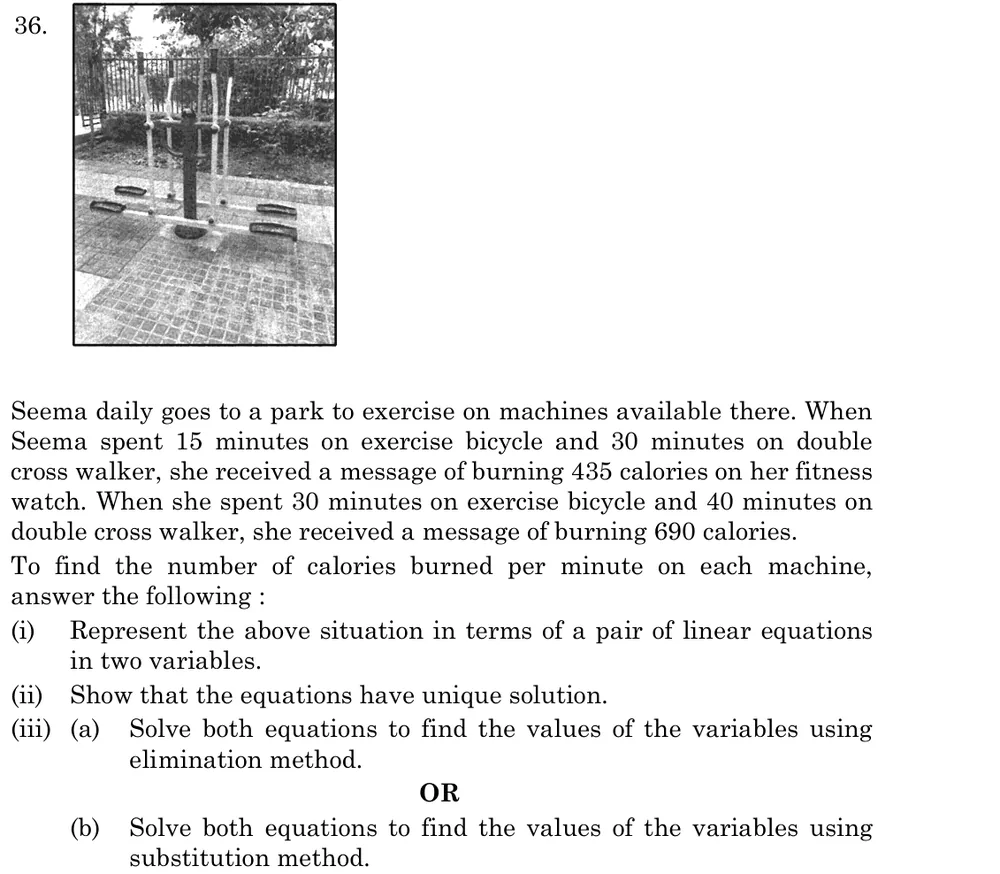
Seema daily goes to a park to exercise on machines available there. When Seema spent 15 minutes on exercise bicycle and 30 minutes on double cross walker, she received a message of burning 435 calories on her fitness watch. When she spent 30 minutes on exercise bicycle and 40 minutes on double cross walker, she received a message of burning 690 calories. To find the number of calories burned per minute on each machine, answer the following : (i) Represent the above situation in terms of a pair of linear equations in two variables. (1) (ii) Show that the equations have unique solution. (1) (iii) (a) Solve both equations to find the values of the variables using elimination method. (2) OR (iii) (b) Solve both equations to find the values of the variables using substitution method. (2) Write your answer, send a photo, get it marked in DheeAnswer and marking
- (i) Let x and y be calories per minute on the bicycle and walker. 15x + 30y = 435 ; 30x + 40y = 690 1 mark
- (ii) Compare the ratios of the x and y coefficients. a₁/a₂ = 15/30 = 1/2 ; b₁/b₂ = 30/40 = 3/4 ; a₁/a₂ ≠ b₁/b₂ ⇒ unique solution 1 mark
- (iii) Simplify, double the first equation, and subtract to remove y. x + 2y = 29 ; 3x + 4y = 69 ; (3x + 4y) − (2x + 4y) = 69 − 58 ⇒ x = 11 1 mark
- Put x = 11 back to get y. 11 + 2y = 29 ⇒ y = 9 1 mark
- (iii) From x + 2y = 29 write x in terms of y and substitute. x = 29 − 2y ; 3(29 − 2y) + 4y = 69 ⇒ 2y = 18 ⇒ y = 9 1 mark
- Put y = 9 back to get x. x = 29 − 18 = 11 1 mark
Answer: (i) 15x + 30y = 435, 30x + 40y = 690; (ii) a₁/a₂ ≠ b₁/b₂, unique; (iii) x = 11, y = 9
Marks: (i) 1 · (ii) 1 · (iii) 2
For full marks: In (ii) write 'a₁/a₂ ≠ b₁/b₂, so unique solution' — the conclusion is paid with the ratios.
Where students lose marks: In (iii) using elimination when substitution is asked (or the reverse); use the method named.
CBSE marking scheme
(i) x, y = calories per minute on bicycle and walker: 15x + 30y = 435, 30x + 40y = 690 (1). (ii) a1/a2 = 15/30 ≠ b1/b2 = 30/40 ⇒ unique solution (1). (iii)(a) Elimination: x = 11, y = 9 (2). OR (b) Substitution: x = 11, y = 9 (2).
- Q6 Case study · 4 marks CBSE · 2026
Case: amusement park tickets
Essel World is one of India's largest amusement park that offers a diverse range of thrilling rides and water attractions for visitors of all ages. The entry ticket charges for the park is ₹ 150 per child and ₹ 250 per adult. On a day cashier of park found that 300 tickets were sold and an amount of ₹ 55,000 was collected. (i) If number of children visited be x, the number of adults visited be y, write the given situation algebraically. (1) (ii) How many children visited the park that day? (1) (iii) (a) How many adults visited the park that day? If there were 50 more adults that day, how much money would have been collected from adults? (2) OR (iii) (b) How many adults visited the park that day? If a special show was arranged and hence the per ticket rate for adults was increased by ₹ 100, totally how much money will be collected? (2) Write your answer, send a photo, get it marked in DheeAnswer and marking
- (i) Count the tickets. x + y = 300 0.5 marks
- Write the money collected. 150x + 250y = 55000 0.5 marks
- (ii) Divide by 50, put y = 300 − x, and solve. 3x + 5y = 1100 ⇒ 3x + 5(300 − x) = 1100 ⇒ 2x = 400 ⇒ x = 200 1 mark
- (iii) Find the number of adults. y = 300 − 200 = 100 1 mark
- Add 50 adults and multiply by the adult ticket. (100 + 50) × 250 = ₹37500 1 mark
- (iii) Find the number of adults. y = 300 − 200 = 100 1 mark
- Adults now pay ₹350; add the children's money. 100 × (250 + 100) + 200 × 150 = ₹65000 1 mark
Answer: (i) x + y = 300, 150x + 250y = 55000; (ii) 200 children; (iii) (a) 100 adults, ₹37500 / (b) 100 adults, ₹65000
Marks: (i) ½ + ½ · (ii) 1 · (iii) 2
For full marks: In (iii) state y = 100 first; the number of adults carries its own mark.
Where students lose marks: In (iii)(b) giving only the adults' ₹35000 and leaving out the children's ₹30000.
CBSE marking scheme
(i) x + y = 300 (½); 150x + 250y = 55000 (½). (ii) Solving, x = 200 (1). (iii)(a) y = 100 (1); money from adults = (100 + 50) × 250 = ₹ 37500 (1). OR (iii)(b) y = 100 (1); total = 100 × (250 + 100) + 200 × 150 = ₹ 65000 (1).
- Q7 Case study · 4 marks CBSE · 2025
Case: telecom plans A and B
A telecommunication company came up with two plans — plan A and plan B for its customers. The plans are represented by linear equations where 't' represents the time (in minutes) bought and 'C' represents the cost. The equations are : Plan A : 3C = 20t Plan B : 3C = 10t + 300 Based on above information, answer the following questions : (i) If you purchase plan B, how much initial amount you have to pay ? (1) (ii) Charu purchased plan A. How many minutes she bought for ₹250 ? (1) (iii) (a) At how many minutes, do both the plans charge the same amount? What is that amount? (2) OR (iii) (b) Which plan is better if you want to buy 60 minutes? Give reason for your answer. (2)
Write your answer, send a photo, get it marked in DheeAnswer and marking
- (i) The initial amount is the cost when no minutes are bought, so put t = 0. 3C = 10(0) + 300 ⇒ C = ₹100 1 mark
- (ii) Put C = 250 in plan A and solve for t. 3 × 250 = 20t ⇒ t = 37.5 minutes 1 mark
- (iii) Same cost means the two right-hand sides are equal. 20t = 10t + 300 ⇒ t = 30 minutes 1 mark
- Find the cost at t = 30 using plan A. C = 20 × 30/3 = ₹200 1 mark
- (iii) Put t = 60 in plan A. 3C = 20 × 60 ⇒ plan A = ₹400 0.5 marks
- Put t = 60 in plan B. 3C = 10 × 60 + 300 ⇒ plan B = ₹300 0.5 marks
- Choose the cheaper plan and give the reason. Plan B is better, it saves ₹100 1 mark
Answer: (i) ₹100; (ii) 37.5 minutes; (iii) (a) 30 minutes, ₹200 / (b) Plan B, saves ₹100
Marks: (i) 1 · (ii) 1 · (iii) 2
For full marks: In (iii)(b) give the reason with numbers: 'plan B costs ₹300, plan A ₹400, so B saves ₹100'.
Where students lose marks: Forgetting to divide by 3, e.g. taking C = 300 in (i) or C = 600 in (iii).
CBSE marking scheme
(i) t = 0 ⇒ 3C = 300, C = ₹100 (1). (ii) 3 × 250 = 20t ⇒ t = 37.5 minutes (1). (iii)(a) 20t = 10t + 300 ⇒ t = 30 minutes (1); amount = 20 × 30/3 = ₹200 (1). OR (iii)(b) t = 60: plan A ₹400, plan B ₹300 (1/2 + 1/2); plan B is better, saves ₹100 (1).
- Q8 Long answer · 5 marks CBSE · 2024
2-digit number: 9× = 2× reverse
The sum of the digits of a 2-digit number is 9. Also, nine times this number is twice the number obtained by reversing the order of the digits. Find the number.
Write your answer, send a photo, get it marked in DheeAnswer and marking
- Let the ones digit be x and tens digit y; use the digit sum. x + y = 9 1 mark
- Write the number as 10y + x and its reverse as 10x + y. 9(10y + x) = 2(10x + y) 1 mark
- Expand and simplify this equation. 90y + 9x = 20x + 2y ⇒ 88y = 11x ⇒ x = 8y 1 mark
- Put x = 8y into x + y = 9. 9y = 9 ⇒ y = 1, x = 8 1 mark
- Build the number from its digits. Number = 10y + x = 18 1 mark
Answer: 18
Marks: Two equations 2 · Simplifying 1 · Digits 1 · Number 1
For full marks: Write the number as 10y + x before forming the equation; the examiner pays for the place-value form.
Where students lose marks: Writing the number as x + y or yx instead of 10y + x, which gives a wrong equation.
CBSE marking scheme
Ones digit x, tens digit y: x + y = 9 (1); 9(10y + x) = 2(10x + y) (1) ⇒ x = 8y (1); solving, x = 8, y = 1 (1); number = 18 (1).
- Q9 Long answer · 5 marks CBSE · 2026
Graph x + y = 7 and 2x − 5y = 7
Solve the following equations graphically: x + y = 7 and 2x − 5y = 7.
Write your answer, send a photo, get it marked in DheeAnswer and marking
- Find points on the first line and draw it. x + y = 7: (0, 7), (7, 0) ; draw the line 2 marks
- Find points on the second line and draw it on the same axes. 2x − 5y = 7: (1, −1), (6, 1) ; draw the line 2 marks
- Read where the lines meet. Lines meet at (6, 1) ⇒ x = 6, y = 1 1 mark
Answer: x = 6, y = 1
Marks: Points and graph of each line 2 + 2 · Solution 1
For full marks: Write the solution as x = 6, y = 1 after marking (6, 1) on the graph.
Where students lose marks: Choosing points for 2x − 5y = 7 that are fractions and plotting them wrongly.
CBSE marking scheme
Correct points and plotting both lines (2 + 2), e.g. x + y = 7: (0, 7), (7, 0); 2x − 5y = 7: (1, −1), (6, 1). Lines meet at (6, 1), so x = 6, y = 1 (1).
- Q10 Long answer · 5 marks CBSE · 2025
Graph 2x + y = 9 and x − 2y = 2
Solve the following pair of linear equations by graphical method : 2x + y = 9 and x − 2y = 2
Write your answer, send a photo, get it marked in DheeAnswer and marking
- Make a table for the first line and draw it. 2x + y = 9: (0, 9), (2, 5), (4, 1) ; draw the line 2 marks
- Make a table for the second line and draw it on the same axes. x − 2y = 2: (0, −1), (2, 0), (4, 1) ; draw the line 2 marks
- Read the point where the lines cross. Lines intersect at (4, 1) ⇒ x = 4, y = 1 1 mark
Answer: x = 4, y = 1
Marks: Graph of each line 2 + 2 · Solution 1
For full marks: Mark the crossing point (4, 1) on the graph and write x = 4, y = 1.
Where students lose marks: Plotting a point wrongly, e.g. (0, 1) instead of (0, −1) for x − 2y = 2.
CBSE marking scheme
Correct graph of each equation (2 + 2); the lines intersect at x = 4, y = 1, i.e. (4, 1) (1).
Free 10-question test: Pair of Linear Equations in Two Variables
MCQ and Assertion–Reason questions from CBSE papers. About 10 minutes. Your score shows straight away.
Common mistakes in Pair of Linear Equations in Two Variables
Mistake Mixing up the three ratio conditions.
Fix One solution (lines cross): a1/a2 ≠ b1/b2. No solution (parallel, inconsistent): a1/a2 = b1/b2 ≠ c1/c2. Infinitely many (coincident): a1/a2 = b1/b2 = c1/c2. Write both equations in the form ax + by = c first, like x = 3y + 4 → x − 3y = 4.
Mistake Finding k from one equal pair of ratios and stopping.
Fix For 'no solution', also check the '≠' part. For 'infinitely many', each pair of ratios gives some values. Keep only the value that works in all of them.
Mistake Plotting points without checking them, or reading the meeting point by guess.
Fix Each correct line earns marks (usually 1 + 1 in a 3-mark question, 2 + 2 in a 5-mark one). Make a table of at least two points (three is safer) for each line and check each point in its equation. Label both lines. Mark the meeting point and write x = …, y = … (½ or 1 mark).
Mistake Missing the extra part after 'solve graphically'.
Fix Some questions also ask where the lines cut the y-axis. That part carries ½ mark. Put x = 0 in each equation and write both points.
Mistake In a case study, solving the pair when the part asks 'show that it has a unique solution'.
Fix That part wants the ratios. Write a1/a2 and b1/b2 with numbers, then 'a1/a2 ≠ b1/b2, so the pair has a unique solution' (1 mark).
Mistake Writing a 2-digit number as x + y.
Fix Write 'tens digit = y, units digit = x, number = 10y + x'. The reversed number is 10x + y. Each equation you form earns marks.
How to write for full marks
- Start with 'Let … = x and … = y', with what each letter means and its unit (₹, calories per minute).
- Write each equation on its own line. The scheme gives ½ or 1 mark for each equation.
- For a consistency check, write the values of a1/a2, b1/b2 and c1/c2, then one line saying what they show.
- End with the answer in words, like 'the fraction is …' or 'Veer scored … marks'. This final line often has ½ mark.
Not in the 2026-27 exam
Leave these out of your revision.
- Cross-multiplication method
- Equations reducible to a pair of linear equations (removed)
Questions students ask
Which Pair of Linear Equations in Two Variables questions are most important for the Class 10 board exam 2027?
Expect MCQs on a1/a2, b1/b2, c1/c2, a 3- or 5-mark graph question, and word problems on fractions and 2-digit numbers. The 10 questions on this page are real CBSE board questions from 2023–2026, chosen across the chapter's topics and question types.
How many marks does Pair of Linear Equations in Two Variables carry in the Class 10 board exam?
Pair of Linear Equations in Two Variables is part of the Algebra unit, which carries 6 of the 80 theory marks in the CBSE Class 10 Maths paper.
Are these real CBSE previous year questions?
Yes. Each question is printed as it appeared in a CBSE board paper or sample paper, with its source, and the answer follows CBSE's official marking scheme.
Questions and answers: CBSE board papers, sample papers and official marking schemes, 2023–2026. Worked steps and tips: Dhee.